Coronary Artery Disease: Symptoms, Causes, Diagnosis, Treatment and Prevention — What You Need to Know

Updated: 12 minutes ago
Medically reviewed by Dr. Baraa Alnahhal, MD · Last reviewed: September 2026
Quick Answer
Coronary artery disease (CAD) is a narrowing or blockage of the coronary arteries, the blood vessels that deliver oxygen-rich blood to the heart muscle. It develops over years as plaque — made of cholesterol and other substances — builds up on the artery walls. The most common symptom is stable angina, a temporary chest pain or discomfort that appears with physical activity or emotional distress and goes away with rest or nitroglycerin. CAD is the leading cause of death in the U.S. and worldwide, affecting more than 18 million U.S. adults, and it is sometimes called a "silent killer" because many people have no symptoms until a heart attack. Treatments range from lifestyle changes and medications to stents and bypass surgery.
TL;DR
Coronary artery disease means plaque buildup (atherosclerosis) has narrowed the arteries feeding your heart, and sometimes the first sign is a heart attack. Chronic CAD usually causes stable angina and shortness of breath with activity. It cannot be reversed, but it can be slowed and managed through lifestyle changes, risk-factor control, medications, and when needed, stent placement (PCI) or bypass surgery (CABG). Limitation statement: the statistics in this article are drawn directly from the cited source; we have not added prevalence, survival, or cure-rate figures that the source does not provide.
Direct from the source: "Coronary artery disease is very common. Over 18 million adults in the U.S. have coronary artery disease. That's roughly the combined populations of New York City, Los Angeles, Chicago and Houston. In 2021, coronary artery disease killed 375,500 people in the U.S."
When Should You Seek Emergency Care?
This is the most important guidance in this article. Call 911 or your local emergency number immediately if you have symptoms of a heart attack or stroke — these are life-threatening medical emergencies that require immediate care.
Situation | What to do |
|---|---|
Chest pain or pressure that is new, severe, or not relieved by rest | Call 911 — do not drive yourself |
Signs of a heart attack (chest discomfort, pain spreading to arm/jaw, sweating, nausea) | Call 911 right away |
Signs of a stroke (sudden weakness, speech trouble, facial droop) | Call 911 right away |
Chest discomfort during activity that reliably goes away with rest | See a healthcare provider promptly for evaluation |
The source also offers a practical safety habit: print out heart attack and stroke symptoms, keep them where you can see them, and share them with family and friends so they can call 911 for you if needed.
What Is Coronary Artery Disease?
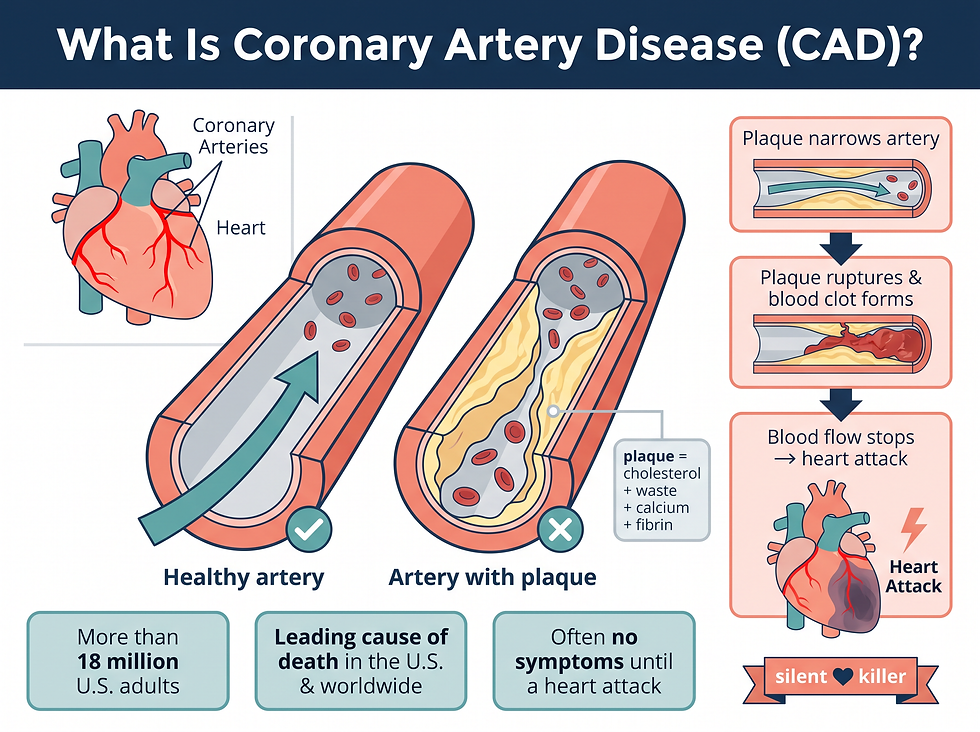
Coronary artery disease (CAD) is a narrowing or blockage of your coronary arteries, the vessels that supply oxygen-rich blood to your heart. Over time, plaque — including cholesterol — builds up in these arteries and limits how much blood can reach your heart muscle.
Think of two traffic lanes merging into one because of construction. Traffic keeps flowing, just more slowly. With CAD, you might not notice anything is wrong until the plaque triggers a blood clot. That clot is like a concrete barrier in the middle of the road: traffic stops. When blood cannot reach your heart, the result is a heart attack.
You can have CAD for many years without any symptoms until a heart attack strikes. That is why CAD is often called a "silent killer."
CAD is also known as coronary heart disease (CHD) or ischemic heart disease, and it is what most people mean when they use the general term "heart disease."
Stable vs. Acute: The Two Main Forms
Form | What happens | Severity |
|---|---|---|
Stable ischemic heart disease | Chronic form; arteries gradually narrow over many years; the heart receives less oxygen-rich blood over time | You may feel symptoms but can live with the condition day to day |
Sudden form; plaque ruptures and forms a blood clot that blocks blood flow to the heart | A medical emergency that causes a heart attack |
How Common Is It?
Coronary artery disease is the leading cause of death in the U.S. and around the world. According to the source, more than 18 million adults in the U.S. live with CAD, and it killed 375,500 people in the U.S. in 2021.
What Are the Symptoms of Coronary Artery Disease?
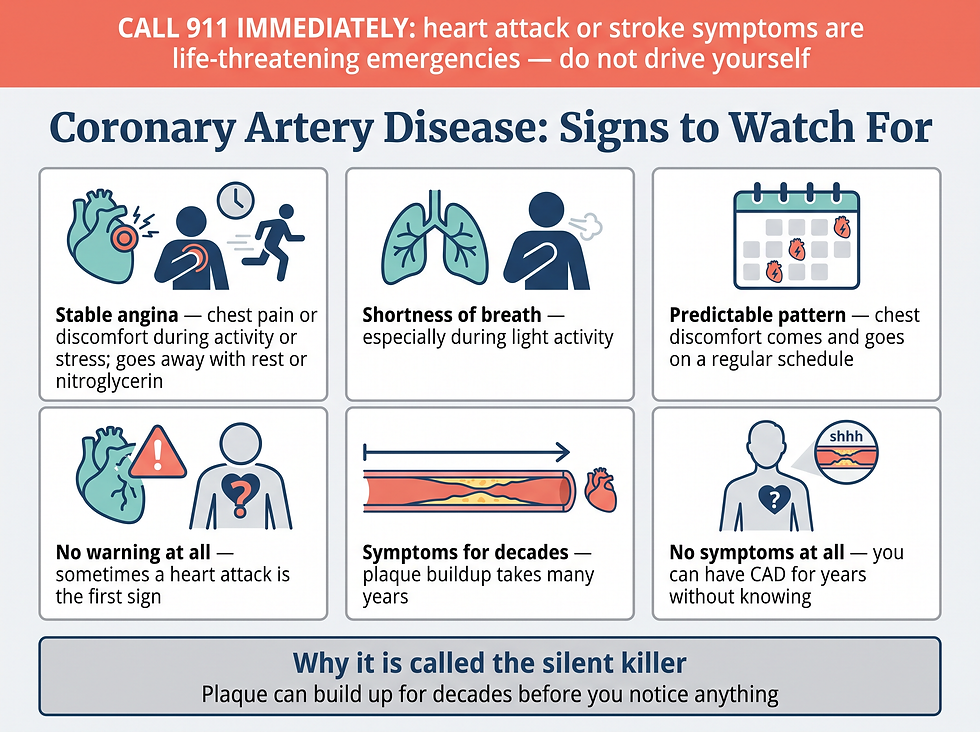
You may have no symptoms of coronary artery disease for a long time. Plaque buildup takes many years — even decades. But as your arteries narrow, mild symptoms can appear. These symptoms mean your heart is pumping harder to deliver oxygen-rich blood to your body.
Symptom | What it looks like |
|---|---|
Stable angina (most common) | Temporary chest pain or discomfort that comes and goes in a predictable pattern, usually during physical activity or emotional distress; goes away with rest or nitroglycerin |
Shortness of breath (dyspnea) | Feeling short of breath during light physical activity |
No warning at all | Sometimes the first symptom of CAD is a heart attack |
The "silent killer" aspect matters for prevention. Because symptoms can be absent for decades, many people first learn they have CAD only when a heart attack or a test for another reason reveals the blockages.
What Causes Coronary Artery Disease?
Atherosclerosis causes coronary artery disease. Atherosclerosis is the gradual buildup of plaque in arteries throughout your body — and when that plaque affects blood flow in your coronary arteries specifically, you have CAD.
Plaque is made of cholesterol, waste products, calcium, and fibrin (a substance that helps your blood clot). As it collects along your artery walls, your arteries become narrow and stiff. When plaque builds up in the coronary arteries, the heart muscle cannot receive enough blood, oxygen, or nutrients to work properly — a condition called myocardial ischemia. This leads to chest discomfort (angina) and puts you at risk of a heart attack.
People with plaque buildup in their coronary arteries often have buildup elsewhere in the body too, which can lead to conditions like carotid artery disease and peripheral artery disease (PAD).
Is Coronary Artery Disease Genetic?
Partly. Family history affects your risk, but many other risk factors have nothing to do with your genetics. The choices you make every day add up to a big impact on your risk of CAD.
What Are the Risk Factors?
There are many risk factors for coronary artery disease. You cannot change all of them, but you can manage many of them through lifestyle changes or medications.
Cannot change | Can influence |
|---|---|
Age (over 45 for men, over 55 for women) | Smoking, vaping, or any tobacco use |
Family history (father/brother with heart disease before 55; mother/sister before 65) | Diet high in saturated fat or refined carbohydrates |
Early menopause (before age 40) | Not exercising enough |
Endometriosis | Not getting enough sleep |
History of gestational diabetes, eclampsia, or preeclampsia | High LDL ("bad") cholesterol, low HDL ("good") cholesterol, high triglycerides |
— | High blood pressure |
— | Diabetes; anemia; autoimmune diseases (lupus, rheumatoid arthritis); chronic kidney disease; HIV/AIDS; metabolic syndrome; BMI over 25; sleep disorders like sleep apnea; use of hormonal birth control; having atherosclerosis |
The source is explicit that you should talk with your provider about what you can do about these risk factors — most of the list is actionable.
What Are the Complications?
The main complication of coronary artery disease is a heart attack — a medical emergency that can be fatal. Your heart muscle starts to die because it is not receiving enough blood. Prompt medical attention is needed to restore blood flow and save your life.
Over the years, CAD can also weaken your heart and lead to:
Complication | What it is |
|---|---|
Arrhythmias | Abnormal heart rhythms, like atrial fibrillation |
Cardiac arrest | The heart suddenly stops beating effectively |
Cardiogenic shock | The heart cannot pump enough blood to sustain the body |
The heart gradually weakens and cannot keep up with the body's needs |
How Is Coronary Artery Disease Diagnosed?
Providers diagnose CAD through a physical exam and testing. During the exam, your provider will measure your blood pressure, listen to your heart with a stethoscope, and ask about your symptoms and how long you have had them, your medical history, your lifestyle, and your family history — including heart disease among your biological parents and siblings. All of this information helps determine your risk.
Test | What it involves |
|---|---|
Blood tests | Checks cardiac markers and cholesterol levels |
Electrocardiogram (EKG/ECG) | Records the heart's electrical activity |
Echocardiogram | Ultrasound images of the heart's structure and function |
Exercise stress test | Monitors the heart while you walk on a treadmill or ride a bike |
Coronary calcium scan | Measures calcium deposits in coronary arteries |
CT coronary angiogram | Imaging that visualizes the coronary arteries |
Heart MRI | Detailed images of heart muscle and blood flow |
Cardiac catheterization | A thin tube is guided into the heart to visualize blockages |
Chest X-ray | Checks heart size and lung condition |
How Is Coronary Artery Disease Treated?
Treatment often includes lifestyle changes, risk factor management, and medications. Some people may also need a procedure or surgery. Your provider will discuss the best treatment plan for you — and following it lowers your risk of serious complications.

Lifestyle Changes
Lifestyle changes play a big role in treating CAD:
Change | Source guidance |
|---|---|
No tobacco | Don't smoke, vape, or use any tobacco products |
Heart-healthy eating | Low in sodium, saturated fat, trans fat, and sugar; the Mediterranean diet is a proven way to lower your risk of a heart attack or stroke |
Exercise | Aim for 30 minutes of walking (or other activity) five days a week |
Alcohol | Limit alcohol use |
Provider guidance | Talk with your provider before starting any new exercise program; they may recommend smoking-cessation options or a dietitian |
Risk Factor Management
Managing risk factors can slow the progression of your disease. Work with your provider to manage diabetes, high blood pressure, high cholesterol, high triglycerides, and a BMI higher than 25.
Medications
Medication purpose | Examples / notes |
|---|---|
Lower blood pressure | Antihypertensives |
Lower cholesterol | Cholesterol-lowering drugs |
Manage stable angina | Nitroglycerin, ranolazine |
Reduce blood-clot risk | Antiplatelet or anticoagulant medications |
Procedures and Surgery
Procedure | What it does |
|---|---|
Percutaneous coronary intervention (PCI), also called angioplasty | A minimally invasive procedure that reopens a blocked artery; a stent may be inserted to keep the artery open |
Coronary artery bypass grafting (CABG) | Surgery that creates a new path ("detour") for blood to flow around blockages; helps people with severe blockages in several coronary arteries |
Recovery time: After PCI, you can usually return to normal activities within a week. After CABG, you will be in the hospital for more than a week, followed by six to twelve weeks for a full recovery.
Treatment side effects can include bleeding, diarrhea, dizziness, cough, blood clots, coronary artery puncture, infection, abnormal heart rhythms, and cardiac tamponade.
What Is the Outlook? Can CAD Be Reversed?
Your provider is the best person to ask about your prognosis. Outcomes vary based on age, medical conditions, risk factors, and symptoms. Lifestyle changes and other treatments can improve your chances of a good prognosis.
The honest answer about reversal: you cannot reverse coronary artery disease. But you can manage your condition and prevent it from getting worse. Working with your provider and following your treatment plan gives you the strongest possible chance of living a long and healthy life.
Living With CAD
The most important thing you can do is keep up with your treatment plan. Your provider may also recommend cardiac rehab — a program especially helpful for people recovering from a heart attack or living with heart failure, which supports exercise, dietary changes, and stress management.
The source is candid about mental health: a CAD diagnosis can be exhausting and overwhelming, and many people experience depression and anxiety. It is normal to worry when living with a condition that can be life-threatening — but the worry shouldn't consume your daily life. You can still live an active, fulfilling life with heart disease. If the diagnosis is affecting your mental health, talk with a counselor, find a support group, and give yourself time to process it.
Direct from the source: "Learning you have coronary artery disease can cause a mix of emotions. You may feel confused about how this could happen. You may feel sad or wish you'd done some things differently to avoid this diagnosis. But this is a time to look forward, not backward. Let go of any guilt or blame you feel. Instead, commit to building a plan to help your heart, beginning today."
When Should You See Your Healthcare Provider?
Your provider will tell you how often to come in for testing or follow-ups, and you may see a cardiologist in addition to your primary care visits. Call your provider if you experience new or changing symptoms, have side effects from your medication, or have questions or concerns about your condition or treatment plan.
Can Coronary Artery Disease Be Prevented?
You cannot always prevent CAD because some risk factors are out of your control. But you can lower your risk and help prevent it from getting worse by committing to quit smoking and all tobacco use, eating heart-healthy foods, getting enough sleep, staying at a healthy weight, learning your risk for heart disease, limiting alcohol, moving around more, and keeping up with your medications.
Questions to Ask Your Doctor
If you have not been diagnosed: What are my risk factors for CAD? What can I do to lower my risk? What lifestyle changes are most important for me? What medications would lower my risk, what are the side effects, and how long would I need them?
If you have been diagnosed: What can I do to slow disease progression? What is the best treatment plan for me? What lifestyle changes should I make? What medications do I need and what are the side effects? Will I need a procedure or surgery, and what does recovery look like? Are there support groups or resources you recommend?
Key Takeaways
Coronary artery disease is the leading cause of death in the U.S. and worldwide, affecting more than 18 million U.S. adults. It develops silently over years through plaque buildup (atherosclerosis), often with no symptoms until a heart attack. The most common symptom is stable angina — predictable chest discomfort during activity that eases with rest or nitroglycerin. While CAD cannot be reversed, it can be slowed and managed with lifestyle changes, risk-factor control, medications, and when necessary, stents or bypass surgery. If you ever experience symptoms of a heart attack or stroke, call 911 immediately — immediate care saves lives.
If you or a loved one are managing heart disease, talk with a healthcare provider about your personal risk factors and treatment plan — and share the heart attack and stroke warning signs with your family so they can act for you if you cannot.
Frequently Asked Questions
Q: What does coronary artery disease actually mean?
CAD is a narrowing or blockage of the coronary arteries — the vessels that supply oxygen-rich blood to your heart muscle — caused by years of plaque buildup (cholesterol, waste products, calcium, and fibrin) on the artery walls.
Q: Is coronary artery disease the same as heart disease?
Coronary artery disease is what most people mean when they use the general term "heart disease." It is also called coronary heart disease (CHD) or ischemic heart disease.
Q: Is coronary artery disease the same as a heart attack?
No — but CAD is the leading underlying cause of heart attacks. When plaque in a coronary artery ruptures and forms a blood clot that blocks blood flow, the result is a heart attack.
Q: Why is CAD called a "silent killer"?
Because you can have it for many years without any symptoms — until a heart attack occurs as the first sign.
Q: What is the most common symptom of coronary artery disease?
Stable angina: temporary chest pain or discomfort that comes and goes in a predictable pattern, usually during physical activity or emotional distress, and goes away with rest or nitroglycerin.
Q: Can CAD cause shortness of breath?
Yes. Shortness of breath (dyspnea) is a recognized symptom — some people feel it during light physical activity.
Q: How long does it take for plaque to build up?
Plaque buildup takes many years, even decades, which is why symptoms can be absent for so long.
Q: What causes the plaque to build up?
Atherosclerosis — the gradual buildup of plaque in arteries throughout your body. When it affects the coronary arteries' blood flow, you have CAD.
Q: Is coronary artery disease genetic?
Partly. Family history affects your risk, but many risk factors have nothing to do with genetics — daily choices add up to a big impact on your risk.
Q: What family history increases my risk?
Having a biological father or brother diagnosed with heart disease before age 55, or a mother or sister before age 65.
Q: Is CAD more common in men or women?
The source flags different age thresholds rather than overall rates: being older than 45 (male) or over 55 (female) is a risk factor, and early menopause (before 40) raises women's risk.
Q: Can my birth control increase heart disease risk?
The source lists use of hormonal birth control among CAD risk factors — worth discussing with your provider in the context of your overall risk profile.
Q: Does pregnancy history affect heart disease risk?
Yes. A history of gestational diabetes, eclampsia, or preeclampsia is listed as a risk factor.
Q: Can sleep problems raise my risk?
Yes — not getting enough sleep, and sleep disorders like sleep apnea, are both listed risk factors.
Q: Can autoimmune diseases increase CAD risk?
Yes. The source lists autoimmune diseases, including lupus and rheumatoid arthritis, among risk factors.
Q: What blood test results point to CAD risk?
High LDL ("bad") cholesterol, low HDL ("good") cholesterol, and high triglycerides (hypertriglyceridemia) are all listed risk factors.
Q: How is CAD diagnosed?
Through a physical exam (blood pressure, stethoscope, symptom and family history) plus one or more tests such as blood tests, EKG, echocardiogram, stress test, calcium scan, CT coronary angiogram, heart MRI, cardiac catheterization, or chest X-ray.
Q: What is a stent?
A small mesh tube inserted during percutaneous coronary intervention (angioplasty) to help a reopened artery stay open.
Q: What is coronary bypass surgery?
Coronary artery bypass grafting (CABG) creates a new path for blood to flow around blockages — a "detour" that restores blood flow to the heart. It helps people with severe blockages in several coronary arteries.
Q: Which is better — a stent or bypass surgery?
That is a decision for your provider. PCI (stent) is minimally invasive and suited to many blockages; CABG is used for severe blockages in several coronary arteries.
Q: How long does recovery take after stent placement or bypass surgery?
After PCI (angioplasty), most people return to normal activities within a week. After CABG, hospital stay is more than a week, followed by six to twelve weeks for full recovery.
Q: Can coronary artery disease be reversed?
No. You cannot reverse CAD — but you can manage it and prevent it from getting worse through treatment and lifestyle changes.
Q: Can CAD be cured?
The source does not describe a cure; treatment focuses on managing the condition, slowing progression, and preventing complications.
Q: Can lifestyle changes really make a difference?
Yes — the source emphasizes that lifestyle changes and other treatments improve your chances of a good prognosis, and that daily choices have a big impact on your risk.
Q: What is cardiac rehab?
A structured program that supports exercise, dietary changes, and stress management — especially helpful after a heart attack or when living with heart failure.
Q: Can CAD affect mental health?
Yes. Many people with CAD experience depression and anxiety. The source says it is normal to worry, the worry should not consume daily life, and talking with a counselor or joining a support group helps.
Q: How do I know when to call 911 vs. seeing my provider?
Call 911 immediately for heart attack or stroke symptoms — they are life-threatening emergencies. Call your provider for new or changing symptoms, medication side effects, or concerns about your treatment plan.
Q: How can I lower my risk of CAD?
Quit all tobacco, eat heart-healthy foods (the Mediterranean diet is proven to lower heart attack and stroke risk), get enough sleep, stay at a healthy weight, learn your risk, limit alcohol, move more, and keep taking your medications.
Q: Is CAD preventable?
Not always — some risk factors are out of your control — but you can lower your risk and help prevent it from getting worse through the steps above.
Q: What happens if CAD is left untreated?
The main complication is a heart attack, which can be fatal. Over years, CAD can also lead to arrhythmias, cardiac arrest, cardiogenic shock, and heart failure.
Sources and Further Reading
All medical facts in this article are drawn from the Cleveland Clinic patient-education page "Coronary Artery Disease" (medically reviewed; last updated Oct. 13, 2023). No facts, statistics, or claims have been added from other sources. Suggested further reading:
American Heart Association — Coronary Artery Disease overview (heart.org)
Centers for Disease Control and Prevention — Coronary Artery Disease (cdc.gov)
National Heart, Lung, and Blood Institute — What Is Coronary Heart Disease? (nhlbi.nih.gov)
NIH MedlinePlus — Coronary Artery Disease (medlineplus.gov)
NHS (UK) — Coronary Heart Disease (nhs.uk)
2019 ACC/AHA Guideline on the Primary Prevention of Cardiovascular Disease (JACC)
References
Disclaimer: This article is for general information only and is not a substitute for professional medical advice, diagnosis, or treatment. Always seek the advice of a qualified healthcare provider with any questions you may have regarding a medical condition. In the event of a medical emergency, call your local emergency number immediately.
Comments