PET Scan: Uses, Preparation, What to Expect and Results

Updated: 2 days ago
Written and medically reviewed by Dr. Baraa Alnahhal, MD · Last reviewed: November 2026 · How we review
Quick Answer: What is a PET scan?
A positron emission tomography (PET) scan is an imaging test that shows how the organs and tissues are working. A radioactive tracer is injected into a vein, and a scanner detects cells that absorb large amounts of it, which can signal disease. PET scans help find and track cancer, heart disease and brain conditions. The visit takes 2 hours. [1]
What the research says
PET helps avoid unnecessary lung cancer surgery. In a randomized trial of 188 people with suspected non-small-cell lung cancer, adding PET to the usual workup cut futile thoracotomies (chest operations that did not help) from 41% to 21%, preventing unnecessary surgery in about one in five patients. (van Tinteren et al., The Lancet, 2002) [3]
Combined PET-CT sharpens lung cancer staging. A randomized trial of 189 patients found PET-CT before surgery reduced both total thoracotomies (60 vs 73) and futile ones (21 vs 38), without changing overall survival. (Fischer et al., The New England Journal of Medicine, 2009) [2]
Key takeaways
PET shows how tissues work, such as blood flow, oxygen use and metabolism, not just how they look. [1]
Diseased cells absorb more or less tracer than healthy cells and show up as hot spots. [1]
PET is often combined with CT in a single PET/CT scan. [1]
Expect about 2 hours: up to 60 minutes of rest while the tracer absorbs, then about a 30-minute scan. [1]
The radiation is very low, but tell your provider if you are pregnant or breastfeeding. [1]
What is a PET scan?
A PET scan is a type of nuclear medicine imaging that creates pictures of your organs and tissues at work. It uses an injectable radioactive chemical called a radiotracer and a device called a PET scanner. Unlike many other imaging tests, PET focuses on processes and molecular activity inside your body, which gives it the potential to find disease in its earliest stages. It can measure vital functions such as blood flow, oxygen use and metabolism. [1]
What does a PET scan check for?
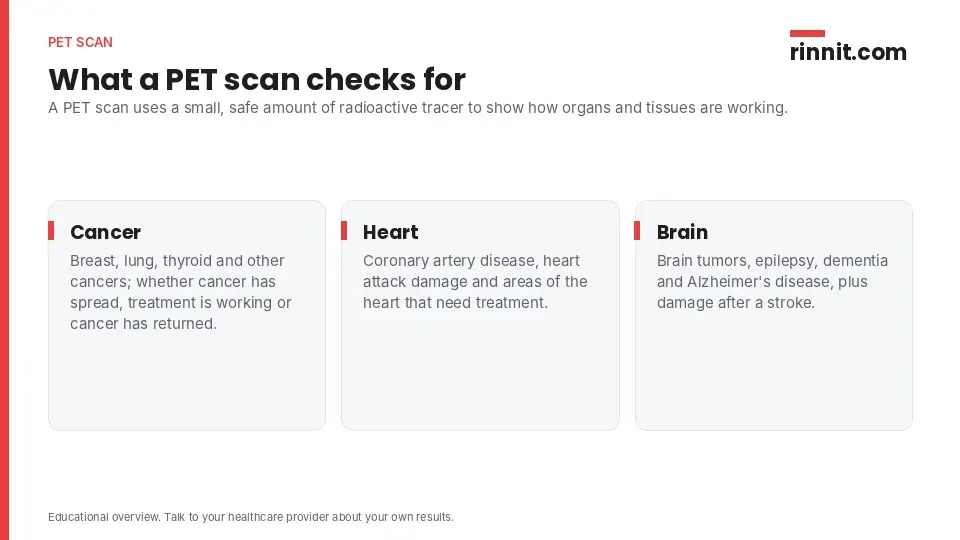
Area | What PET can help with |
Cancer | Signs of breast, lung, thyroid and other cancers; whether cancer has spread, whether treatment is working or whether cancer has returned |
Heart | Coronary artery disease, heart attack and other heart problems; damage after a heart attack and areas of the heart that need treatment |
Brain | Brain tumors, epilepsy, dementia and Alzheimer's disease; damage after a stroke |
Sources: [1]
How does a PET scan work?
The radiotracer travels through your bloodstream and is absorbed by your organs and tissues. Diseased cells absorb different amounts of tracer than healthy ones, creating hot spots. The PET scanner detects this radiation and produces images of the affected tissue. Your provider may order a PET/CT scan, which combines PET images with CT scan images. [1]
How do you prepare for a PET scan?
PET scans are outpatient procedures, so you go home the same day. Your provider will give you detailed instructions. In general: [1]
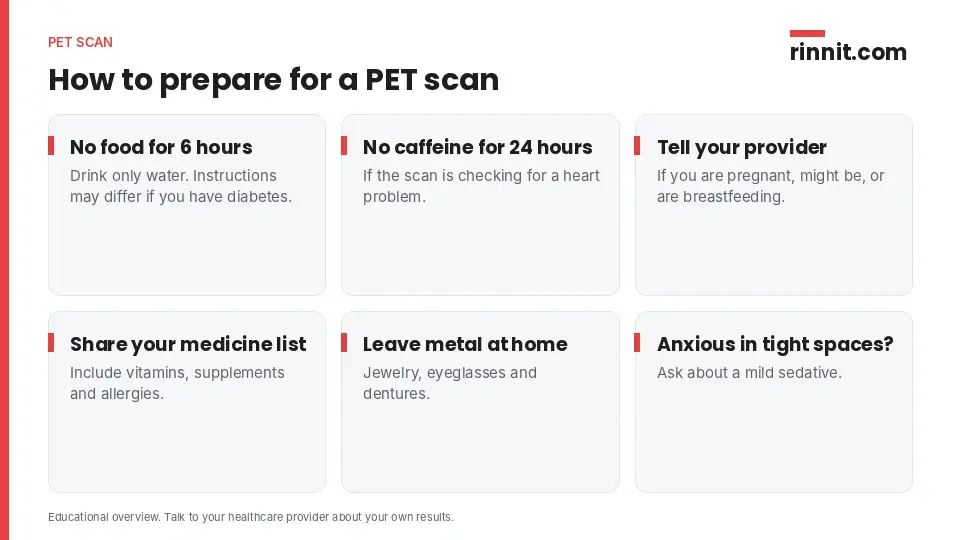
Give your provider a current list of all medicines, vitamins, supplements and allergies.
Tell your provider if you might be pregnant or are breastfeeding.
Do not eat for 6 hours before the test and drink only water. If you have diabetes, your provider may change this and will advise on insulin or diabetes medicines.
Avoid caffeine for 24 hours before the test if you are being checked for a heart problem.
Wear comfortable clothes and leave metal items, such as jewelry, eyeglasses and dentures, at home.
If enclosed spaces make you anxious, ask about a mild sedative.
Sources: [1]
What happens during a PET scan?

You receive an IV injection of a radiotracer containing a safe amount of radioactive drug. You will not feel it.
You sit quietly for about an hour while it moves through your bloodstream. Too much activity can send tracer to areas not being tested.
For a PET/CT scan, you may also get an IV contrast dye that helps irregular areas stand out.
You lie on a table that slides through a doughnut-shaped scanner and stay still, because movement blurs the images.
You hear buzzing and clicking sounds as images are taken.
A technologist reviews the scans before you leave to make sure they are clear.
Sources: [1]
Step | Typical time |
Fasting before the scan | 6 hours (water only) |
Tracer absorption | Up to 60 minutes |
The scan | About 30 minutes |
Whole visit | About 2 hours |
Results to your provider | 24 to 48 hours |
Sources: [1]
What are the risks and side effects of a PET scan?
PET scans are generally safe and rarely cause problems. The amount of radiation in the tracer is very low and does not stay in your body for long. Drinking plenty of water afterward helps flush it out. Risks arise mainly in these situations: [1]
Pregnancy or breastfeeding: the radiation may harm a fetus and can pass to a baby through breast milk.
Allergic reaction: reactions to the tracer or CT contrast dye are extremely rare and usually mild.
Diabetes: you may not absorb the sugar in the tracer normally, which can affect results, so your provider may adjust your diet and medicines first.
Sources: [1]
What happens after a PET scan?
You can go back to your usual activities. The tracer leaves your body within a few hours, and drinking plenty of fluids helps it leave faster. Side effects are rare, but you may have some discomfort at the injection site. [1]
What do PET scan results mean?
A radiologist with special training in PET reviews the images and sends a report to your provider, usually within 24 to 48 hours. [1]
Result | What it means |
Normal | No signs of disease or irregularities |
Abnormal | Something unusual that suggests infection, inflammation or cancer |
Sources: [1]
PET can also show how a disease is progressing or how well treatment is working. Your provider will explain what your results mean and whether you need follow-up tests. [1]
When should you call your provider?
Contact your provider if you have dizziness, nausea, difficulty breathing or worsening pain at the injection site after the scan. [1]
Conclusion
A PET scan is a useful and generally safe test that shows how your tissues are working, helping your care team assess cancer, heart problems and brain conditions, often earlier than other imaging. Preparation is simple, and you go home the same day. If you are worried about the exam, ask your provider; they are there to help. [1]
Keep learning: Read our guides to lung cancer, Alzheimer's disease and the CT scan. For more, see the Radiological Society of North America's PET/CT guide.
FAQ
What is a PET scan?
A positron emission tomography (PET) scan is an imaging test that uses a safe, injected radioactive tracer to show how your organs and tissues are working [1].
What does a PET scan detect?
It checks for signs of cancer, heart disease such as coronary artery disease, and brain disorders such as tumors, epilepsy, dementia and Alzheimer's disease [1].
How long does a PET scan take?
About 2 hours in total: up to 60 minutes for the tracer to absorb and about 30 minutes for the scan itself [1].
How do I prepare for a PET scan?
Usually no food for 6 hours, water only, no caffeine for 24 hours if your heart is being checked, and comfortable clothes without metal [1].
Is a PET scan safe?
Generally yes. The radiation in the tracer is very low and does not stay in your body long [1].
Can I have a PET scan if I am pregnant or breastfeeding?
Tell your provider first. The radiation may harm a fetus and can pass to a baby through breast milk [1].
What is a PET/CT scan?
It combines PET images with CT scan images, sometimes with an IV contrast dye, so irregular areas stand out [1].
What are hot spots on a PET scan?
Hot spots are areas where cells absorb more tracer than healthy tissue, which can point to disease and need a closer look [1].
How long do PET scan results take?
A radiologist usually reports to your provider within 24 to 48 hours [1].
What should I do after a PET scan?
You can return to usual activities. Drink plenty of fluids to help flush the tracer, which leaves your body within a few hours [1].
Related Reading
Nuclear Medicine Imaging: How Tracer Scans Work, Safety and Results explains how tracer-based scans show how organs work.
Gallium Scan: What It Shows, How It Works and What to Expect explains the nuclear scan that can find hidden infection, inflammation and some cancers.
Learn more in our guide to Lung Cancer: Symptoms, Causes, Diagnosis, and Treatment Explained.
Learn more in our guide to Alzheimer's Disease: Symptoms, Causes, Treatment & Complete Guide.
Learn more in our guide to Epilepsy: Seizures, Symptoms, Causes, and Treatment.
Learn more in our guide to Coronary Artery Disease: Symptoms, Causes, Diagnosis, Treatment and Prevention — What You Need to Know.
PSMA PET Scan for Prostate Cancer: How It Works, How to Prepare and How Accurate It Is explains the prostate cancer imaging scan used for staging and recurrence.
SPECT Scan: How It Works, What It Shows and What to Expect explains the nuclear medicine scan that shows how the heart, brain and bones work.
Cardiac PET Scan: Heart Blood Flow Imaging, Prep and Results explains the nuclear scan that shows blood flow to the heart muscle.
References
Cleveland Clinic. PET Scan: Procedure Details and Results. Cleveland Clinic. Last updated April 14, 2026. https://my.clevelandclinic.org/health/diagnostics/10123-pet-scan
Fischer B, Lassen U, Mortensen J, et al. Preoperative staging of lung cancer with combined PET-CT. N Engl J Med. 2009;361(1):32-39. PMID 19571281. https://doi.org/10.1056/NEJMoa0900043
van Tinteren H, Hoekstra OS, Smit EF, et al. Effectiveness of positron emission tomography in the preoperative assessment of patients with suspected non-small-cell lung cancer: the PLUS multicentre randomised trial. Lancet. 2002;359(9315):1388-1393. PMID 11978336. https://doi.org/10.1016/S0140-6736(02)08352-6
Medical disclaimer
This article is for general education only and does not replace advice from a qualified healthcare professional. Talk to your doctor about your own diagnosis and treatment, and seek emergency care right away for severe or sudden symptoms.



Comments