Epilepsy: Seizures, Symptoms, Causes, and Treatment

Updated: 3 days ago
Medically reviewed by Dr. Baraa Alnahhal, MD · Last reviewed: October 2026

Quick answer
Epilepsy is a brain condition that causes recurring seizures from abnormal electrical activity. Signs include staring spells, jerking of the arms and legs, confusion and loss of awareness. In about half of cases the cause is never found. About half of people become seizure-free with the first medicine, and others benefit from surgery, brain stimulation devices or a ketogenic diet. [1] [2]
What the research says
According to PubMed:
Epilepsy is common worldwide, and more common in lower-resource regions. A meta-analysis of 216 studies with 278,651,975 participants and 2,114,157 epilepsy cases found a pooled global prevalence of 7.57 per 1,000 people (95% CI 6.78 to 8.45), highest in Africa (10.67 per 1,000) and lowest in Asia (5.20 per 1,000), with no significant difference between sexes. (Zhao et al., DOI).
Infection can be a major cause of seizures in some regions. A systematic review and Bayesian meta-analysis found neurocysticercosis, a brain infection from a tapeworm larva, in 25.2% (95% credible interval 19.5% to 32.2%) of people with epileptic seizures across 35 studies in endemic regions. (Jalal et al., DOI).
Surgery can beat continued medicine for the right patients. A review reports that nearly one third of people with epilepsy become medically intractable and that randomized trials in temporal lobe epilepsy show surgery achieves superior outcomes compared with continued medical management. (Perry and Duchowny, DOI).
Study details are from PubMed abstracts.
What is epilepsy?
Epilepsy, also called a seizure disorder, is a brain condition that causes recurring seizures. A seizure is a burst of abnormal electrical activity in the brain. Because the brain controls so much of what the body does, a seizure can disrupt movement, sensation, awareness, and behavior in many different ways. [1]
It is a very common condition. Around 3 million people in the United States live with epilepsy, which makes it the fourth most common neurological disease after migraine, stroke, and Alzheimer's disease. It affects people of every gender, race, ethnic background, and age, though onset is most common in children and older adults. [1]
One important point: having a single seizure does not mean you have epilepsy. Doctors diagnose epilepsy when a person has had at least two unprovoked seizures, which are seizures without a clear cause, at least 24 hours apart. [1]
A final encouraging note up front. About half of people with epilepsy become seizure-free with the first anti-seizure medicine, and some children outgrow the condition as they age. [1]
At a glance | Epilepsy |
Also known as | Seizure disorder |
What it is | Recurring seizures caused by abnormal brain electrical activity |
How common | About 3 million people in the U.S.; 4th most common neurological disease [1] |
Who gets it | Anyone, at any age; most common in children and older adults [1] |
How it is diagnosed | Two or more unprovoked seizures at least 24 hours apart, confirmed with exam, EEG, and imaging [2] |
First-line treatment | Anti-seizure medicine; about half become seizure-free with the first drug [2] |
What does a seizure look like?
Seizure symptoms vary widely because the abnormal electrical activity can affect any brain process. Most people with epilepsy have the same type of seizure each time, so symptoms tend to be similar from episode to episode. [1]
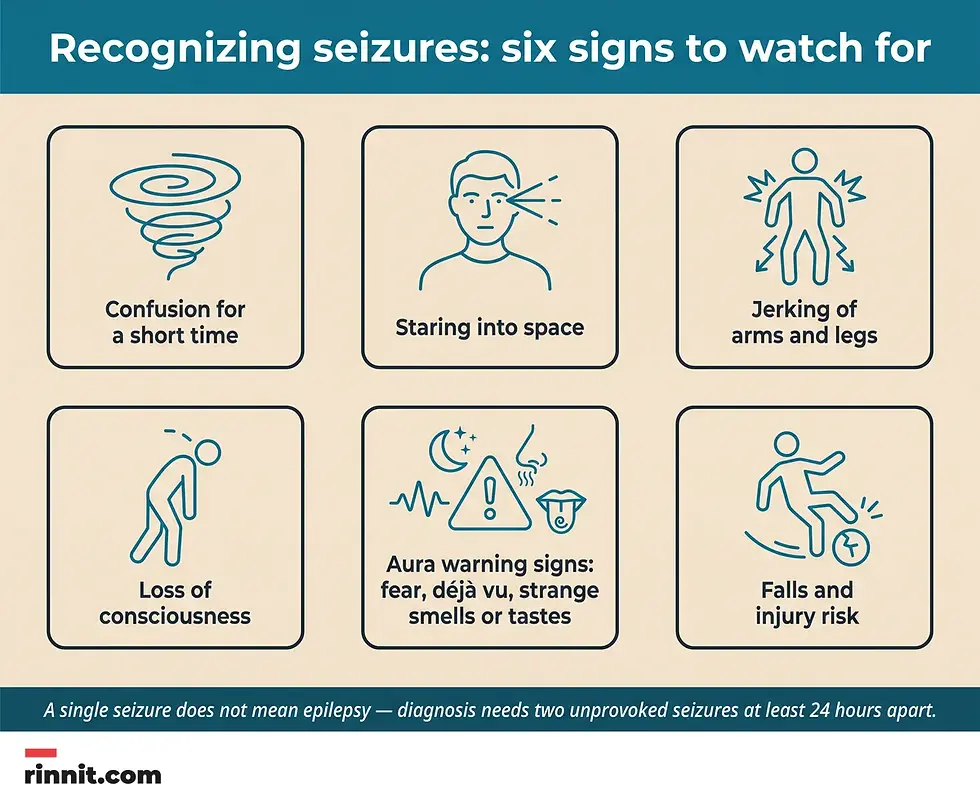
Common seizure symptoms include:
Short-term confusion
A staring spell
Stiff muscles
Jerking movements of the arms and legs
Loss of consciousness
Psychological symptoms such as fear, anxiety, or déjà vu
Some people also have behavior changes during or after seizures. A few may have a break from reality, known as psychosis.
Warning signs: the aura
People with focal seizures may get warning signs, called auras, in the moments before a seizure begins. Auras can feel like a rising sensation in the stomach, sudden fear, or déjà vu. They can be sensory, too: a strange taste or smell, a steady or flashing light, a color, or a shape. Some people feel dizzy and lose balance, and some see things that are not there (hallucinations).
The two main types of seizures
Seizures are classified by where the abnormal brain activity begins.
Focal seizures start in one area of the brain. They come in two forms:
Type | Awareness | What it looks like |
Focal seizure with preserved consciousness (formerly simple partial) | Awareness stays intact | Altered emotions or senses (changes in how things look, smell, feel, taste, or sound); déjà vu; jerking of one arm or leg; tingling, dizziness, or flashing lights |
Focal seizure with impaired consciousness (formerly complex partial) | Awareness is changed or lost | A dreamlike state; staring into space without responding normally; repeated movements such as hand rubbing, chewing, swallowing, or walking in circles |
Focal seizures can arise from any lobe of the brain. Temporal lobe seizures often begin with an aura (sudden fear or joy, a taste or smell, déjà vu, or a rising stomach feeling) and may include lip smacking, chewing, or finger movements. Frontal lobe seizures make a person turn their head and eyes to one side, scream or laugh, or make repeated movements like rocking or bicycle pedaling. Occipital lobe seizures affect vision and can cause hallucinations or vision loss.
Because these symptoms overlap with migraine, narcolepsy, and some mental health conditions, a thorough exam and testing are needed to confirm epilepsy.
Generalized seizures involve all areas of the brain from the start. The main types are:
Type | What happens |
Absence | Staring blankly into space; may include blinking or lip smacking; often lasts only seconds |
Tonic | Stiffening of the back, arms, and legs |
Atonic | Sudden loss of muscle control; everything goes slack, which often causes a fall |
Clonic | Repeated jerking, usually of the neck, face, and arms |
Myoclonic | Sudden, brief jerks or twitches of the arms |
Tonic-clonic | Stiffening followed by shaking; may include loss of bladder control or tongue biting |
When is a seizure an emergency?
Most seizures are brief. Absence seizures may last five to six seconds, and tonic-clonic seizures typically last two to three minutes. Short seizures do not harm growth or development. But some situations require emergency care. [1]
Seek emergency help right away if a seizure:
Lasts more than five minutes
Is followed by a second seizure
Does not allow the person to regain consciousness or normal breathing afterward
Happens while the person is in water
Is the person's first seizure ever
Occurs in someone who is pregnant or has diabetes
Results in an injury
Continues even though the person takes anti-seizure medicine
Anyone who has a seizure for the first time should seek medical advice, even without these emergency features.
What causes epilepsy?
In about half of all people with epilepsy, no identifiable cause is ever found. In the other half, the condition can be traced to specific factors. [1]
Known causes | How they lead to epilepsy |
Genetic influence | Some types run in families and have been linked to specific genes; some genetic changes occur in the child without being inherited |
Head trauma | Injury from a car accident or other trauma can cause epilepsy |
Brain factors | Brain tumors, blood vessel conditions such as arteriovenous malformations, and stroke, a leading cause in adults over 35 |
Infections | Meningitis, HIV, viral encephalitis, and some parasitic infections |
Injury before birth | Infection in the pregnant parent, poor nutrition, or low oxygen can damage the developing brain |
Developmental conditions | Epilepsy is more common in people with autism and ADHD |
Genes alone are usually only part of the picture; certain genes may make a person more sensitive to environmental conditions that trigger seizures.
What triggers a seizure?
Triggers do not cause epilepsy, but they can set off seizures in someone who has it. Most people with epilepsy do not have reliable triggers, yet some factors commonly make seizures more likely:
Alcohol
Flashing lights
Illicit drug use
Skipping doses of anti-seizure medicine or taking more than prescribed
Lack of sleep
Hormone changes during the menstrual cycle
Stress
Dehydration and skipped meals
Illness
Who is at higher risk?
Risk factors for developing epilepsy include childhood and older-adult age, a family history of epilepsy, head injuries, stroke and other blood vessel diseases, dementia in older adults, brain infections such as meningitis, and high fevers in childhood. Febrile seizures themselves rarely lead to epilepsy, but risk rises if a fever-triggered seizure was long, the child has another nervous system condition, or there is a family history.
Wearing seat belts and helmets is a practical way to lower risk, since head injuries are responsible for some cases. Heart-healthy habits, such as limiting alcohol, not smoking, eating well, and exercising, reduce stroke risk, another leading cause.
What can go wrong? Understanding the complications
The risks of epilepsy mostly come from when and where a seizure happens, plus its emotional weight.
Complication | Why it matters |
Falls | A seizure can cause head injury or a broken bone |
Drowning | Seizures in the bath or while swimming raise drowning risk |
Car accidents | Loss of awareness while driving is dangerous; many states require a seizure-free period before driving |
Sleep problems | Insomnia is more common in people with epilepsy |
Pregnancy | Seizures during pregnancy and some medicines can raise risks; most women with epilepsy still have healthy babies with careful planning |
Memory loss | Some seizure types affect memory |
Emotional health | Depression, anxiety, and suicidal thoughts are more common, even with well-managed epilepsy |
Two rare but life-threatening complications deserve attention. Status epilepticus is continuous seizure activity lasting more than five minutes, or repeated seizures without regaining consciousness in between; it raises the risk of permanent brain damage and death. SUDEP (sudden unexpected death in epilepsy) is a small but real risk, most common in people with frequent tonic-clonic seizures or poorly controlled epilepsy.
How is epilepsy diagnosed?
A single seizure often is not enough to diagnose epilepsy. To confirm the condition and find its cause, doctors combine a symptom review with testing. [2]
A neurological exam checks behavior, movements, and mental function. Blood tests look for infections, genetic conditions, or other issues linked to seizures. Genetic testing (most often done in children, sometimes in adults) can reveal causes and treatment clues.
The most common test is the electroencephalogram (EEG). Small metal discs called electrodes are attached to the scalp and record the brain's electrical activity. People with epilepsy often show changes in brain wave patterns even between seizures. The test can be done in the office or hospital, with video monitoring while awake or asleep, or at home over several days (ambulatory EEG). Sometimes doctors ask patients to get little sleep before the test, since sleep loss can provoke seizure activity.
Brain imaging and scans detect structural changes that may be causing seizures:
Test | What it shows |
CT scan | Tumors, bleeding, or cysts in the brain |
MRI | A detailed structural view of the brain |
Functional MRI (fMRI) | Blood flow changes when brain areas are working; maps speech and movement areas before surgery |
PET scan | Brain metabolism; low-metabolism areas may mark where seizures start |
SPECT scan | A 3D map of blood flow during seizures; a combined version (SISCOM) overlaps results with MRI |
Neuropsychological tests assess thinking, memory, and speech to identify affected brain areas. Advanced techniques, including statistical parametric mapping (SPM), electrical source imaging (ESI), and magnetoencephalography (MEG), help pinpoint exactly where seizures begin, which guides treatment decisions. Pinpointing the seizure type and its starting location gives the best chance of finding effective treatment.
A practical tool between visits is a seizure journal. Recording the time, type, and duration of each seizure, along with possible triggers such as missed medication, poor sleep, stress, menstruation, or illness, helps the care team spot patterns and adjust treatment.
How is epilepsy treated?

The goal of treatment is fewer seizures, or no seizures at all. Four approaches are available: medicines, surgery, brain stimulation devices, and a special diet. [2]
Medicines first
About half of people with epilepsy become seizure-free on the first anti-seizure medicine they try. The keys are taking it exactly as prescribed and never stopping suddenly. Common side effects include fatigue, dizziness, weight gain, and loss of bone density. Less common but more serious effects include mood problems, rash, and organ inflammation. Keeping a seizure journal helps the doctor find the right medicine and dose.
When medicine is not enough
About a third of people still have seizures despite appropriate treatment. This is called medically refractory epilepsy, and surgery evaluation is a real option for them.
Surgery works best when seizures consistently start in one small, identifiable brain area that can be safely removed without harming vital functions such as speech, movement, or vision. The main surgical approaches are removing the seizure-starting area, laser ablation, disconnection surgery for certain generalized epilepsies, and implanted devices such as responsive neurostimulation (a device that detects abnormal electrical activity and delivers a counter-stimulation, like a pacemaker for the brain) or deep brain stimulation. Many people who have surgery need lower medication doses afterward, and some need none.
Vagus nerve stimulation uses an implanted chest device that sends signals to the brain through the vagus nerve, reducing seizures by 20% to 40%. Side effects can include hoarseness, throat pain, coughing, and breathing difficulty.
The ketogenic diet is a high-fat, low-carbohydrate eating plan that has proven effective for some children whose seizures do not respond to medicine, and for some adults. Modified versions exist to improve tolerability.
Living well with epilepsy
Daily habits make a real difference. Take every dose of anti-seizure medicine on schedule, protect sleep, manage stress, limit alcohol, and avoid known personal triggers. Keep the seizure journal updated and bring it to appointments. At home, consider showers instead of deep baths, wear a helmet for cycling and similar activities, and teach family members seizure first aid: keep the person safe from injury, do not put anything in their mouth, do not restrain them, and stay with them until they recover. Epilepsy is not contagious and no one can swallow their tongue. [1]
Children with epilepsy benefit from a written seizure action plan that gives school nurses and teachers a clear roadmap: what the child's seizures look like, which medication to use during a seizure, and who to contact if one runs long.
Conclusion and next steps
Epilepsy is far more common, and far more treatable, than most people realize. It begins as abnormal electrical activity in the brain, usually shows itself through recognizable patterns such as staring spells, jerking movements, and auras, and in about half of cases has no known cause. The good news is that about half of people become seizure-free with the first medicine, and surgery, devices, and diet offer real options when medicine falls short. The single most important step after any first seizure is seeing a doctor for a proper evaluation.
Next steps: If you or someone you know has had a seizure, even just one, talk to a doctor. Accurate diagnosis is the foundation of effective treatment, and better treatment means fewer seizures and more daily life.
Frequently asked questions
Does a single seizure mean you have epilepsy?
No. Epilepsy is diagnosed only after at least two unprovoked seizures occurring at least 24 hours apart. A single seizure deserves medical evaluation, but it is not by itself epilepsy. [1]
What are the warning signs of an epileptic seizure?
Warning signs, called auras, can include a rising feeling in the stomach, sudden fear or déjà vu, strange tastes or smells, flashing lights, dizziness, and loss of balance. General signs include short-term confusion, staring spells, and jerking of the arms or legs. [1]
Can epilepsy go away on its own?
Epilepsy can. Some children outgrow epilepsy with age. In other cases, seizures stop after treatment and medicine can eventually be tapered under a doctor's guidance, while some people need lifelong treatment. [1]
What triggers a seizure in someone with epilepsy?
Common triggers include lack of sleep, stress, alcohol, illness, dehydration, skipped meals, flashing lights, hormone changes during the menstrual cycle, and missed or extra doses of anti-seizure medicine. [1]
Is epilepsy genetic?
Some types run in families and are linked to specific genes, but most cases are only partly genetic, and some genetic changes arise in the child without being passed down from a parent. [1]
This article is for general education and is not a substitute for professional medical advice, diagnosis, or treatment. Always consult a qualified healthcare professional about your individual situation.
When is a seizure an emergency?
Get immediate medical help if the seizure lasts more than 5 minutes, breathing or consciousness does not return after it stops, a second seizure follows right away, the person has a high fever, is pregnant or has diabetes, was injured during the seizure, or seizures continue despite anti-seizure medicine. [1]
How will a doctor diagnose epilepsy?
With a review of symptoms and medical history, a neurological exam, blood tests and most often an EEG, which records the brain's electrical activity through electrodes on the scalp. Imaging such as MRI, CT, PET or SPECT may be added. [2]
What is the first-line treatment?
Anti-seizure medicines. At least half of people newly diagnosed with epilepsy become seizure-free with the first medicine tried. Treatment usually starts with one medicine at a low dose that is increased gradually. [2]
What happens if medicines don't stop my seizures?
Next steps can include surgery to remove the area of the brain where seizures start, brain-stimulation devices such as vagus nerve stimulation, deep brain stimulation or responsive neurostimulation, or a medically supervised ketogenic diet. Many people still take fewer or lower-dose medicines after surgery. [2]
Related Reading
Deep Brain Stimulation (DBS): Uses, Procedure and Recovery explains how deep brain stimulation works.
Benzodiazepines (Benzos): Uses, Side Effects and Risks explains what benzodiazepines treat and their risks.
Hemispherectomy: Types, Procedure, Recovery and Outcomes explains how removing or disconnecting half of the brain stops seizures that medicine cannot control, plus recovery and outcomes.
Responsive Neurostimulation (RNS) for Epilepsy: How It Works, Surgery and Results explains how an implanted device that detects and responds to seizure activity can reduce focal seizures when medicines are not enough.
Learn more in our guide to PET Scan: Uses, Preparation, What to Expect and Results.
Neuropsychological Testing: What It Is, Why It's Done, What to Expect and Results explains how neuropsychological testing measures memory, attention, language and other thinking skills.
Brain MRI: Why It's Done, How to Prepare and What to Expect explains what a brain MRI shows and what to expect during the scan.
Functional MRI (fMRI): What It Shows, How It Works and How to Prepare explains how functional MRI maps important brain areas before surgery.
Electroencephalogram (EEG): Types, How to Prepare and What Results Mean explains how an EEG records brain activity and what to expect.
SPECT Scan: How It Works, What It Shows and What to Expect explains the nuclear medicine scan that shows how the heart, brain and bones work.
SEEG (Stereoelectroencephalography): Finding Where Seizures Start explains the deep-brain electrode test used to find where seizures start.
Magnetoencephalography (MEG): Mapping the Brain Before Epilepsy Surgery explains the magnetic brain scan used to find where seizures start.
References
Mayo Clinic Staff. Epilepsy: Symptoms and causes. Mayo Clinic. October 14, 2025. https://www.mayoclinic.org/diseases-conditions/epilepsy/symptoms-causes/syc-20350093
Mayo Clinic Staff. Epilepsy: Diagnosis and treatment. Mayo Clinic. October 14, 2025. https://www.mayoclinic.org/diseases-conditions/epilepsy/diagnosis-treatment/drc-20350098
Zhao X, Dai J, Jiang L, et al. Global Prevalence of Epilepsy and Temporal Trends, 1980-2025: A Systematic Review and Meta-Analysis. Neuroepidemiology. 2026:1-12. PMID 42328991. https://doi.org/10.1159/000552994
Jalal MS, Figuet O, Di Bacco K, et al. An updated estimate of the proportion of neurocysticercosis among people with epileptic seizures: a systematic review and Bayesian meta-analysis. Infect Dis Poverty. 2026;15(1). PMID 42717381. https://doi.org/10.1186/s40249-026-01501-1
Perry MS, Duchowny M. Surgical versus medical treatment for refractory epilepsy: outcomes beyond seizure control. Epilepsia. 2013;54(12):2060-2070. PMID 24304432. https://doi.org/10.1111/epi.12427



Comments