TMJ Disorders: Symptoms, Causes, Diagnosis, Treatment and Self-Care

Updated: 2 days ago
Medically reviewed by Dr. Baraa Alnahhal, MD · Last reviewed: October 2026
Quick Answer: What are TMJ disorders?
Temporomandibular joint (TMJ) disorders are conditions affecting the jaw joints and the muscles that control jaw movement. They may cause jaw pain, aching around the ear, pain while chewing, locking, headaches or neck pain. The exact cause can be hard to identify, and a professional evaluation helps decide among home care, physical therapy, a mouth guard, medicines or procedures. [4]
What the research says
TMJ disorders are common. A systematic review of 21 studies that used standardized diagnostic criteria found a pooled prevalence of 31.1% in adults and older adults and 11.3% in children and adolescents. The most common individual diagnosis was disc displacement with reduction (25.9% in adults) (Valesan et al., Clin Oral Investig, 2021). [1]
Education and self-management performed about as well as many other conservative treatments beyond the short term. A meta-analysis of 47 randomized trials (3,238 participants), summarized in a published commentary, found that other conservative treatments gave greater short-term pain reduction than education and self-management alone (standardized mean difference 0.79, 95% CI 0.27 to 1.32), but no significant differences in medium-term pain or jaw function. Most trials had substantial methodological limitations (Türp, Evid Based Dent, 2026). [2]
Different non-drug treatments may suit different goals, but rankings are short-term. In a network meta-analysis of 41 trials (2,021 participants) in adults with muscle-related TMD, photobiomodulation ranked highest for short-term pain relief and manual therapy ranked highest for improving mouth opening. Photobiomodulation was superior to occlusal splint therapy for pain (standardized mean difference −1.43, 95% CI −2.29 to −0.56). The rankings are probabilistic, not proof that one treatment is best for an individual (Zhang et al., BMC Oral Health, 2026). [3]

What are TMJ disorders?
The temporomandibular joints are located on both sides of the head, in front of the ears. Each joint connects the jawbone to the skull. The joint combines hinge and sliding movements so the mouth can open, close and move from side to side. [4]
A small cartilage disk acts as a cushion between the bones. TMJ disorders can affect the joint itself or the muscles that control jaw movement. The term TMD, or temporomandibular disorder, is also used for this group of conditions. [4]
The exact cause is often difficult to identify. Pain may reflect several factors at the same time rather than one single problem.
TMJ disorders at a glance
Topic | Key information |
Definition | Disorders affecting the jaw joints and the muscles that control jaw movement. |
Common symptoms | Jaw pain or tenderness, ear-area ache, painful chewing, facial pain, locking, headaches and neck pain. |
Possible causes | Disk changes, soft-tissue strain, arthritis, jaw injury, muscle spasms, clenching, habits and stress. |
Evaluation | Symptom discussion, jaw movement assessment, physical examination and imaging when helpful. |
Treatment | May include no treatment, self-care, physical therapy, counseling, oral splints, medicines or selected procedures. |
Home care | Soft foods, smaller pieces, avoiding gum and wide opening, gentle exercises taught by a professional, and heat or cold when appropriate. |
Urgent next step | Seek care for sudden or constant pain, painful movement or inability to open or close the jaw completely. |
What are the symptoms of TMJ disorders?

Symptoms may include:
Pain or tenderness in the jaw.
Pain in one or both temporomandibular joints.
Aching in or around the ear.
Difficulty chewing or pain while chewing.
Aching facial pain.
A locked joint that makes it difficult to open or close the mouth. [4]
Headache.
Neck pain.
Eye pain.
Tooth pain that occurs with jaw tenderness.
Clicking or a grating sensation when opening the mouth or chewing. [4]
Clicking by itself does not necessarily mean treatment is needed. If clicking is not painful and does not limit jaw movement, it may not require care. [4]
Symptoms can vary over time. Jaw pain may occur constantly, during specific movements or in episodes. Tracking when symptoms begin, what triggers them and how the jaw moves can help during an appointment.
When should someone seek care?
Seek care for TMJ disorders if you have sudden or constant jaw pain, trouble fully opening or closing the jaw or symptoms that affect eating, speaking or sleep.
Sudden jaw pain or tenderness.
Constant jaw pain or tenderness.
Pain that occurs during jaw movement.
Inability to open or close the jaw completely.
Ongoing difficulty or pain with chewing.
Symptoms that interfere with eating, speaking or sleep.
A dentist, TMJ specialist or other healthcare professional can discuss possible causes and treatment choices. The right professional depends on the symptoms, examination findings and local care options.
This article cannot determine whether a particular symptom is a TMJ disorder. Jaw, ear, face, tooth and neck symptoms can have more than one explanation.
What causes TMJ disorders?
Painful TMJ disorders may happen when the joint's cartilage disk erodes or moves, ligaments are strained, arthritis damages cartilage, an injury occurs or jaw muscles spasm. [4]
Other habits and conditions may contribute. Teeth clenching, teeth grinding, gum chewing and nail biting can place repeated stress on the jaw. Stress may also increase muscle tension or habits that worsen symptoms. [4]
In many cases, the cause is a mixture of physical, behavioral and emotional factors. Identifying a contributing factor does not always prove that it is the only cause.
What raises the risk of TMJ disorders?
TMJ disorder risk may be raised by arthritis, a previous jaw injury, teeth clenching or grinding, stress, anxiety, fibromyalgia, sleep disturbances and smoking. [4]
Having a risk factor does not mean that a person will develop a TMJ disorder. A professional evaluation is needed when symptoms occur.
How are TMJ disorders diagnosed?
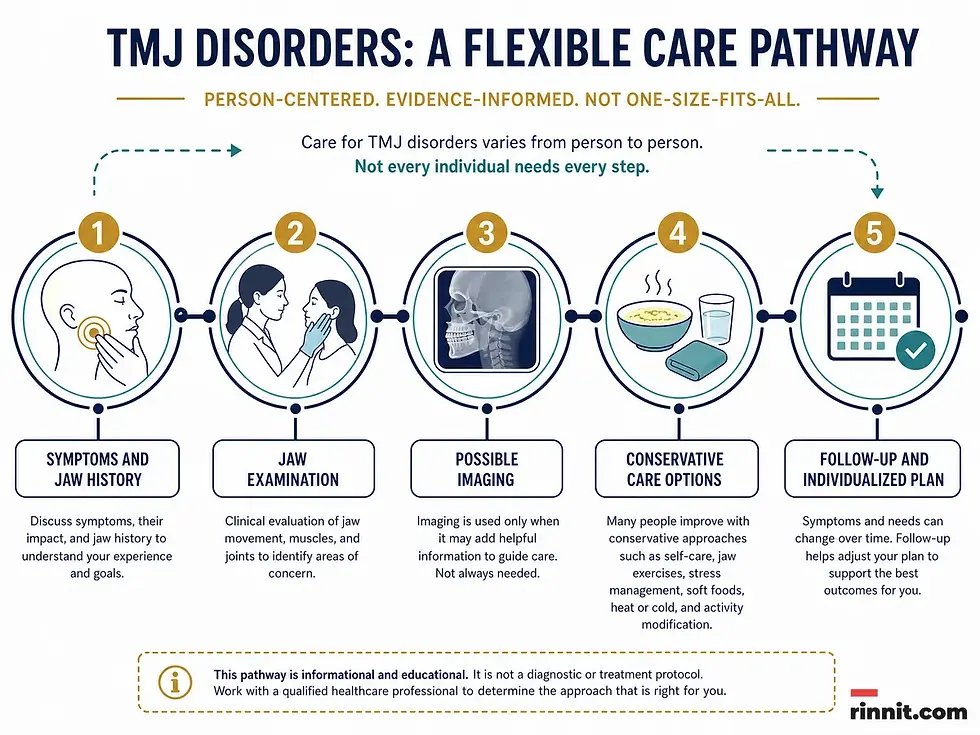
Diagnosis begins with a discussion of symptoms and a physical examination of the jaw. [5]
A healthcare professional may:
Listen to and feel the jaw as it opens and closes. [5]
Watch the jaw’s range of motion.
Press around the jaw to identify areas of pain or discomfort. [5]
Ask whether pain is constant or comes and goes.
Ask whether a specific activity causes pain.
Ask whether clicking or popping is painful.
Ask whether it is difficult to open the mouth normally.
When might imaging be used?
Imaging is not automatically needed for every person. When it may add useful information, options can include:
Test | What it may show |
Dental X-rays | Teeth and jaw structures. |
CT scan | Detailed images of the bones involved in the joint. |
MRI | The joint disk or surrounding soft tissue. |
TMJ arthroscopy | Direct viewing of the joint space with a small camera, sometimes used to diagnose and also to treat in selected situations. |
The choice of imaging depends on symptoms, examination findings and the professional’s assessment.
How are TMJ disorders treated?
Symptoms may go away without treatment. If symptoms continue, a healthcare professional may recommend one or more options at the same time. [5]
Treatment is individualized. A method that helps one person may not be appropriate for another, and decisions should take account of possible causes, symptom severity, movement limits, tooth or jaw findings and other health conditions.
Medicines
Medicine options may include pain relievers and anti-inflammatory medicines, selected low-dose tricyclic antidepressants for pain, bruxism or sleeplessness, and muscle relaxants for a few days or weeks when muscle spasms create pain. [5]
These options require professional guidance. Do not start, stop or change a medicine based on this article, and do not assume that an over-the-counter medicine is safe or suitable for you.
Non-drug therapies
Therapies may include:
Self-care: Avoid teeth clenching, gum chewing and nail biting. A resting jaw position places the tongue gently on the palate, keeps the teeth apart and lets the jaw relax. [5]
Oral splints or mouth guards: Some people with jaw pain may benefit from a soft or firm device placed over the teeth. The reasons these devices help are not well understood. [5]
Physical therapy: A professional may teach exercises to stretch and strengthen jaw muscles. Treatments may include ultrasound, TENS, moist heat and repeated stretching. [5]
Counseling: Education and counseling may help identify behaviors that worsen pain, such as clenching, grinding, leaning on the chin or biting fingernails. [5]
Do not choose a mouth guard, jaw exercise plan or physical therapy routine without considering the cause of symptoms and the advice of a qualified professional.
Procedures and surgery
When other methods do not help, a healthcare professional may discuss procedures such as arthrocentesis, selected injections, TMJ arthroscopy, modified condylotomy or open-joint surgery. [5]
Arthrocentesis uses small needles and fluid flow to remove debris and inflammatory byproducts from the joint. Corticosteroid injections into the joint may help some people, while botulinum toxin type A injected into chewing muscles may ease pain in rare situations. [5]
TMJ arthroscopy uses a small camera and instruments in the joint space and has fewer risks and complications than open-joint surgery, though it has limitations. Open-joint surgery may be considered when pain continues and a structural joint problem appears to be causing it. It involves more risks than other procedures, so the possible benefits and risks should be discussed carefully. [5]
What can help at home?
Home measures may ease symptoms, but they do not replace evaluation when pain, locking or limited movement is present.
Possible measures include:
Eat soft foods and cut food into small pieces.
Avoid sticky or chewy foods and chewing gum.
Avoid opening the mouth very wide.
Eat with both sides of the mouth rather than relying on one side. [5]
Use utensils such as a spoon or fork when that reduces strain. [5]
Apply warm, moist heat or an ice pack to the side of the face. Heat or cold for 15 to 20 minutes several times a day is described as helpful, especially when combined with stretching. [5]
Practice gentle stretching or massage only after a physical therapist or other healthcare professional has shown you how. [5]
Notice habits linked with stress, including clenching the jaw, grinding the teeth or chewing objects. [5]
Use relaxation techniques such as slower, regular breathing when appropriate. [5]
Acute pain may respond differently from a chronic dull ache. Ice is described as best for acute pain and heat for chronic dull pain, but ask a healthcare professional which approach is appropriate for you. [5]
When are procedures or surgery considered?
Procedures are not the first step for every TMJ disorder. They may be discussed when symptoms continue after other methods have not helped or when a structural problem appears to be responsible for pain or locking.
Before a procedure or surgery, ask about:
The reason it is being considered.
What other options are available.
Potential benefits and risks.
Whether the procedure is intended to address pain, movement, a structural issue or another finding.
What recovery and follow-up may involve.
A recommendation should be based on an individual examination and discussion rather than a symptom checklist.
How should someone prepare for a TMJ appointment?
To prepare for a TMJ appointment, write down when symptoms began, what triggers them, which medicines you take and whether jaw clicking is painful.
When symptoms began.
Whether they have happened before.
Whether stress has increased recently.
Whether headaches, neck aches or toothaches occur often.
Which medicines and supplements are taken regularly.
Whether pain is constant or comes and goes.
Whether a particular activity causes symptoms.
Whether jaw clicking or popping is painful.
Whether the mouth is difficult to open in the usual way.
This information can help a dentist or healthcare professional understand patterns and decide what needs to be examined.
Frequently asked questions
What are TMJ disorders?
TMJ disorders affect the jaw joints and the muscles that control jaw movement. They may cause pain, tenderness, chewing difficulty, locking, headaches or other symptoms.
What are common TMJ disorder symptoms?
Common symptoms include jaw pain, pain in one or both jaw joints, aching around the ear, painful chewing, facial pain, locking, headaches, neck pain, eye pain, tooth pain with jaw tenderness, and clicking or grating.
Is jaw clicking always a TMJ disorder?
No. Clicking without pain or limitation of jaw movement may not need treatment. Painful clicking or clicking with movement limitation should be discussed with a healthcare professional.
When should someone seek care for jaw pain?
Seek care for sudden or constant jaw pain or tenderness, pain during jaw movement, or inability to open or close the jaw completely. A dentist, TMJ specialist or other healthcare professional can discuss possible causes and treatment.
What causes TMJ disorders?
Possible causes include disk changes, soft-tissue strain, arthritis, jaw injury and jaw-muscle spasms. Habits such as clenching, grinding, gum chewing and nail biting may also contribute.
Can stress contribute to TMJ symptoms?
Stress may be one factor associated with TMJ disorders and may increase clenching or muscle tension. It is not the only possible explanation for jaw pain or movement problems.
How are TMJ disorders diagnosed?
A professional may discuss symptoms, feel the jaw during movement, assess range of motion and press around the jaw. Dental X-rays, CT, MRI or TMJ arthroscopy may be used in selected situations.
Do TMJ disorders always need treatment?
No. Symptoms may go away without treatment. If symptoms continue, a professional may recommend one or more options based on the examination and possible causes.
What home measures may ease symptoms?
Soft foods, smaller pieces, avoiding gum and chewy foods, limiting wide mouth opening, professional-guided stretching, heat or cold and relaxation techniques may help some people.
Do mouth guards help TMJ disorders?
Some people with jaw pain may benefit from an oral splint or mouth guard, but the reasons these devices help are not well understood. A dentist or healthcare professional should help determine whether one is appropriate.
When are injections or surgery considered?
Procedures may be discussed when other methods do not help or when a structural problem appears to cause pain or locking. Options and risks vary, so a professional should explain them before a decision is made.
How should someone prepare for a TMJ appointment?
Bring a list of symptom timing, stress changes, headaches, neck aches, toothaches, medicines and supplements. Note whether pain is constant, whether clicking is painful and whether the mouth is difficult to open.
Conclusion: what to remember about TMJ disorders
TMJ disorders affect the jaw joints and the muscles that control jaw movement. They can cause jaw pain, ear-area aching, painful chewing, facial pain, locking, headaches, neck pain and tooth pain associated with jaw tenderness.
The cause is often difficult to identify and may involve joint changes, arthritis, injury, clenching, grinding, habits, stress or other conditions. Clicking without pain or limited movement may not need treatment, but sudden or constant pain, painful movement or an inability to open or close the jaw completely needs professional attention.
Symptoms may improve without treatment. When care is needed, it is individualized and may include self-care, physical therapy, counseling, a mouth guard, medicines, selected procedures or surgery. Conservative options are generally considered before surgery, and any procedure should be discussed carefully with a qualified professional.
Related Reading
Prosthodontics: What It Is, Treatments and When to See a Prosthodontist explains prosthodontics and tooth replacement.
Double Jaw Surgery (Bimaxillary Osteotomy): Procedure and Recovery explains surgery that repositions both the upper and lower jaws.
References
Valesan LF, Da-Cas CD, Réus JC, et al. Prevalence of temporomandibular joint disorders: a systematic review and meta-analysis. Clin Oral Investig. 2021;25(2):441-453. PMID: 33409693. DOI: 10.1007/s00784-020-03710-w
Türp JC. More therapy is not necessarily better: patient education and self-management perform similarly to other conservative interventions for temporomandibular disorders. Evid Based Dent. 2026 (Epub ahead of print). PMID: 42811105. https://doi.org/10.1038/s41432-026-01273-5
Zhang L, Liu M, Li X, et al. Comparative effectiveness of nonpharmacological therapies for adult myogenic temporomandibular disorders: a network meta-analysis of randomized trials. BMC Oral Health. 2026;26(1):1355. PMID: 42365270. https://doi.org/10.1186/s12903-026-09044-5
Mayo Clinic Staff. TMJ disorders: Symptoms and causes. Mayo Clinic. December 24, 2024. https://www.mayoclinic.org/diseases-conditions/tmj/symptoms-causes/syc-20350941
Mayo Clinic Staff. TMJ disorders: Diagnosis and treatment. Mayo Clinic. December 24, 2024. https://www.mayoclinic.org/diseases-conditions/tmj/diagnosis-treatment/drc-20350945
Disclaimer
This article is for general educational purposes and is not a substitute for professional medical advice, diagnosis or treatment. Always seek the advice of a qualified health provider with any questions you may have regarding a medical condition.
Sudden or constant jaw pain, pain during jaw movement, inability to open or close the jaw completely, or major chewing difficulty should be assessed by a dentist or healthcare professional. Do not diagnose a TMJ disorder from clicking alone, and do not start or change medicines, mouth guards, injections, exercises or surgery without professional guidance.



Comments