Double Jaw Surgery (Bimaxillary Osteotomy): Procedure and Recovery

Updated: 2 days ago
Written and medically reviewed by Dr. Baraa Alnahhal, MD · Last reviewed: November 2026 · How we review
Quick Answer
Double jaw surgery, also called bimaxillary osteotomy, is an operation that repositions and reshapes both the upper and lower jaws. It's used for a severe bad bite that affects chewing, speech or breathing and for obstructive sleep apnea. Most people return to daily routines within six weeks, but full recovery can take up to a year.
What the research says
Moving the jaws forward treats sleep apnea: a review of 45 studies with 518 people found that advancing both jaws cut breathing pauses during sleep by an average of 80%, with surgical success in 85.5% and a complete cure in 38.5% (Zaghi S et al., JAMA Otolaryngol Head Neck Surg, 2016) [2]
Numbness is the most common complication: in 18 studies with 1,734 people who had double jaw surgery for jaw deformities, about 45% had some change in feeling, such as numbness of the lip or chin, while infection occurred in about 3.6% (Kassir MF et al., Otolaryngol Head Neck Surg, 2026) [3]
Key takeaways
Double jaw surgery moves both the upper and lower jaws in one operation.
It treats severe bite problems, jaw size or position problems and sleep apnea.
Braces are usually needed for up to two years before surgery.
The operation takes four to six hours under general anesthesia.
Full recovery can take up to a year.
What is double jaw surgery?
In double jaw surgery, a surgeon cuts the bone of the upper jaw (maxilla) and the lower jaw (mandible), moves each into a better position and fixes it there. It's a form of orthognathic surgery, which an oral and maxillofacial surgeon performs together with an orthodontist. When only one jaw is out of position, surgery on a single jaw may be enough; double jaw surgery is used when both jaws need to move. Sources: [1]
Why it's done
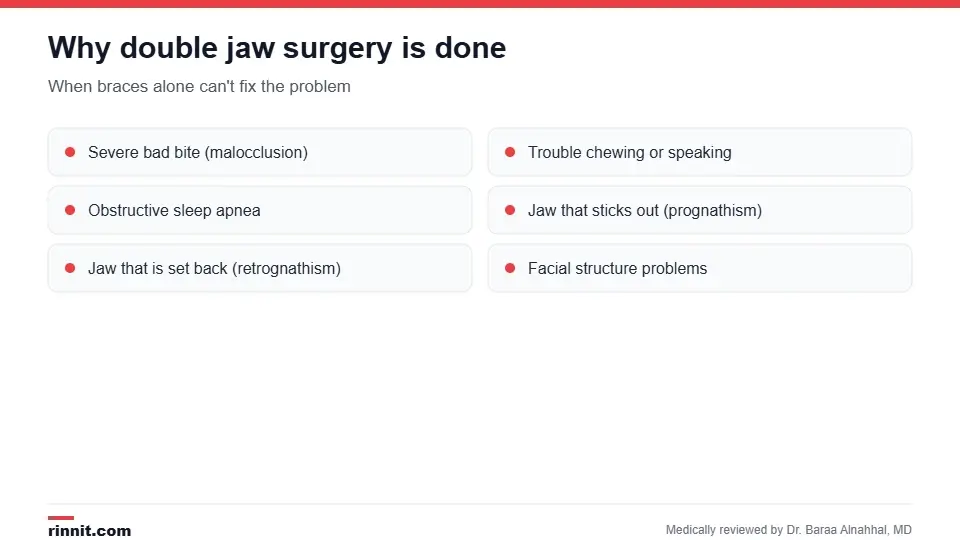
Surgery is considered when braces alone can't fix the bite.
Severe malocclusion, such as an overbite or underbite, that affects chewing, speech or breathing and can't be fixed with braces alone.
Obstructive sleep apnea or trouble breathing during sleep; moving the jaws forward opens the airway.
A jaw that is too large or sticks out (prognathism).
A jaw that is too small or set back (retrognathism).
Other facial structure problems. Sources: [1]
How to prepare
Wear braces or other orthodontic appliances, often for up to two years, to move your teeth into the right position.
Have records such as X-rays, scans and dental impressions taken so your surgeon can plan the jaw movements.
Plan for about two days in the hospital and several weeks off work or school.
Stock up on liquid and soft foods for recovery. Sources: [1]
What happens during surgery

The operation takes about four to six hours.
You receive general anesthesia, so you're asleep.
Your surgeon makes incisions inside your mouth, so there are usually no visible scars on your face.
The jawbone is cut and moved into its new position.
Bone may be removed, reshaped or added as needed.
The jaw is secured with screws, plates or wires.
The same steps are repeated on the other jaw.
The incisions are closed with stitches. Temporary plastic splints may be placed on your teeth to hold the jaws in place and spread chewing pressure. Sources: [1]
Risks
Possible risk | What it means |
Bleeding | Excessive bleeding during or after surgery |
Infection | Infection at the surgical site |
Nerve damage | Numbness or changed feeling in the lips, chin or face |
Bone or tooth damage | Injury to the jawbone or nearby teeth |
TMJ problems | TMJ disorders that develop or worsen after surgery |
Research shows that some change in feeling, such as lip or chin numbness, is common after double jaw surgery, and infection is less common. Your surgeon will explain your own risks. Sources: [1, 3]
Recovery and results

Recovery happens in stages.
Time after surgery | What to expect |
First days | About two days in the hospital |
Weeks 1 to 2 | Liquid diet |
Weeks 3 to 8 | Soft-food diet for three to six weeks |
Several weeks | Swelling and bruising of the lower face |
About 6 weeks | Most people return to daily routines |
3 months to 1 year | Healing continues; full recovery can take up to a year |
Surgery may correct your bite, ease or cure sleep apnea, change the shape or size of your jaws and improve confidence in your appearance. Including braces before surgery, the whole process can take more than two years. Sources: [1, 2]
Call your provider if you have pain that medicine doesn't relieve, a fever above 100.4°F (38°C), or pus or discharge from your incisions. Sources: [1]
Conclusion
Double jaw surgery repositions both jaws at once to fix a severe bite, jaw size problems or sleep apnea. It's a long process that starts with braces and ends with months of healing, but it can improve how you eat, speak, breathe and look.
Keep learning: read about corrective jaw surgery and TMJ disorders.
Frequently asked questions
What is double jaw surgery?
Surgery that moves and reshapes both the upper and lower jaws in one operation.
What is a bimaxillary osteotomy?
The medical name for double jaw surgery.
Why would I need double jaw surgery?
For a severe bad bite, jaw size problems or sleep apnea that braces alone can't fix.
Do I need braces first?
Usually yes, often for up to two years.
How long does the surgery take?
About four to six hours.
Will I be asleep?
Yes. It's done under general anesthesia.
Will I have scars?
Incisions are usually made inside the mouth.
How long is the hospital stay?
About two days.
What can I eat afterward?
Liquids for two weeks, then soft foods for three to six weeks.
How long does recovery take?
Most people resume daily routines in about six weeks; full recovery can take up to a year.
Related Reading
Sliding Genioplasty: Procedure, Recovery and Results explains sliding genioplasty chin surgery.
Corrective Jaw Surgery (Orthognathic Surgery): Procedure and Recovery an overview of jaw surgery.
Maxillofacial Surgery: Advanced Care for Face, Jaw, and Neck Conditions the specialty that performs jaw surgery.
TMJ Disorders: Symptoms, Causes, Diagnosis, Treatment and Self-Care jaw joint problems that can occur after surgery.
Underbite Correction: Symptoms, Causes, and Modern Treatment Options one of the bite problems surgery treats.
Oral Appliances for Sleep Apnea: How They Work, Who They Help, and What to Expect a non-surgical option for sleep apnea.
References
Cleveland Clinic. Double Jaw Surgery: Procedure & Recovery. Cleveland Clinic. Last updated September 25, 2026. https://my.clevelandclinic.org/health/procedures/double-jaw-surgery
Zaghi S, Holty JE, Certal V, et al. Maxillomandibular advancement for treatment of obstructive sleep apnea: a meta-analysis. JAMA Otolaryngol Head Neck Surg. 2016;142(1):58-66. PMID 26606321. https://doi.org/10.1001/jamaoto.2015.2678
Kassir MF, Walker A, Howser LA, et al. Comparative meta-analysis of complications of maxillomandibular advancement for OSA versus orthognathic surgeries for dentofacial deformities. Otolaryngol Head Neck Surg. 2026;175(5):1005-1017. PMID 42529894. https://doi.org/10.1002/ohn.70352
Medical disclaimer
This article is for general education only and does not replace advice from a qualified healthcare professional. Talk to your doctor about your own diagnosis and treatment, and seek emergency care right away for severe or sudden symptoms.


Comments