Sliding Genioplasty: Procedure, Recovery and Results

Updated: 2 days ago
Written and medically reviewed by Dr. Baraa Alnahhal, MD · Last reviewed: November 2026 · How we review
Quick Answer
A sliding genioplasty, also called an osseous genioplasty, is surgery that reshapes the chin by cutting and moving part of the chin bone. It's mostly cosmetic but is also used for reconstruction. The incision is inside the mouth, so there's no visible scar. Most people return to work in 7 to 10 days.
What the research says
Chin surgery gave good cosmetic results: a review of 54 studies with 4,897 patients found all chin techniques gave satisfactory results; complications occurred in 19.7% after sliding genioplasty and 15.7% after implants, including temporary nerve numbness in 16.4% and 2.4% (Oranges CM et al., Plastic and Reconstructive Surgery, 2023) [2]
Chin advancement stayed stable: across 8 studies with an average chin advancement of 8.2 mm, bone shifted back only 0.1 to 2.1 mm after a year, so advancement genioplasty was predictable and stable (Janssens E et al., Journal of Cranio-Maxillo-Facial Surgery, 2021) [3]
Key takeaways
A sliding genioplasty reshapes the chin by moving bone.
The incision is inside the mouth.
It can move the chin forward, back or sideways.
Swelling lasts up to two weeks.
Most people return to normal activities in 7 to 10 days.
What is a sliding genioplasty?
The surgeon cuts the chin bone (osteotomy), repositions it and fixes it in place. To shorten a long chin, a piece of bone is removed; to lengthen a short chin, a gap is left for new bone to fill. A chin implant is an alternative for a small chin. Learn more about genioplasty. Sources: [1]
Why it's done

It improves facial balance and symmetry.
Chin asymmetry.
A long or short chin.
A large (macrogenia) or small (microgenia) chin.
A chin that sticks out or sits back (retrognathia).
Reconstruction after facial injury or a birth condition. Sources: [1]
Who's a good candidate

A chin implant may be an option for a small chin.
No jaw disorder.
Nonsmoker.
Finished growing, usually by the late teens.
Good health and realistic expectations. Sources: [1]
How to prepare
Quit smoking several weeks before.
You'll have imaging, a physical exam and blood work.
Stop aspirin, NSAIDs and herbal supplements as directed.
You may take antibiotics. Sources: [1]
What happens during surgery
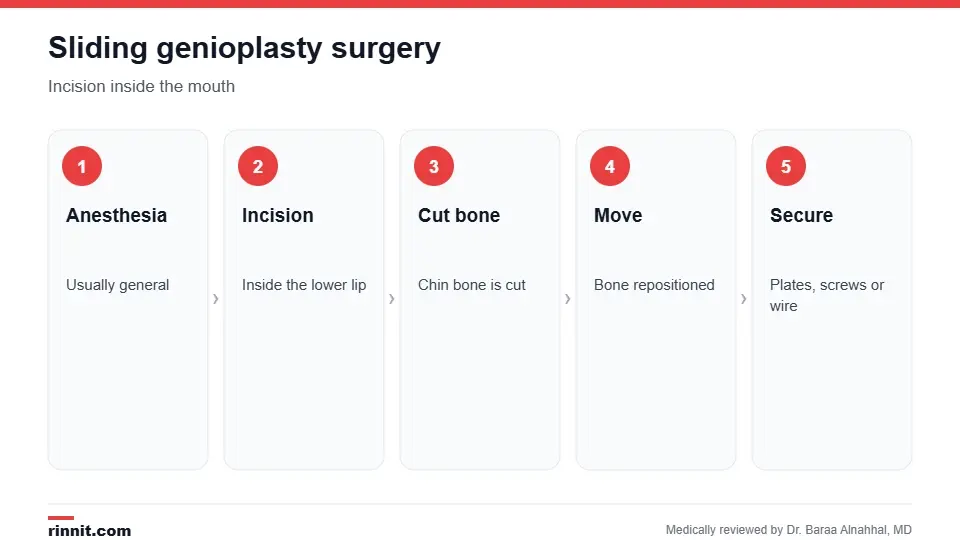
Some people go home the same day.
You usually get general anesthesia.
The surgeon makes an incision inside your mouth at the base of the jaw.
The chin bone is cut and moved to its new position.
It's secured with plates, screws or wire.
Dissolvable stitches close the incision, and a tape-like dressing supports the chin. Sources: [1]
Risks
Bleeding or bruising.
Infection.
Scarring.
Tingling or numbness in the chin or lower lip. Sources: [1, 2]
Recovery
Dressings come off 3 to 4 days after surgery.
Eat liquids or soft foods for several days.
Rinse with salt water before and after meals.
Use cold compresses and over-the-counter pain relievers.
Sleep with your head raised.
Return to work and exercise in 7 to 10 days. Sources: [1]
Swelling and bruising can last up to two weeks, and full recovery takes several weeks. Sources: [1]
Outlook
A sliding genioplasty improves facial balance and symmetry and can correct problems from birth, injury or past surgery. Studies show the results stay stable over time. Sources: [1, 3]
When to call your provider
Chest pain or shortness of breath.
Fever, chills or flu-like symptoms.
Pus or drainage from the incision.
Swelling or pain lasting more than a few weeks.
An unusual heart rate. Sources: [1]
Conclusion
A sliding genioplasty can bring your chin into balance with the rest of your face with no visible scar. Following your diet and mouth-care instructions helps you heal quickly.
Keep learning: read about genioplasty and jaw surgery.
Frequently asked questions
What is a sliding genioplasty?
Surgery that reshapes the chin by cutting and moving the chin bone.
Will I have a scar?
No visible scar; the incision is inside your mouth.
What can it fix?
A chin that's too small, large, long, short, set back or uneven.
How is the bone held in place?
With plates, screws or wire.
Is it better than a chin implant?
It moves your own bone; an implant adds material. Your surgeon can help you choose.
Will I stay in the hospital?
Some go home the same day; others stay overnight.
What can I eat after surgery?
Liquids or soft foods for several days.
How long does swelling last?
Up to about two weeks.
When can I go back to work?
Usually 7 to 10 days after surgery.
Can my lip feel numb?
Yes, tingling or numbness in the chin or lower lip can happen.
Related Reading
Genioplasty (Chin Augmentation and Reshaping) other chin surgery options.
Chin Implant: Surgery, Recovery, Risks, and Who It's For an implant alternative.
Retrognathia (Receding Chin): Symptoms, Causes, and Treatments a receding chin.
Corrective Jaw Surgery (Orthognathic Surgery): Procedure and Recovery jaw realignment surgery.
Double Jaw Surgery (Bimaxillary Osteotomy): Procedure and Recovery surgery on both jaws.
References
Cleveland Clinic. Sliding Genioplasty: Procedure, Recovery, Results & Risks. Cleveland Clinic. Last updated August 19, 2022. https://my.clevelandclinic.org/health/treatments/24041-sliding-genioplasty
Oranges CM, Grufman V, di Summa PG, et al. Chin augmentation techniques: a systematic review. Plastic and Reconstructive Surgery. 2023;151(5):758e-771e. PMID 36729154. https://doi.org/10.1097/PRS.0000000000010079
Janssens E, Shujaat S, Shaheen E, et al. Long-term stability of isolated advancement genioplasty, and influence of associated risk factors: a systematic review. Journal of Cranio-Maxillo-Facial Surgery. 2021;49(4):269-276. PMID 33583665. https://doi.org/10.1016/j.jcms.2021.01.013
Medical disclaimer
This article is for general education only and does not replace advice from a qualified healthcare professional. Talk to your doctor about your own diagnosis and treatment, and seek emergency care right away for severe or sudden symptoms.



Comments