Genioplasty (Chin Augmentation and Reshaping)

Updated: 3 days ago
Medically reviewed by Dr. Baraa Alnahhal, MD · Last reviewed: October 2026
Quick Answer: What is genioplasty?
Genioplasty is a surgical procedure that augments or reshapes the chin for better facial harmony [1]. The two main types are silicone chin implants and sliding genioplasty, which repositions the chin bone [1]. It is typically done under general anesthesia through incisions inside the mouth [1]. Recovery involves about a week of restricted activity and soft foods, with swelling fading over several weeks [1].
What the research says
Chin augmentation techniques give satisfactory cosmetic results, with different risk profiles. A systematic review of 54 studies (4,897 patients) found consistently satisfactory outcomes across techniques. The overall complication rate was 15.7% for implants and 19.7% for osteotomy (bone-cutting procedures), including transient mental nerve-related injuries in 2.4% and 16.4% of cases, respectively (Oranges et al., Plast Reconstr Surg, 2023) [2].
The implant material influences the chance of lasting numbness. In a systematic review of 39 articles (more than 3,104 patients) on chin implants, paresthesia (abnormal sensation or numbness) occurred in 0.4% of silicone implants versus 20.1% with high-density porous polyethylene (P < 0.01) and 3.2% with expanded polytetrafluoroethylene (P < 0.05); rates of malposition, infection, extrusion, revision, removal, and asymmetry did not differ significantly by implant type (Liao et al., Ann Plast Surg, 2023) [3].
Types of Genioplasty
The right surgical approach depends on the patient's anatomy and their specific goals for facial balance.
Procedure Type | Material / Method | Primary Use |
Chin Implant | Flexible silicone [1] | Adding size or definition to a small chin [1] |
Sliding Genioplasty | Bone repositioning [1] | Correcting recessed, protruding, or misaligned chins [1] |
Reconstructive | Varies (implant or bone) | Repairing birth defects, trauma, or tumor removal sites [1] |
The Surgical Procedure
Genioplasty is a precise operation that prioritizes facial symmetry while minimizing visible signs of surgery.
Preparation and Candidacy
Ideal candidates for chin augmentation are physically healthy non-smokers with normal jaw alignment who have reached full skeletal maturity [1]. Preparation often involves imaging exams, such as X-rays, to help the surgeon plan the repositioning or implant placement [1]. Patients may need to pause certain medications, such as blood thinners or anti-inflammatory drugs, and must quit smoking several weeks before the operation to support proper healing [1].
Execution and Incisions
The procedure is usually performed under general anesthesia [1]. To prevent visible scarring, incisions are typically placed inside the mouth [1]. For implants, the silicone piece is centered and secured [1]. In a sliding genioplasty, a portion of the chin bone is cut, moved to the desired position (forward, backward, or sideways), and secured with specialized plates and screws [1]. Dissolvable stitches close the incisions, and a supportive bandage may be applied to reduce initial swelling [1].

Recovery and Aftercare
Good post-operative care is essential for keeping the chin aligned and ensuring the surgical site heals without infection.
Most patients are discharged the same day [1] but must follow strict recovery guidelines. Strenuous activity, heavy lifting, and bending should be avoided for at least one week [1]. A soft-food or liquid diet is necessary for the first few days to prevent irritation of the internal stitches [1]. Patients are encouraged to sleep with their heads elevated and use cold compresses to manage the normal swelling and bruising, which can persist for a few weeks [1]. Regular mouth rinsing with a prescribed oral solution helps keep the incision site clean [1].

Potential Risks and Complications
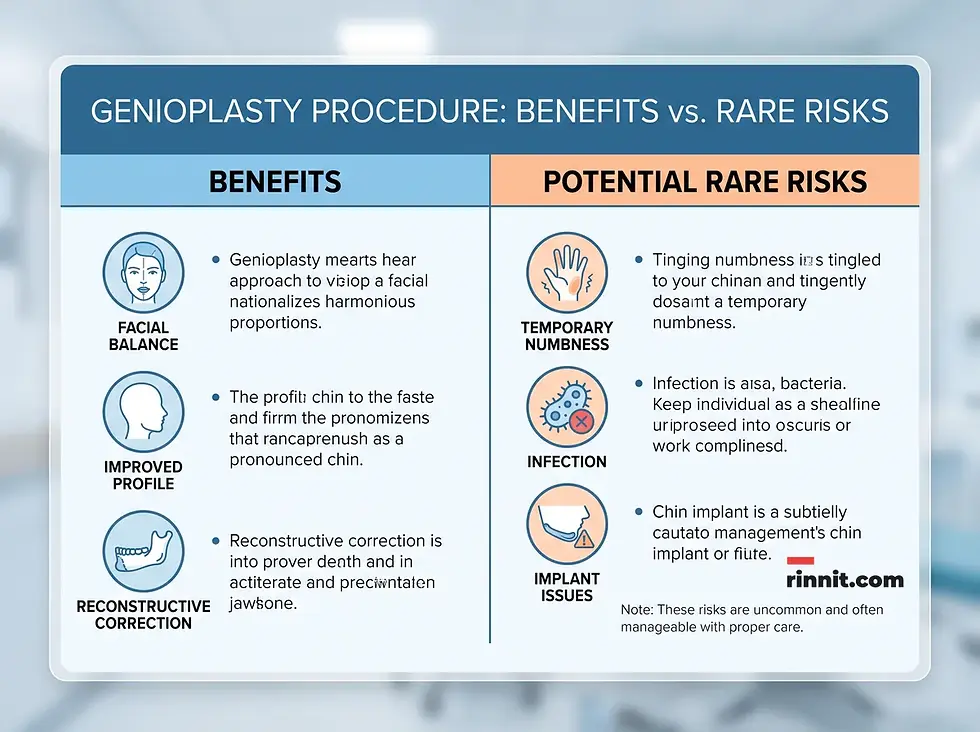
Genioplasty is generally safe, but patients should be aware of the rare but possible complications of facial surgery [1].
Standard surgical risks include bleeding, infection, and bruising [1]. Specific to genioplasty, patients may experience temporary or prolonged numbness or tingling in the lower lip and chin area [1]. There is also a small risk of problems with the implant or with the hardware used to secure the bone [1]. Patients who develop breathing difficulties, chest pain, fever, or signs of infection such as unusual drainage should contact their healthcare provider immediately [1].
Conclusion
Genioplasty offers a reliable path to improved facial symmetry and confidence, whether for cosmetic enhancement or reconstructive need. By understanding the differences between implants and bone repositioning, patients can work with their surgeons to achieve a balanced profile that complements their natural features. With proper preparation and a commitment to recovery, the results of a genioplasty can provide a lasting improvement in facial harmony.
Professional note: Successful chin augmentation requires realistic expectations and good general health. Discussing your goals openly with a qualified plastic surgeon is the first step toward the outcome you want.
Frequently Asked Questions
Will there be visible scars after a genioplasty?
In most cases, no. Surgeons typically make incisions inside the mouth to hide any resulting scars. For some implant procedures, a small incision may be made under the chin where it is less noticeable.
How long does the recovery take?
Most patients return to light activities within a week, but swelling and bruising can take several weeks to fully subside. You may need to stay home from work for a few days or weeks depending on your job.
Can I eat normally after the surgery?
You will need to stick to a liquid or very soft-food diet for the first few days to protect your stitches. Your surgeon will tell you when it is safe to return to a regular diet.
Is a genioplasty the same as a chin implant?
A chin implant is one type of genioplasty. The other main type is a sliding genioplasty, which involves repositioning your natural chin bone rather than using a silicone insert.
How do I know if I am a good candidate?
Good candidates are generally healthy non-smokers with normal jaw alignment whose bones have finished growing. A consultation with a surgeon is necessary to confirm candidacy.
What is the difference between cosmetic and reconstructive genioplasty?
Cosmetic genioplasty is done to improve facial balance and appearance. Reconstructive genioplasty is used to correct birth defects, repair injuries, or restore the chin after tumor removal.
How should I sleep after the procedure?
It is recommended to sleep with your head elevated above your heart for the first few weeks to help reduce facial swelling.
Are the results of a genioplasty permanent?
Yes, both chin implants and sliding genioplasty provide long-lasting changes to the shape and position of the chin.
What are the most common risks?
Common risks include temporary swelling, bruising, and numbness in the lower lip or chin. Serious complications such as infection or implant problems are rare.
When can I resume exercise?
Strenuous activity and heavy lifting should be avoided for at least one week following the surgery to prevent complications.
Content reviewed and produced following the Rinnit editorial framework. Last updated: October 8, 2026.
How do I prepare for a genioplasty?
Your provider will give you specific instructions and may order bloodwork or other tests to confirm surgery is safe for you. [1] X-rays may be used to plan the operation, and photos of your chin and jawline may be taken. [1] You may need to stop certain medicines beforehand, including aspirin, anti-inflammatory drugs, herbal supplements and blood thinners. [1] If you smoke, you'll be advised to quit several weeks before the procedure. [1]
Does a genioplasty hurt, and what anesthesia is used?
Most people have general anesthesia for genioplasty, so you're asleep during the operation. [1] In some cases your surgeon may recommend local anesthesia or sedation instead. [1] Afterward, some pain is possible, and your provider may recommend pain relievers if your chin hurts. [1] Swelling and bruising are normal for a few weeks; cold compresses and sleeping with your head raised can help. [1]
When should I call my doctor after a genioplasty?
Contact your provider if you have breathing problems or shortness of breath, chest pain, or an unusual pulse or heart rate. [1] Also call for fever, chills or flu-like symptoms, pus or drainage from the incision, or numbness in your chin, lips or face that doesn't go away. [1] Swelling or pain that lasts longer than a few weeks should be checked too. [1]
Related Reading
Sliding Genioplasty: Procedure, Recovery and Results explains sliding genioplasty chin surgery.
Enhancing Facial Definition: A Guide to Jaw Implants explains how silicone jaw implants add definition to the lower face, plus recovery and risks.
References
Cleveland Clinic. Genioplasty (Chin Augmentation). Cleveland Clinic. April 15, 2024. https://my.clevelandclinic.org/health/procedures/genioplasty-chin-augmentation
Oranges CM, Grufman V, di Summa PG, et al. Chin augmentation techniques: a systematic review. Plast Reconstr Surg. 2023;151(5):758e-771e. PMID 36729154. doi:10.1097/PRS.0000000000010079
Liao CD, Rodriguez E, Zhao K, et al. Complications following alloplastic chin augmentation: a systematic review of implant materials and surgical techniques. Ann Plast Surg. 2023;90(6S Suppl 5):S515-S520. PMID 36880789. doi:10.1097/SAP.0000000000003423
Medical disclaimer
The information provided in this article is for educational purposes only and should not be used as a substitute for professional medical advice, diagnosis, or treatment. Always seek the advice of your physician or other qualified health provider with any questions you may have regarding a medical condition.



Comments