Kyphoplasty: Procedure, Recovery, Results and Risks

Updated: 2 days ago
Written and medically reviewed by Dr. Baraa Alnahhal, MD · Last reviewed: November 2026 · How we review
Quick Answer: What is kyphoplasty?
Kyphoplasty, also called balloon kyphoplasty, is a minimally invasive procedure that treats painful compression fractures in the spine. A surgeon guides a needle into the broken vertebra, inflates a balloon to restore its height, then fills the space with bone cement. Most people go home the same day, and about 92% report better pain relief, often within 48 hours.
What the research says
Kyphoplasty and vertebroplasty relieve pain equally well, with less cement leakage after kyphoplasty. A review of 17 overlapping meta-analyses on osteoporotic compression fractures found that the two procedures gave similar pain relief and function, while kyphoplasty had a lower rate of cement leakage. (Liu et al., Pain Physician, 2024) [2]
Early kyphoplasty may lower the chance of a new fracture nearby. In a meta-analysis of 13 studies with 930 patients, early kyphoplasty gave similar or better results than delayed treatment and was linked to fewer fractures in neighboring vertebrae (odds ratio 0.31). (Liu et al., Pain Physician, 2023) [3]
Vertebral augmentation also helps cancer-related spinal fractures. A meta-analysis of 7 randomized trials with 476 participants found vertebral augmentation relieved pain better than nonsurgical care for cancer-related compression fractures. Cement leaked in about 24% of cases, without major adverse events. (Mattie et al., Spine, 2021) [4]
Key takeaways
Kyphoplasty treats painful vertebral compression fractures using a balloon and bone cement. [1]
It is done through a small skin puncture, takes less than an hour per level and is usually an outpatient procedure. [1]
About 92% of people report better pain relief, often within 48 hours. [1]
Serious complications are rare but include nerve damage, new fractures and cement moving out of the bone. [1]
Treating the underlying osteoporosis helps prevent future fractures. [1]
What is kyphoplasty?
Kyphoplasty is a minimally invasive procedure to treat compression fractures, painful breaks in the bones of the spine (vertebrae). It is not major surgery, because it uses a small puncture instead of an incision. More than 19,000 kyphoplasty procedures are done each year in the United States. [1]
The goal is to stop the vertebra from collapsing further. Collapse can lead to a hunched spine (kyphosis), which may restrict breathing or the work of the organs in the belly. [1]

How kyphoplasty repairs a compressed vertebra.
Who needs kyphoplasty?
Kyphoplasty may help if you have painful, worsening back pain from a compression fracture that limits how you move or function. [1]
Osteoporosis, the most common cause of compression fractures [1]
A spinal injury [1]
Pathologic fractures from spinal tumors or multiple myeloma [1]
The pain must come from the fracture itself, not from conditions such as a herniated disk, arthritis or spinal stenosis. Imaging confirms the fracture, and a DXA bone density scan may be ordered if osteoporosis is suspected. [1]
Kyphoplasty vs vertebroplasty
Feature | Kyphoplasty | Vertebroplasty |
Technique | Balloon restores height, then cement fills the space | Cement is injected directly into the bone |
Pain relief and function | Similar | Similar |
Cement leakage | Lower | Higher |
Sources: [2]. Read our full vertebroplasty guide to compare the two.
How do you prepare for kyphoplasty?
You have a physical exam, spine imaging (X-ray, CT or MRI) and blood tests. [1]
Your provider reviews recent illnesses, allergies and medicines. [1]
Stop blood thinners or other medicines only if your provider approves. [1]
Fast for up to three hours before the procedure. [1]
Wear loose clothing, leave jewelry at home and cut back on or quit smoking. [1]
What happens during kyphoplasty?
An anesthesiologist gives you moderate sedation or general anesthesia. [1]
You lie on your stomach. [1]
Using real-time X-ray (fluoroscopy), the surgeon guides a hollow needle (trocar) through your skin into the broken vertebra. [1]
A balloon-like device passes through the needle and is inflated to restore height and create space. [1]
Bone cement is injected into the space to prevent further collapse. [1]
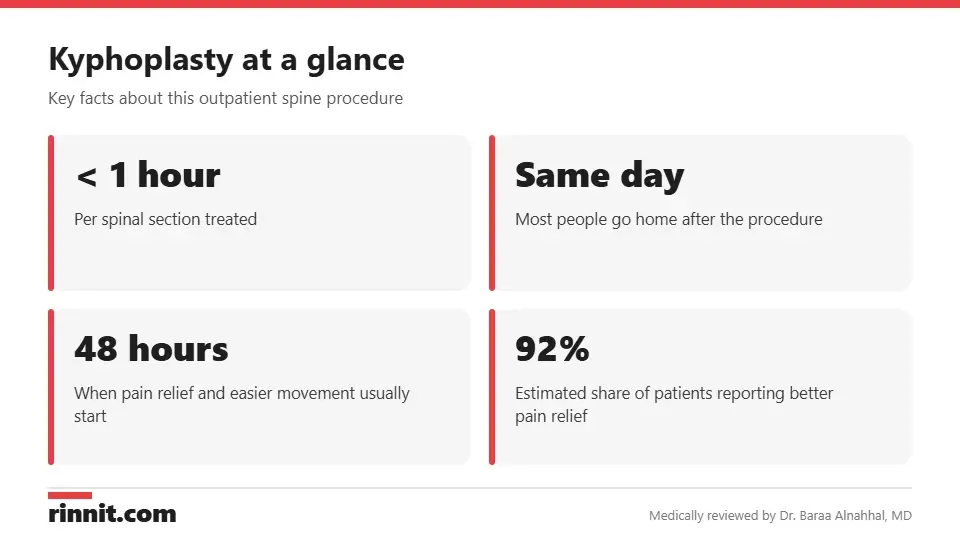
Kyphoplasty key numbers at a glance.
Item | Typical detail |
Time | Less than one hour for one spinal level |
Anesthesia | Moderate sedation or general anesthesia |
Setting | Outpatient; home the same day with a driver |
Pain relief | Within 48 hours, sometimes right away |
Success | About 92% report better pain relief |
Sources: [1]
How long is kyphoplasty recovery?

A typical recovery timeline after kyphoplasty.
Time after the procedure | What to expect |
Same day | Go home once anesthesia wears off; normal light activity can resume |
48 hours | Pain relief and better mobility for most people |
2 days | Bandage can come off once approved; shower instead of bathing |
2 to 3 days | Procedure soreness fades; ice can help |
Several weeks | Avoid strenuous activity and heavy lifting |
Sources: [1]
Your provider may prescribe bone-strengthening medicine if you have osteoporosis, because it lowers your risk of new fractures. [1]
What are the risks of kyphoplasty?
Kyphoplasty is very low risk, and serious problems are uncommon. You should not feel pain during the procedure, but mild soreness afterward is common. [1]
Risk | What it means |
Infection or bleeding | At the puncture site |
More pain, numbness or tingling | Usually from nerve irritation |
Nerve damage | Rare |
New fractures | More likely with osteoporosis |
Cement migration | Cement leaving the bone can cause a pulmonary embolism or spinal stenosis |
Sources: [1]
When should you call a doctor after kyphoplasty?
Swelling, skin color changes or fever, which can signal infection [1]
Excessive bleeding [1]
Numbness or tingling [1]
Worsening pain. Call 911 right away for sudden shortness of breath or chest pain, which can signal bone cement traveling to the lungs [1]
Conclusion
Kyphoplasty uses a balloon and bone cement to stabilize a painful spinal compression fracture through a small puncture. It takes less than an hour, usually lets you go home the same day, and most people feel relief within 48 hours. [1]
Serious complications are rare. Ask your provider whether kyphoplasty suits your fracture, and how to treat osteoporosis or another underlying cause to protect your spine in the future. [1]
Keep learning: Read our compression fracture guide to understand the injury kyphoplasty treats.
Frequently asked questions
What is kyphoplasty?
It is a minimally invasive procedure that uses a balloon and bone cement to treat spinal compression fractures.
Who is a candidate for kyphoplasty?
People with painful, worsening back pain from a confirmed compression fracture that limits movement or function.
How long does kyphoplasty take?
It takes less than one hour for one spinal level.
Is kyphoplasty major surgery?
No. It uses a small skin puncture rather than an incision, and most people go home the same day.
Does kyphoplasty hurt?
Sedation or anesthesia prevents pain during it. Mild soreness afterward usually fades within two to three days.
How soon does kyphoplasty relieve pain?
Most people feel relief within 48 hours, and some feel better right away.
How successful is kyphoplasty?
About 92% of people report better pain relief after the procedure.
What is the difference between kyphoplasty and vertebroplasty?
Kyphoplasty uses a balloon before the cement. Both relieve pain similarly, but kyphoplasty has less cement leakage.
What are the risks of kyphoplasty?
Rare risks include infection, bleeding, nerve damage, new fractures and cement moving out of the bone.
What activities should I avoid after kyphoplasty?
Avoid heavy lifting and strenuous activity for several weeks while your bones strengthen.
How do I prepare for kyphoplasty?
You'll have a physical exam, spine imaging (X-ray, CT or MRI) and blood tests, and your provider reviews recent illnesses, allergies and medicines [1]. Stop blood thinners only if your provider approves, fast for up to three hours beforehand, wear loose clothing, leave jewelry at home, and cut back on or quit smoking [1].
When should I call my doctor after kyphoplasty?
Contact your provider for swelling, skin color changes or fever, which can signal infection, as well as excessive bleeding, numbness or tingling, or worsening pain [1].
Related Reading
What Is a Compression Fracture? Symptoms, Causes, Treatment & Outlook Explained explains the spinal fractures that kyphoplasty treats.
Osteoporosis: Causes, Symptoms, Diagnosis and Treatment Explained covers the bone-thinning disease behind most compression fractures.
Vertebroplasty: Procedure, Recovery, and Benefits describes the related cement procedure without a balloon.
Kyphosis: Symptoms, Causes & Treatment — A Complete Guide explains the hunched spine that vertebral collapse can cause.
What Is Multiple Myeloma? A Plain-Language Guide to Symptoms, Causes, and Treatment reviews a blood cancer that can weaken the spine.
References
Cleveland Clinic. Kyphoplasty: What It Is, Purpose, Procedure & Side Effects. Cleveland Clinic. Last updated November 30, 2023. https://my.clevelandclinic.org/health/procedures/kyphoplasty
Liu D, Wen T, Li X, et al. Percutaneous Vertebroplasty Versus Balloon Kyphoplasty in the Treatment of Osteoporotic Vertebral Compression Fractures: Evaluating the Overlapping Meta-analyses. Pain Physician. 2024;27(4):E383-E394. PMID 38805534. https://pubmed.ncbi.nlm.nih.gov/38805534/
Liu D, Xu J, Wang Q, et al. Timing of Percutaneous Balloon Kyphoplasty for Osteoporotic Vertebral Compression Fractures. Pain Physician. 2023;26(3):231-243. PMID 37192225. https://pubmed.ncbi.nlm.nih.gov/37192225/
Mattie R, Brar N, Tram JT, et al. Vertebral Augmentation of Cancer-Related Spinal Compression Fractures: A Systematic Review and Meta-Analysis. Spine (Phila Pa 1976). 2021;46(24):1729-1737. PMID 33958537. https://doi.org/10.1097/BRS.0000000000004093
Medical disclaimer
This article is for general education only and does not replace advice from a qualified healthcare professional. Talk to your doctor about your own diagnosis and treatment, and seek emergency care right away for severe or sudden symptoms.



Comments