Spinal Tumor: Symptoms, Causes, Diagnosis, and Treatment Explained

Updated: 3 days ago
Medically reviewed by Dr. Baraa Alnahhal, MD · Last reviewed: October 2026
Quick Answer: What Is a Spinal Tumor?
A spinal tumor is a benign or malignant growth in or around the spine. About 95% of spinal cancers are metastatic, spreading from cancers such as breast, lung or prostate. The hallmark symptom is persistent back or neck pain that worsens at night, while weakness, numbness or bladder changes signal cord pressure. MRI is the most accurate test. [1] [2]
What the research says
Surgery plus radiation helped more patients keep or regain walking than radiation alone when metastatic cancer compressed the spinal cord. In a randomized trial of 101 patients, 84% (42 of 50) of those who had surgery followed by radiotherapy could walk after treatment versus 57% (29 of 51) with radiotherapy alone. Patients who could not walk at the start regained walking in 62% (10 of 16) versus 19% (3 of 16), and the trial was stopped early after an interim analysis (Patchell et al., The Lancet, 2005).
What Is a Spinal Tumor?
Some spinal tumors grow slowly and are noncancerous (benign). Others are cancerous (malignant) and can spread. The term "spinal tumor" covers both types, while spinal cancer usually refers to a malignant tumor that started in or spread to the spine. Spinal cord tumors are a type of spinal tumor that starts in or right next to the cord [1].
Spinal tumors can occur anywhere along the spine but are most common in the middle part of the spine behind the chest. Another common location is the lower back, and less often the neck. Rare types include chordoma and osteosarcoma. Treatment depends on the tumor's size, type, and location, and small or slow-growing tumors may only need regular MRI monitoring [1].
What Types of Spinal Tumors Are There?
Spinal tumors are grouped by where they start growing [1]. For example, a spinal hemangioma is a benign vertebral tumor.
Type | Where it grows | Benign examples | Malignant examples |
|---|---|---|---|
Vertebral | Inside the bones of the spine | Osteoid osteoma, hemangioma | Osteosarcoma, metastatic cancers |
Intradural extramedullary | Inside the dura (cord covering) but outside the cord | Meningioma, schwannoma, neurofibroma | Malignant peripheral nerve sheath tumors (rare) |
Intramedullary | Inside the spinal cord tissue | Low-grade ependymoma | Astrocytoma, high-grade ependymoma |

What Are the Symptoms of a Spinal Tumor?
Spinal tumor symptoms depend on where the tumor grows and how much pressure it puts on nerves or the spinal cord. Some tumors grow slowly and cause no symptoms at first. The most common symptom is back or neck pain that does not go away, which may feel dull, sharp, or burning. Even small tumors can cause symptoms if they press on a nerve [1]. Other symptoms can include:
Pain that gets worse at night or when lying down
Pain that radiates from the spine to the arms, legs, chest, or hips
Numbness or tingling in the arms, legs, hands, or feet
Muscle weakness or trouble walking
Trouble with balance or coordination
Reduced sensitivity to pain or temperature
Muscle spasms
In severe disease, loss of bladder or bowel function
Is It Spinal Tumor Pain or Regular Back Pain?
Most back pain is not caused by cancer. It is often due to muscle strain, arthritis, or a bulging disk. Back pain might signal a spinal tumor if it gets worse at night or does not improve with rest, keeps getting worse over time, comes with numbness, weakness, or tingling, comes with extreme tiredness or unexplained weight loss, worsens when you cough, sneeze, or strain, or does not get better with medicine [1]. See also our guide to lower back pain.

Why Is Spinal Tumor Pain Worse at Night?
It may happen because of changes in spinal fluid pressure, less movement, or less distraction from pain during sleep. Some tumors also release chemicals that cause more pain when the body is at rest. Ask your care team to look for the cause of nighttime pain that wakes you or does not improve with position changes [1].
When to Seek Care
Seek care for back pain you cannot explain if it lasts more than a few weeks, gets worse over time, or does not improve with rest or movement. Early testing can find the cause and prevent serious nerve damage [1].
What Causes a Spinal Tumor?
A spinal tumor happens when cells in or around the spine grow out of control and form a lump that can press on the spinal cord or nerves. For many tumors the exact cause is not known [1]. Primary spinal tumors begin in the spine itself and may be linked to gene changes or rare inherited conditions. Metastatic (secondary) tumors start elsewhere and spread to the spine, and they are the most common spinal tumors in adults.
Cancers that often spread to the spine | Notes |
|---|---|
Breast, lung, prostate, kidney, thyroid | Among the cancers that most often spread to the spine. |
Gastrointestinal cancer, multiple myeloma, lymphoma | Can also spread to the spine. |
If you have had one of these cancers, your care team may advise checking your spine if you have new back pain or nerve symptoms [1].
What Raises Your Risk?
Having another cancer that can spread to the spine is one of the biggest risk factors for a spinal tumor. Other risk factors may include [1]:
Genetic conditions such as neurofibromatosis type 2 (NF2) and Von Hippel-Lindau disease. Most people with spinal tumors do not have a family history of these conditions.
A weakened immune system, including long-term use of immune-suppressing medicines, which may raise the risk of certain lymphomas that can affect the spine.
Previous radiation therapy, especially to the head, neck, or spine area.
Rarely, a family history of spinal tumors.
Many people with spinal tumors have no clear risk factors. Most spinal tumors cannot be prevented, but healthy habits lower overall cancer risk: avoid tobacco, eat well, exercise, keep a healthy weight, and limit alcohol [1].
What Complications Can Occur?
MEDICAL EMERGENCY: Nerve damage and spinal cord compression from a growing tumor is a medical emergency. New symptoms or fast changes need urgent evaluation by your care team.
Complication | What happens |
|---|---|
Nerve damage and spinal cord compression | A growing tumor presses on spinal nerves or the cord, causing numbness, weakness, balance trouble, or, when severe, paralysis. |
Back or neck pain | Pain may worsen over time, may not ease with rest, and can spread to the arms, legs, or chest. |
Loss of movement or coordination | It can become hard to walk, use the hands, or keep balance. |
Loss of bladder or bowel function | Compression of certain nerves can cause lasting bladder or bowel trouble if not treated quickly. |
Spinal instability or fractures | Tumors in the spine bones can make them weaker or more likely to break. |
How Is a Spinal Tumor Diagnosed?
Diagnosis starts with a medical history and a physical exam. If a spinal tumor is suspected, imaging is the next step, and a biopsy may confirm the tumor type [2].
Test | What it does |
|---|---|
Neurological exam | Checks strength, reflexes, and sensation for signs of nerve or cord problems. |
MRI (usually with dye) | Shows the spinal cord, nerves, and soft tissues in detail; the most accurate test for tumors and cord compression. |
CT myelography | Uses dye and X-rays; an alternative when MRI is not possible. |
CT | Shows bone changes and checks spinal stability. |
X-ray | Can show bone damage or compression fractures but may miss small or early tumors and cannot show tumors inside the cord. |
Biopsy | A small tissue sample confirms the tumor type before treatment is planned. |
If a spinal tumor is suspected, the team may advise an MRI of the whole spine to find the exact location and size and to see whether it presses on nerves or the cord [2].
How Are Spinal Cancers Staged?
Staging is usually part of diagnosis if the tumor is cancerous. For primary spinal cancers, the Enneking system groups tumors by grade (how aggressive), location (inside or outside the bone), and spread [2].
Stage | Growth speed | Location meaning |
|---|---|---|
Stage 1A | Grows slowly | Stays inside the bone |
Stage 1B | Grows slowly | Has started to grow outside the bone into nearby tissues |
Stage 2A | Grows faster | Still inside the bone |
Stage 2B | Grows faster | Has grown beyond the bone |
Stage 3 | Not specified | The tumor has spread (metastasized) to lymph nodes or other parts of the body |
For tumors that have spread, care teams use scoring systems instead of a stage. The Tomita system shows how far the tumor has grown in or around the bone and helps plan surgery, and the Bilsky scale shows how much the tumor presses on the covering of the spinal cord or the cord itself [2].
How Is a Spinal Tumor Treated?
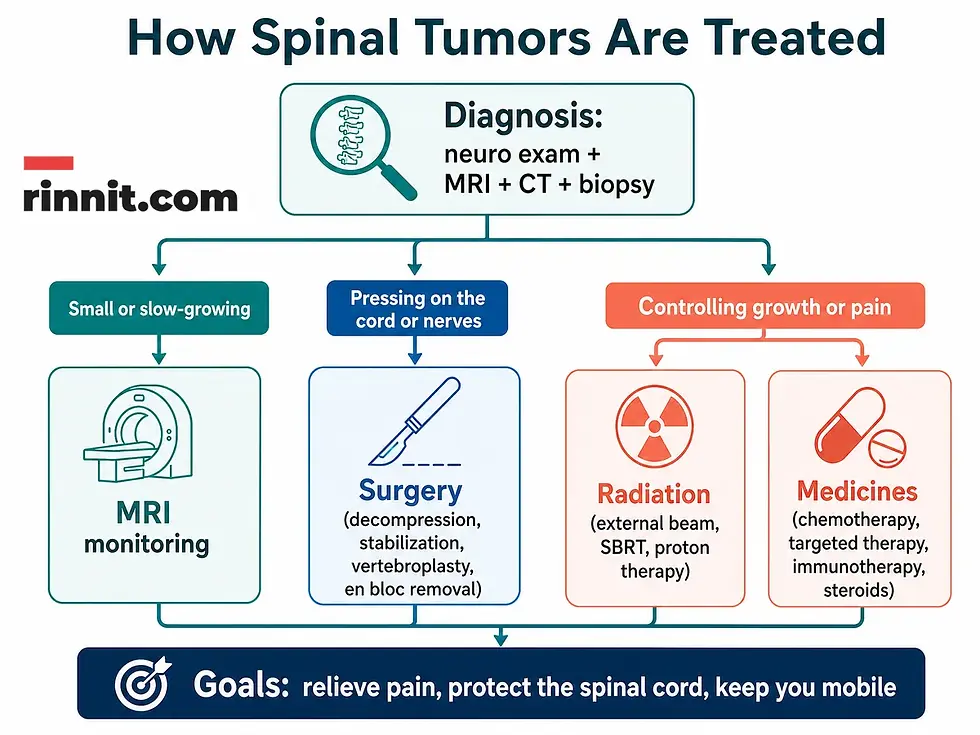
Care often involves a team of neurosurgeons, radiation oncologists, medical oncologists, and rehabilitation specialists. Treatment depends on the tumor type, whether it started in the spine or spread from elsewhere, your overall health, and how aggressive the tumor is. The goal is to relieve pain, protect the spinal cord, and improve mobility and quality of life [2].
Treatment | How it works | Key notes |
|---|---|---|
MRI monitoring | Regular imaging to watch growth. | Small or slow-growing tumors; treatment may not be needed at first. |
External beam radiation | A machine outside the body targets tumor cells. | Tumor control and pain relief while limiting damage to healthy tissue. |
SBRT | Very focused, high-dose radiation, usually in one to five sessions. | Targets the tumor precisely while protecting the cord and nerves. |
Proton therapy | Charged particles release most of their energy at the tumor. | Can limit radiation reaching nearby healthy tissue. |
Chemotherapy | Bloodstream medicines kill fast-growing cancer cells or slow them. | Mainly for cancers that have spread to the spine; nausea is common. |
Targeted therapy and immunotherapy | Block proteins that help cancer grow, or help the immune system attack cancer cells. | Often fewer whole-body side effects than standard chemotherapy. |
Steroids | Reduce swelling around the cord and nerves. | Often started early; can raise blood sugar and are tapered slowly. |
Decompression surgery | Removes tumor tissue pressing on the cord or nerves. | Preserves strength and movement. |
Stabilization with implants | Rods, screws, or cages steady the spine. | Used after pressure is relieved. |
Vertebroplasty or kyphoplasty | Bone cement supports a cracked or weak vertebra. | Not used when there is spinal cord compression. |
En bloc removal | The whole tumor is removed in one piece and the spine rebuilt. | Can lower the risk of regrowth in the same area. |
Radiation side effects most often include tiredness, skin redness over the treatment area, and short-term soreness. Very high doses can sometimes irritate the spinal cord or nearby nerves, though this is not common [2].
Can Metastatic Spine Cancer Be Cured?
Most spinal metastases cannot be cured, but they can often be controlled for a long time. The main goal is to ease pain, protect the spinal cord and nerves, and help you keep walking and staying active. Sometimes, such as when a single small metastasis is found early, surgery and focused radiation may remove or destroy all visible cancer. Many people now live months to years longer with good quality of life thanks to combined treatments [2].
What Is the Prognosis?
Prognosis depends on the tumor type, its grade, its location in the spine, and whether it started in the spine or spread there. Some slow-growing primary tumors can be managed for many years. When cancer spreads to the spine, outcomes vary widely, from months to years. Finding a tumor early and starting treatment quickly can protect walking and independence [2].
Outlook measure | Figure from the source |
|---|---|
Average survival after surgery (cancer spread to a single spot in the spine) | About 30 months |
Alive at five years (single spine metastasis) | About 1 in 5 |
Keep walking if walking when radiation starts | Up to 80% |
Regain walking after paralysis | About 5% to 20% |
Being able to walk at the start of treatment is a strong predictor of outcome [2].
What Treatments Are in Research?
Treatments being researched for spinal tumors include sharper radiation planning and imaging, next-generation proton therapy and radiation combined with newer drugs.
Sharper planning and imaging: Daily imaging and careful planning keep radiation away from the spinal cord and target the tumor more accurately.
Next-generation proton therapy: Proton SBRT and proton arc therapy are under study and may focus radiation even more tightly.
Radiation combined with newer drugs: Pairing radiation with targeted therapy or immunotherapy is being explored to improve control and reduce symptoms.
What Can Help During Treatment?
Some people use integrative therapies alongside standard treatment to manage pain, stress, and fatigue, including acupuncture, acupressure, gentle massage, guided imagery, relaxation, mindfulness, music therapy, and hypnosis by qualified professionals. They do not replace surgery, radiation, or medicine, and you should discuss them with your care team first [2].
Gentle movement such as short walks, stretching, or light yoga can reduce fatigue and improve balance, but ask which exercises are safe for your spine and avoid heavy lifting or twisting. Small, frequent meals with lean protein, vegetables, and whole grains and plenty of fluids can help you cope with therapy. Support from friends, family, counselors, or support groups matters too [2].
How Should You Prepare for Your Appointment?
To prepare for a spinal tumor appointment, write down your symptoms, list your conditions, medicines and family history, bring someone along and prepare questions.
Write down your symptoms and how long you have had them.
List your conditions and all medicines you take, and note any family history of brain or spinal tumors, especially in a parent or sibling.
Bring a family member or friend to help remember the information.
Write down questions. Useful ones include: What type of tumor do I have? What are the goals of treatment? Do you advise surgery, radiation, or chemotherapy, and what are the risks of each? If the first treatment does not work, what is next? What is the long-term outlook? Do I need a second opinion?
Expect to answer questions about when symptoms started, whether they have worsened, where the pain starts and spreads, any weakness or numbness in your legs, trouble walking, bladder or bowel changes, other conditions, and the medicines you take [2].
Conclusion
Spinal tumors are rare, but their hallmark symptom is one you can recognize: back or neck pain that does not go away, especially pain that worsens at night or when lying down. Most back pain is never a tumor, but pain that lasts beyond a few weeks, keeps worsening, or comes with numbness, weakness, balance trouble, or bladder and bowel changes deserves prompt attention, because spinal cord compression is an emergency where speed matters.
Diagnosis today is precise, using a neurological exam, MRI, CT, and biopsy when needed. The treatment picture is far from bleak: many benign tumors are removed or monitored safely, and even metastatic spine cancer can often be controlled for long periods with surgery, radiation, and modern medicines. The goal throughout is to relieve pain, protect the spinal cord, and keep you walking and living well.
If your back or neck pain is constant, worsening at night, or paired with numbness, weakness, balance problems, or bladder and bowel changes, make an appointment with your healthcare professional now. Seek urgent care for new or rapidly worsening weakness or any loss of bladder or bowel control.
Related Reading
Spinal Hemangioma: Symptoms, Causes, Diagnosis, and Treatment Explained
Understanding Lower Back Pain: Causes, Symptoms, and Solutions
Myelogram: What It Shows, How to Prepare and Recovery explains how a myelogram images the spinal cord, nerves and disks.
Frequently Asked Questions
What is a spinal tumor?
A spinal tumor is a growth that starts in or around the spine, which includes the backbone, spinal cord, and nerves. The term covers both benign (noncancerous, slow-growing) and malignant (cancerous, can spread) tumors [1].
Are spinal tumors rare?
Yes. They make up only 2% to 4% of all primary central nervous system tumors [1].
Are spinal tumors cancer?
Not always. Some grow slowly and are benign. Others are malignant and can spread. Spinal cancer usually refers to a malignant tumor that started in or spread to the spine [1].
How do most spinal cancers start?
About 95% of spinal cancers begin as tumors in other parts of the body and spread to the spine. These are called metastatic spinal tumors [1].
What is the most common symptom of a spinal tumor?
Back or neck pain that does not go away, which may feel dull, sharp, or burning. Pain that gets worse at night or when lying down can be an early sign [1].
How can I tell if my back pain is cancer or regular pain?
Most back pain is not cancer; it is usually muscle strain, arthritis, or a bulging disk. Back pain may signal a tumor if it worsens at night or does not improve with rest, keeps getting worse, comes with numbness, weakness, or tingling, comes with fatigue or unexplained weight loss, worsens with coughing or sneezing, or does not improve with medicine [1].
What causes spinal tumors?
Spinal tumors happen when cells in or around the spine grow out of control. For many tumors the exact cause is not known; primary tumors may be linked to gene changes or rare inherited conditions [1].
What raises the risk of a spinal tumor?
The biggest risk factor is having another cancer that can spread to the spine, especially breast, lung, prostate, kidney, or thyroid cancer. Others include NF2 and Von Hippel-Lindau disease, a weakened immune system, previous radiation to the head, neck, or spine, and, rarely, a family history of spinal tumors [1].
How are spinal tumors diagnosed?
Diagnosis starts with a medical history and neurological exam, then imaging. MRI, usually with dye, is the most accurate test. CT checks bone changes and stability, and a biopsy may confirm the tumor type [2].
What do the stages of spinal cancer mean?
Primary spinal cancers often use the Enneking system: stage 1 grows slowly, stage 2 grows faster, and stage 3 means the tumor has spread. Spread tumors use the Tomita and Bilsky scores to plan care [2].
What treatments are available?
Options include surgery, radiation therapy (external beam, SBRT, proton therapy), and medicines such as chemotherapy, targeted therapy, immunotherapy, and steroids. Small or slow-growing tumors may only need regular MRI monitoring [2].
Can metastatic spine cancer be cured?
Most spinal metastases cannot be cured but can often be controlled for a long time. The main goal is to ease pain, protect the spinal cord and nerves, and help you keep walking. A single small metastasis found early may sometimes be removed or destroyed with surgery and focused radiation [2].
What is the outlook?
It depends on the tumor type, grade, location, and whether it started in the spine or spread there. Being able to walk at the start of treatment is a strong predictor of outcome [2].
When should I seek emergency care?
Nerve damage and spinal cord compression is a medical emergency. Get urgent evaluation if you develop new or rapidly worsening weakness, balance trouble, or any loss of bladder or bowel function [1].
References
Mayo Clinic Staff. Spinal tumor and spinal mass - Symptoms and causes. Mayo Clinic. November 21, 2025. https://www.mayoclinic.org/diseases-conditions/spinal-tumor/symptoms-causes/syc-20591793
Mayo Clinic Staff. Spinal tumor and spinal mass - Diagnosis and treatment. Mayo Clinic. November 21, 2025. https://www.mayoclinic.org/diseases-conditions/spinal-tumor/diagnosis-treatment/drc-20591822
Patchell RA, Tibbs PA, Regine WF, et al. Direct decompressive surgical resection in the treatment of spinal cord compression caused by metastatic cancer: a randomised trial. The Lancet. 2005;366(9486):643-648. PMID 16112300. https://doi.org/10.1016/S0140-6736(05)66954-1
Medical disclaimer
This guide is based on medical information last reviewed on November 21, 2025. Always consult a healthcare professional for diagnosis and treatment decisions.
Health information, not medical advice. This article is for general education and is not a substitute for professional diagnosis or treatment. Always consult a qualified healthcare provider about your own health, and seek emergency care for urgent symptoms.



Comments