Spinal Hemangioma: Symptoms, Causes, Diagnosis, and Treatment Explained

Updated: 2 days ago
Medically reviewed by Dr. Baraa Alnahhal, MD · Last reviewed: October 17, 2026
Quick Answer: What Is a Spinal Hemangioma?
A spinal hemangioma is a benign tumor of extra blood vessels in the spine bones that usually causes no symptoms and is found by accident on imaging. If it grows, it can press on the spinal cord or nerves, causing pain, numbness or weakness. Small, symptom-free cases need only monitoring, while active cases may need vertebroplasty, surgery or radiation. [1] [2]
What the research says
Radiosurgery relieved pain in most symptomatic cases, but the evidence is small. A systematic review found only 3 studies (23 patients, 24 hemangiomas). Pain relief was reported in 87.5% of patients, overall response in 94.1%, and no progressive disease occurred; tissue damage after irradiation was reported in one series that used higher doses (Conti et al., World Neurosurgery, 2022).
Most vertebral hemangiomas stay quiet. A review of one center's experience plus the literature notes that most need only surveillance and that a few become aggressive and compress the spinal cord or nerve roots. It also states that the role of embolization, radiotherapy, and vertebroplasty as add-ons to surgery has not been settled (Teferi et al., The Spine Journal, 2023).
What Is a Spinal Hemangioma?
A hemangioma is a benign tumor made of extra blood vessels. Benign means it is not cancerous. When a hemangioma forms in the spaces of the spine bones, it is called a spinal or vertebral hemangioma [1]. It is also known as a vertebral body hemangioma, a spinal vertebral hemangioma, a symptomatic vertebral hemangioma, or an aggressive vertebral hemangioma.
The bones of the spine are called vertebrae. The cervical spine runs from the base of the skull to the base of the neck and upper shoulders, the thoracic spine is in the middle of the back, and the lumbar spine is below it and above the hip area. The spinal cord extends down from the base of the brain and carries messages between the brain and the body [1].
Spinal hemangiomas typically do not cause symptoms, and most are found accidentally on imaging done for another reason. If one does not cause symptoms, treatment is usually not needed. Instead, your healthcare team may monitor it to see whether it grows or symptoms start [1].
What Types of Spinal Hemangiomas Are There?
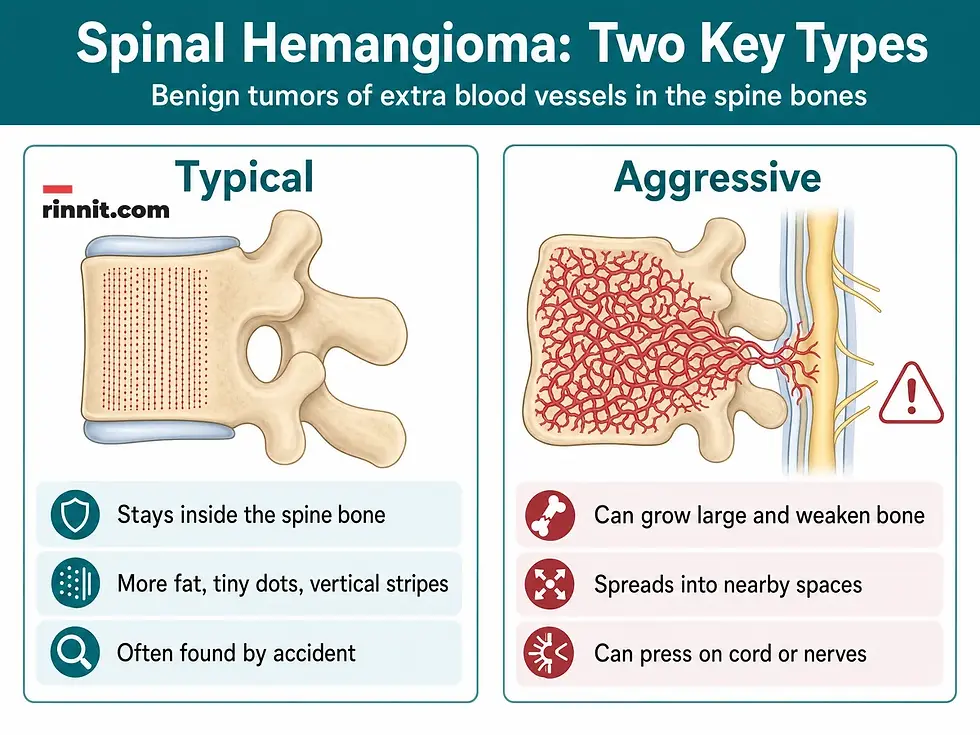
Spinal hemangiomas are grouped by how they behave and how they look on imaging [1].
Type | Behavior | Imaging appearance | Typical concern |
|---|---|---|---|
Typical | Stays inside the spine bone | More fat, tiny dots, and vertical stripes | Usually none; often found by accident |
Atypical | Can look like cancer on imaging | More blood vessel tissue and less fat | Needs careful evaluation |
Aggressive | Can grow large, weaken the bone, and spread into nearby spaces | May show growth outside the bone (extraosseous extension) | Back pain, trouble walking, and pressure on the spinal cord or nerves |
Under a microscope, hemangiomas are also described by their blood vessels [1].
Microscopic subtype | Description |
|---|---|
Capillary | Many tiny blood vessels. |
Cavernous | Larger, blood-filled spaces. This is the most common subtype. |
Arteriovenous (AV) | A rare subtype with unusual connections between arteries and veins. |
Venous | Made of veinlike blood vessels. |
What Are the Symptoms of a Spinal Hemangioma?
Spinal hemangiomas usually cause no symptoms, but some can lead to back or neck pain, numbness, weakness or bladder and bowel problems. If symptoms happen, they may include [1]:
Back or neck pain
Pain traveling down an arm or a leg
Pins and needles or numbness in the arms and legs
Weakness in the arms and legs
Trouble walking
Trouble urinating or urinary leakage (urinary incontinence)
Bowel issues
When to See a Doctor
Make an appointment with your healthcare professional if back pain is constant, getting worse, and does not seem to be caused by a certain activity [1]. Our guide to lower back pain explains other common causes.
MEDICAL EMERGENCY: Seek immediate medical care if you have back pain along with weakness in your arms or legs, trouble walking, loss of balance, or loss of bladder or bowel function.
What Causes a Spinal Hemangioma, and Who Is at Risk?
Spinal hemangiomas are benign tumors made of extra blood vessels inside the spaces in the spine bones. Experts do not know what causes them. Risk factors include older age, cardiovascular disease, and prior spinal trauma [1].
What Complications Can Occur?
If a spinal hemangioma grows, it may press on the spinal cord or nearby nerves. It may cause back pain at first. Later, it may cause numbness or changes in feeling, weakness, trouble walking, and bladder and bowel problems [1].
How Is a Spinal Hemangioma Diagnosed?
Diagnosis typically starts with a physical exam and questions about your symptoms. Imaging tests then show the size and location of the hemangioma and help identify its type [2].
Imaging test | What it can show |
|---|---|
X-rays | Size and location of the hemangioma. |
CT scan | Size and location; tiny dots or vertical stripes in typical hemangiomas. |
MRI | Size and location, and the mix of fat and blood vessels: typical hemangiomas look bright because they contain a lot of fat, while aggressive ones may look dark on certain images. |
How Is a Spinal Hemangioma Graded?
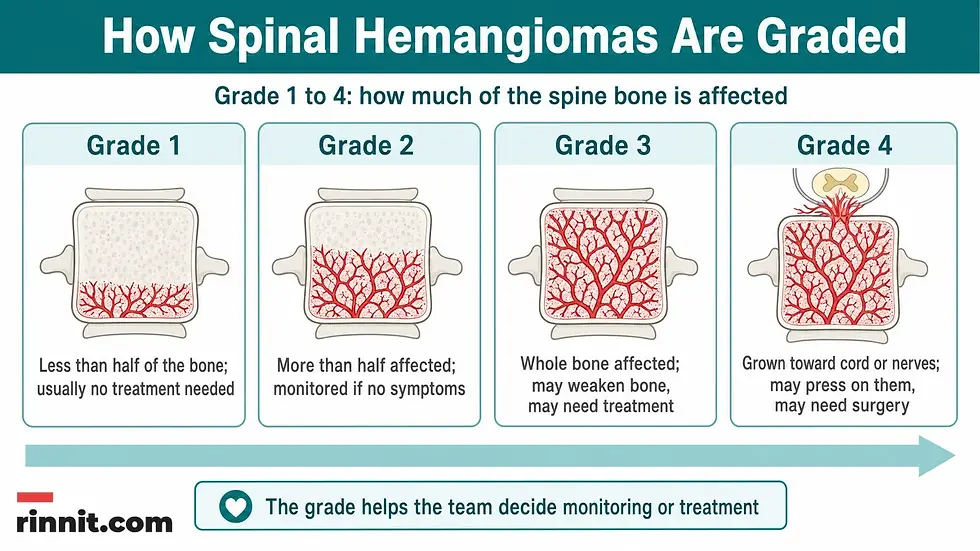
Healthcare professionals use images and symptoms to grade spinal hemangiomas from 1 to 4. The grade describes how much of the vertebral body (the main part of the spine bone) is affected, and it helps the team decide whether the hemangioma is small or large, weakening the bone, or getting close to the spinal cord and nerves [2].
Grade | What it means | Typical next step |
|---|---|---|
Grade 1 | Often found by accident; affects less than half of the vertebral body. | Usually none needed. |
Grade 2 | Affects more than half of the vertebral body. | Careful monitoring if there are no symptoms. |
Grade 3 | Affects the whole vertebral body; the bone may weaken. | May require treatment. |
Grade 4 | Has grown past the vertebral body toward spaces near the spinal cord or nerves and may press on them. | May require surgery. |
How Is a Spinal Hemangioma Treated?
Spinal hemangiomas typically do not need treatment if they are small and there are no symptoms. The type of treatment depends on the symptoms, how the hemangioma looks on imaging, and whether it is pressing on the nerves or spinal cord [2].
Monitoring: If the hemangioma is not causing symptoms, your team may carefully monitor it, or you may be told to make an appointment if symptoms start.
Biopsy: If the hemangioma looks suspicious, a biopsy (a small tissue sample tested in a lab) can check whether it has cancer cells.
Active treatment may be suggested if the hemangioma looks more aggressive or has a higher grade, causes painful symptoms, or presses on the spinal cord or nerves [2].
Treatment | How it works | When it is typically used |
|---|---|---|
Vertebroplasty | Cement is injected into a cracked or broken spinal bone to lessen pain. | Pain relief, for example in the thoracic spine without spinal cord symptoms. |
Corpectomy | The piece of spinal bone containing the hemangioma is surgically removed and then rebuilt. | Aggressive or higher-grade hemangiomas, or those pressing on the cord or nerves. |
Sclerotherapy | Alcohol is injected into the hemangioma to shrink it. | Shrinking the hemangioma as part of treatment. |
Radiation | Targeted radiation therapy. | Pain without nerve or spinal cord problems. |
Your team also considers which part of the spine is affected [2]:
Spine region | Treatment considerations |
|---|---|
Cervical (C1–C7) | Usually harder to treat with vertebroplasty; surgery is usually favored if symptoms are severe. |
Thoracic (T1–T12) | Pain without spinal cord symptoms: vertebroplasty may be used. Pressure on nerves or the cord: surgery. |
Lumbar (L1–L5) | The thoracolumbar transition zone may be treated like thoracic hemangiomas. |

What Is the Outlook?
The outlook for people with spinal hemangiomas is typically very good. Most do not cause symptoms, and treatment options are available for people who have painful or aggressive hemangiomas [2].
Who Treats Spinal Hemangiomas?
If you have a spinal hemangioma, you will likely be referred to a specialist [2]:
Neurologists diagnose and treat spinal cord conditions.
Neurosurgeons operate on the spinal cord.
Orthopedic oncologists diagnose and treat tumors that affect the bones.
Orthopedic surgeons operate on bones and joints.
Radiation oncologists give radiation therapy.
Radiologists may help deliver some treatments, including vertebroplasty and sclerotherapy.
How Should You Prepare for Your Appointment?
To prepare for a spinal hemangioma appointment, write down your symptoms, list your conditions and medicines, bring someone along and prepare your questions.
Write down your symptoms and how long you have had them.
List your medical conditions and every medicine you take, including over-the-counter ones.
Bring a family member or friend who can help you remember what is said.
Write down your questions. Useful ones include: What type of spinal hemangioma do I have? Will it grow? What is the goal of treatment, and what do you recommend? If the first treatment is not successful, what can we try next? Do I need a second opinion?
Be ready to answer questions about when your symptoms began, whether they have worsened, where the pain starts and spreads, any weakness or numbness in your legs, trouble walking, bladder or bowel changes, and any family history of tumors [2].
Conclusion
Spinal hemangiomas are benign, and the great majority never cause symptoms. Most are discovered by accident, and small, symptom-free ones usually need only monitoring. When one grows enough to weaken the bone or press on the spinal cord or nerves, options include vertebroplasty, corpectomy, sclerotherapy, and radiation. The right choice depends on the grade, the location in the spine, and your symptoms, and the overall outlook is encouraging.
If you have constant, worsening back or neck pain that is not tied to an activity, make an appointment with your healthcare professional. Seek immediate care if it comes with weakness, trouble walking, loss of balance, or bladder or bowel changes.
Related Reading
Frequently Asked Questions
What is a spinal hemangioma?
A spinal hemangioma is a benign (noncancerous) tumor made of extra blood vessels that forms in the spaces of the spine bones. It is also called a vertebral body hemangioma or spinal vertebral hemangioma [1].
Is a spinal hemangioma cancer?
No. Benign means it is not cancerous. A hemangioma is an overgrowth of extra blood vessels inside the spine bone [1].
Are spinal hemangiomas dangerous?
Usually not. Most cause no symptoms and are found by accident. An aggressive type can grow large, weaken the bone, and press on the spinal cord or nerves, causing pain, weakness, and bladder or bowel problems [1].
What are the symptoms of a spinal hemangioma?
Most people have none. If symptoms occur, they can include back or neck pain, pain traveling down an arm or leg, pins and needles or numbness, weakness, trouble walking, trouble urinating or urinary leakage, and bowel issues [1].
What causes spinal hemangiomas?
Experts do not know what causes them. Most are found accidentally during imaging done for another reason [1].
Who is at risk for spinal hemangiomas?
Risk factors include older age, cardiovascular disease, and prior spinal trauma [1].
How are spinal hemangiomas diagnosed?
Diagnosis starts with a physical exam and questions about your symptoms, followed by imaging such as X-rays, CT, and MRI. The hemangioma is then graded from 1 to 4 [2].
What do the grades mean?
Grade 1 affects less than half of the vertebral body, grade 2 more than half, grade 3 the whole vertebral body (and the bone may weaken), and grade 4 means it has grown toward the spinal cord or nerves and may need surgery [2].
Do all spinal hemangiomas need treatment?
No. Small hemangiomas without symptoms typically need no treatment and may only be monitored. Treatment is considered when a hemangioma looks aggressive, is a higher grade, causes painful symptoms, or presses on the spinal cord or nerves [2].
What treatments are available?
Options include vertebroplasty (injecting cement into the spine bone), corpectomy (surgically removing and rebuilding the affected bone), sclerotherapy (injecting alcohol to shrink the hemangioma), and radiation for pain without nerve or spinal cord involvement [2].
When should I seek emergency care?
Seek immediate care if you have back pain with weakness in your arms or legs, trouble walking, loss of balance, or loss of bladder or bowel function [1].
What is the long-term outlook?
The outlook is typically very good. Most spinal hemangiomas never cause symptoms, and treatment options exist for painful or aggressive ones [2].
References
Mayo Clinic Staff. Spinal hemangioma - Symptoms and causes. Mayo Clinic. August 7, 2026. https://www.mayoclinic.org/diseases-conditions/spinal-hemangioma/symptoms-causes/syc-20604491
Mayo Clinic Staff. Spinal hemangioma - Diagnosis and treatment. Mayo Clinic. August 7, 2026. https://www.mayoclinic.org/diseases-conditions/spinal-hemangioma/diagnosis-treatment/drc-20604511
Conti A, Starnoni D, Barges-Coll J, et al. Radiosurgery for benign vertebral body hemangiomas of the spine: a systematic review and meta-analysis. World Neurosurg. 2022;164:97-105. PMID 35378316. https://doi.org/10.1016/j.wneu.2022.03.120
Teferi N, Chowdhury AJ, Mehdi Z, et al. Surgical management of symptomatic vertebral hemangiomas: a single institution experience and literature review. Spine J. 2023;23(9):1243-1254. PMID 37059306. https://doi.org/10.1016/j.spinee.2023.04.002
Medical disclaimer
This guide is based on medical information last reviewed on August 7, 2026. Always consult a healthcare professional for diagnosis and treatment decisions.
Health information, not medical advice. This article is for general education and is not a substitute for professional diagnosis or treatment. Always consult a qualified healthcare provider about your own health, and seek emergency care for urgent symptoms.



Comments