Myelogram: What It Shows, How to Prepare and Recovery

Updated: 2 days ago
Written and medically reviewed by Dr. Baraa Alnahhal, MD · Last reviewed: November 2026 · How we review
Quick Answer: What is a myelogram?
A myelogram is an imaging test that uses contrast material with X-rays or a CT scan to show the spinal canal, spinal cord, nerves and the disks and bones around them. The contrast is injected into the fluid around the spinal cord. It's usually done when a CT scan or MRI has not explained back pain or nerve symptoms. [1]
What the research says
A myelogram can show nerve pinching that MRI misses. In 26 people having spine surgery, MRI underestimated surgically confirmed nerve root compression in the lateral recess in 28% to 29% of cases, while conventional myelography correctly predicted it in 93% to 95%. (Bartynski and Lin, American Journal of Neuroradiology, 2003) [2]
Serious reactions to spinal contrast are uncommon. A review of US Food and Drug Administration reports from 1978 to 1994 found 235 reports of serious, nonfatal reactions linked to nonionic contrast injected around the spine, small compared with the estimated 170 million contrast studies done in that period. (Spring et al., Radiology, 1997) [3]
Key takeaways
A myelogram shows the spinal canal, spinal cord, nerve roots, disks and nearby bones. [1]
It is usually ordered when a CT scan or MRI does not explain the problem. [1]
The test takes about an hour, and you are monitored for about an hour afterward. [1]
Up to 10% of people have side effects, most often headache or nausea. [1]
Rest, fluids and avoiding heavy lifting for 24 hours help recovery. [1]
What is a myelogram?
A myelogram uses contrast material together with X-rays or CT scans to make detailed pictures of your spinal canal, spinal cord and nerves, plus the disks and bones that surround them. The contrast appears white on the images. [1]
It is a type of fluoroscopy, so the radiologist can watch the contrast move in real time. The words "cervical" (neck) and "lumbar" (lower back) describe the part of the spine being imaged, not different tests. [1]
What does a myelogram show?

A myelogram can help diagnose: [1]
Herniated disks
Arthritis in the spinal joints
Spinal stenosis (narrowing of the spinal canal)
Bone spurs
Spinal tumors
Why would you need a myelogram?
For long-term back pain, providers usually try a CT scan or MRI first. If those tests do not explain the problem, they may order a myelogram. It may also be recommended after recent spine surgery, especially if you have new or lingering pain or weakness. [1]
How do you prepare for a myelogram?
Your care team will give you instructions. In general: [1]
Arrange for someone to drive you home, since you may get a sedative.
Drink clear fluids the day before, about 4 to 8 ounces every two hours.
Stop eating six hours before the test. You can keep drinking clear fluids until then.
If you have diabetes, take your usual insulin and tell your provider when you arrive.
Lab tests are usually not needed unless you have a blood disorder, dehydration or chronic kidney disease. Tell your provider if you take blood thinners, including aspirin, since you may need to stop them for a few days before the spinal injection, and mention any allergy to contrast dye. [1]
What happens during a myelogram?

You stay awake, though you may receive a sedative. [1]
You lie on your stomach or side.
Your provider cleans and numbs your lower back.
Contrast is injected into the fluid-filled sac around your spinal cord.
The table is tilted to guide the contrast to the area being studied.
The test takes about an hour. [1]
Does a myelogram hurt?
You may feel pressure during the injection and a brief, sharp sting down your buttock or leg. The contrast can cause a warm, flushed feeling, a metallic taste or short-lived nausea. [1]
What happens after a myelogram?
You are monitored for about an hour before you leave. The radiologist sends a report to your primary care physician. [1]
What are the side effects of a myelogram?
Up to 10% of people have side effects. Headaches and nausea or vomiting are the most common and usually go away within a day or two. [1]
How long does it take to recover?
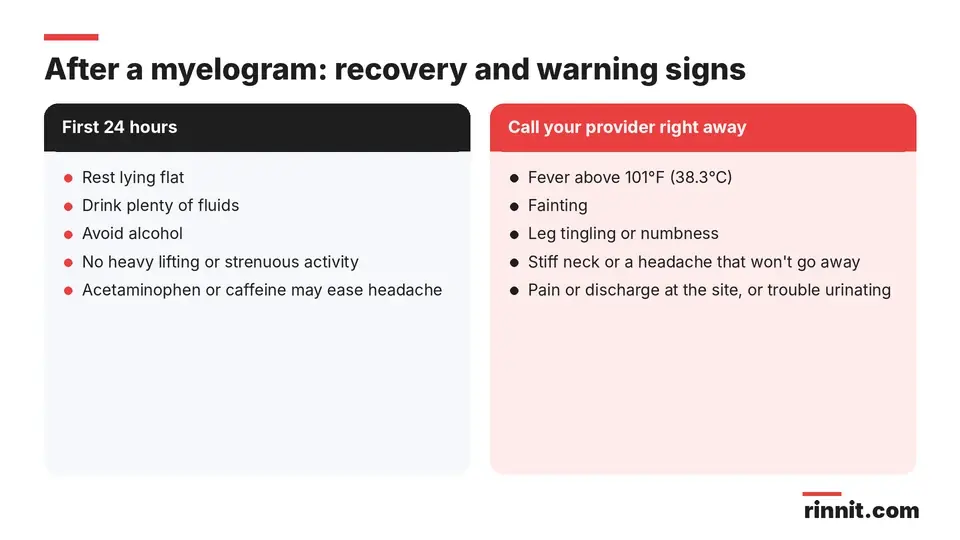
Full recovery takes about 24 hours. During that time: [1]
Rest lying flat.
Drink plenty of fluids.
Avoid alcohol.
Avoid heavy lifting and strenuous activity.
Acetaminophen and caffeinated drinks can help with headaches. [1]
When should you call your provider?
Call your provider right away if you have: [1]
Warning sign | Details |
Fever | Above 101°F (38.3°C) |
Fainting | Any episode of passing out |
Nerve symptoms | Tingling or numbness in your legs |
Injection site problems | Pain or discharge |
Stiff neck or headache | A stiff neck, or a headache that won't go away |
Urination | Being unable to urinate |
Sources: [1]
When will you get your results?
Your primary care physician usually reviews the report within a few days and calls you to explain the results and next steps. [1]
Conclusion
A myelogram is a detailed look at your spinal cord and nerves when other scans have not answered the question. It takes about an hour, and most people recover within a day.
Plan ahead for a driver, drink plenty of clear fluids and give yourself a quiet 24 hours afterward. Knowing the warning signs means you can act quickly if anything feels wrong.
Keep learning: Read our spinal stenosis guide or our guide to lumbar puncture. For more background, see the RadiologyInfo page on myelography.
FAQ
What is a myelogram?
It is an imaging test that uses contrast with X-rays or CT to show your spinal canal, spinal cord, nerves, disks and nearby bones. [1]
Why would a doctor order a myelogram?
Usually when a CT scan or MRI has not explained back pain, or after spine surgery with new or lingering pain or weakness. [1]
What conditions can a myelogram find?
Herniated disks, spinal joint arthritis, spinal stenosis, bone spurs and spinal tumors. [1]
How long does a myelogram take?
About an hour, followed by about an hour of monitoring. [1]
Are you awake during a myelogram?
Yes, though you may receive a sedative to help you relax. [1]
Does a myelogram hurt?
You may feel pressure and a brief sting down the buttock or leg during the injection. [1]
What are common side effects?
Headache and nausea or vomiting, which usually go away within a day or two. [1]
How long is recovery after a myelogram?
About 24 hours of rest, fluids and no heavy lifting. [1]
Can I drive after a myelogram?
No. Arrange a driver because you may receive a sedative. [1]
When should I call my provider?
Call for fever above 101°F, fainting, leg numbness, a stiff neck, a headache that won't go away or trouble urinating. [1]
Related Reading
Spinal Stenosis: Symptoms, Causes, Diagnosis, and Treatment — Complete Guide explains a common condition a myelogram helps confirm.
Herniated Disk: Symptoms, Causes & What Actually Helps covers disk problems that show up on a myelogram.
Radiculopathy (Pinched Nerve): Symptoms, Causes, Types, and Treatment describes the nerve compression this test can reveal.
Spinal Tumor: Symptoms, Causes, Diagnosis, and Treatment Explained explains another finding a myelogram can show.
References
Cleveland Clinic. Myelogram: What It Is, Procedure, Results & Side Effects. Cleveland Clinic. Last updated July 13, 2023. https://my.clevelandclinic.org/health/diagnostics/4892-myelogram
Bartynski WS, Lin L. Lumbar root compression in the lateral recess: MR imaging, conventional myelography, and CT myelography comparison with surgical confirmation. AJNR Am J Neuroradiol. 2003;24(3):348-360. PMID 12637281. https://pubmed.ncbi.nlm.nih.gov/12637281/
Spring DB, Bettmann MA, Barkan HE. Nonfatal adverse reactions to iodinated contrast media: spontaneous reporting to the U.S. Food and Drug Administration, 1978-1994. Radiology. 1997;204(2):325-332. PMID 9240515. https://doi.org/10.1148/radiology.204.2.9240515
Medical disclaimer
This article is for general education only and does not replace advice from a qualified healthcare professional. Talk to your doctor about your own diagnosis and treatment, and seek emergency care right away for severe or sudden symptoms.



Comments