Gastric Emptying Study in Children (Solid-Meal GES): What to Expect

Updated: 2 days ago
Written and medically reviewed by Dr. Baraa Alnahhal, MD · Last reviewed: November 2026 · How we review
Quick Answer
A solid-meal gastric emptying study (GES) for children is a nuclear medicine test that measures how long food takes to leave the stomach. It's most often used to diagnose gastroparesis and dumping syndrome. The test is painless, needs no sedation and usually takes four to five hours. Your child can't eat after midnight the night before.
What the research says
A standard 4-hour test is recommended: a joint expert consensus recommends one standardized test using a low-fat egg-white meal with pictures at 0, 1, 2 and 4 hours, so results are reliable and comparable between centers (Abell TL et al., Am J Gastroenterol, 2008) [2]
Longer imaging finds more cases: in 129 people, extending the scan from 2 to 4 hours raised the share found to have delayed emptying from 33% to 58% (Guo JP et al., Dig Dis Sci, 2001) [3]
Key takeaways
A gastric emptying study measures how fast food leaves the stomach.
Your child eats a meal with a harmless tracer, then has short scans over four hours.
It helps diagnose gastroparesis and dumping syndrome.
The test is painless and needs no sedation.
No food or drink after midnight the night before.
What is a gastric emptying study?
Normally, food leaves the stomach about one and a half to two hours after eating. In gastroparesis, the stomach empties too slowly; in dumping syndrome, it empties too quickly. A gastric emptying study shows how fast the stomach empties by tracking the tracer in the meal. It's also called a gastric emptying scan, stomach emptying test or gastric emptying scintigraphy, and it's a type of nuclear medicine imaging. For adults, see the general gastric emptying study. Sources: [1]
Why it's done

Finding slow emptying early lets treatment start before complications.
Diagnose gastroparesis, when the stomach takes longer than normal to empty.
Diagnose dumping syndrome, when the stomach empties too quickly.
Detect gastroesophageal reflux.
Find the cause of frequent vomiting, belly pain, not gaining weight or feeling full sooner than normal.
Start treatment for gastroparesis before serious complications develop. Sources: [1]
How to prepare
No food or drink after midnight the night before, so the stomach is empty.
Ask your child's provider whether any medicines need to be stopped.
Explain the test to your child in simple words.
Bring books, toys or activities for the waiting time. Sources: [1]
What happens during the test

The test usually takes four to five hours.
Your child changes into a hospital gown.
Your child eats scrambled egg whites and two slices of white toast with strawberry jelly or jam, and drinks 4 ounces of water, within 10 minutes. The tracer doesn't change the taste or look of the food.
A first scan of about one minute is taken in the nuclear medicine room.
More one-minute scans are taken at one, two and four hours.
Your child stays nearby and can't eat or drink until the last scan. Sources: [1]
Time after meal | What happens |
0 hours | First scan, about 1 minute |
1 hour | Second scan |
2 hours | Third scan |
4 hours | Final scan; eating and drinking can resume |
If your child vomits the meal before the test ends, the study needs to be rescheduled. Sources: [1]
Risks
The test is painless and carries little risk. The radiation dose is very low and isn't considered harmful for most people. It shouldn't be done in anyone who is or might be pregnant. Sources: [1]
Results
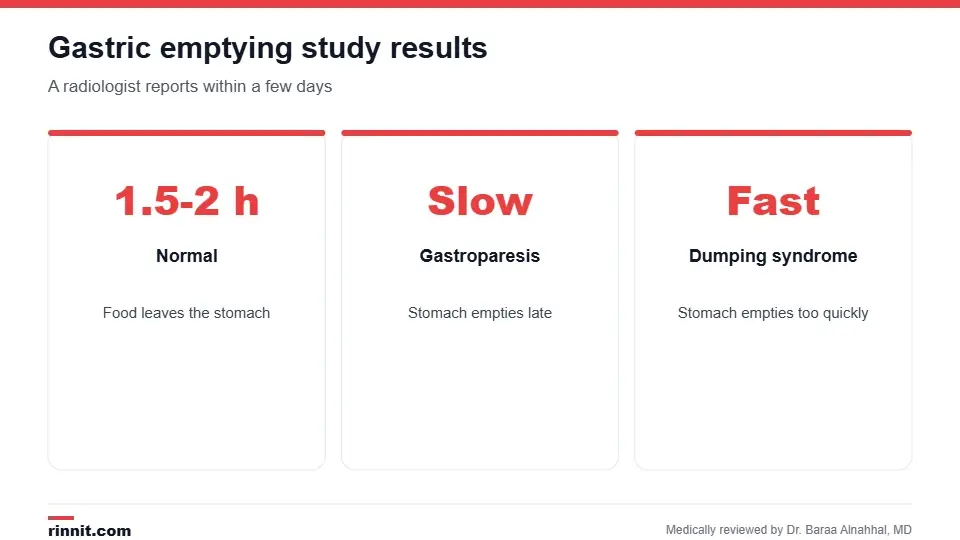
Your provider contacts you about any next steps.
Result | What it may mean |
Normal emptying | Food leaves the stomach in about 1.5 to 2 hours |
Slow emptying | Gastroparesis |
Fast emptying | Dumping syndrome |
A radiologist reviews the images and sends a report to your child's provider within a few days, and the provider will contact you about any next steps. Delayed emptying can rarely be a sign of cancer, but this is an exceedingly uncommon cause in children, and other imaging is used to look for cancer. Your child can go home and return to normal eating and activities right after the test. Sources: [1, 2, 3]
Conclusion
A solid-meal gastric emptying study is a gentle, painless way to see how quickly your child's stomach empties. It can explain ongoing vomiting, belly pain or poor weight gain and help your child's provider choose the right treatment.
Keep learning: read about gastroparesis and the gastric emptying study.
Frequently asked questions
What is a gastric emptying study?
A nuclear test that measures how fast food leaves the stomach.
What does my child eat?
Scrambled egg whites, white toast with jelly and 4 ounces of water.
Is the tracer safe?
Yes. The radiation dose is very low.
Does the test hurt?
No. It's painless and needs no sedation.
How long does it take?
Usually four to five hours.
Can my child eat before the test?
No food or drink after midnight the night before.
What if my child vomits the meal?
The test needs to be rescheduled.
How fast does a normal stomach empty?
About one and a half to two hours after eating.
What can the test diagnose?
Gastroparesis, dumping syndrome and reflux.
When will we get results?
Usually within a few days.
Related Reading
Gastric Emptying Study: How to Prepare, What Happens and Normal Results the general gastric emptying study.
Gastroparesis: Symptoms, Causes, Diet & Treatment — Complete Guide the main condition this test diagnoses.
Nuclear Medicine Imaging: How Tracer Scans Work, Safety and Results an overview of tracer-based tests.
Upper GI Series: What It Is, Why It's Done, How to Prepare and What to Expect X-ray imaging of the upper GI tract.
Hydrogen Breath Test: How to Prepare, What Happens and What Results Mean another digestive test used in children and adults.
References
Cleveland Clinic. Gastric Emptying Study/Scan (GES) in Children. Cleveland Clinic. Last updated March 23, 2023. https://my.clevelandclinic.org/health/diagnostics/16577-solid-meal-gastric-emptying-study-ges
Abell TL, Camilleri M, Donohoe K, et al. Consensus recommendations for gastric emptying scintigraphy: a joint report of the American Neurogastroenterology and Motility Society and the Society of Nuclear Medicine. Am J Gastroenterol. 2008;103(3):753-763. PMID 18028513. https://doi.org/10.1111/j.1572-0241.2007.01636.x
Guo JP, Maurer AH, Fisher RS, et al. Extending gastric emptying scintigraphy from two to four hours detects more patients with gastroparesis. Dig Dis Sci. 2001;46(1):24-29. PMID 11270790. https://doi.org/10.1023/a:1005697422454
Medical disclaimer
This article is for general education only and does not replace advice from a qualified healthcare professional. Talk to your doctor about your own diagnosis and treatment, and seek emergency care right away for severe or sudden symptoms.


Comments