Enzyme Markers: Blood Tests for Heart, Liver and Muscle Damage

Updated: 2 days ago
Written and medically reviewed by Dr. Baraa Alnahhal, MD · Last reviewed: November 2026 · How we review
Quick Answer
Enzyme markers, also called biomarkers, are blood tests that measure enzymes and other proteins that leak into the blood when tissues are damaged or stressed. They help diagnose a heart attack, check for liver disease and find muscle damage. Common examples include troponin, liver enzymes like ALT and AST, and creatine kinase (CK).
What the research says
Sensitive troponin finds heart attacks sooner: in 718 emergency patients, sensitive troponin tests diagnosed heart attacks more accurately than standard tests, especially within 3 hours of symptoms (Reichlin T et al., N Engl J Med, 2009) [2]
Early accuracy is high: in 1,818 people with chest pain, a sensitive troponin I test detected heart attacks with about 91% sensitivity and 90% specificity (Keller T et al., N Engl J Med, 2009) [3]
Key takeaways
Enzyme markers are blood tests that show tissue damage.
Cardiac enzymes such as troponin help diagnose heart attacks.
Liver enzymes help find liver disease; muscle enzymes find muscle damage.
Troponin can take hours to rise, so tests are repeated.
The test is a simple, low-risk blood draw.
What are enzyme markers?
Enzymes are proteins that speed up chemical reactions in your cells. Each organ has its own mix. When cells are injured, their enzymes spill into the bloodstream, so higher levels can show which organ is affected and how badly. Sources: [1]
Types of enzyme markers
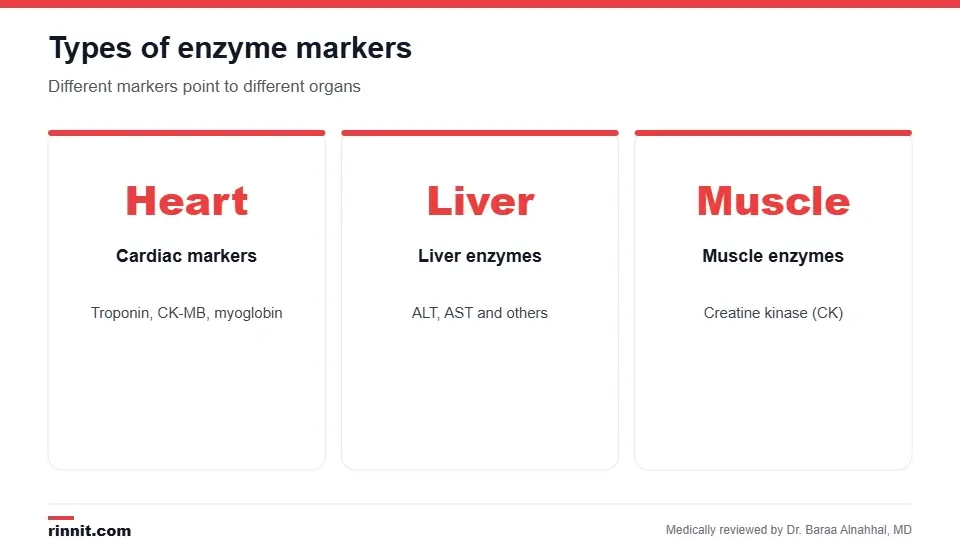
Different markers point to different organs.
Type | Examples | Used to check |
Cardiac | Heart attack and heart muscle damage | |
Liver | ALT, AST, other liver function tests | Hepatitis, cirrhosis, fatty liver disease |
Muscle | Muscular dystrophy, myositis, muscle injury |
Sources: [1]
Why they're done
Screen for organ or muscle damage or stress.
Diagnose a heart attack or coronary artery disease.
Help evaluate stroke and some brain tumors.
Diagnose muscle diseases such as muscular dystrophy, dermatomyositis and polymyositis, and malignant hyperthermia.
Assess liver disease.
Check whether treatment is working or whether medicines are harming organs. Sources: [1]
How to prepare
Drink plenty of water.
Avoid smoking or vaping beforehand.
Fasting is rarely needed; follow your provider's instructions. Sources: [1]
What happens during the test

The blood draw takes only a few minutes.
A phlebotomist or other provider draws blood from a vein, usually in your arm.
A bandage is placed; keep it on for 2 to 4 hours.
For a possible heart attack, blood is drawn again a few hours later to see whether levels are rising. Sources: [1]
Risks
The test is low risk. Some people feel dizzy or nauseated from a drop in blood pressure. Mild swelling or bruising usually clears within a few days; an ice pack or over-the-counter pain reliever can help. Avoid heavy lifting or vigorous exercise for 24 hours. Sources: [1]
What the results mean

Emergency results come back quickly.
Result | What it may mean |
Elevated cardiac enzymes | Heart attack; higher levels suggest more damage |
Elevated liver enzymes | Liver damage |
High CK | Muscle disease or injury |
Troponin is typically around 0.02 ng/mL, but normal ranges vary by lab and test type. Because troponin can take up to 12 hours to rise after a heart attack, tests are spaced hours apart. Newer, more sensitive troponin tests can detect heart attacks earlier, often within 3 hours. Emergency results come back quickly; others take several days. Sources: [1, 2, 3]
Conclusion
Enzyme markers are a fast, simple way to detect damage in your heart, liver or muscles. They're essential in diagnosing heart attacks and help track liver and muscle diseases and the effects of treatment.
Keep learning: read about the troponin test and liver function tests.
Frequently asked questions
What are enzyme markers?
Blood tests that measure enzymes released by damaged tissues.
What are cardiac enzymes?
Markers such as troponin that rise after heart damage.
What is a normal troponin level?
Typically around 0.02 ng/mL, depending on the test.
Why are heart enzyme tests repeated?
Troponin can take hours to rise after a heart attack.
What do high liver enzymes mean?
Possible liver damage.
What does high CK mean?
Possible muscle damage or disease.
Do I need to fast?
Rarely.
How long does the test take?
Only a few minutes.
Are there risks?
Very few; some people feel dizzy.
When will I get results?
Quickly in an emergency; otherwise in several days.
Related Reading
Troponin Test: What It Is, Why It's Done, Normal Range and What High Levels Mean the main cardiac enzyme test.
Creatine Kinase (CK) Test: What It Is, Normal Levels and High CK Causes a muscle enzyme test.
Liver Function Tests (LFTs): What They Measure, Normal Ranges and Results blood tests of liver health.
ALT Blood Test: What It Measures, Normal Range and What High Levels Mean a key liver enzyme test.
AST Blood Test (Aspartate Transferase): Normal Range and Results another liver enzyme test.
References
Cleveland Clinic. Enzyme Markers: Purpose, Procedure & Results. Cleveland Clinic. Last updated November 24, 2021. https://my.clevelandclinic.org/health/diagnostics/22174-enzyme-markers
Reichlin T, Hochholzer W, Bassetti S, et al. Early diagnosis of myocardial infarction with sensitive cardiac troponin assays. N Engl J Med. 2009;361(9):858-867. PMID 19710484. https://doi.org/10.1056/NEJMoa0900428
Keller T, Zeller T, Peetz D, et al. Sensitive troponin I assay in early diagnosis of acute myocardial infarction. N Engl J Med. 2009;361(9):868-877. PMID 19710485. https://doi.org/10.1056/NEJMoa0903515
Medical disclaimer
This article is for general education only and does not replace advice from a qualified healthcare professional. Talk to your doctor about your own diagnosis and treatment, and seek emergency care right away for severe or sudden symptoms.



Comments