Myoglobin Test: What It Is, Why It's Done, How It Works and Results

Updated: 2 days ago
Written and medically reviewed by Dr. Baraa Alnahhal, MD · Last reviewed: November 2026 · How we review
Quick Answer: What is a myoglobin test?
A myoglobin test measures how much myoglobin, an oxygen-carrying protein found in the heart and skeletal muscles, is in blood or urine. Providers use it to look for recent muscle damage and check for heart, kidney and muscle conditions. A normal blood level is usually under 72 ng/mL, and myoglobin normally does not show up in urine. [1]
What the research says
Very high blood myoglobin flagged kidney injury risk better than CK after heatstroke. In 161 intensive care patients with muscle breakdown after exertional heatstroke, 52 (32.3%) had serum myoglobin of 1,000 ng/mL or more, and this cutoff predicted acute kidney injury with an area under the curve of 0.786, outperforming creatine kinase (CK). (Wu et al., International Journal of Hyperthermia, 2022) [2]
After exercise-related muscle breakdown, kidney injury was uncommon, and a myoglobin-to-CK ratio helped flag high risk. In a study of 136 emergency patients with exertional rhabdomyolysis, only 5 (4%) developed acute kidney injury, and a myoglobin-to-CK ratio of 0.48 or higher had 99% specificity as a supportive high-risk marker. (Vangstad et al., BMJ Open Sport & Exercise Medicine, 2026) [3]
Myoglobin is a weaker early heart attack marker than troponin. A large systematic review and meta-analysis of early biomarkers for suspected heart attack found myoglobin had 62% sensitivity and 83% specificity, compared with 77% and 93% for troponin I, and high-sensitivity troponin was the most effective strategy. (Goodacre et al., Health Technology Assessment, 2013) [4]
Key takeaways
Myoglobin is a protein in your heart and skeletal muscles that delivers oxygen so your muscles can turn stored energy into movement. [1]
When muscle fibers are damaged, myoglobin leaks into your blood, and your kidneys filter it into your urine. [1]
The test can be done on blood or urine, and you do not need to fast or stop your usual medicines beforehand. [1]
A normal blood myoglobin level is usually below 72 ng/mL, though reference ranges differ between labs. [1]
A high result suggests recent muscle or heart damage, but it cannot show what caused it, so providers combine it with other tests. [1]
What is a myoglobin test?

Myoglobin travels from damaged muscle into the blood and can then pass into urine.
A myoglobin test measures the amount of myoglobin in a sample of your blood or urine. [1]
Myoglobin is a protein made of amino acids, iron and other molecules. It lives in your skeletal muscles and your heart muscle. [1]
Its job is to carry oxygen to your muscles. That oxygen helps your muscles change stored energy into movement. [1]
Why myoglobin shows up in blood and urine
When heart muscle or other muscle fibers are injured, they can release myoglobin into your bloodstream. [1]
Your kidneys then filter myoglobin out of your blood, which is why it can appear in your urine. [1]
Why is a myoglobin test done?
The main purpose of the test is to look for signs of muscle damage. [1]
Your provider may order it to help evaluate possible: [1]
Blood test vs. urine test
Myoglobin can be checked in either a blood sample or a urine sample. Your provider will choose the type that fits your situation. [1]
Feature | Blood myoglobin test | Urine myoglobin test |
How the sample is collected | Blood drawn from a vein, usually in your arm | Clean-catch urine collected in a cup |
Who collects it | A healthcare provider or phlebotomist | You, after cleaning your genital area |
Usual normal result | Usually less than 72 ng/mL | Myoglobin is not normally detectable |
Possible discomfort | Brief sting or pinch, maybe a small bruise | None expected |
Sources: [1]
How do I prepare for a myoglobin test?
You do not need any special preparation for a blood or urine myoglobin test. [1]
You can eat, drink and take your medicines as you normally would. [1]
Your provider will interpret your results alongside your symptoms and other findings. [1]
What happens during a myoglobin test?
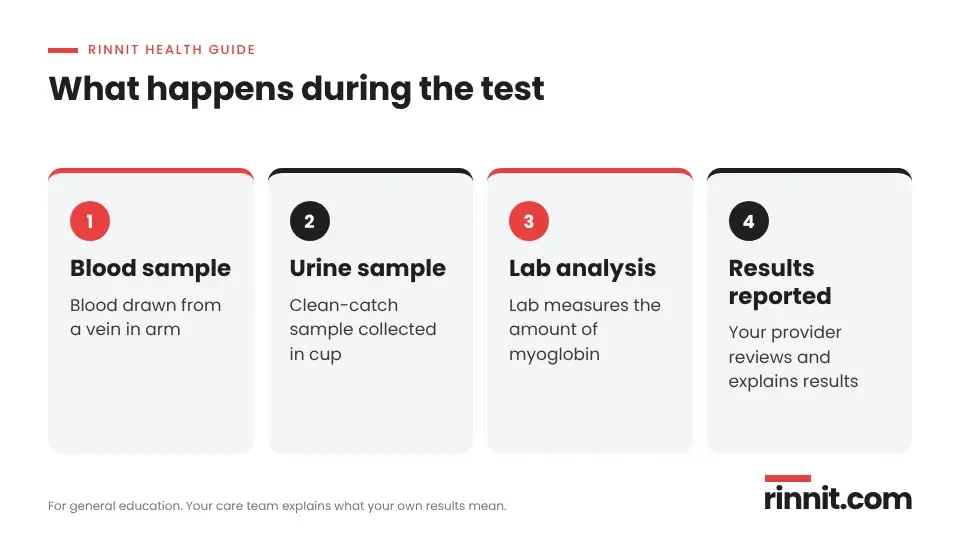
Both versions of the test are quick, and the lab does the measuring.
Blood test
A healthcare provider or phlebotomist uses a small needle to draw blood from a vein, usually in your arm. [1]
Urine test
For a clean-catch sample, you clean your genital area first and then collect urine in a sterile cup. [1]
At the lab
Your sample goes to a lab, where technicians measure how much myoglobin it contains and report the result to your provider. [1]
Are there risks to a myoglobin test?
Both the blood and urine tests are safe, and they carry no risk of severe side effects. [1]
With a blood draw, you may feel a quick sting or pinch when the needle goes in. A small bruise can form where the needle was placed. [1]
What do myoglobin test results mean?

Your provider reads your myoglobin result together with your symptoms and other tests.
Result | What it may mean |
Blood level usually under 72 ng/mL | Normal range for most labs |
Blood level above the lab's normal range | Possible damage to heart or other muscles |
No myoglobin found in urine | Expected, normal result |
Myoglobin found in urine | Possible muscle damage; a blood test may follow |
Sources: [1]
Normal results
A normal blood myoglobin level is usually less than 72 nanograms per milliliter (ng/mL). [1]
Labs can use slightly different reference ranges, so compare your result with the range printed on your own report. [1]
In urine, myoglobin is normally not detectable. [1]
High results
A blood level above the normal range can be a sign of damage to your heart or other muscles. [1]
If myoglobin is found in your urine, your provider may order a blood test to learn more. [1]
What the test cannot tell you
The test cannot pinpoint what caused the muscle damage. A high level mainly suggests that the damage likely happened recently. [1]
That is why providers use myoglobin results together with your symptoms, exam and other test results. [1]
Follow-up and when to call your provider
Your provider will explain your results and let you know whether you need more tests, follow-up visits or treatment. [1]
Contact your provider if you notice any of these symptoms: [1]
Conclusion
A myoglobin test is a quick, low-risk way to check your blood or urine for signs of recent muscle or heart damage. It needs no special preparation, and the sample is simple to collect.
A high result is a clue, not a diagnosis. Your provider will combine it with other tests to narrow down the cause and plan the right next steps for you.
Keep learning: Read our guide to the creatine kinase (CK) test or our guide to rhabdomyolysis symptoms, causes and emergency care. For more background, see the MedlinePlus Myoglobin blood test page.
FAQ
What is a myoglobin test?
It measures myoglobin, an oxygen-carrying protein from your heart and skeletal muscles, in a blood or urine sample to look for signs of muscle damage.
Why would my doctor order a myoglobin test?
It helps check for muscle damage and can support the evaluation of heart conditions, kidney problems, muscle injuries, myositis, muscular dystrophy and seizure disorders.
How is a myoglobin test done?
A blood sample is drawn from a vein in your arm, or you give a clean-catch urine sample in a cup. A lab then measures the myoglobin.
Does a myoglobin blood test hurt?
You may feel a brief sting or pinch from the needle, and a small bruise can form. The urine test causes no discomfort.
Do I need to fast before a myoglobin test?
No. You can eat, drink and take your usual medicines before either the blood or urine version of the test.
How long does a myoglobin test take?
Both tests are quick. The sample goes to a lab, and your provider will tell you when to expect results.
What is a normal myoglobin level?
A normal blood level is usually less than 72 ng/mL, though ranges vary by lab. Myoglobin is normally not detectable in urine.
What does a high myoglobin level mean?
A high level suggests recent damage to your heart or other muscles. It does not show the exact cause, so more testing is often needed.
Are there risks to a myoglobin test?
Both tests are safe with no risk of severe side effects. A blood draw may leave a small bruise.
What happens after an abnormal myoglobin result?
Your provider will review your result with other findings and may order more tests, schedule a follow-up visit or recommend treatment.
Related Reading
Rhabdomyolysis: Symptoms, Causes, and Emergency Care explains the serious muscle breakdown condition that can push myoglobin levels very high.
Heart Attack Symptoms and Treatment: A Complete Guide covers the heart muscle injury that can release myoglobin into your blood.
Acute Kidney Injury: What Causes Sudden Kidney Failure, and How It Is Treated explains the kidney complication providers watch for when myoglobin is high.
Acute Tubular Necrosis: The Most Common Cause of Acute Kidney Injury — How It Develops, How It Is Diagnosed, and How Kidneys Recover covers the kidney tubule damage that myoglobin can contribute to.
Creatine Kinase (CK) Test: What It Is, Normal Levels and High CK Causes explains the muscle enzyme test often ordered alongside myoglobin.
References
Cleveland Clinic. Myoglobin: What It Is, Function & Test Results. Cleveland Clinic. Last updated March 21, 2025. https://my.clevelandclinic.org/health/diagnostics/22142-myoglobin
Wu M, Wang C, Zhong L, et al. Serum myoglobin as predictor of acute kidney injury and 90-day mortality in patients with rhabdomyolysis after exertional heatstroke: an over 10-year intensive care survey. Int J Hyperthermia. 2022;39(1):446-454. PMID 35260032. https://doi.org/10.1080/02656736.2022.2046183
Vangstad M, Kro Birkeland JA, Gulsvik AK, et al. Exertional rhabdomyolysis: clinical features, management, complications and prediction of acute kidney injury. BMJ Open Sport Exerc Med. 2026;12(1):e003214. PMID 41788978. https://doi.org/10.1136/bmjsem-2026-003214
Goodacre S, Thokala P, Carroll C, et al. Systematic review, meta-analysis and economic modelling of diagnostic strategies for suspected acute coronary syndrome. Health Technol Assess. 2013;17(1):v-vi, 1-188. PMID 23331845. https://doi.org/10.3310/hta17010
Medical disclaimer
This article is for general education only and does not replace advice from a qualified healthcare professional. Talk to your doctor about your own diagnosis and treatment, and seek emergency care right away for severe or sudden symptoms.



Comments