Rhabdomyolysis: Symptoms, Causes, and Emergency Care

Updated: 3 days ago
Medically reviewed by Dr. Baraa Alnahhal, MD · Last reviewed: October 2026
Quick Answer: What is rhabdomyolysis?
Rhabdomyolysis is a medical emergency caused by rapid breakdown of skeletal muscle, which releases potassium, myoglobin and other substances that can damage the kidneys and cause kidney failure. [1] Signs include muscle swelling, weakness and tea-colored urine. [1] Get emergency care for extreme muscle pain with dark urine after a workout or injury. Treatment is hospital IV fluids and electrolytes. [1]

What the research says
Kidney injury is common but not inevitable. In 232 adults with confirmed rhabdomyolysis (creatine kinase above 1,000 U/L) in one UK critical care unit, 19% developed acute kidney injury and 12.5% needed dialysis. Mortality was 62% in those who developed kidney injury versus 18% in those who did not, and CK peaked between admission and day 3 in 91% of cases (Simpson et al., Eur J Anaesthesiol, 2016) [3].
Dialysis for rhabdo-related kidney injury is usually temporary. Among 101 adults with severe rhabdomyolysis who needed dialysis, half were off it by 11 days (95% CI 8 to 16 days), and only 5% were still on dialysis at 3 months (Lim et al., Front Med, 2020) [4].
Statin-related rhabdomyolysis is rare. A systematic review estimated its incidence at 3.4 per 100,000 person-years (95% CI 1.6 to 6.5) for statins other than cerivastatin, supported by data from 20 randomized trials. The case fatality was 10%, and the incidence was about 10 times higher when gemfibrozil was combined with a statin (Law & Rudnicka, Am J Cardiol, 2006) [5].
What Is Rhabdomyolysis?
Rhabdomyolysis (often shortened to “rhabdo”) is a condition in which muscle fibers break down and die. Their contents spill into the bloodstream and reach the kidneys, where they can cause damage. [1] It can follow overexertion, trauma, medicines, or an underlying health condition. [1]
It is relatively uncommon: about 26,000 people in the United States develop it each year. [1] It can happen to anyone, but some groups are at higher risk, including endurance athletes, people who work in hot environments, military recruits in intense training, and adults over 65 who may fall and be unable to get up. [1] Up to half of people with rhabdomyolysis develop acute kidney injury (Cleveland Clinic, 2023) [1].
What are the symptoms and warning signs of rhabdomyolysis?
Symptoms usually develop one to three days after a muscle injury, although some people do not notice any muscle soreness. [1] They range from mild to severe and can appear over hours to days (Nance & Mammen, Muscle Nerve, 2015) [6].
Symptom Category | Common Signs |
|---|---|
Muscle symptoms | Swelling, weakness, tenderness, and soreness. |
Urinary changes | Dark urine that is brown, red, or tea-colored, and passing less urine than usual. |
Other signs | Dehydration, nausea, and in severe cases loss of consciousness. |
What causes rhabdomyolysis, and who is at risk?
Rhabdomyolysis can be triggered by physical, chemical, or environmental factors that cause rapid muscle injury.
Injury or trauma: Crushing injuries, severe burns, and electrocution can break down muscle quickly. Crush injury is one of the most common causes. [1]
High-intensity exercise: Starting a hard program too fast, or not resting between workouts, does not give muscles time to recover. [1]
Severe dehydration and overheating: Heat speeds muscle breakdown, and the kidneys need plenty of fluid to clear waste.
Medications: Some antipsychotic, antidepressant, and antiviral medicines can cause muscle breakdown, and statins can too, although this is rare. [1] [5]
Substance use: Non-prescribed psychoactive drugs and heavy alcohol use can damage muscle in some situations. [6]
Long periods of inactivity: Falling or losing consciousness and being unable to get up for hours can compress and injure muscle. [1]
Medical and genetic conditions: McArdle disease, Duchenne muscular dystrophy, and certain metabolic or mitochondrial disorders raise the risk. [1] Doctors also look for acquired causes such as electrolyte abnormalities, endocrine problems, and autoimmune muscle disease (Nance & Mammen, Muscle Nerve, 2015) [6].
Possible Complications
Complications include kidney damage or failure, abnormal electrolyte levels, metabolic acidosis (too much acid in the blood), compartment syndrome (dangerous pressure inside a muscle), and disseminated intravascular coagulation, a bleeding and clotting disorder. [1]
How is rhabdomyolysis diagnosed?
Doctors diagnose rhabdomyolysis from your history, an exam, and blood and urine tests. [1] Most studies define it as a creatine kinase (CK) level at least five times above the upper limit of normal (Chavez et al., Crit Care, 2016) [2].
History and exam: Your recent activity, injuries, medicines, and substance use help point to the cause. [1]
Blood test for creatine kinase (CK): CK is the main marker of muscle damage. [1] Doctors also check kidney function and electrolytes such as potassium.
Urine test for myoglobin: Myoglobin in the urine is what gives it the dark color. [1] [6]
Muscle biopsy or genetic testing: These may be ordered after diagnosis, especially if episodes keep coming back, to look for an inherited muscle condition. [1] [6]
CK alone does not tell the whole story. In one cohort, a peak CK of at least 5,000 U/L was 83% sensitive but only 55% specific for predicting kidney injury that needed dialysis, so doctors weigh several factors together (Simpson et al., Eur J Anaesthesiol, 2016) [3].

How is rhabdomyolysis managed and treated?
The main goal is to protect the kidneys and correct the problems caused by the muscle breakdown (Torres et al., Ochsner J, 2015) [7]. Treatment is given in the hospital.
IV fluids and electrolytes: Large amounts of fluid help flush the toxins out of the kidneys. You may need to stay in the hospital for a few days. [1]
Treating the cause: This may mean stopping a medicine, cooling the body, or treating an underlying condition.
Dialysis: Used only if the kidneys are severely damaged. It filters the blood while the kidneys recover. [1]
Rest, then physical therapy: After the first days, a period of rest is followed by gradual physical therapy to rebuild muscle strength. [1]
Doctors still do not know whether adding bicarbonate or mannitol to IV fluids helps, because no randomized trials have compared fluids alone with fluids plus these agents (Chavez et al., Crit Care, 2016) [2]. Without complications, you may feel better within a few weeks, although muscle weakness can linger. [1] Do not return to exercise until your doctor tells you it is safe. [1]
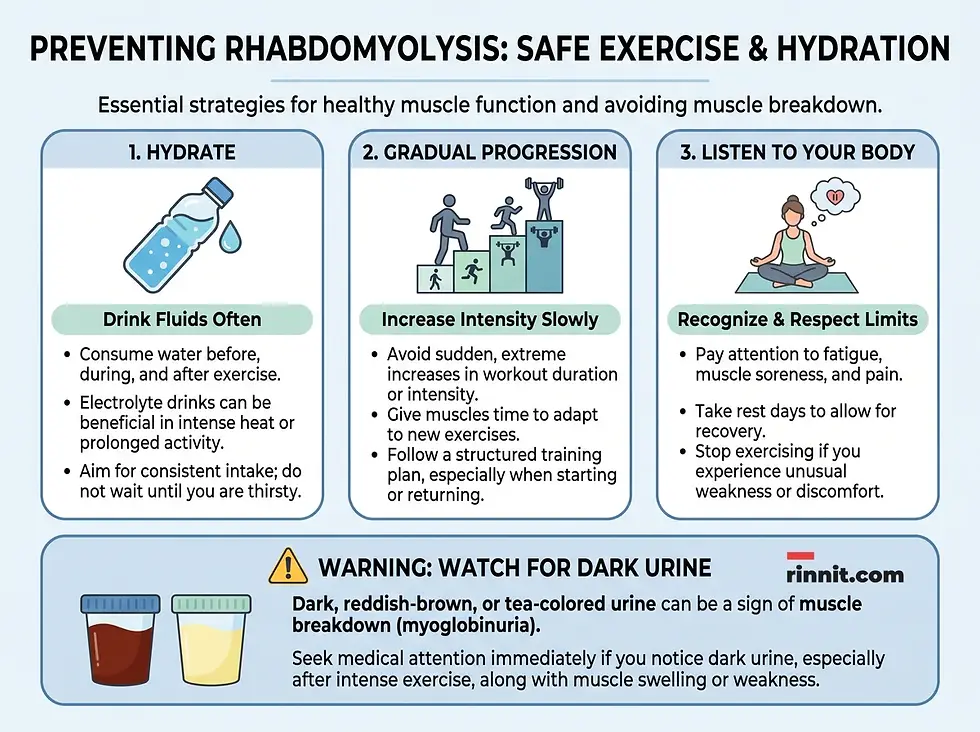
How can rhabdomyolysis be prevented?
You cannot prevent every cause, especially accidents or an underlying condition, but you can lower your risk of exercise-related rhabdomyolysis.
Hydrate steadily: Drink fluids before, during, and after activity, especially in hot weather, and take breaks in the shade. [1]
Build up gradually: Start new programs slowly and avoid sudden jumps in intensity or duration. [1]
Listen to your body: If you feel especially sore, tired, dizzy, or overheated, stop and rest. [1]
Review your medicines: If you take a statin or another higher-risk medicine, tell your doctor about unusual muscle pain or weakness. [1] Do not stop a prescribed medicine on your own.
Limit alcohol and avoid non-prescribed drugs. [1]
Watch your urine color: Dark, tea-colored urine after exertion is a reason to seek care right away. [1]
Conclusion
Rhabdomyolysis is serious, but it is treatable when caught early. Understanding the risks of intense exercise, heat, trauma, and some medicines, and recognizing dark urine with muscle pain and weakness as a warning sign, can protect your kidneys. If you suspect rhabdo in yourself or someone else, seek emergency care without delay.
What are the next steps if you suspect rhabdomyolysis?
If you are starting a new fitness routine, focus on hydration and adequate rest between sessions. If you have had a muscle injury or a very hard workout, watch your urine color and output closely for the next few days, and contact a healthcare provider if anything seems wrong. To learn more about how the kidneys can be injured, read our guide to acute kidney injury and sudden kidney failure.
Trusted resources: Centers for Disease Control and Prevention (NIOSH), National Kidney Foundation, American College of Sports Medicine.
Frequently Asked Questions
What does rhabdo urine look like?
Rhabdo urine is usually dark brown, red, or tea-colored (some people compare it to cola). The color comes from myoglobin, a muscle protein that leaks into the blood and is filtered out in the urine. Some people also pass much less urine than usual.
Can you get rhabdo from just one workout?
Yes, it can happen after a single extremely intense workout, especially if you jump into a hard program too fast, push without rest, or are dehydrated or overheated. Ordinary hard workouts and normal muscle soreness do not cause it.
Is rhabdomyolysis permanent?
The muscle injury usually heals with rest and treatment. Kidney damage can be lasting if treatment is delayed. In one study of 101 adults who needed dialysis because of severe rhabdomyolysis, only 5% were still on dialysis after 3 months.
How long does it take to recover from rhabdo?
If there are no complications, many people feel better within a few weeks, though muscle weakness can linger. Your doctor may ask you to wait several weeks to months before returning to exercise, and you should not restart until you are cleared.
Can statins cause rhabdomyolysis?
Yes, but it is rare. A systematic review estimated about 3.4 cases per 100,000 person-years for statins other than cerivastatin, with a higher risk when a statin is combined with certain other drugs. Do not stop a statin on your own; talk to your doctor about unusual muscle pain or weakness.
Can dehydration alone cause rhabdo?
Severe dehydration and overheating make muscle break down faster, and they often combine with hard exertion, illness, or medicines. If you feel dizzy, nauseous, or overheated during exercise, stop and cool down.
What are the classic symptoms of rhabdo?
Muscle pain, weakness or swelling, and dark urine. Symptoms usually appear one to three days after the muscle injury, and some people do not notice muscle soreness at all.
Does rhabdo always lead to kidney failure?
No. Kidney injury occurs in up to half of cases, and early treatment with IV fluids helps protect the kidneys. In one ICU study of 232 adults, 19% developed acute kidney injury and 12.5% needed dialysis.
Can you get rhabdo from a fall?
Yes. If a person falls, loses consciousness, and cannot get up for a long time, the pressure on their muscles can cause them to break down. This is one reason older adults are at higher risk.
Is rhabdomyolysis hereditary?
Rhabdomyolysis itself is not inherited, but some genetic conditions raise the risk, including McArdle disease and Duchenne muscular dystrophy, as well as certain metabolic and mitochondrial disorders.
What is creatine kinase (CK)?
CK is an enzyme that muscle cells release when they are damaged. Most studies define rhabdomyolysis as a blood CK level at least five times the upper limit of normal.
Should I stop exercising if my muscles are sore?
Normal soreness after exercise is expected. Stop and get medical help if the pain is severe, your muscles are swollen or unusually weak, or your urine turns dark.
Is dialysis always needed for rhabdomyolysis?
No. Dialysis is only used when the kidneys are severely damaged and cannot clear waste on their own.
Related Reading
Learn more in our guide to Creatine Kinase (CK) Test: What It Is, Normal Levels and High CK Causes.
Myoglobin Test: What It Is, Why It's Done, How It Works and Results explains the blood and urine test that detects myoglobin, a muscle protein released after muscle or heart damage.
References
Cleveland Clinic. Rhabdomyolysis. Cleveland Clinic. February 24, 2023. https://my.clevelandclinic.org/health/diseases/21184-rhabdomyolysis
Chavez LO, Leon M, Einav S, et al. Beyond muscle destruction: a systematic review of rhabdomyolysis for clinical practice. Crit Care. 2016;20(1):135. PMID 27301374. https://doi.org/10.1186/s13054-016-1314-5
Simpson JP, Taylor A, Sudhan N, et al. Rhabdomyolysis and acute kidney injury: creatine kinase as a prognostic marker and validation of the McMahon Score in a 10-year cohort: a retrospective observational evaluation. Eur J Anaesthesiol. 2016;33(12):906–912. PMID 27259093. https://doi.org/10.1097/EJA.0000000000000490
Lim AKH, Azraai M, Pham JH, et al. The association between illicit drug use and the duration of renal replacement therapy in patients with acute kidney injury from severe rhabdomyolysis. Front Med (Lausanne). 2020;7:588114. PMID 33240909. https://doi.org/10.3389/fmed.2020.588114
Law M, Rudnicka AR. Statin safety: a systematic review. Am J Cardiol. 2006;97(8A):52C–60C. PMID 16581329. https://doi.org/10.1016/j.amjcard.2005.12.010
Nance JR, Mammen AL. Diagnostic evaluation of rhabdomyolysis. Muscle Nerve. 2015;51(6):793–810. PMID 25678154. https://doi.org/10.1002/mus.24606
Torres PA, Helmstetter JA, Kaye AM, et al. Rhabdomyolysis: pathogenesis, diagnosis, and treatment. Ochsner J. 2015;15(1):58–69. PMID 25829882. https://pubmed.ncbi.nlm.nih.gov/25829882/
Medical Disclaimer
This article is for informational purposes only and does not constitute medical advice. Rhabdomyolysis is a medical emergency. Always seek the advice of your physician or other qualified health provider with any questions you may have regarding a medical condition. Never disregard professional medical advice or delay in seeking it because of something you have read in this article.



Comments