Acute Kidney Injury: What Causes Sudden Kidney Failure, and How It Is Treated

Updated: 2 days ago
Medically reviewed by Dr. Baraa Alnahhal, MD · Last reviewed: September 2026
Editorial note: This article is for educational purposes only and is not a substitute for professional medical advice, diagnosis, or treatment. Always consult a qualified healthcare provider for medical decisions.
TL;DR
Acute kidney injury (AKI) is a sudden loss of kidney function that develops over hours to days, usually triggered by another serious condition such as dehydration, sepsis, or a blockage in the urinary tract. Most cases occur in hospitals, where AKI affects roughly 7% of admitted patients and up to 60% of intensive care patients. Mild cases often reverse within days; severe cases may require temporary dialysis and take weeks to recover. Early recognition and treatment of the underlying cause give the kidneys the best chance of full recovery.
Quick Answer
An acute kidney injury is when the kidneys abruptly stop filtering waste from the blood, developing over a few hours to a week. Symptoms range from peeing less, swelling, and fatigue to confusion, nausea, and flank pain — but mild cases may cause no symptoms at all. AKI usually results from reduced blood flow to the kidneys, direct kidney damage, urinary blockages, or certain medications. Treatment targets the underlying cause, and dialysis is used temporarily when waste products build up. With prompt treatment, the damage is often reversible.
What Exactly Is an Acute Kidney Injury?
An acute kidney injury (AKI) is when the kidneys abruptly decrease function and stop removing waste products from the blood. The word "acute" matters: it means the problem develops suddenly — over a few hours or over the course of about a week — rather than gradually over years. In most cases, AKI develops as a result of another serious condition rather than on its own.
AKI may also be called acute renal injury, acute kidney failure, or acute renal failure. The word "renal" is simply the medical term for kidney.
The severity varies widely. Mild cases may cause no permanent damage at all, while a severe AKI may be fatal without treatment.
Clinicians often define and stage AKI using internationally agreed criteria. Under the widely used KDIGO definition, AKI is diagnosed when there is a rise in serum creatinine of at least 0.3 mg/dL within 48 hours, a rise of at least 1.5 times the baseline value within the prior seven days, or urine output below 0.5 mL/kg/hour for six hours.
Stage 1 (mild): 1.5–1.9 times baseline creatinine, or ≥0.3 mg/dL rise within 48 hours; urine output under 0.5 mL/kg/hour for 6–12 hours
Stage 2 (moderate): 2–2.9 times baseline creatinine; urine output under 0.5 mL/kg/hour for 12 hours or more
Stage 3 (severe): 3 times baseline, or ≥4.0 mg/dL, or dialysis started; urine output under 0.3 mL/kg/hour for 24 hours, or no urine for 12 hours
Dialysis is provided in fewer than 10% of AKI hospitalizations, which illustrates that most cases do not reach the most severe stage.
How Common Is Acute Kidney Injury, and Who Gets It?
AKI is surprisingly common — and increasingly so. In the United States, more than 1 million people experience AKI during hospitalizations each year, and one national estimate puts the total at roughly 3 million AKI cases annually. Hospital discharge records show the number of U.S. hospitalizations with AKI more than quadrupled, rising from about 954,000 in 2000 to nearly 3.96 million in 2014.
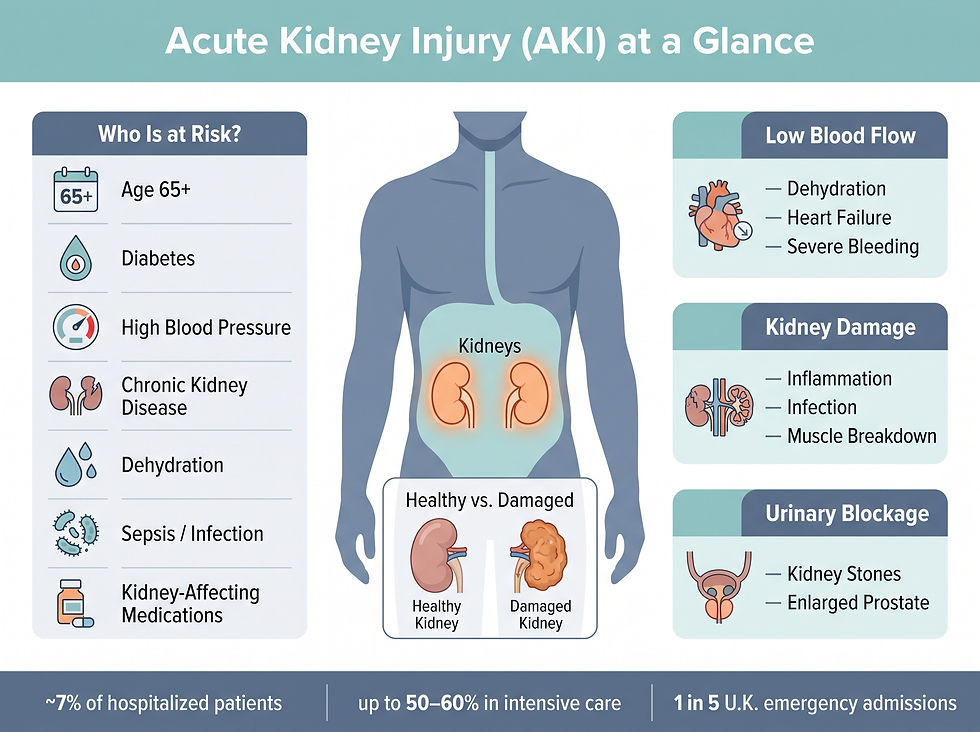
The hospital-level numbers are striking. AKI affects roughly 7% of all hospitalized patients, and in intensive care units the rate climbs to up to 50–60%. In the U.K., about one in five emergency hospital admissions is associated with AKI, and the condition contributes to an estimated 100,000 deaths in secondary care. The share of hospitalizations in which AKI is diagnosed rose steadily from 15.5% in 2011 to 26.8% in 2021.
U.S. hospitalizations per year: More than 1 million (one estimate: ~3 million cases)
Hospitalized patients affected: ~7% of all admissions; up to 50–60% in intensive care
U.K. emergency admissions with AKI: ~1 in 5
Sepsis hospitalizations with AKI: 50.1% (2021 Medicare data)
Trend 2000–2014 (U.S.): Hospitalizations rose from ~954,000 to ~3.96 million
Hospitalization rate rise (diabetes, 2000–2014): +139% among adults with diabetes; +230% without
Several factors raise the risk substantially. People at greater risk include those who are 65 or older, those with chronic kidney disease (CKD), diabetes, or high blood pressure, people who are dehydrated, those with sepsis or severe bacterial infection, people with a urinary blockage, and anyone taking medications or substances that increase kidney-damage risk. Diabetes is a particularly important amplifier: adults with diabetes are nearly four times more likely to be hospitalized with AKI than those without, and diabetes appears as a comorbidity in roughly 40% of AKI hospitalizations. AKI is also most common in sepsis hospitalizations — more than half of patients hospitalized for sepsis develop it.
Notably, more than half of hospitalizations in patients with stage 4 or 5 CKD include an AKI diagnosis, compared with about 21% of hospitalizations in patients without prior kidney disease.
What Are the Symptoms of Acute Kidney Injury?
Symptoms vary with the cause and the severity of the kidney damage. In mild cases, you may have no symptoms at all — many patients are diagnosed from routine blood tests rather than from symptoms.
When symptoms do occur, they may include:
Peeing less than usual (oliguria): The classic early sign of declining kidney output
Swelling: Especially in the feet, ankles, and legs
Fatigue and weakness: Tiredness, low energy levels
Itchy skin: Medically called pruritus
Nausea and vomiting: Often accompanies waste buildup in the blood
Diarrhea: Reported in some cases
Confusion: Altered mental status, trouble focusing
Loss of appetite: Not feeling hungry
High blood pressure: Hypertension can develop or worsen
Flank pain: Pain in the side, below the ribs
Chest pain: In more severe cases
An important nuance: 50–60% of AKI cases are nonoliguric, meaning urine output stays near normal even while the kidneys' filtering function drops. So the absence of reduced urination does not rule out AKI.
What Causes Acute Kidney Injury?
Doctors traditionally group the causes of AKI into three categories, based on where the problem originates:
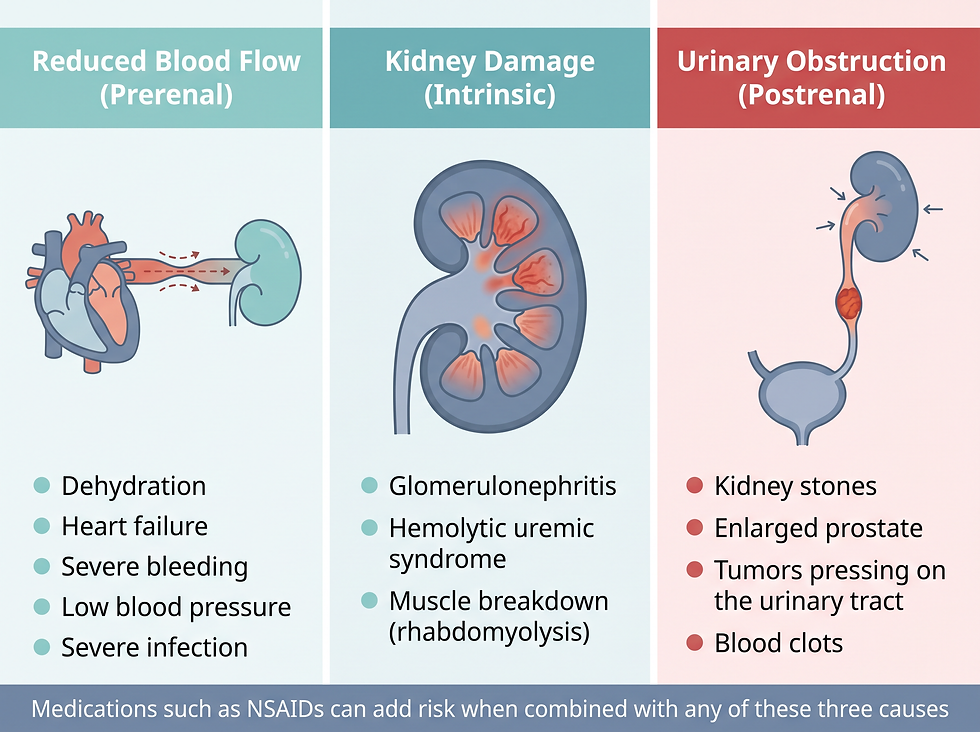
Reduced blood flow (prerenal): The kidneys get too little blood to filter with. Typical causes: dehydration, low blood volume, heart attack, heart failure, severe bleeding, severe burns, low blood pressure, severe bacterial infections
Problems with the kidney itself (intrinsic): Direct damage to kidney tissue. Typical causes: glomerulonephritis, hemolytic uremic syndrome, scleroderma, thrombotic thrombocytopenic purpura, rhabdomyolysis, tumor lysis syndrome
Urinary obstructions (postrenal): Urine cannot drain, backing pressure up into the kidneys. Typical causes: kidney stones, enlarged prostate (BPH), cervical, bladder, prostate, or colorectal cancer, blood clots in the urinary system
Medications and other substances form an additional risk layer. They may not be the sole cause on their own, but they raise the risk when reduced blood flow, kidney damage, or an obstruction is already present. Risk-increasing substances include nonsteroidal anti-inflammatory drugs (NSAIDs), certain antibiotics, blood pressure medications (ACE inhibitors, ARBs, and diuretics), medications used to treat cancer or HIV, toxic alcohols such as rubbing alcohol (isopropyl), antifreeze (ethylene glycol), and methanol, as well as heroin and cocaine.
A reassuring point about the most common trigger group: when AKI is caused by conditions that reduce blood flow to the kidneys, the outlook is usually better — because those conditions are typically treatable.
How Is Acute Kidney Injury Diagnosed?
Diagnosis starts with the basics: a healthcare provider will review your medical history, ask about symptoms and everything you take — including over-the-counter medications and herbal supplements — and perform a physical exam.
If AKI is suspected, several tests help confirm it:
Blood tests: creatinine, BUN, eGFR: Creatinine and blood urea nitrogen (BUN) rise as filtering fails; eGFR estimates overall kidney function. A BUN-to-creatinine ratio above 20:1 often suggests reduced blood flow (prerenal AKI)
Urinalysis: Checks urine for protein, blood, and other signs of kidney damage
Ultrasound and other imaging: Looks for obstructions and structural problems
Kidney biopsy (rare): Used in selected cases to pinpoint the exact type of kidney damage
It is worth knowing that certain medications — such as cimetidine, trimethoprim, and some cancer drugs — can raise creatinine by blocking its secretion without actually reducing kidney filtration. A careful medication review prevents false conclusions.
How Is Acute Kidney Injury Treated?
The guiding principle: treating an AKI means treating its cause. Specific measures depend on what triggered the injury and how severe it is:
Rehydration (oral fluids, sports/electrolyte drinks, or IV fluids): Dehydration or low blood volume
Stopping kidney-affecting medications: When drugs contribute to the injury
Antibiotics: To treat an underlying infection
Potassium or phosphate binders: When kidneys cannot filter potassium or phosphate
Urinary catheter: To drain the bladder when obstruction or retention is the problem
Temporary dialysis: When waste products build up significantly in the blood
If a lot of waste products accumulate in the blood, you may need temporary dialysis to do the kidneys' work while they recover. As soon as the kidneys recover, dialysis can usually be stopped. Supportive care also addresses complications such as fluid overload, severe acidosis, and life-threatening high potassium; dialysis is indicated for refractory acidosis, pulmonary edema from fluid overload, dangerous hyperkalemia, or uremic symptoms.
Is Acute Kidney Injury Reversible?
Yes — in many cases. With a proper diagnosis of the cause and prompt treatment, the damage is often reversible. The outcome depends on the underlying cause, the severity of kidney damage, and your overall health. No large randomized trial has shown benefit from non-specific "kidney-protecting" drugs, so treatment centers on the cause and supportive care.
How Long Does Recovery Take?
With appropriate treatment, a mild AKI may heal within a few days, while severe cases may take at least two to three weeks or even longer. If you had kidney problems before the AKI, the kidneys may not fully heal. After treatment you are likely to feel tired or weak, and it may take up to a few weeks before you start feeling better.
The longer-term picture matters too. Among older patients hospitalized with AKI and discharged alive, the cumulative incidence of death is 31.0% at one year and 41.4% at two years, and about 11.8% are diagnosed with new chronic kidney disease within three months when they had no prior CKD. Roughly one-third of AKI survivors develop new or worsened chronic kidney disease over time. And among patients whose AKI was severe enough to require outpatient dialysis, only about 31% recovered kidney function by six months — nearly 48% progressed to end-stage kidney disease. These numbers underscore why preventing AKI in the first place is so valuable.
Mild AKI, treated promptly: Heals within a few days
Severe AKI: At least two to three weeks, sometimes longer
Pre-existing kidney disease: Kidneys may not fully heal
Feeling fully well after treatment: Up to a few weeks of lingering fatigue
Can an Acute Kidney Injury Be Prevented?
Prevention focuses on protecting the kidneys and catching risk factors early:
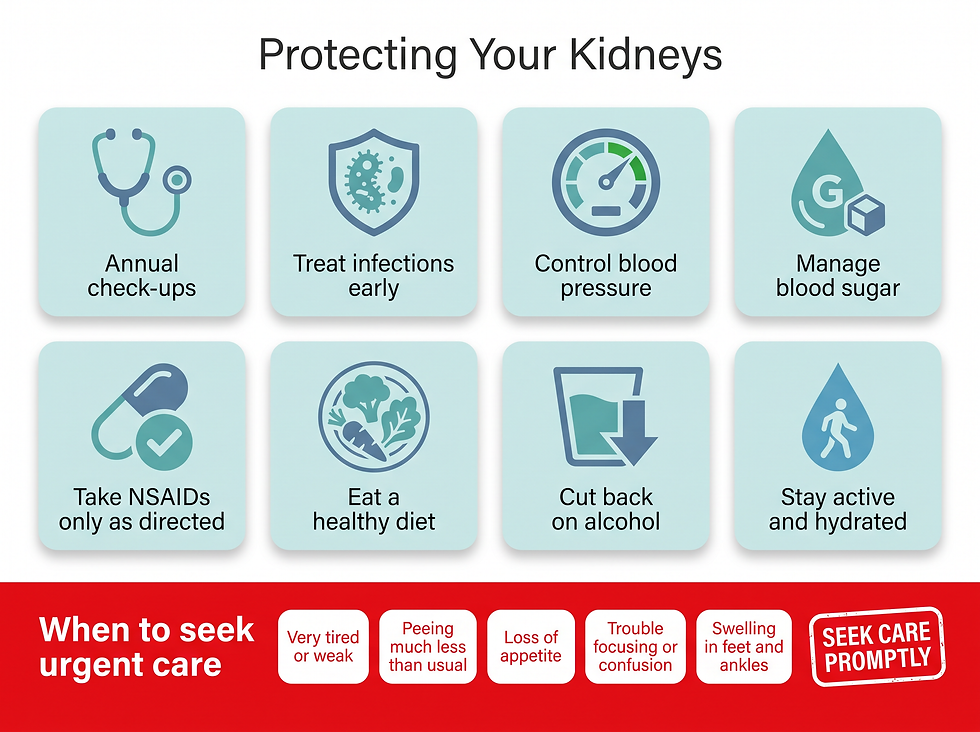
Annual physical exams: Monitors conditions that raise AKI risk
Treating infections promptly: Prevents sepsis, the leading AKI trigger
Managing high blood pressure: Protects kidney blood vessels
Monitoring blood sugar (if you have diabetes): Diabetes nearly quadruples AKI hospitalization risk
Eating a healthy diet daily: Supports overall kidney and cardiovascular health
Taking NSAIDs only as directed: Overuse is a known kidney-damage risk
Cutting back on alcohol: Reduces dehydration and blood pressure effects
Not smoking, vaping, or using tobacco: Protects blood vessels including those in the kidneys
Staying active (30 minutes, ≥5 days/week): Supports circulation and metabolic health
One sobering finding: a national U.K. inquiry estimated that one-fifth of post-admission AKI was both predictable and avoidable, which suggests real room for improvement in prevention and early detection.
The Bottom Line
Acute kidney injury is a sudden, often reversible loss of kidney function that usually arrives as a complication of something else — dehydration, infection, heart problems, a blockage, or a medication. It affects a surprising share of hospitalized patients and is rising in both frequency and awareness. The encouraging news is that mild cases heal in days, dialysis is temporary in most cases, and prompt treatment of the underlying cause gives the kidneys the best chance of full recovery.
Talk to your healthcare provider about your kidney risk factors — and seek care promptly if you notice reduced urination, unexplained swelling, or sudden confusion — because early treatment is the single biggest determinant of whether your kidneys fully recover.
Frequently Asked Questions (FAQ)
1. What is the difference between acute kidney injury and chronic kidney disease?
AKI develops suddenly over hours to days, usually from another condition, and is often reversible. Chronic kidney disease develops gradually over months or years and is generally not reversible. However, an AKI episode can increase the risk of developing CKD later — about 11.8% of older patients without prior CKD were diagnosed with CKD within three months after an AKI hospitalization.
2. Can acute kidney injury be cured?
In many cases, yes. With a proper diagnosis of the cause and prompt treatment, the damage is often reversible. Mild cases may heal within a few days, while severe cases can take two to three weeks or longer.
3. Do I need dialysis forever if I have acute kidney injury?
Usually not. Dialysis for AKI is typically temporary and is used only while waste products build up in the blood. As soon as the kidneys recover, dialysis can usually be stopped.
4. Can you have an acute kidney injury without knowing it?
Yes. Mild cases may cause no symptoms at all, and 50–60% of AKI cases are "nonoliguric," meaning urine output stays near normal. Many patients are diagnosed through routine blood tests rather than symptoms.
5. Is ibuprofen (an NSAID) dangerous for the kidneys?
NSAIDs are a recognized risk factor for kidney injury, especially when combined with dehydration, existing kidney damage, or a urinary obstruction. They should be taken only as directed, and people with kidney risk factors should discuss safer pain-relief options with their provider.
6. How is acute kidney injury diagnosed?
Providers combine a medical history, a medication review (including over-the-counter drugs and supplements), and a physical exam with blood tests (creatinine, BUN, eGFR), a urine test (urinalysis), and imaging such as an ultrasound. A kidney biopsy is used only in rare cases.
7. Who is most at risk for acute kidney injury?
People aged 65 or older, those with chronic kidney disease, diabetes, or high blood pressure, people who are dehydrated or have sepsis, anyone with a urinary blockage, and people taking kidney-affecting medications or substances.
8. When should I go to the emergency room for possible kidney problems?
Seek emergency care if you are very tired, not peeing as much as you should, not hungry, unable to focus or having trouble sleeping, and have swelling around your feet or ankles — especially if several of these occur together.
References
Cleveland Clinic — Acute Kidney Injury (medically reviewed, last updated 05/20/2026)
Goyal A, Daneshpajouhnejad P, Hashmi MF, et al. — Acute Kidney Injury, StatPearls (2023)
United States Renal Data System (USRDS) / NIH-NIDDK — Acute Kidney Injury, 2023 Annual Data Report, Chapter 4
National Kidney Foundation — Acute Kidney Injury (AKI) (last updated 2/26/2024)
StatPearls / NIH — Acute Kidney Injury incidence estimates (~3 million U.S. cases/year)
Pavkov ME, Harding JL, Burrows NR — Trends in Hospitalizations for Acute Kidney Injury, United States, 2000–2014, MMWR (2018)
NICE Clinical Knowledge Summaries — Acute kidney injury: How common is it? (last revised July 2023)
Workeneh BT, Batuman V — Acute Kidney Injury (AKI), Medscape eMedicine (updated Sep 11, 2024)
Merck Manual Consumer Version — Acute Kidney Injury (last reviewed 2/2025)
National Health Service (U.K.) — Acute Kidney Injury (last reviewed 3/11/2026)
Comments