Creatine Kinase (CK) Test: What It Is, Normal Levels and High CK Causes

Updated: 2 days ago
Written and medically reviewed by Dr. Baraa Alnahhal, MD · Last reviewed: November 2026 · How we review
Quick Answer: What is a creatine kinase (CK) test?
A creatine kinase (CK) test is a blood test that measures creatine kinase, an enzyme found mainly in the skeletal muscles and heart. When muscle, heart or brain tissue is damaged, it leaks CK into the bloodstream, so a high level usually points to recent muscle damage. Providers use it to diagnose and monitor muscle diseases, injuries and inflammation. [1]
What the research says
CK level helps predict kidney injury after muscle breakdown, but not perfectly. A meta-analysis that pooled 18 studies found that higher CK was strongly linked with acute kidney injury after crush injuries (odds ratio 14.7). Overall, CK predicted kidney injury with an area under the curve of 0.75, which the authors judged too low to rely on CK alone. (Safari et al., Clinical and Experimental Nephrology, 2016) [2]
Healthy people often have CK above the lab's printed limit. In a random sample of 1,444 adults tested after three days of rest, the upper normal limits were 2 to 5 times higher than the assay maker's limits. Above-limit values were found in 13% of white European, 23% of South Asian and 49% of Black participants. (Brewster et al., American Heart Journal, 2007) [3]
Key takeaways
CK is an enzyme that helps your muscles make energy; damaged muscle, heart or brain cells release it into your blood. [1]
A high CK level usually means recent muscle damage, but the test can't show which muscle was hurt or why. [1]
Intense exercise, injections and some medicines can raise CK for a short time, so a high result doesn't always mean disease. [1]
Normal ranges vary by sex, race, activity level and lab, and people with more muscle tend to have higher CK. [1] [3]
Troponin has largely replaced CK for diagnosing a heart attack. [1]
What is creatine kinase (CK)?
Creatine kinase is an enzyme, a protein that speeds up a specific chemical reaction in the body. It sits mainly in your heart and skeletal muscles (the muscles attached to your bones), with small amounts in your brain. [1]
Its everyday job is to add a phosphate group to creatine, turning it into phosphocreatine, a high-energy molecule your muscles use for fuel. When muscle cells break open from injury or disease, their contents, including CK, spill into your blood. [1]
The three types of CK
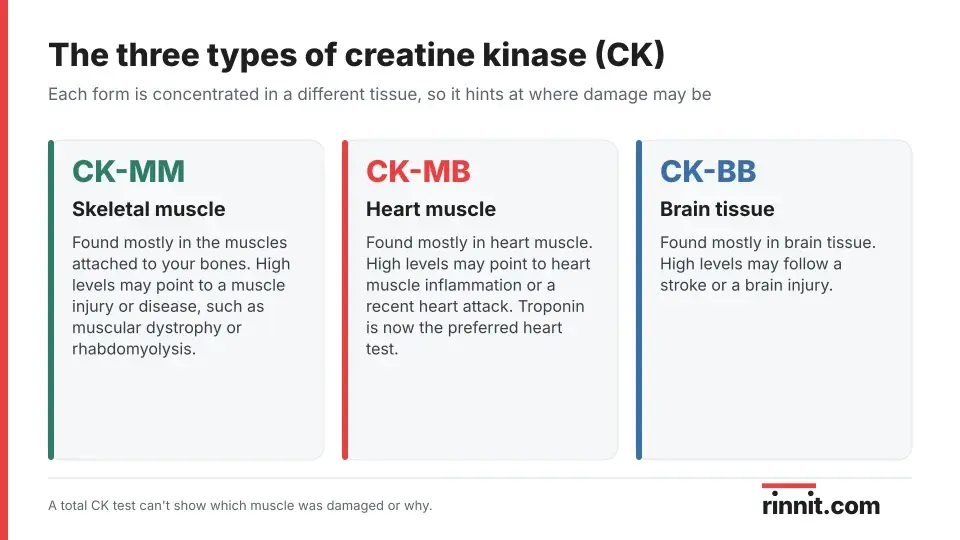
Type | Where it's found | High levels may point to |
CK-MM | Mostly skeletal muscle | Muscle injury or disease, such as muscular dystrophy or rhabdomyolysis |
CK-MB | Mostly heart muscle | Heart muscle inflammation, or a current or recent heart attack |
CK-BB | Mostly brain tissue | A stroke or a brain injury |
Sources: [1]
What is a CK test used for?
A CK test measures the total amount of creatine kinase in your blood. Other names for it include CK total, CK creatine and phosphokinase (CPK). Providers mostly use it to diagnose and monitor three groups of muscle problems: [1]
Muscle diseases (myopathies): such as Duchenne muscular dystrophy, an inherited condition that weakens skeletal muscles, and rhabdomyolysis, a rapid breakdown of muscle tissue.
Muscle injuries: crushed, compressed, torn or strained muscles from accidents or intense exercise, third-degree burns and electrocution.
Muscle inflammation (myositis): including polymyositis, dermatomyositis and pyomyositis, a rare bacterial muscle infection.
Because muscle symptoms have many causes, your provider may order other tests at the same time, such as electrolytes, blood urea nitrogen (BUN), creatinine and urine myoglobin. [1]
CK tests and heart attacks
CK testing was once a common way to check for a heart attack. Today, providers rely on troponin, a test that is better at detecting heart damage, and use CK for this purpose only occasionally. [1]
Why would you need a CK test?
Your provider may order a CK test if you have symptoms of a muscle disorder, such as: [1]
Muscle pain or cramps
Muscle weakness
Balance problems
Numbness or tingling
Dark urine
It may also be ordered after a muscle injury or a stroke. Because CK may not peak until up to two days after some injuries, you may need the test more than once. [1]
How do you prepare for a CK test?
In most cases you don't need to do anything special. If the test is checking for a possible muscle disorder, keep your exercise to normal activities beforehand, because strenuous exercise can raise CK for a while. [1]
What happens during a CK test?
A CK test is a simple blood draw, usually done by a phlebotomist: [1]
You sit in a chair while the provider finds a vein, usually on the inside of your elbow.
They clean the area and insert a small needle, which may feel like a quick pinch.
A small amount of blood collects in a test tube.
They remove the needle, press gauze on the spot and apply a bandage.
The whole draw usually takes less than five minutes. A lab then measures the CK in your sample. [1]
CK test at a glance
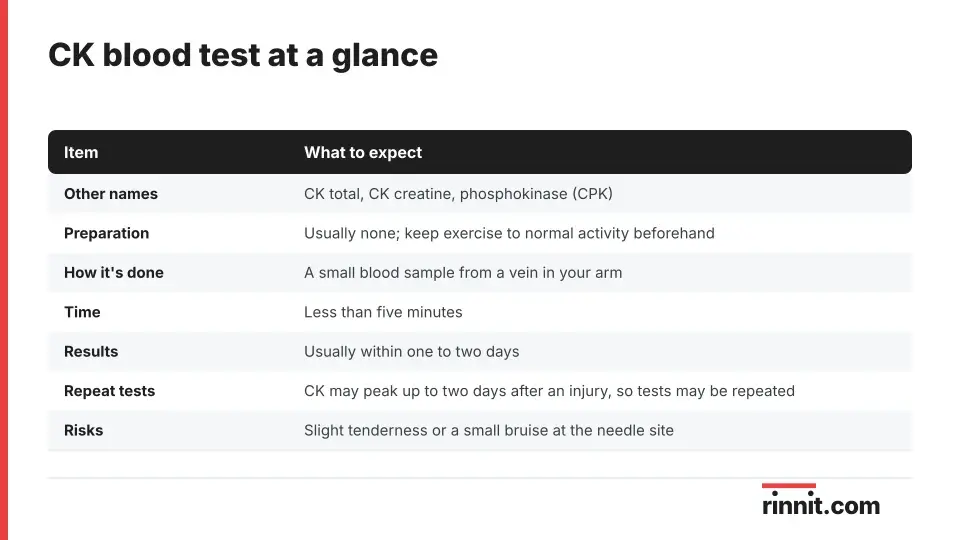
Item | Details |
Sample | Blood from a vein in your arm |
Fasting | Not needed |
Time | Less than five minutes |
Results | Usually within one to two days |
Risks | Slight tenderness or a small bruise |
Sources: [1]
What are the risks of a CK test?
Blood tests carry very little risk. You may have slight tenderness or a bruise where the needle went in, and it usually fades quickly. [1]
What do CK test results mean?
Your report shows your CK level next to the lab's normal (reference) range and flags whether it's high or low. Normal CK levels vary with sex, race and activity level, and ranges differ between labs, so always compare your number with the range on your own report. Ranges are generally higher in males, and people with more muscle mass normally have higher CK. [1]
Normal variation can be wide. In one large population study, many healthy, rested adults had CK above the limits printed by the test maker. [3]
What does a high CK level mean?
A high CK level, or a level that rises across repeat tests, usually means recent muscle damage. The test can't tell which muscle was damaged or what caused it. [1]
Providers often repeat the test to follow the trend. Levels that peak and then fall usually mean the damage is easing, while levels that keep rising or stay high may point to ongoing muscle damage or degeneration. Your provider may also check the specific CK types (CK-MM, CK-MB or CK-BB) to see which tissue is involved. [1]
In rhabdomyolysis, CK levels are linked with the risk of kidney injury, especially after crush injuries, but CK alone is not an accurate enough predictor. [2]

Other causes of a high CK level
Some conditions that aren't directly muscle problems can also raise CK: [1]
Group | Examples |
Hormone disorders | Thyroid disease, Addison's disease, Cushing's syndrome |
Infections | Viral, bacterial, fungal or parasitic infections; high fever with shivering |
Connective tissue disorders | Lupus, rheumatoid arthritis |
Other conditions | Celiac disease, kidney failure, seizures, a blood clot |
Procedures and substances | Long surgeries, injections, drugs or toxins that disrupt muscle energy use |
Sources: [1]
Should you worry about a high CK result?
Not necessarily. Exercise, certain medicines and injections can raise CK temporarily, and errors in processing the sample are possible. Your provider will weigh your medicines, lifestyle and symptoms and tell you whether you need more tests. [1]
When should you call your doctor?
Muscle pain and weakness are usually temporary. Talk to your provider if your muscle problems last, so they can look for the cause with a CK test and other tests. [1]
Get urgent care for severe muscle pain or weakness with dark urine, especially after a crush injury or extreme exercise, as these can be signs of rhabdomyolysis.
Questions to ask your provider
Why do I need a CK test?
Should I avoid exercise before the test?
Could any of my medicines affect my CK level?
Will I need repeat tests to follow my level?
If my CK is high, what other tests will I need?
Conclusion
A creatine kinase test is a quick blood test that shows whether muscle, heart or brain tissue may have been damaged. A high result usually reflects recent muscle damage, but exercise, injections, medicines and normal differences between people can raise it too, so your provider reads it alongside your symptoms and other tests. [1] [3]
If your level is high, repeat testing often shows whether the damage is improving or ongoing.
Keep learning: Read our guides to rhabdomyolysis, muscular dystrophy and myositis. For more on the test, see MedlinePlus: Creatine Kinase.
FAQ
What is a creatine kinase (CK) test?
A CK test is a blood test that measures the level of creatine kinase, an enzyme mainly found in skeletal muscle and the heart. High levels usually point to recent muscle damage. [1]
What does a high CK level mean?
A high CK level usually means recent muscle damage from an injury, disease or inflammation. The test can't show which muscle was damaged or why. [1]
Can exercise raise CK levels?
Yes. Intense exercise strains muscles and can raise CK for a while, so you may be asked to keep exercise to normal activities before the test. [1]
Do I need to fast for a CK test?
No. You usually don't need any special preparation for a CK blood test. [1]
What is a normal CK level?
Normal CK levels vary with sex, race, activity level and the lab, so compare your result with the range on your report. Ranges are usually higher in males and in people with more muscle. [1]
What is the difference between CK-MM, CK-MB and CK-BB?
CK-MM is found mostly in skeletal muscle, CK-MB mostly in heart muscle and CK-BB mostly in the brain. Testing them can show which tissue is damaged. [1]
Is a CK test used to diagnose a heart attack?
Rarely today. Troponin has replaced CK because it is better at detecting heart damage. [1]
How long do CK test results take?
Results usually come back within one or two days, though it can take longer. [1]
Why might I need repeat CK tests?
CK may not peak until up to two days after some injuries, and repeat tests show whether muscle damage is easing or ongoing. [1]
When should I see a doctor about muscle pain?
See your provider if muscle pain or weakness lasts. Get urgent care for severe pain or weakness with dark urine. [1]
Related Reading
Creatine: Benefits, How It Works, Side Effects and Safety explains how creatine supplements work and their safety.
Enzyme Markers: Blood Tests for Heart, Liver and Muscle Damage explains blood tests that detect heart, liver and muscle damage.
Muscle Biopsy: Diagnosing Muscle Diseases, Procedure and Recovery explains the procedure that takes a small muscle sample to diagnose muscle diseases.
Learn more in our guide to Rhabdomyolysis: Symptoms, Causes, and Emergency Care.
Learn more in our guide to What Is Muscular Dystrophy? A Plain-Language Guide to the Group of Diseases That Weaken Muscles.
Learn more in our guide to Duchenne Muscular Dystrophy (DMD): A Parent's Guide to Symptoms, Causes and Care.
Learn more in our guide to Myositis (Idiopathic Inflammatory Myopathy): Symptoms, Types, Causes, Treatment and Outlook.
Learn more in our guide to Myopathy: Causes, Symptoms, Diagnosis, Treatment and Daily Support.
Myoglobin Test: What It Is, Why It's Done, How It Works and Results explains the blood and urine test that detects myoglobin, a muscle protein released after muscle or heart damage.
References
Cleveland Clinic. Creatine Kinase (CK): What It Is, Purpose & Procedure. Cleveland Clinic. Last updated April 11, 2022. https://my.clevelandclinic.org/health/diagnostics/22692-creatine-kinase-ck
Safari S, Yousefifard M, Hashemi B, et al. The value of serum creatine kinase in predicting the risk of rhabdomyolysis-induced acute kidney injury: a systematic review and meta-analysis. Clin Exp Nephrol. 2016;20(2):153-61. PMID 26801932. https://doi.org/10.1007/s10157-015-1204-1
Brewster LM, Mairuhu G, Sturk A, et al. Distribution of creatine kinase in the general population: implications for statin therapy. Am Heart J. 2007;154(4):655-61. PMID 17892987. https://doi.org/10.1016/j.ahj.2007.06.008
Medical disclaimer
This article is for general education only and does not replace advice from a qualified healthcare professional. Talk to your doctor about your own diagnosis and treatment, and seek emergency care right away for severe or sudden symptoms.



Comments