Cardiac Blood Tests: Heart Disease Risk Tests and Ideal Levels

Updated: 2 days ago
Written and medically reviewed by Dr. Baraa Alnahhal, MD · Last reviewed: November 2026 · How we review
Quick Answer
Cardiac blood tests are blood tests that help estimate your risk of heart and blood vessel disease, such as a heart attack or stroke. They include a cholesterol panel plus more specialized tests, such as lipoprotein (a), C-reactive protein and hemoglobin A1c. You may need to fast for 9 to 12 hours.
What the research says
Heart peptides help rule out heart failure: in 37 study groups with 15,263 test results, NT-proBNP below 300 ng/L caught 99% of acute heart failure cases and BNP below 100 ng/L caught 95%, making them strong rule-out tests (Roberts E et al., BMJ, 2015) [2]
Fast troponin testing is safe in the ER: in 11,014 people with chest pain, a high-sensitivity troponin test repeated after one hour detected about 98% of heart attacks, and only 0.1% of those ruled out died within 30 days (Chiang CH et al., Heart, 2020) [3]
Key takeaways
Cardiac blood tests help estimate your risk of heart disease and stroke.
A cholesterol panel is the most common test.
Specialized tests look at proteins, inflammation and blood sugar.
You may need to fast for 9 to 12 hours.
Results are combined with your health history.
What are cardiac blood tests?
No single blood test can predict heart disease. Instead, providers use a group of tests that each reflect a different part of your risk, such as fats in your blood, inflammation in your arteries, blood clotting or stress on your heart. A lipid panel is ordered for almost everyone, while less common tests are usually ordered when you have several risk factors. A primary care provider may order cholesterol tests, and a cardiologist often orders the more specialized ones. Sources: [1]
These risk tests are different from emergency tests, such as the troponin test, which are used to check for a heart attack that's happening now. Sources: [1, 3]
Why they're done
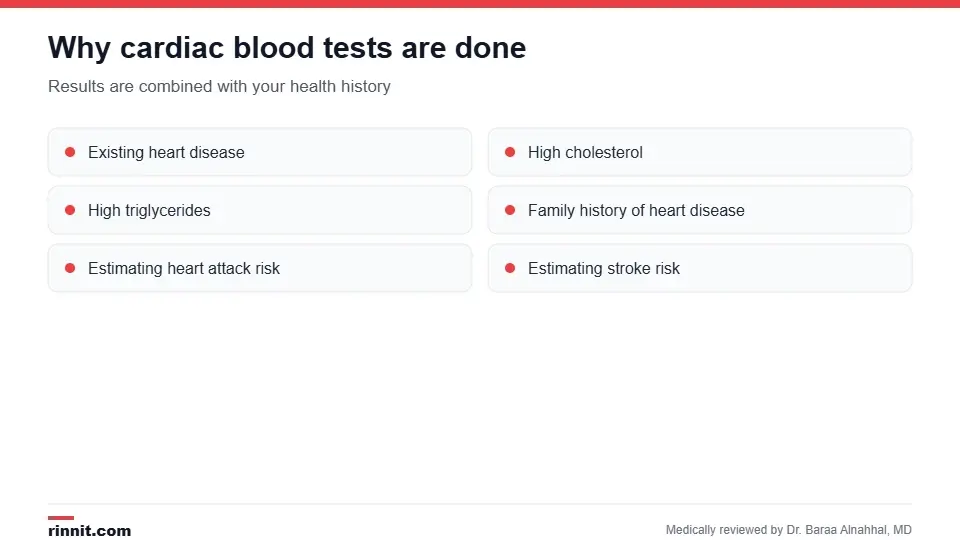
Results are combined with your health history.
You already have heart disease.
You have high cholesterol or high triglycerides.
You have a family history of heart disease.
To estimate your risk of heart attack, stroke or other cardiovascular problems. Sources: [1]
Types of cardiac blood tests

Each test reflects a different part of your heart risk.
Group | Tests | What they show |
Cholesterol | Total cholesterol, LDL, HDL, triglycerides | Fats that can build up in arteries |
Proteins | Lipoprotein (a), apolipoprotein B, fibrinogen, NT-proBNP | Inherited risk, harmful cholesterol particles, clotting and heart strain |
Inflammation | Ultra-sensitive CRP, myeloperoxidase (MPO) | Inflammation linked to plaque |
Diabetes | Hemoglobin A1c, fasting glucose, insulin | Blood sugar control |
Other | Homocysteine, TMAO | Other substances linked to heart risk |
NT-proBNP is a protein the heart releases when it's under strain, and it rises in heart failure. A related test, the BNP test, works the same way. Sources: [1, 2]
How to prepare
If you're asked to fast, have only water for 9 to 12 hours before the test.
Stay hydrated so your vein is easier to find.
A morning appointment is often easiest if you need to fast. Sources: [1]
What happens during the test
You sit in a chair with an armrest and roll up your sleeve.
The inside of your elbow is cleaned with antiseptic.
An elastic band is placed above your elbow.
A needle is inserted into a vein, and blood flows into tubes for the lab.
The band and needle are removed, and a bandage is applied. You can go home and eat and drink normally. Sources: [1]
Results
Test | Ideal level |
Total cholesterol | 125 to 200 mg/dL |
LDL | Below 100 mg/dL (below 70 mg/dL with diabetes or high risk) |
HDL | Above 40 to 60 mg/dL |
Triglycerides | Less than 150 mg/dL |
Lipoprotein (a) | Less than 30 mg/dL |
ApoB | Less than 100 mg/dL |
Fibrinogen | Less than 300 mg/dL |
NT-proBNP | Less than 125 pg/mL |
us-CRP | Less than 2.0 mg/L |
HbA1c | 5.6% or lower |
Fasting glucose | Less than 100 mg/dL |
Homocysteine | Less than 10 µmol/L |
TMAO | Less than 6.2 µM |
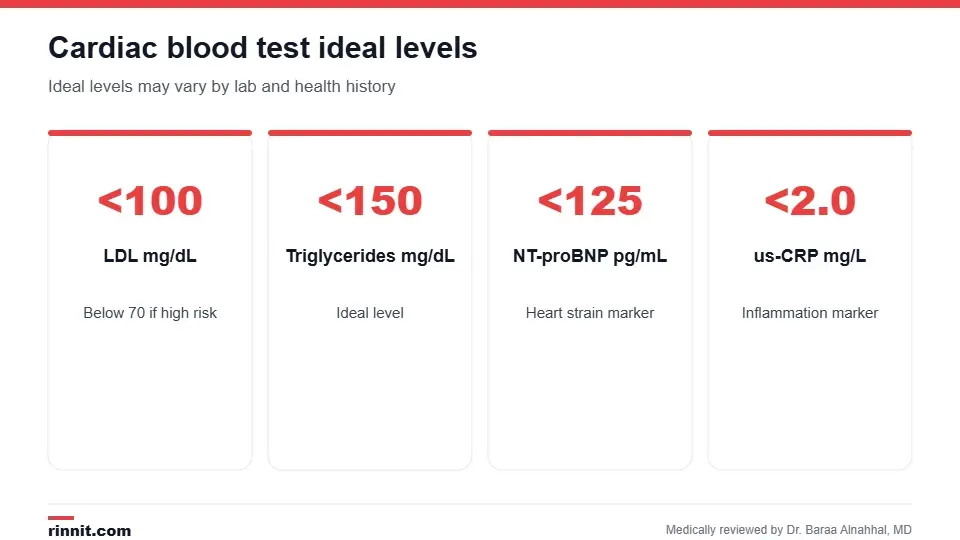
Results outside ideal levels may lead to lifestyle changes or medicine.
Results outside ideal levels may lead to advice to eat less fat, avoid fast food and red meat, exercise more, avoid tobacco and lose weight, or to medicines such as cholesterol-lowering drugs. Most results are ready within a couple of days. Call your provider if you haven't received results after a week or don't understand them. Sources: [1]
Conclusion
Cardiac blood tests give your provider a detailed picture of your heart disease risk. Together with your health history, they help you and your provider decide on lifestyle changes or medicines to protect your heart.
Keep learning: read about blood tests for heart disease risk and the lipid panel.
Frequently asked questions
What are cardiac blood tests?
Blood tests that help estimate your risk of heart disease and stroke.
What is the most common cardiac blood test?
A cholesterol panel, also called a lipid panel.
Do I need to fast?
Sometimes; if so, have only water for 9 to 12 hours.
What is NT-proBNP?
A protein the heart releases under strain; it rises in heart failure.
What is an ideal LDL level?
Below 100 mg/dL, or below 70 mg/dL with diabetes or high risk.
What does us-CRP measure?
Inflammation linked to heart disease.
Can these tests diagnose a heart attack?
No. A heart attack is checked with emergency tests such as troponin.
Who orders these tests?
Primary care providers or cardiologists.
How long do results take?
Usually a couple of days.
What happens if my results are high?
Lifestyle changes and possibly medicine.
Related Reading
Blood Tests for Heart Disease Risk: Lipids, Lp(a), apoB and hs-CRP blood tests used to assess heart disease risk.
Lipid Panel: What It Measures, Normal Cholesterol Levels and How to Prepare the standard cholesterol test.
BNP Test (B-Type Natriuretic Peptide): Normal Levels and What High BNP Means a heart-strain blood test.
Troponin Test: What It Is, Why It's Done, Normal Range and What High Levels Mean the main blood test for heart attacks.
Coronary Artery Disease: Symptoms, Causes, Diagnosis, Treatment and Prevention — What You Need to Know the condition these tests help assess.
References
Cleveland Clinic. Blood Tests for Heart Disease. Cleveland Clinic. Last updated November 26, 2021. https://my.clevelandclinic.org/health/diagnostics/22207-cardiac-blood-tests
Roberts E, Ludman AJ, Dworzynski K, et al. The diagnostic accuracy of the natriuretic peptides in heart failure: systematic review and diagnostic meta-analysis in the acute care setting. BMJ. 2015;350:h910. PMID 25740799. https://doi.org/10.1136/bmj.h910
Chiang CH, Chiang CH, Lee GH, et al. Safety and efficacy of the European Society of Cardiology 0/1-hour algorithm for diagnosis of myocardial infarction: systematic review and meta-analysis. Heart. 2020;106(13):985-991. PMID 32245882. https://doi.org/10.1136/heartjnl-2019-316343
Medical disclaimer
This article is for general education only and does not replace advice from a qualified healthcare professional. Talk to your doctor about your own diagnosis and treatment, and seek emergency care right away for severe or sudden symptoms.


Comments