Homocysteine Test: Normal Levels, Causes of High Homocysteine and What It Means for Your Heart

Updated: 2 days ago
Written and medically reviewed by Dr. Baraa Alnahhal, MD · Last reviewed: November 2026 · How we review
Quick Answer
A homocysteine test is a blood test that measures homocysteine, an amino acid the body breaks down with the help of vitamins B6, B9 (folate) and B12. A high level can point to a B-vitamin deficiency, homocystinuria or a higher risk of heart disease, stroke and blood clots. A normal level is usually below about 15 µmol/L.
What the research says
Lowering homocysteine with vitamins has limited heart benefit: a Cochrane review of 15 randomized trials with 71,422 people found that B-vitamin supplements to lower homocysteine did not reduce heart attacks or deaths, but slightly reduced stroke (4.3% vs 5.1%, a 10% relative reduction) (Martí-Carvajal AJ et al., Cochrane Database of Systematic Reviews, 2017) [2]
Genetics support a modest link with heart disease: in 40 studies with 11,162 people with coronary heart disease and 12,758 controls, people with the MTHFR 677 TT gene variant, which raises homocysteine, had 16% higher odds of coronary heart disease, especially when folate levels were low (Klerk M et al., JAMA, 2002) [3]
Key takeaways
Homocysteine is an amino acid broken down with vitamins B6, B9 (folate) and B12.
The test helps find B-vitamin deficiencies and assess heart and stroke risk; it's also part of newborn screening for homocystinuria.
You may need to fast for 8–12 hours and should list all medicines and supplements.
Normal is usually below about 15 µmol/L.
Treating a deficiency is important, but B-vitamin supplements haven't been shown to prevent heart attacks.
What is homocysteine?
Homocysteine is made when your body breaks down methionine, an amino acid from protein-rich foods. Normally, vitamins B6, B9 and B12 quickly convert it into other substances. If you don't have enough of these vitamins, or an inherited enzyme problem slows the process, homocysteine builds up in the blood. High levels may damage the lining of blood vessels and promote clotting. Sources: [1]
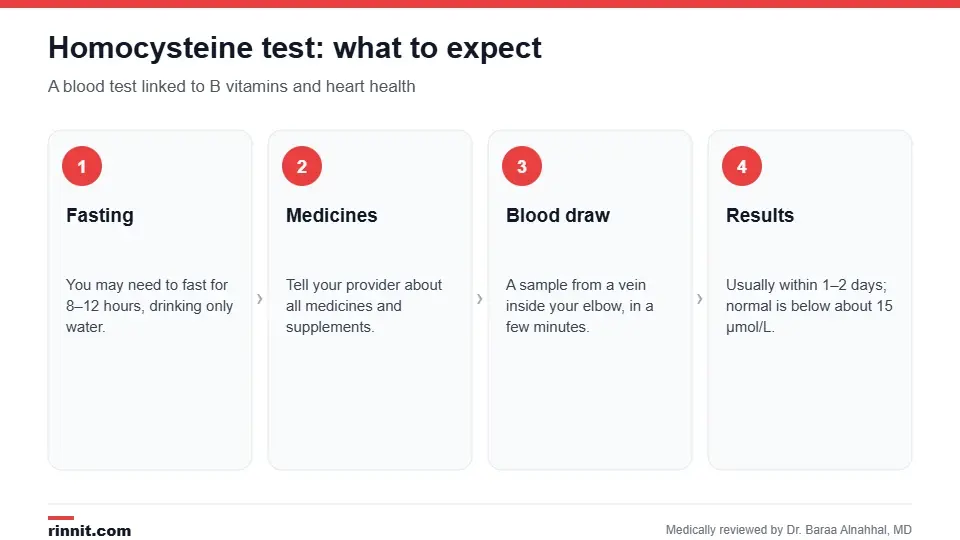
The homocysteine test is a routine blood draw.
Why is it done?
To check for a deficiency of vitamin B12, folate or vitamin B6.
To assess the risk of heart disease or stroke, or to monitor heart disease.
As part of newborn screening for homocystinuria, a rare inherited condition. Sources: [1]
Your provider may also order it for symptoms of B-vitamin deficiency, such as fatigue and weakness, numbness or tingling in the hands and feet, balance or memory problems, palpitations, shortness of breath, depression, tongue changes, scaly skin or bowel changes. Sources: [1]
How do I prepare?
You may need to fast for 8–12 hours, drinking only water.
Tell your provider about all medicines and supplements, including B vitamins, which can affect results. Sources: [1]
What happens during the test?
A provider draws blood from a vein on the inside of your elbow.
The sample is sent to a lab.
Keep the bandage on and avoid exercise for a few hours afterward. Sources: [1]
The test takes only a few minutes and is very safe. You may get a small bruise; rarely, the vein swells, and a warm compress helps. Results are usually ready in a day or two. Sources: [1]
Understanding your results
A normal homocysteine level is usually less than 15.1 µmol/L, though reference ranges differ slightly between labs. A higher level isn't a diagnosis but a sign to look for the cause. Sources: [1]
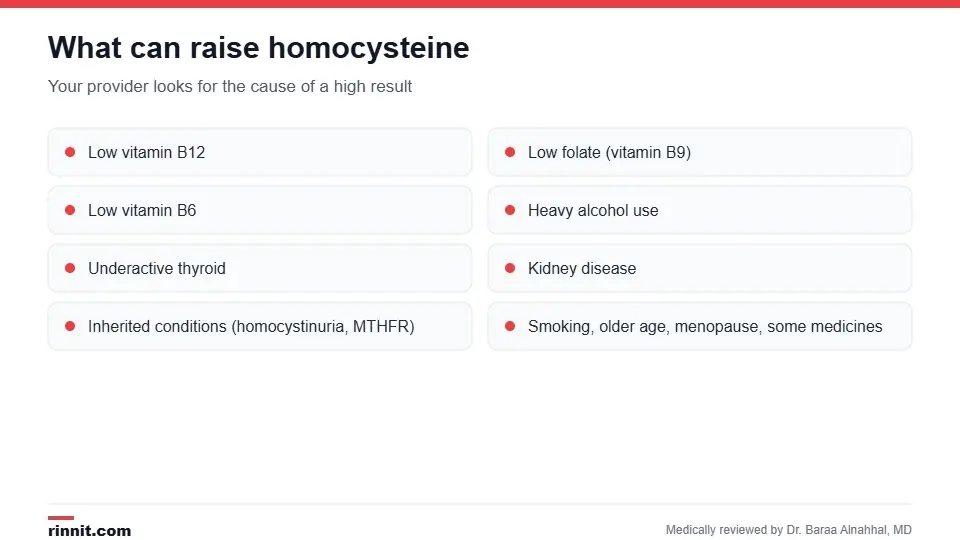
Your provider looks for the cause of a high level.
Possible cause | Notes |
Low vitamin B12, folate or B6 | From diet, poor absorption or megaloblastic anemia |
Heavy alcohol use | More than recommended amounts |
Other conditions | Underactive thyroid, Alzheimer's disease, kidney disease |
Inherited conditions | Homocystinuria; MTHFR gene variants can raise levels modestly |
Other factors | Older age (higher in men), menopause, smoking and some medicines |
High homocysteine is linked to blood clots, coronary artery disease, atherosclerosis, heart attack, peripheral vascular disease and stroke. Sources: [1, 3]
Does lowering it help?

Results from 15 randomized trials of B-vitamin supplements.
If a vitamin deficiency is found, treating it with B12, folate or B6 is important for your nerves, blood and overall health. However, large trials show that taking B vitamins just to lower homocysteine doesn't prevent heart attacks, though it may slightly reduce stroke. Managing blood pressure, cholesterol, blood sugar and smoking remains the main way to protect your heart. Sources: [2]
Conclusion
The homocysteine test is a useful clue to B-vitamin status and an extra piece of information about heart and stroke risk. If your level is high, your provider will look for the cause, often a low B12 or folate, and treat it. Ask how your result fits with your other heart risk factors.
Keep learning: read about vitamin B12 deficiency and MTHFR gene variants.
Frequently asked questions
What is a normal homocysteine level?
Usually below about 15 µmol/L, though labs vary slightly.
Do I need to fast?
Often yes, for 8–12 hours, drinking only water.
What causes high homocysteine?
Most often low B12, folate or B6; also alcohol, underactive thyroid, kidney disease, inherited conditions, smoking and some medicines.
Is high homocysteine dangerous?
It's linked to a higher risk of heart disease, stroke and blood clots.
Can B vitamins lower homocysteine?
Yes, but trials show they don't prevent heart attacks, though they may slightly reduce stroke.
What is homocystinuria?
A rare inherited condition that causes very high homocysteine; it's included in newborn screening.
Does an MTHFR variant mean I have high homocysteine?
Not necessarily; common MTHFR variants raise levels only modestly, mainly when folate is low.
How long do results take?
Usually one to two days.
Should everyone get a homocysteine test?
No. It's ordered for specific reasons, such as suspected B-vitamin deficiency or heart risk assessment.
Can I exercise after the test?
Avoid exercise for a few hours afterward.
Related Reading
Understanding Vitamin B12 Deficiency: Causes, Symptoms, and Recovery the most common cause of a high homocysteine.
Folate Deficiency Anemia: Symptoms, Causes, and Management low folate, another common cause.
MTHFR Gene Variants: What They Mean, Testing and Care gene changes that can modestly raise homocysteine.
Homocystinuria: Understanding the Genetic Buildup of Homocysteine the inherited condition found by newborn screening.
Megaloblastic Anemia: Understanding Vitamin-Deficiency Blood Disorders anemia from B12 or folate deficiency.
Methylmalonic Acid (MMA) Test: Normal Range, High MMA and Vitamin B12 explains the test that shows whether your body is truly short of vitamin B12.
Blood Tests for Heart Disease Risk: Lipids, Lp(a), apoB and hs-CRP explains the blood tests used to estimate coronary artery disease risk.
References
Cleveland Clinic. Homocysteine Test: Purpose, Procedure & Results. Cleveland Clinic. Last updated February 2, 2022. https://my.clevelandclinic.org/health/diagnostics/22393-homocysteine-test
Martí-Carvajal AJ, Solà I, Lathyris D, et al. Homocysteine-lowering interventions for preventing cardiovascular events. Cochrane Database of Systematic Reviews. 2017;8(8):CD006612. PMID 28816346. https://doi.org/10.1002/14651858.CD006612.pub5
Klerk M, Verhoef P, Clarke R, et al. MTHFR 677C→T polymorphism and risk of coronary heart disease: a meta-analysis. JAMA. 2002;288(16):2023-2031. PMID 12387655. https://doi.org/10.1001/jama.288.16.2023
Medical disclaimer
This article is for general education only and does not replace advice from a qualified healthcare professional. Talk to your doctor about your own diagnosis and treatment, and seek emergency care right away for severe or sudden symptoms.



Comments