Blood Tests for Heart Disease Risk: Lipids, Lp(a), apoB and hs-CRP

Updated: 3 days ago
Written and medically reviewed by Dr. Baraa Alnahhal, MD · Last reviewed: November 2026 · How we review
Quick Answer
Blood tests for coronary artery disease risk help estimate your chance of developing heart disease or having a heart attack. The core test is a lipid panel (total cholesterol, LDL, HDL and triglycerides). These tests don't diagnose heart disease on their own, but they help your provider judge risk and decide on lifestyle changes or medicines such as statins.
What the research says
Inflammation markers can identify hidden risk: in a trial of 17,802 healthy adults with normal LDL but hs-CRP of 2 mg/L or higher, a statin reduced major cardiovascular events by 44% compared with placebo (Ridker PM et al., N Engl J Med, 2008) [2]
Lipoprotein(a) is an inherited risk factor: in a large Danish population study, people with lipoprotein(a) levels above the 95th percentile had about 2.6 times the risk of heart attack compared with those with the lowest levels, and genetic data suggested the link is causal (Kamstrup PR et al., JAMA, 2009) [3]
Key takeaways
Blood tests estimate heart disease risk but don't diagnose it.
The lipid panel is the core test.
Lp(a), apoB and hs-CRP add information about hidden risk.
Blood sugar, kidney and other tests round out the picture.
Ask whether you need to fast before testing.
Who should be tested?
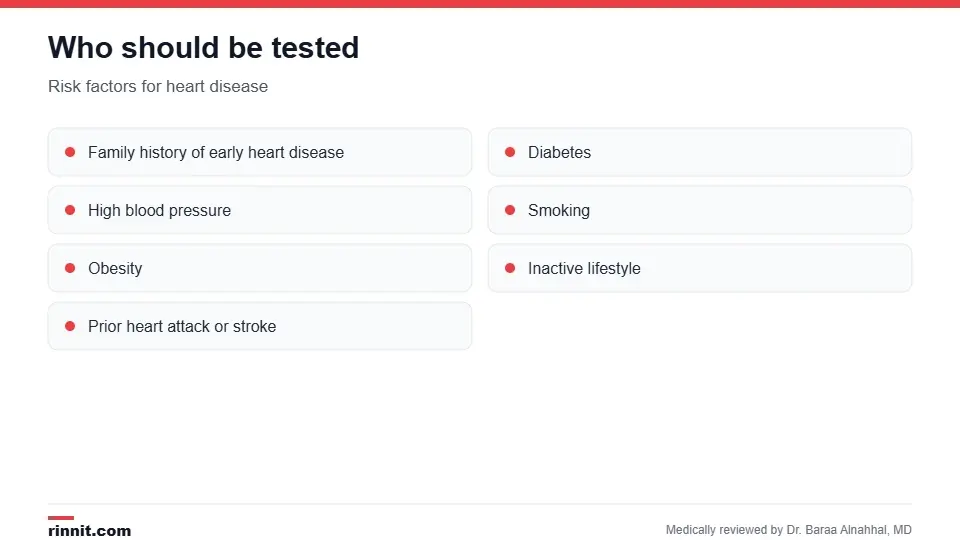
Risk factors help decide who needs testing.
A family history of coronary artery disease, especially diagnosed at age 50 or younger.
Diabetes, high blood pressure or a prior heart attack or stroke.
Smoking or tobacco use.
Obesity, an unhealthy diet or too little physical activity. Sources: [1]
Cholesterol and lipid tests
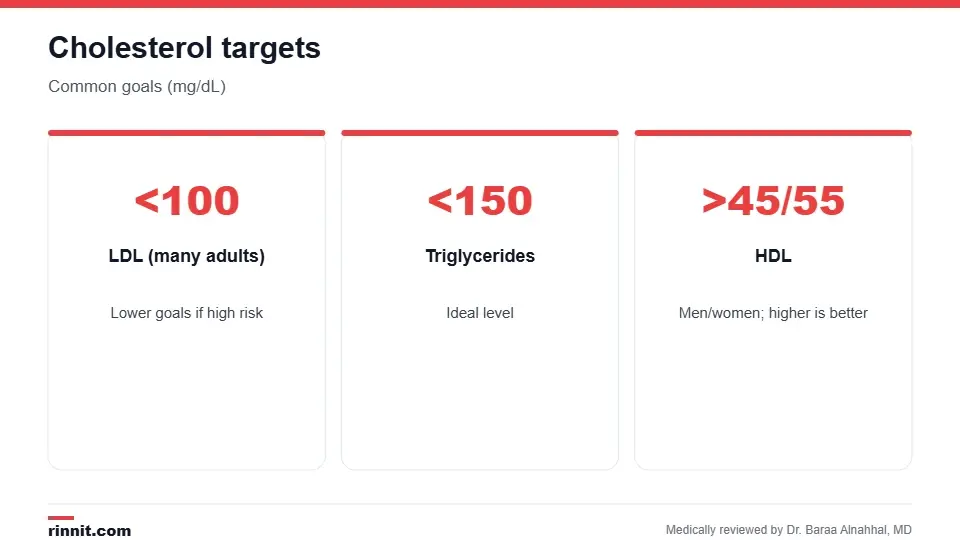
Targets depend on your overall risk.
Test | Target or ideal |
Total cholesterol | 100–199 mg/dL (adults 21+) |
LDL ("bad") cholesterol | Below 70 mg/dL with heart disease, diabetes or very high risk; below 100 with metabolic syndrome or several risk factors; below 130 at low risk |
HDL ("good") cholesterol | Above 45 mg/dL (men) or 55 mg/dL (women) |
Triglycerides | Below 150 mg/dL |
Lipoprotein(a) | Below 30 mg/dL; often runs in families |
Apolipoprotein B | Below 100 mg/dL |
The lipid panel is the starting point. The apolipoprotein B test may reflect risk better than LDL alone. Very high triglycerides, above 500–1,000 mg/dL, also raise the risk of pancreatitis. Sources: [1]
Other risk markers
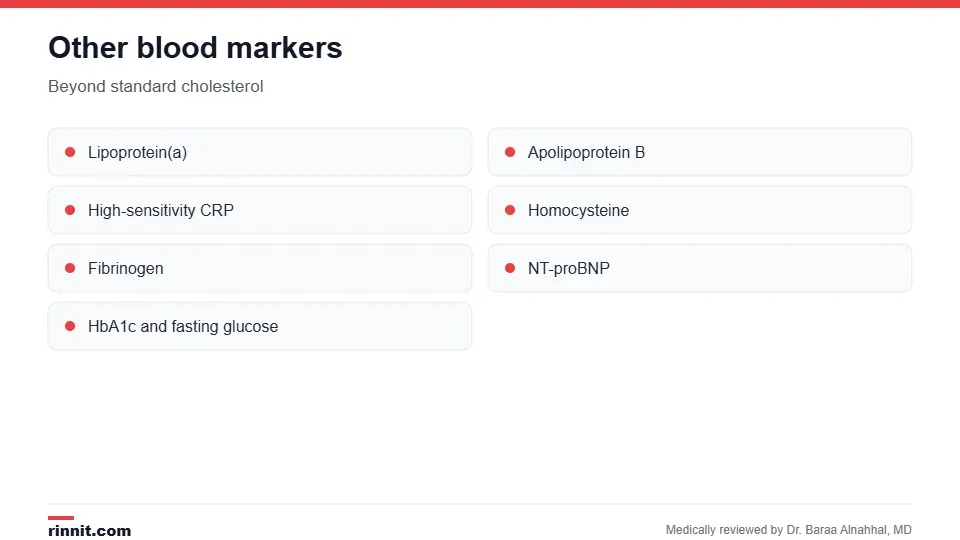
These markers add detail beyond cholesterol.
Test | Ideal level | What it reflects |
Below 2.0 mg/L (high risk above 3.0) | Inflammation in blood vessels | |
Below 15 µmol/L | An amino acid linked to vessel damage | |
Fibrinogen | 200–400 mg/dL | A clotting protein |
NT-proBNP | Below 125 pg/mL | Strain on the heart |
6% or lower | Average blood sugar | |
Below 100 mg/dL | Blood sugar after fasting |
Your provider may also check kidney function (urine albumin), liver enzymes, creatine kinase, thyroid function, vitamin D and a complete blood count, especially if you take or may start cholesterol medicine. Sources: [1]
How is the test done?
Ask your provider whether to fast and whether to pause any medicines, vitamins or supplements; don't stop medicines on your own. A phlebotomist draws blood from your hand or inside your elbow in about a minute. Results usually take a few days. Sources: [1]
Understanding your results
Abnormal numbers don't mean you have heart disease, but they raise your estimated risk. Your provider combines results with your age, blood pressure, smoking and other factors, often using a 10-year risk score, to plan care. Management may include diet and exercise changes and, when needed, medicines such as statins. Sources: [1, 2, 3]
Conclusion
Heart disease risk blood tests give a fuller picture of your cardiovascular health than cholesterol alone. Knowing your numbers early gives you time to lower your risk before problems start.
Keep learning: read about high cholesterol and the lipid panel.
Frequently asked questions
Which blood tests check heart disease risk?
A lipid panel plus tests like Lp(a), apoB, hs-CRP and HbA1c.
Can a blood test diagnose heart disease?
No. It estimates risk; other tests diagnose disease.
What is a good LDL level?
Often below 100 mg/dL, and lower if you're at high risk.
What is lipoprotein(a)?
An inherited cholesterol particle that raises heart attack risk.
What does high hs-CRP mean?
More inflammation and a higher heart risk.
Do I need to fast?
Ask your provider; some tests need fasting.
Who should be tested?
People with risk factors like family history, diabetes or smoking.
How long do results take?
Usually a few days.
What happens if my results are high?
Your provider may suggest lifestyle changes or medicine.
Is apoB better than LDL?
It may reflect risk better for some people.
Related Reading
Cardiac Blood Tests: Heart Disease Risk Tests and Ideal Levels explains the blood tests used to estimate heart disease risk.
Carotid Intima-Media Thickness (CIMT) Test: Checking Artery Walls explains the ultrasound that measures carotid artery wall thickness.
Lipid Panel: What It Measures, Normal Cholesterol Levels and How to Prepare the core cholesterol blood test.
Apolipoprotein B (Apo B) Test: Normal Levels and What High Results Mean a test of atherogenic particles.
C-Reactive Protein (CRP) Test: Normal Levels, High CRP and What Results Mean an inflammation marker linked to heart risk.
Homocysteine Test: Normal Levels, Causes of High Homocysteine and What It Means for Your Heart another heart risk marker.
Coronary Artery Disease: Symptoms, Causes, Diagnosis, Treatment and Prevention — What You Need to Know the condition these tests help predict.
References
Cleveland Clinic. What Blood Tests Detect Heart Problems? Cleveland Clinic. Last updated August 31, 2022. https://my.clevelandclinic.org/health/diagnostics/16792-blood-tests-to-determine-risk-of-coronary-artery-disease
Ridker PM, Danielson E, Fonseca FA, et al. Rosuvastatin to prevent vascular events in men and women with elevated C-reactive protein. N Engl J Med. 2008;359(21):2195-2207. PMID 18997196. https://doi.org/10.1056/NEJMoa0807646
Kamstrup PR, Tybjaerg-Hansen A, Steffensen R, et al. Genetically elevated lipoprotein(a) and increased risk of myocardial infarction. JAMA. 2009;301(22):2331-2339. PMID 19509380. https://doi.org/10.1001/jama.2009.801
Medical disclaimer
This article is for general education only and does not replace advice from a qualified healthcare professional. Talk to your doctor about your own diagnosis and treatment, and seek emergency care right away for severe or sudden symptoms.



Comments