Statins: How They Work, Benefits, Side Effects, and Who Needs Them

Updated: 5 days ago
Written and medically reviewed by Dr. Baraa Alnahhal, MD · Last reviewed: November 2026 · How we review
Quick Answer: What are statins?
Statins are prescription medicines that lower LDL, the "bad" cholesterol that builds up inside arteries, by blocking an enzyme the liver needs to make cholesterol. Lower LDL means less plaque and a lower chance of heart attack or stroke. Most people take statins without problems; muscle aches are the most common complaint. [1]
What the research says
Every drop in LDL lowers heart risk. A pooled analysis of 26 trials with about 170,000 people found that each 1.0 mmol/L (about 39 mg/dL) fall in LDL cut major heart and stroke events by just over a fifth and lowered death from any cause by 10%, with no rise in cancer. (Cholesterol Treatment Trialists' Collaboration, Lancet, 2010)
Statins help even people without heart disease yet. A review of 18 trials with 56,934 people who had never had heart disease found statins lowered the odds of death by 14% and cut heart and blood vessel events by 25%, with no evidence of serious harm. (Taylor et al., Cochrane Database Syst Rev, 2013)
Most muscle aches are not caused by the statin. In 19 blinded trials with 123,940 people, muscle pain or weakness was reported by 27.1% on a statin and 26.6% on a placebo. More than 90% of muscle complaints in the statin group were not due to the drug. (Cholesterol Treatment Trialists' Collaboration, Lancet, 2022)
Key takeaways
Statins lower LDL cholesterol and triglycerides, and may raise HDL ("good") cholesterol.
Some statins can lower LDL by 50% or more.
They are usually a long-term, often lifelong, medicine.
Most people have no side effects. Muscle aches and mild liver test changes are the most common.
Statins are usually stopped in pregnancy and breastfeeding, and may not suit some liver diseases.
What are statins?
Statins are prescription medicines that bring high cholesterol down to a healthier level by mainly targeting LDL (low-density lipoprotein), the type of cholesterol that sticks to artery walls. [1]
When LDL builds up, it forms plaque. Plaque narrows your blood vessels and makes it harder for blood to flow. If plaque fully blocks an artery, it can cause a heart attack or stroke. [1]
Statins also: [1]
Lower your triglycerides (another blood fat).
Help your liver clear more cholesterol from your blood.
May raise HDL, the "good" cholesterol that carries cholesterol back to your liver for removal.
Statins are among the most prescribed medicines in the U.S.: about 92 million adults aged 40 and older reported taking one in 2018–2019. [5]
If you want the bigger picture on high cholesterol itself, read our guide to hyperlipidemia and managing high cholesterol.
How do statins work?
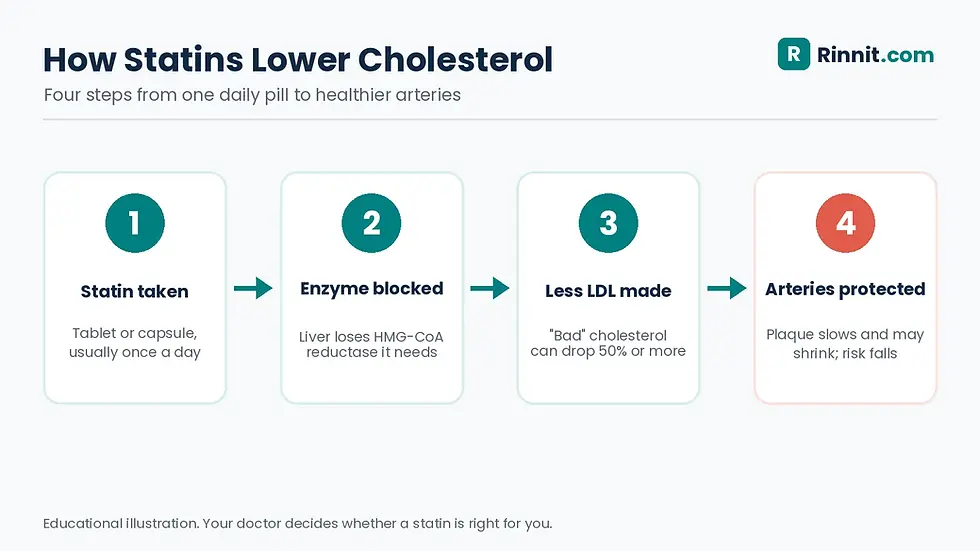
Statins work by blocking HMG-CoA reductase, an enzyme your liver needs to make cholesterol. Your body makes most of its own cholesterol in the liver, and the rest comes from the food you eat. [1]
Think of a basketball defender who keeps the other team from getting the ball: the liver simply can't get what it needs to produce cholesterol. Because your body makes most of your cholesterol, cutting that production can drop your levels a lot. [1]
Why are statins used?
Statins are used to lower total and LDL cholesterol, reduce inflammation and slow plaque growth in the arteries, which lowers the risk of heart attack and stroke. [1]
Your body does need some cholesterol. It uses it to make vitamin D, hormones, and the bile acid that helps you digest food. The problem is too much cholesterol in your blood. Extra LDL collects inside your arteries, a process called atherosclerosis. Over time, plaque can: [1]
Narrow your arteries and slow blood flow.
Become unstable and break open.
Trigger a clot that causes a heart attack or stroke.
By lowering cholesterol, statins slow plaque growth, and some plaque may even shrink. Learn more about plaque in the body's largest artery in our article on atherosclerosis of the aorta. [1]
Statin benefits at a glance
Benefit | What it means for you |
Lower LDL cholesterol | Some statins cut LDL by 50% or more |
Lower triglycerides | Less of another fat that harms arteries |
Possible HDL boost | More "good" cholesterol to clear the bad |
Slower plaque buildup | Existing plaque may stop growing or shrink |
Less inflammation | Calmer artery walls |
Fewer heart attacks and strokes | The main goal of treatment |
Source: [1]
What types of statins are there?
The main types of statins are atorvastatin, rosuvastatin, simvastatin, pravastatin, pitavastatin, fluvastatin and lovastatin, available as brand-name or generic medicines. Generic versions contain the same active medicine. [1]
Generic name | Brand name(s) |
Atorvastatin | Lipitor, Atorvaliq |
Rosuvastatin | Crestor |
Simvastatin | Zocor, FloLipid |
Pravastatin | Pravachol |
Pitavastatin | Livalo, Zypitamag |
Fluvastatin | Lescol XL |
Lovastatin | Available as generic |
Source: [1]
Some statins also come combined with a second medicine in one pill: [1]
Simvastatin with ezetimibe (another cholesterol medicine)
Atorvastatin with ezetimibe
Atorvastatin with amlodipine (a blood pressure medicine)

Who needs to take statins?
People who need statins are usually those whose cholesterol stays high despite healthier eating and more physical activity, especially if they have other heart risk factors. Your doctor looks at your overall risk of heart and blood vessel disease. Key risk factors include: [1]
Risk factor | Why it matters |
Diabetes | Raises the risk of artery damage |
High blood pressure | Strains and injures artery walls |
High cholesterol | Feeds plaque buildup |
Tobacco use | Damages blood vessels |
BMI over 30 | Linked to higher heart risk |
Family history of heart disease | Shared genes can raise your risk |
Past stroke, heart attack, or peripheral artery disease (PAD) | You're at higher risk of another event |
Source: [1]
Women can have different warning signs and risk factors. Read more in our guide to heart disease in women.
How should you take statins?
You should take your statin once a day at the same time, swallowed whole with or without food, at the dose your doctor chooses. Doses range from 1 mg to 80 mg. [1]
Statins come as tablets or capsules. Swallow them whole, with or without food.
Take your statin at the same time every day, usually once daily.
Check the label. Some statins leave your body quickly and work best in the evening, before your body makes cholesterol overnight. Others last longer and work just as well at any time of day.
Tell your doctor about everything you take, including prescriptions, over-the-counter medicines, vitamins, herbs, supplements, and recreational drugs. Some of these can interact with statins.
How long will you need to take a statin?
Most people need to take a statin for life, because the most benefit comes from taking it for decades. If you stop, your cholesterol will likely climb back up unless you've made major changes to how you eat and move. [1]
What are the side effects and risks of statins?
The most common side effect of statins is muscle aches, followed by mild liver test changes, and most people have no side effects at all. Your doctor will monitor your health while you take one. [1]
Side effect or risk | What to know |
Muscle aches | The most common complaint |
Liver test changes | Usually mild and reversible |
Diabetes risk | May rise slightly if you're already at risk; the heart benefit greatly outweighs this |
Weight gain | Possibly slight; staying active and eating well still matters |
Drug interactions | Share your full medicine and supplement list with your doctor |
Source: [1]
If one statin causes side effects, ask your doctor about switching to a different one. Don't stop or switch on your own. [1]
When should you call a doctor while taking a statin?
Call your doctor while taking a statin if you have muscle or joint pain, weakness, fever, yellowing of your skin or eyes, or dark urine. [1]
Muscle or joint pain
Weakness
Fever
Yellowing of your skin or eyes (jaundice)
Dark urine

Who should avoid statins?
Statins are usually stopped during pregnancy and breastfeeding and may not suit people with certain types of liver disease; some very high-risk pregnant patients may continue under a doctor's care. [1] [8]
Pregnant
Breastfeeding
Living with certain types of liver disease
Tell your doctor if you have diabetes. Statins can slightly raise the risk of developing diabetes in people already at risk, but their benefits greatly outweigh this risk. [1]
For more on blood sugar medicines that also protect the heart, see our guide to SGLT2 inhibitors for type 2 diabetes.
Conclusion
Statins are one of the most effective tools for lowering LDL cholesterol and protecting your heart and brain. They work by slowing your liver's cholesterol production, which reduces plaque and lowers your risk of heart attack and stroke.
Many people find their cholesterol won't budge despite their best efforts with food and exercise. That's common, and it's when a statin can help. You'll still get the best results if you keep eating well and staying active while you take it.
Have questions about your cholesterol or whether a statin fits your situation? Bring this guide to your next appointment, and explore more heart health guides on [Rinnit.com](https://www.rinnit.com).
FAQ
What do statins do?
Statins lower LDL ("bad") cholesterol by blocking an enzyme your liver needs to make cholesterol. They also lower triglycerides, may raise HDL, reduce inflammation, and slow plaque buildup in your arteries.
What is the most common side effect of statins?
Muscle aches are the most common side effect of statins. Some people also have mild, reversible changes on liver blood tests, and most people have no side effects at all.
How much can statins lower cholesterol?
Some statins can lower LDL cholesterol by 50% or more, depending on the medicine and dose.
Do I have to take statins for life?
Yes, most people take statins for life. The biggest benefit comes from taking a statin for decades, and if you stop, your cholesterol will likely rise again unless you make significant lifestyle changes.
What time of day should I take my statin?
The best time of day to take your statin depends on the medicine, so follow your label. Short-acting statins work best in the evening, while longer-acting ones work just as well at other times of day.
Do statins cause weight gain?
Statins may cause slight weight gain, according to some researchers. Some people also eat more because their cholesterol results look good, so healthy eating and activity still matter.
Do statins cause diabetes?
Statins can slightly raise the risk of diabetes in people who are already at risk. The heart benefits greatly outweigh this small risk for most people.
Who should not take statins?
Statins are usually stopped in pregnancy and breastfeeding and may not suit some liver diseases; your doctor will advise if you are at very high risk.
What should I do if my statin causes side effects?
If your statin causes side effects, talk to your doctor, who may switch you to a different statin. Call them promptly if you have muscle or joint pain, weakness, fever, yellow skin or eyes, or dark urine.
Can I eat grapefruit while taking a statin?
Grapefruit and grapefruit juice can raise the level of some statins in your blood, such as simvastatin, lovastatin and atorvastatin, which raises the risk of side effects. Ask your pharmacist whether your statin is affected. [6] [7]
Related reading
References
Cleveland Clinic. Statins: Benefits & Side Effects. Cleveland Clinic. Last updated August 24, 2026. https://my.clevelandclinic.org/health/treatments/22282-statins
Cholesterol Treatment Trialists' (CTT) Collaboration; Baigent C, Blackwell L, Emberson J, et al. Efficacy and safety of more intensive lowering of LDL cholesterol: a meta-analysis of data from 170,000 participants in 26 randomised trials. Lancet. 2010;376(9753):1670-1681. PMID 21067804. https://doi.org/10.1016/S0140-6736(10)61350-5
Taylor F, Huffman MD, Macedo AF, et al. Statins for the primary prevention of cardiovascular disease. Cochrane Database Syst Rev. 2013;2013(1):CD004816. PMID 23440795. https://doi.org/10.1002/14651858.CD004816.pub5
Cholesterol Treatment Trialists' Collaboration. Effect of statin therapy on muscle symptoms: an individual participant data meta-analysis of large-scale, randomised, double-blind trials. Lancet. 2022;400(10355):832-845. PMID 36049498. https://doi.org/10.1016/S0140-6736(22)01545-8
Matyori A, Brown CP, Ali A, et al. Statins utilization trends and expenditures in the U.S. before and after the implementation of the 2013 ACC/AHA guidelines. Saudi Pharm J. 2023;31(6):795-800. PMID 37228328. https://doi.org/10.1016/j.jsps.2023.04.002
National Health Service (U.K.). Statins. NHS website. Last updated May 5, 2026. https://www.nhs.uk/medicines/statins/
National Library of Medicine (U.S.). Statins. MedlinePlus. Last updated May 5, 2025. https://medlineplus.gov/statins.html
U.S. Food and Drug Administration. FDA requests removal of strongest warning against using cholesterol-lowering statins during pregnancy; still advises most pregnant patients should stop taking statins. U.S. Food and Drug Administration. July 20, 2021. https://www.fda.gov/drugs/drug-safety-and-availability/fda-requests-removal-strongest-warning-against-using-cholesterol-lowering-statins-during-pregnancy
Medical disclaimer
This article is for general education and does not replace advice from your doctor, pharmacist or another qualified healthcare professional. Never start, stop or switch a statin without your doctor's guidance. If you have chest pain, signs of a stroke, or severe muscle pain with dark urine, seek emergency care right away.



Comments