What Is Atherosclerosis of the Aorta? Symptoms, Causes, and Treatment

Updated: 3 days ago
Medically reviewed by Dr. Baraa Alnahhal, MD · Last reviewed: October 2026
Quick Answer: What is atherosclerosis of the aorta and is it serious?
Atherosclerosis of the aorta is plaque buildup in the aorta, the major artery carrying blood from the heart to the body. [7] It often causes no symptoms on its own, but it raises the risk of life-threatening emergencies if plaque or clots break off and block blood flow. [1] Statins, blood pressure drugs, clot-prevention pills and heart-healthy habits help manage it. [9]
Key takeaways
Atherosclerosis of the aorta means progressive plaque buildup in the aorta, the largest artery in your body; it most often becomes severe in the abdominal aorta. [9]
It is a silent condition for years. You may have no symptoms until a clot or plaque fragment blocks blood flow somewhere else. [9]
The main complication is an embolus: a sudden, traveling blockage that can cause a heart attack, stroke, or loss of blood flow to an organ or limb. [9]
Plaque over about 4 millimeters thick carries a higher embolism risk; plaque under 1 millimeter is considered mild. [5] [9]
The condition cannot be cured or reversed, but it can be managed with medications and lifestyle changes. [9]
Call 911 or your local emergency number immediately for chest pain, stroke symptoms, sudden limb pain or coldness, or sudden severe belly or back pain. [9]
What the research says
Plaque in the aortic arch is linked to about four times the odds of stroke. A meta-analysis of 12 observational studies (3,918 participants) found an odds ratio of 3.93 (95% CI 2.86-5.40) for stroke when aortic atheroma was present. Complex atheroma carried a higher risk (OR 5.90, 95% CI 4.14-8.41) than protruding atheroma (OR 3.75, 95% CI 3.05-4.61). (Cui et al., J Evid Based Med, 2014) [4]
A plaque thickness of 4 mm or more is the most common cut-off for "complex" plaque, which is found in about a third of people with cryptogenic stroke. In a systematic review of 45 studies, 74% used 4 mm or more as the imaging criterion. Across 23 prospective studies, complex aortic plaque was found in 960 of 2,778 patients with cryptogenic stroke (pooled prevalence 32%, 95% CI 24-41%), though results varied widely between studies. (Sakai et al., J Am Heart Assoc, 2023) [5]
Plaque in the aorta often signals trouble in the heart's arteries too. Among 187 patients who had transesophageal echocardiography, thoracic aortic atheroma above grade II was linked to 7.5 times the odds of high-risk coronary anatomy. During a 41-month follow-up, 25% of patients with atheroma above grade II died, compared with 8% of those with grade II or lower. (Shen et al., Arch Med Sci, 2011) [2]
What Is Atherosclerosis of the Aorta?
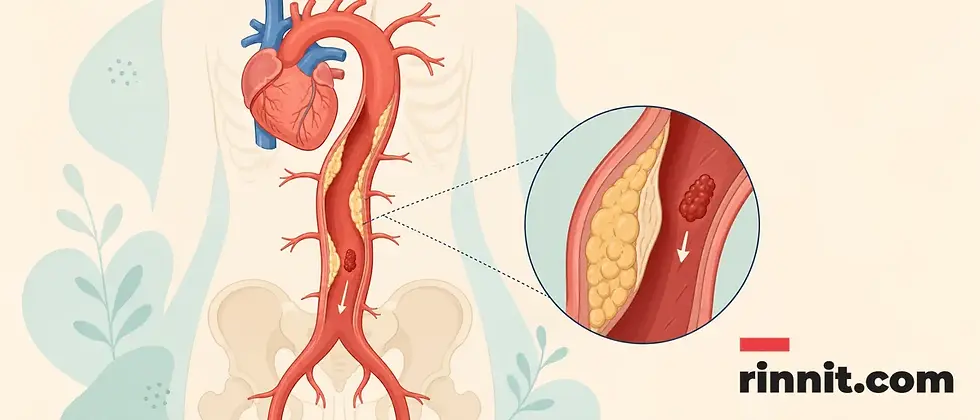
Atherosclerosis of the aorta is the progressive buildup of plaque in the aorta, the largest artery in your body. [9] You may also hear it called aortic atherosclerosis. Plaque is a sticky substance made of fat, cholesterol, and other components. [6] It begins forming in your arteries as early as childhood and gradually accumulates as you age. [6]
Plaque can develop anywhere along the aorta, which stretches more than a foot from your heart down to your pelvis. Severe buildup is most likely in the abdominal aorta, the section that runs through your belly. [9]
Because atherosclerosis is a systemic disease, people with plaque in the aorta often have plaque in other arteries too, including the coronary arteries that feed the heart (see coronary artery disease) and the carotid arteries that feed the brain. Plaque in one artery often signals plaque elsewhere. [2]
How Common Is Atherosclerosis of the Aorta?
Aortic atherosclerosis can affect anyone, and it is a common condition. Your risk goes up as you get older. [9] Many people carry some degree of aortic plaque without ever knowing it, because the condition develops silently over decades.
How Does Atherosclerosis of the Aorta Affect the Body?
The aorta is the main pipeline that carries blood to your entire body. [3] [7] Smaller arteries branch off it to deliver oxygen-rich blood in different directions: up to your brain, down to your legs, and out to your organs. Plaque along the aorta disrupts this normal flow and raises your risk of ischemia, a shortage of oxygen-rich blood in organs and tissues.
Here is the surprising part: total blockage of the aorta itself is actually unlikely. Your aorta is so wide that blood can usually keep flowing even with plaque along its walls. [9] The main problem is something else entirely: the embolus.
An embolus is any object that travels through your bloodstream until it gets stuck and cannot move any further. The moment it lodges in an artery, it cuts off blood flow. Plaque growth is gradual, like soap scum building up in a bathroom drain. An embolus is sudden, like dropping a toothpaste cap straight down the pipe, where it wedges and blocks the water.
Embolus type | What it is made of | How it forms | How common |
Thromboembolism | A blood clot | A clot forms on the surface of the plaque, then breaks away and travels through the bloodstream | More common |
Cholesterol crystals from the plaque | The plaque ruptures (breaks open), a fragment breaks away, and it travels through the bloodstream | Less common |
An embolus can travel anywhere the blood flows. How it affects your body depends entirely on where it ends up stuck. The tissue or organ downstream loses its oxygen supply and quickly becomes damaged.
Is Atherosclerosis of the Aorta Serious?
Atherosclerosis of the aorta can lead to a life-threatening medical emergency when an embolus breaks away and blocks blood flow somewhere else in your body. [9] The table below lists the emergencies it raises your risk of.
Emergency | What happens |
Blood flow to the heart is blocked | |
Stroke or transient ischemic attack (TIA) | Blood flow to the brain is blocked |
Acute limb ischemia | Blood flow to the limbs, usually the legs, is blocked |
Acute ischemic colitis | Blood flow to the colon is blocked |
Renal infarction | Blood flow to the kidneys is blocked |
Splenic infarction | Blood flow to the spleen is blocked |
Aortic aneurysm, rupture, or dissection | Plaque weakens the aortic wall, raising the risk of a bulge or tear; ruptures and dissections can be fatal |
What Are the Symptoms of Atherosclerosis of the Aorta?
Plaque can build up in your aorta for years without causing a single symptom. [9] Most people only find out something is wrong when an embolism travels to another part of the body, and by then the symptoms depend on where it lodged and which tissue lost its oxygen.
Call 911 or your local emergency number if you experience any of the symptoms below.

Heart attack symptoms
Chest pain, anxiety or a feeling of impending doom, dizziness or fainting, heart palpitations, nausea or vomiting, pain or discomfort in the shoulder, arm, neck, or jaw, and sweating are the classic signs. Females may also experience unusual fatigue and shortness of breath. [9]
Stroke symptoms
Watch for dizziness or loss of balance, slurred or confused speech, sudden numbness or weakness in the face, arm, or leg (often on one side), a sudden severe headache, sudden trouble speaking or understanding others, trouble seeing in one or both eyes, and trouble walking. [9]
Acute limb ischemia symptoms
A limb suddenly losing its blood supply shows cool skin, pale or blue skin, numbness or tingling, a weak or absent pulse in the affected limb, and in severe cases a blotchy mottled pattern of red, purple, or brown lines on the skin. Without treatment, gangrene (tissue death) can develop. [9] Slower narrowing of leg arteries is covered in our guide to peripheral artery disease.
Blocked blood flow to abdominal organs
Blocked flow to the organs in your belly can cause pain or tenderness in the belly, diarrhea, nausea, and blood in your stool. [9]
Abdominal aortic aneurysm (AAA) symptoms
Plaque in the aorta is associated with abdominal aortic aneurysms. The two conditions share risk factors and often occur together, and plaque usually causes the aneurysm. [8] Many people have no symptoms until an AAA is close to rupturing. Early warning signs include back, leg, or belly pain that does not go away and a pulsing sensation in the belly, like a heartbeat. [9]
Signs of a ruptured AAA are a medical emergency: sudden severe pain in the belly, lower back, or legs, clammy and sweaty skin, dizziness or fainting, a fast heart rate, nausea and vomiting, and shortness of breath. [9] A similar bulge in the chest portion is described in our guide to thoracic aortic aneurysm.
What Causes Atherosclerosis of the Aorta?
The condition begins with damage to the endothelium, the inner lining of the aorta. This damage accumulates gradually over many years. [9] Plaque then forms at the sites of injury and grows over time.
Risk factor | How it contributes |
Smoking or tobacco use | Directly damages the endothelium |
Hyperlipidemia (high cholesterol) | Feeds plaque formation with excess fat and cholesterol |
Stresses and injures the arterial lining | |
Hyperglycemia (high blood sugar) | Damages vessel walls over time |
Autoimmune disease and inflammation | Especially large-vessel vasculitis, which inflames the aortic wall |
How Is Atherosclerosis of the Aorta Diagnosed?
Because the condition is so often silent, doctors typically discover it through imaging rather than symptoms. Providers use these tests to diagnose aortic atherosclerosis and measure how far it has progressed. [9]
Diagnostic test | What it does |
Computed tomography (CT) scan | Produces detailed cross-sectional images of the aorta and any plaque buildup |
Magnetic resonance imaging (MRI) | Images the aorta using magnetic fields, without radiation |
Transesophageal echocardiogram (TEE) | An ultrasound probe passed through the esophagus gives a close-up view of the thoracic aorta |
What Is the Treatment for Atherosclerosis of the Aorta?
Treatment has two goals: lower your risk of complications and slow the disease down. Since plaque cannot be removed or reversed, management focuses on medications and lifestyle changes.
Treatment category | What it includes | What it does |
Medications: anticoagulants/antiplatelets | Blood-thinning and clot-preventing drugs | Lowers the risk that a clot forms on plaque and breaks loose |
Medications: antihypertensives | Blood pressure drugs | Reduces stress on the aortic wall and slows endothelial damage |
Medications: statins | Cholesterol-lowering drugs | Manages cholesterol and stabilizes existing plaque |
Lifestyle changes | Diet, exercise, tobacco cessation | Slows progression and cuts overall cardiovascular risk |
Your provider may recommend anticoagulant or antiplatelet medication to lower your blood clot risk, antihypertensive medication to control blood pressure, and statins to manage cholesterol. [9]
Lifestyle changes matter just as much. Your provider will likely advise you to avoid foods high in saturated fat and cholesterol, avoid foods and drinks high in sugar, lower your salt intake, exercise more often, and quit smoking and all tobacco products. [6] [9]
Treatment for complications
If an embolism has already caused damage, your provider will treat that specific complication. Treatments vary widely depending on where and how the damage occurred, and may include medications, minimally invasive procedures, surgery, dialysis for kidney damage, or amputation in severe limb ischemia. [9] Talk with your provider about the best options for you and why they are needed.
What Is the Outlook?
Everyone's prognosis is different, and it depends on three main factors: the severity of your plaque buildup, whether you have plaque in other arteries, and your overall health. [9]
Plaque severity | Diameter | Risk level |
Mild | Smaller than 1 millimeter | Lower risk of complications |
Significant | Larger than 4 millimeters | Higher risk of triggering an embolism |
Plaque in other arteries adds further risk of heart attack and stroke. Other conditions such as high blood pressure, and tobacco use, also raise your complication risk. [9] Talk with your provider about what your plaque severity means for you specifically.
Can it be cured?
There is no cure for atherosclerosis of the aorta, and it cannot be reversed. [9] The good news is that lifestyle changes and medications can help you manage the condition and meaningfully reduce your risk of complications.
How Can You Prevent Atherosclerosis of the Aorta?
You cannot always prevent aortic atherosclerosis, but you can slow its progression and lower your risk of serious complications with six proven steps. [9]

Prevention step | Details |
Avoid all tobacco | Includes cigarettes, vaping, and smokeless tobacco |
Eat a heart-healthy diet | Choose foods low in saturated fat and cholesterol |
Keep a healthy weight | Ask your provider for your ideal range |
Keep moving | Add planned exercise plus more movement in daily routines |
Manage numbers | Control blood pressure, cholesterol, and blood sugar; take medications as prescribed |
Yearly checkups | Keep all appointments and follow-ups with your provider |
Living With Atherosclerosis of the Aorta
If you have aortic atherosclerosis, you face a higher risk of other conditions such as coronary artery disease. [9] Keep your heart and blood vessels as healthy as possible by following your provider's guidance on diet, exercise, lifestyle changes, and medications.
Visit your provider for yearly checkups, and see specialists such as a cardiologist if your provider recommends them. Call your provider if you experience new or changing symptoms, or whenever you have questions.
When to seek immediate medical attention. Call 911 or your local emergency number right away if you have symptoms of a heart attack, stroke, transient ischemic attack, abdominal aortic aneurysm, thoracic aortic aneurysm, or acute limb ischemia. [9]
Questions to ask your provider
Ask how severe your condition is, how you can slow its progression, which lifestyle changes matter most for you, and what medications you need along with their side effects. If you face heart surgery or a catheter-based procedure, note that aortic atherosclerosis raises the risk of complications during some heart and vascular procedures. [9] Ask what risks you face and what your care team can do to reduce them.
Conclusion
Atherosclerosis of the aorta is a silent but manageable condition. Plaque builds gradually in your body's largest artery, and while you may feel nothing for years, the real danger lies in the sudden emergencies it can trigger: heart attack, stroke, and blocked blood flow to organs and limbs. [9] You cannot reverse the plaque, but statins, blood pressure and clot-prevention medications, a heart-healthy diet, regular exercise, and quitting tobacco all work together to slow the disease and protect you. [9] The single most important step is staying connected with your healthcare provider: know your plaque severity, keep your checkups, and never hesitate to call emergency services when emergency symptoms strike.
Take the next step in understanding your health. If you or a loved one is managing heart health, visual guides make it easier to remember the warning signs and daily habits that matter. Rinnit's library of health infographic templates can help you create clear, shareable visuals for your wellness journey.
Frequently Asked Questions
What is the difference between atherosclerosis and atherosclerosis of the aorta?
Atherosclerosis is the general buildup of plaque in any artery. Atherosclerosis of the aorta refers specifically to plaque in the aorta, the body's largest artery. Because the aorta is wide, plaque there rarely blocks flow directly. The danger comes from emboli that break off and block smaller arteries. [1]
Can atherosclerosis of the aorta go away?
No. There is no cure and the condition cannot be reversed. However, medications and lifestyle changes can slow progression and significantly reduce your risk of complications. [9]
What does plaque in the aorta feel like?
Usually nothing. The condition is silent for years. [6] Symptoms typically appear only after an embolism travels elsewhere, producing the signs of a heart attack, stroke, limb ischemia, or abdominal organ damage. [9]
Is atherosclerosis of the aorta the same as an abdominal aortic aneurysm?
No, but the two are closely associated. They share risk factors and often occur together, and plaque usually causes the abdominal aortic aneurysm. [8] Plaque can weaken the aortic wall and raise aneurysm risk.
How big does aortic plaque have to be to be dangerous?
Plaque larger than about 4 millimeters in diameter carries a higher risk of triggering an embolism. [5] [9] Plaque smaller than 1 millimeter is considered mild with lower complication risk. [9]
What medications treat atherosclerosis of the aorta?
Providers commonly prescribe anticoagulants or antiplatelet drugs to reduce clot risk, antihypertensive medications to control blood pressure, and statins to manage cholesterol. All aim to prevent complications and slow disease progression. [9]
Can a clot from the aorta cause a stroke?
Yes. A fragment of plaque or a blood clot can travel from the aorta to the arteries of the brain, blocking blood flow and causing a stroke or transient ischemic attack. [1]
What should I eat with atherosclerosis of the aorta?
A heart-healthy diet that is low in saturated fat and cholesterol, low in added sugars, and lower in salt. [9] Focus on fruits, vegetables, whole grains, fish, and lean proteins.
Does exercise help atherosclerosis of the aorta?
Yes. Regular exercise is one of the key lifestyle changes recommended to slow progression and reduce overall cardiovascular risk. [6] Add planned exercise plus more movement throughout your day.
When should I go to the ER for atherosclerosis of the aorta?
Call 911 or your local emergency number immediately for any symptoms of heart attack, stroke, TIA, acute limb ischemia, or a ruptured abdominal or thoracic aortic aneurysm, including sudden chest pain, one-sided weakness, a cold painful leg, or sudden severe belly or back pain. [9]
Related Reading
Stroke: Symptoms, Causes, Diagnosis, and Treatment: A Complete Guide
High Blood Pressure: Silent Symptoms, Serious Risks, and Proven Ways to Lower It
Coronary Artery Disease: Symptoms, Causes, Diagnosis, Treatment and Prevention
Aortic Aneurysm: Types, Causes, Dissection Risk & Complete Guide
Peripheral Artery Disease (PAD): Symptoms, Causes, Diagnosis & Treatment Options
Cholesterol Emboli: What They Are, Why They Happen, and How They're Treated
Centers for Disease Control and Prevention: About Aortic Aneurysm
Abdominal Aortic Aneurysm (AAA) Screening: Who Needs It, How It's Done and What Results Mean explains the quick ultrasound used to find an abdominal aortic aneurysm early.
References
Saric M, Kronzon I. Aortic atherosclerosis and embolic events. Curr Cardiol Rep. 2012;14(3):342-349. PMID: 22437371. https://doi.org/10.1007/s11886-012-0261-2
Shen X, Aronow WS, Nair CK, et al. Thoracic aortic atheroma severity predicts high-risk coronary anatomy in patients undergoing transesophageal echocardiography. Arch Med Sci. 2011;7(1):61-66. PMID: 22291734. https://doi.org/10.5114/aoms.2011.20605
Bossone E, Eagle KA. Epidemiology and management of aortic disease: aortic aneurysms and acute aortic syndromes. Nat Rev Cardiol. 2021;18(5):331-348. PMID: 33353985. https://pubmed.ncbi.nlm.nih.gov/33353985/
Cui X, Li Y, Liu J, et al. Aortic arch atheroma and the risk of stroke: a meta-analysis. J Evid Based Med. 2014;7(3):185-191. PMID: 25154372. https://doi.org/10.1111/jebm.12113
Sakai Y, Cao Q, Rubin J, et al. Imaging biomarkers and prevalence of complex aortic plaque in cryptogenic stroke: a systematic review. J Am Heart Assoc. 2023;12(23):e031797. PMID: 38014682. https://doi.org/10.1161/JAHA.123.031797
National Library of Medicine. Atherosclerosis. MedlinePlus. Last updated November 23, 2025. Accessed October 15, 2026. https://medlineplus.gov/atherosclerosis.html
National Heart, Lung, and Blood Institute. What Is Aortic Aneurysm? NHLBI, NIH. Last updated March 24, 2022. Accessed October 15, 2026. https://www.nhlbi.nih.gov/health/aortic-aneurysm
Centers for Disease Control and Prevention. About Aortic Aneurysm. CDC Heart Disease. Last updated May 15, 2024. Accessed October 15, 2026. https://www.cdc.gov/heart-disease/about/aortic-aneurysm.html
Cleveland Clinic. Atherosclerosis of the Aorta. Cleveland Clinic Health Library. Last updated June 29, 2022. Accessed November 5, 2026. https://my.clevelandclinic.org/health/diseases/23431-atherosclerosis-of-aorta
Medical disclaimer
The information provided in this article is for educational purposes only and is not intended as medical advice. Always seek the advice of your physician or other qualified health provider with any questions you may have regarding a medical condition. If you experience symptoms of a medical emergency, call 911 or your local emergency number immediately.



Comments