Abdominal Aortic Aneurysm (AAA) Screening: Who Needs It, How It's Done and What Results Mean

Updated: 2 days ago
Written and medically reviewed by Dr. Baraa Alnahhal, MD · Last reviewed: November 2026 · How we review
Quick Answer: What is an abdominal aortic aneurysm screening?
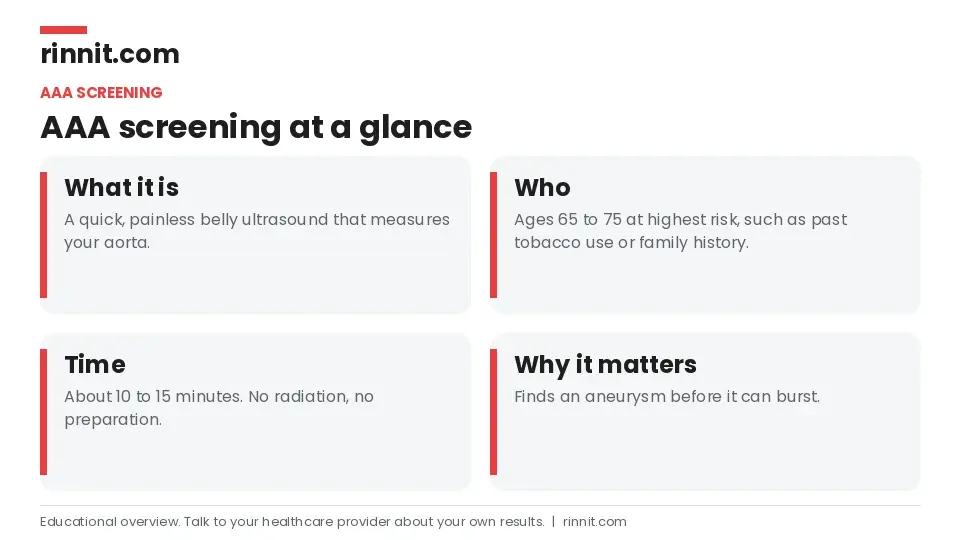
An abdominal aortic aneurysm (AAA) screening is a painless ultrasound that checks for a bulge in the aorta in the belly. AAAs grow slowly with no symptoms until they burst, which is often fatal. A one-time screening is recommended for people aged 65 to 75 at highest risk, including those with a history of tobacco use. [1]
What the research says
One-time screening lowers deaths from AAA in older men. A review of trials with more than 124,000 people found that inviting men 65 and older for screening reduced AAA-related deaths by about 35% (odds ratio 0.65) and ruptures by about 38% over 12 to 15 years, though it did not change overall death rates. (Guirguis-Blake et al., JAMA, 2019) [2]
Small aneurysms are watched with regular imaging. The Society for Vascular Surgery guideline recommends imaging every 12 months for aneurysms measuring 4.0 to 4.9 cm, and ultrasound is its preferred method for screening. (Chaikof et al., Journal of Vascular Surgery, 2018) [3]
Key takeaways
AAA screening is a painless belly ultrasound that measures the width of your aorta. [1]
A one-time screening is recommended for people aged 65 to 75 at highest risk, such as those who have used tobacco or have a relative with an AAA. [1]
Some people under 65 or over 75 may also be screened, depending on their risk. [1]
The test takes about 10 to 15 minutes, uses no radiation and needs no preparation. [1]
Most people have no aneurysm and need no further monitoring. [1]
If an aneurysm is found, its size decides whether you need regular imaging or surgery. [1]
What is an abdominal aortic aneurysm?
Your aorta is the large blood vessel that carries blood from your heart to the rest of your body. An abdominal aortic aneurysm is a bulge in the part of the aorta that runs through your belly. It can grow slowly and silently for years, and most people have no warning signs until it bursts (ruptures). A rupture causes internal bleeding, is a medical emergency and is usually fatal. Call 911 right away if you have sudden, severe pain in your belly, back or side, especially with dizziness, sweating or fainting. Screening gives your provider a chance to treat an aneurysm before that happens. [1]
Who should get AAA screening?
Group | Recommendation |
Ages 65 to 75 with a history of tobacco use or a biological relative with an AAA | One-time screening is recommended |
Under 65 with conditions that raise risk, such as tobacco use, atherosclerosis, an aneurysm elsewhere or inherited connective tissue disease | Your provider may suggest screening |
Over 75 with risk factors who have never been screened | Your provider may suggest screening |
Sources: [1]
Talk to your provider about whether you should be screened. You may also see a reminder in your electronic health record. [1]
How is AAA screening done?
The screening uses an abdominal ultrasound, which takes pictures of the inside of your belly, including your aorta, and shows its width. Ultrasound is an accurate way to diagnose AAA, and the Society for Vascular Surgery recommends it as the preferred screening method. [1]
Painless
Noninvasive: nothing goes into your body
No radiation
Takes about 10 to 15 minutes
Sources: [1]
How do you prepare?
You do not need to do anything to prepare. You may want to ask your provider why you need the test and when you will get the results. [1]
What happens during the test?
You lie on an exam table and lift your shirt so the technician can reach your belly. [1]
The ultrasound technician spreads a clear, cool gel on your skin, which helps the sound waves enter your body. [1]
They move a small wand over the gel to take pictures of your aorta. [1]
They wipe off the gel and let you know the test is done. [1]
AAA screening is safe, with no known risks. You can go home right afterward. [1]

What do the results mean?
Result | What it means |
No aneurysm | Your aorta is not abnormally widened. This is the most common result, and you likely need no further AAA monitoring. |
Aneurysm | There is a bulge in your abdominal aorta, ranging from small to large. Your provider will explain its size and your treatment plan. |
Sources: [1]
What happens if an aneurysm is found?
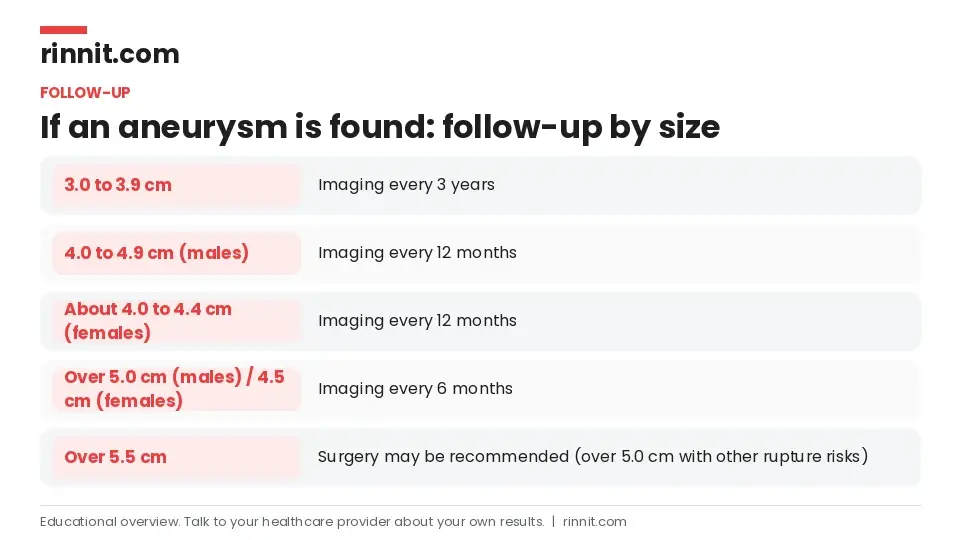
In general, if your aorta measures more than 5.5 cm, or more than 5.0 cm with other risk factors for rupture, your provider may recommend surgery. Otherwise, they may suggest regular imaging to check for growth: [1]
Aorta size | How often to repeat imaging |
3.0 to 3.9 cm | Every 3 years |
4.0 to 4.9 cm (males) | Every 12 months |
About 4.0 to 4.4 cm (females) | Every 12 months |
More than 5.0 cm (males) | Every 6 months |
More than 4.5 cm (females) | Every 6 months |
Sources: [1]
If you have an AAA, tell your close biological relatives. They may also be candidates for screening. [1]
When to call your doctor
Call your healthcare provider if you: [1]
Want to learn more about AAA screening
Want to talk about your risk and how to lower it
Have questions about your screening results or treatment plan
Have a family member diagnosed with an AAA
Conclusion
AAA screening is a simple, painless ultrasound that can save your life. Most results are normal. If you do have an aneurysm, small ones have a very low chance of rupturing and are watched closely for growth, and your provider will tell you if you need treatment. [1]
Try not to worry. Instead, talk to your provider about managing your risk factors, such as quitting tobacco, and reach out any time you have questions. [1]
Keep learning: Read our guide to abdominal aortic aneurysm or our guide to the ultrasound. For more trusted, doctor-reviewed health guides, visit Rinnit.com.
FAQ
What is an AAA screening?
It is a quick, painless ultrasound that checks for a bulge in the aorta in your belly. [1]
Who should get screened for abdominal aortic aneurysm?
People aged 65 to 75 at highest risk, such as those with a history of tobacco use or a relative with an AAA. [1]
How is AAA screening done?
A technician moves an ultrasound wand over gel on your belly to take pictures of your aorta. [1]
How long does AAA screening take?
About 10 to 15 minutes. [1]
Do I need to prepare for AAA screening?
No. You do not need to do anything to prepare. [1]
Is AAA screening safe?
Yes. It uses no radiation and has no known risks. [1]
What does it mean if no aneurysm is found?
Your aorta is not widened, and you likely need no further AAA monitoring. [1]
What happens if an aneurysm is found?
Depending on its size, your provider may recommend regular imaging or, for larger aneurysms, surgery. [1]
What size of AAA needs surgery?
Surgery may be recommended above 5.5 cm, or above 5.0 cm with other risk factors for rupture. [1]
Should my family be screened if I have an AAA?
Tell close biological relatives, since they may be candidates for screening. [1]
Related Reading
Open Aneurysm Surgery: Procedure, Recovery and Outlook explains open aneurysm surgery.
Abdominal Aortic Aneurysm (AAA): Complete Guide to Symptoms, Causes, Screening, and Treatment Options explains the condition this screening looks for, including symptoms and treatment.
Aortic Aneurysm: Types, Causes, Dissection Risk & Complete Guide covers all types of aortic aneurysm and the risk of tearing or rupture.
Arteriosclerosis & Atherosclerosis: Symptoms, Causes, Diagnosis & Treatment — Complete Guide explains artery hardening, one of the conditions that can make earlier screening worthwhile.
What Is Atherosclerosis of the Aorta? Symptoms, Causes, and Treatment covers plaque buildup in the aorta, a related risk factor for aneurysm.
References
Cleveland Clinic. Abdominal Aortic Aneurysm Screening. Cleveland Clinic. Last updated May 21, 2025. https://my.clevelandclinic.org/health/diagnostics/24919-abdominal-aortic-aneurysm-screening
Guirguis-Blake JM, Beil TL, Senger CA, et al. Primary Care Screening for Abdominal Aortic Aneurysm: Updated Evidence Report and Systematic Review for the US Preventive Services Task Force. JAMA. 2019;322(22):2219-2238. PMID 31821436. https://doi.org/10.1001/jama.2019.17021
Chaikof EL, Dalman RL, Eskandari MK, et al. The Society for Vascular Surgery practice guidelines on the care of patients with an abdominal aortic aneurysm. J Vasc Surg. 2018;67(1):2-77.e2. PMID 29268916. https://doi.org/10.1016/j.jvs.2017.10.044
Medical disclaimer
This article is for general education only and does not replace advice from a qualified healthcare professional. Talk to your doctor about your own diagnosis and treatment, and seek emergency care right away for severe or sudden symptoms.



Comments