Aortic Aneurysm: Types, Causes, Dissection Risk & Complete Guide

Updated: 2 days ago
Medically reviewed by Dr. Baraa Alnahhal, MD · Last reviewed: October 2026
Quick Answer: What Is an Aortic Aneurysm?
An aortic aneurysm is a bulge in the wall of the aorta, the body's main artery. As it enlarges, the wall thins and the risk of rupture rises, along with the risk of aortic dissection. Causes include genetic conditions, high blood pressure and cholesterol, smoking, obesity and inflammation. Larger aneurysms need surgical repair with a graft. [1]
What the research says
Risk stays low until about 5 cm, then climbs with size. In 964 patients with unoperated ascending thoracic aortic aneurysms followed for a median of 7.9 years, the average yearly risk of dissection, rupture, or aortic death was 0.2% at 3.5–4.4 cm, 0.3% at 4.5–4.9 cm, 1.4% at 5.0–5.4 cm, 2.0% at 5.5–5.9 cm, and 3.5% at 6 cm or more; aortic size was an independent risk factor (HR 1.78, 95% CI 1.50–2.11). (Wu et al., Eur Heart J, 2023) [3]
Stent repair is safer early; open repair did better over the long term for descending aneurysms. In 29 studies of 49,972 patients (22,049 endovascular and 27,923 open repairs), endovascular repair had lower postoperative mortality (odds ratio 0.57, 95% CI 0.45–0.72), but open repair had better all-cause survival beyond 16 months (HR 1.64, 95% CI 1.53–1.75), and endovascular repair needed more aortic-related reinterventions (HR 2.10, 95% CI 1.45–3.04). (Liu et al., Int J Surg, 2025) [4]
Aortic Aneurysm at a Glance
Definition: A bulge in the wall of the aorta, the main artery carrying blood from the heart to the body.
Two main types: Abdominal aortic aneurysm (belly area) and thoracic aortic aneurysm (chest cavity).
Shape: Tube shaped or round.
Main risk: Rupture and aortic dissection (a tear in the inner layer of the aortic wall).
Genetic causes: Marfan syndrome (classic), bicuspid aortic valve (most common for ascending aneurysms).
Lifestyle causes: High blood pressure, high cholesterol, smoking, obesity, sometimes diabetes.
Inflammatory causes: Vasculitis or infection (least common).
Key screening test: Echocardiogram, followed by CT scan if it suggests aortic disease.
Surgery sizes: 5.5 cm (general), 5 cm (bicuspid valve), 4.5 cm (genetic), 5.5–6 cm (descending thoracic).
Repair methods: Open surgery with Dacron graft or endovascular repair with graft and stent.

What Is an Aortic Aneurysm?
The aorta is the body's main artery. It carries blood from the heart to the rest of the body. An aortic aneurysm is a bulge that occurs in the wall of this artery.
An aneurysm is a weak spot in the aortic wall that begins to bulge or balloon outward. It can occur anywhere in the aorta, and aneurysms may be tube shaped or round.
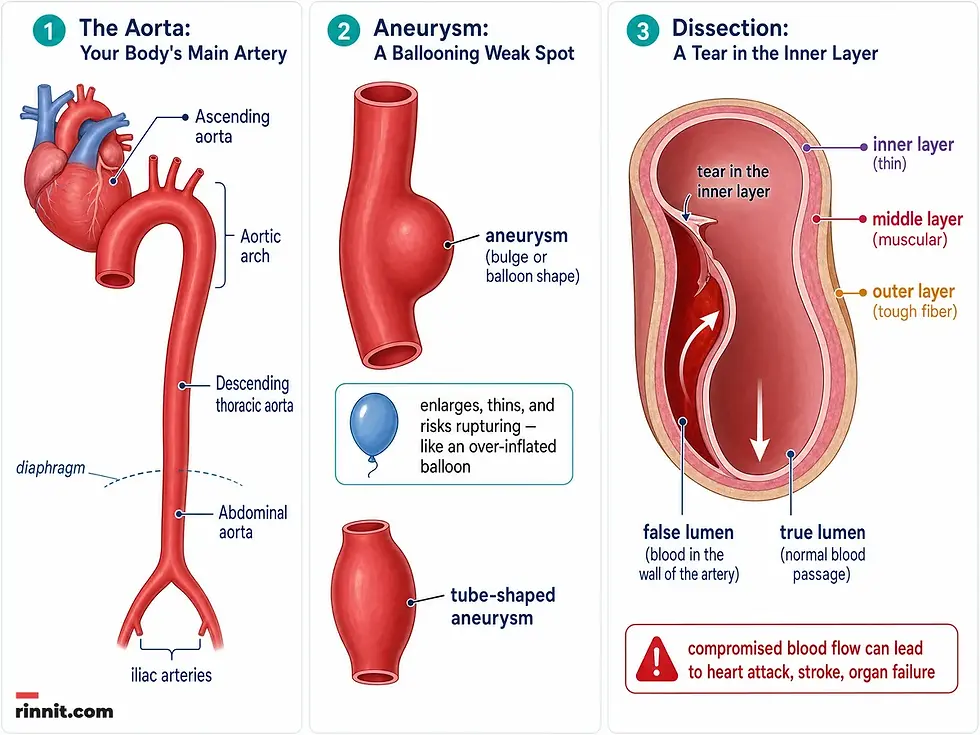
The Aorta's Four Parts
To understand aneurysms, it helps to know the aorta's path. At the simplest level, the aorta divides into four parts:
Ascending aorta: Starts at the heart with the aortic root (holding the aortic valve and the origin of the coronary arteries); the tubular ascending aorta then travels to the base of the neck.
Aortic arch: Arches back toward the spine; three branch vessels come off here, carrying blood to the brain and the arms.
Descending thoracic aorta: Travels downward along the spine.
Abdominal aorta: After crossing the diaphragm (the muscle dividing chest from abdomen), the name changes; at the pelvis, the aorta divides into the iliac arteries.
What are the two types of aortic aneurysm?
Abdominal aortic aneurysm. This type occurs along the part of the aorta that passes through the belly area.
Thoracic aortic aneurysm. This type occurs along the part of the aorta that passes through the chest cavity.
Some people may have both types of aortic aneurysms.
Why are rupture and aortic dissection the biggest risks of an aortic aneurysm?
An aortic aneurysm thins the aortic wall as it enlarges, raising the risk of rupture and of aortic dissection, a tear in the wall's inner layer.
Why Aneurysms Rupture
As the aorta enlarges, it becomes thinner. The thinner the wall, the more likely it is to rupture — much like an over-inflated balloon at high risk of popping.
What Is an Aortic Dissection?
People with an aortic aneurysm have an increased risk of a tear in the inner layer of the aortic wall. This tear is called an aortic dissection.
The aorta has three layers:
Inner layer: Thin; prevents blood from clotting.
Middle layer: Muscular; provides the structural integrity of the vessel.
Outer layer: Tough and fibrous; holds everything in place.
During a dissection, the inner layer tears. Blood is forced inside the muscular middle layer, tearing it apart. This forms a new channel called the false lumen, as opposed to the true lumen — the passage where the aorta should be carrying blood.
Why a Dissection Is Dangerous
As blood keeps flowing into the false lumen, the false lumen grows until it reaches a branch vessel. At that point, the tissue may tear (connecting the true and false lumen), or the false lumen may compress the branch vessel, cutting off blood flow through it.
This matters because the vessels branching from the aorta feed organs such as the heart, brain, kidneys, liver, and intestine. Compromised blood flow in these vessels can lead to:
Heart attacks
Strokes
Organ failure
Acute heart failure — if the dissection compromises the aortic valve
The dissection itself also weakens the aortic wall, putting it at further risk for rupture. A dissection involving the ascending aorta is called a Type A dissection — and it always requires emergency surgery.
What Causes an Aortic Aneurysm?
There are three players in the aortic disease game.
1. Structural Genetic Abnormality
In these cases, the aorta is built wrong.
Marfan syndrome is the classic genetic disease that leads to aortic aneurysm and dissection.
Bicuspid aortic valve is the most common genetic abnormality associated with ascending aortic aneurysm.
2. Accelerated Atherosclerotic Injury
This can also be a genetic problem, but it just as often stems from sustained high blood pressure, compounded by:
High cholesterol
Smoking
Obesity
Sometimes diabetes
3. Inflammatory Disease
The least common player is inflammatory disease — such as vasculitis or even infection.
What are the risk factors for an aortic aneurysm?
Risk factors for an aortic aneurysm include a family history of aortic disease or high blood pressure, Marfan syndrome or bicuspid aortic valve, high blood pressure, high cholesterol, smoking and obesity.
Family history of aortic disease: Genetic/family.
Family history of high blood pressure: Genetic/family.
Heart murmur: Warning sign worth screening.
Marfan syndrome or bicuspid aortic valve: Genetic.
High blood pressure: Lifestyle/medical.
High cholesterol: Lifestyle/medical.
Smoking: Lifestyle.
Obesity: Lifestyle.
Diabetes (sometimes): Medical.
Vasculitis or infection: Inflammatory.
How Is an Aortic Aneurysm Detected?
Screening before catastrophe strikes is the key message from the experts.
If you have any of the following, a good starting point is an echocardiogram — an ultrasound of the heart and the ascending aorta:
Family history of aortic disease
Family history of high blood pressure
A heart murmur
If the echocardiogram suggests any aortic disease, it should be followed by a CT scan. Once an aneurysm is identified, the medical team decides when it is time for surgical intervention.
When is surgery needed for an aortic aneurysm?
Treatment decisions center on the aneurysm's size and location. Here are the surgical thresholds:
Ascending aortic aneurysm (all patients): Greater than 5.5 cm.
With bicuspid aortic valve: 5 cm.
With genetic abnormalities (such as Marfan syndrome): 4.5 cm.
Descending thoracic aortic aneurysm: Between 5.5 and 6 cm.
Thoracoabdominal aortic aneurysms: 5.5–6 cm (same criteria).
Open Surgery
An aneurysm in the aorta is replaced by a Dacron graft. At the root, a normal aortic valve can be saved inside a Dacron conduit — an operation called a valve-sparing root replacement. If the valve is abnormal, it can be replaced at the same time as the aorta, using either a biologic or a mechanical valve.
A portion of the aortic arch often needs replacement during ascending replacement. The arch is particularly important because its branch vessels supply blood to the brain, so repair techniques must protect brain function.
Endovascular Repair
Replacement of the descending thoracic aorta can often be done with endovascular techniques with good results. This procedure involves:
A Dacron graft is advanced through a peripheral artery
A metal stent holds the graft in place
Access is obtained through a small incision — no need to open the chest or abdomen
The Most Complex Cases
Thoracoabdominal aortic aneurysms — those spanning the thoracic and abdominal aorta — are the last and most complex. The majority require open surgery where both the chest and the abdomen are entered. Techniques are employed to minimize the risk of paraplegia (loss of movement in the lower body) that can result from these repairs. Technology is in development to allow more of these complex aneurysms to be repaired endovascularly.
The Care Team
Aortic aneurysm care typically involves a multidisciplinary team — including cardiovascular surgeons, vascular and endovascular surgeons, cardiovascular medicine specialists, radiologists, and pediatric cardiac surgery for young patients — so any diseased portion of the aorta can be evaluated and repaired, either open or endovascularly [2].
How should you prepare for an aortic aneurysm appointment?
If you are at risk for or have been diagnosed with an aortic aneurysm, you will likely work with cardiovascular surgeons and vascular specialists.
Before your visit, make a list of:
Your symptoms and when they began (including any family history of aortic disease or high blood pressure)
Key medical information, including other conditions such as Marfan syndrome, bicuspid aortic valve, or a heart murmur
All medicines, vitamins, and supplements you take, including dosages
Questions to ask your healthcare professional
Questions to Ask
Do I have an aortic aneurysm, and how large is it?
Where is the aneurysm located?
What size triggers surgery for my type of aneurysm?
Would open surgery or endovascular repair suit my case?
How often should I return for imaging follow-up?
What signs should send me to the emergency room?
Should my family members be screened?
Be sure to ask all the questions you have.
What Your Doctor Will Ask
Do you have a family history of aortic disease or high blood pressure?
Have you been told you have a heart murmur?
Do you have high blood pressure, high cholesterol, or diabetes?
Do you smoke?
Have you noticed any new chest, back, or abdominal pain?
Frequently Asked Questions
What is an aortic aneurysm?
An aortic aneurysm is a bulge that occurs in the wall of the aorta, the body's main artery that carries blood from the heart to the body. The aneurysm can occur anywhere in the aorta and may be tube shaped or round.
What are the two types of aortic aneurysm?
The abdominal aortic aneurysm occurs along the part of the aorta that passes through the belly area, and the thoracic aortic aneurysm occurs along the part that passes through the chest cavity. Some people have both types.
What is an aortic dissection?
An aortic dissection is a tear in the inner layer of the aortic wall. Blood is forced into the muscular middle layer, creating a new channel called the false lumen. If this growing false lumen reaches a branch vessel, it can cut off blood flow to the heart, brain, kidneys, liver, or intestine — leading to heart attack, stroke, organ failure, or acute heart failure.
What causes aortic aneurysms?
Three factors drive aortic disease: structural genetic abnormalities (such as Marfan syndrome and bicuspid aortic valve), accelerated atherosclerotic injury (sustained high blood pressure compounded by high cholesterol, smoking, obesity, and sometimes diabetes), and — least commonly — inflammatory disease such as vasculitis or infection.
How is an aortic aneurysm detected?
If you have a family history of aortic disease or high blood pressure, or have a heart murmur, a good starting point is an echocardiogram, an ultrasound of the heart and ascending aorta. If it suggests aortic disease, it should be followed by a CT scan.
At what size does an aortic aneurysm need surgery?
An ascending aortic aneurysm greater than 5.5 cm requires surgery for all patients. With a bicuspid aortic valve, the threshold is 5 cm. With genetic abnormalities such as Marfan syndrome, 4.5 cm indicates surgery. For the descending thoracic aorta, the size indication is between 5.5 and 6 cm.
How is an aortic aneurysm repaired?
The diseased aorta is replaced with a Dacron graft. Open surgery is used for most ascending and complex thoracoabdominal aneurysms, sometimes saving or replacing the aortic valve at the same time. Endovascular repair — advancing a graft through a peripheral artery and holding it with a metal stent through a small incision — is often used for the descending thoracic aorta.
Conclusion
The three lessons to carry away from this guide:
An aneurysm is a ballooning weak spot in the body's main artery, and the thinner the wall gets, the closer it is to rupture — the over-inflated balloon analogy is not just imagery, it is the mechanism.
Dissection is the silent danger: a tear in the inner layer creates a false channel for blood that can cut off supply to the heart, brain, kidneys, liver, and intestine, and a Type A dissection always requires emergency surgery.
Size drives treatment: at 5.5 cm (or less for bicuspid valves and genetic conditions), a Dacron graft — open or endovascular — replaces the risky segment.
This guide has walked you through the aorta's four segments, the two aneurysm types, the three causes, the screening path from echocardiogram to CT scan, and the surgical thresholds and repair options. Knowing your family history and acting on it with screening is the single most protective step you can take.
If you want to explore a related condition in depth, read our complete guide to abdominal aortic aneurysm, the most common type of aortic aneurysm.
This article is for informational purposes only and is not a substitute for professional medical advice, diagnosis, or treatment. Always seek the advice of your physician or other qualified health provider with any questions you may have regarding a medical condition.
Related Reading
Open Aneurysm Surgery: Procedure, Recovery and Outlook explains open aneurysm surgery.
Aortic Root Replacement: Bentall vs. Valve-Sparing Surgery explains aortic root replacement surgery.
Learn more in our guide to CT Angiogram (CTA): What It Shows, How to Prepare and What to Expect.
MRA (Magnetic Resonance Angiography): What It Is, Why It's Done, Procedure and Results explains how magnetic resonance angiography makes detailed pictures of your blood vessels without X-ray radiation.
Transthoracic Echocardiogram (TTE): What It Shows, What to Expect and Results explains the heart ultrasound used to diagnose and monitor heart conditions.
Learn more in our guide to Transesophageal Echocardiogram (TEE): Why It's Done, What to Expect and Risks.
Abdominal Aortic Aneurysm (AAA) Screening: Who Needs It, How It's Done and What Results Mean explains the quick ultrasound used to find an abdominal aortic aneurysm early.
References
Mayo Clinic Staff. Aortic aneurysm - Symptoms and causes. Mayo Clinic. April 10, 2025. https://www.mayoclinic.org/diseases-conditions/aortic-aneurysm/symptoms-causes/syc-20369472
Mayo Clinic Staff. Aortic aneurysm - Doctors and departments. Mayo Clinic. April 10, 2025. https://www.mayoclinic.org/diseases-conditions/aortic-aneurysm/doctors-departments/ddc-20369475
Wu J, Zafar MA, Liu Y, et al. Fate of the unoperated ascending thoracic aortic aneurysm: three-decade experience from the Aortic Institute at Yale University. Eur Heart J. 2023;44(43):4579-4588. PMID 36994934. https://doi.org/10.1093/eurheartj/ehad148
Liu J, Gou D, Xu K, et al. Comparison of short-and long-term outcomes between endovascular and open repair for descending thoracic aortic aneurysm: a systematic review and meta-analysis. Int J Surg. 2025;111(3):2662-2674. PMID 39869368. https://doi.org/10.1097/JS9.0000000000002230



Comments