Aortic Root Replacement: Bentall vs. Valve-Sparing Surgery

Updated: 2 days ago
Written and medically reviewed by Dr. Baraa Alnahhal, MD · Last reviewed: November 2026 · How we review
Quick Answer
Aortic root replacement is open-heart surgery that repairs an aneurysm in the aortic root, the part of the aorta attached to the heart, by replacing it with a graft. It prevents a rupture or dissection, which can be life-threatening. The hospital stay is about a week, and full recovery takes 6 to 12 weeks or longer.
What the research says
Valve-sparing surgery had lower early deaths in emergencies: in a review of 9 studies with 706 people with acute type A aortic dissection, valve-sparing root replacement had lower early death than the Bentall procedure (odds ratio 0.34), though reoperation was more common (1.6% vs. 0.4%) (Wu J et al., Interactive Cardiovascular and Thoracic Surgery, 2019) [2]
The David procedure had better long-term survival with bicuspid valves: in a review of 13 studies with 1,866 people with bicuspid valves, the valve-sparing David operation had better survival over 8 years and fewer complications than the Bentall procedure, with similar reoperation rates (Zoupas I et al., Heart, Lung and Circulation, 2025) [3]
Key takeaways
Aortic root replacement fixes an aneurysm where the aorta meets the heart.
It prevents a rupture or dissection.
The Bentall procedure replaces the valve; valve-sparing surgery keeps it.
Surgery takes 4 to 6 hours.
Full recovery takes at least 6 to 12 weeks.
What is aortic root replacement?
An aortic aneurysm is a weak, bulging area of the aorta. In the root, it can tear (aortic dissection) or burst. The graft, made of collagen-coated polyester, works as a new artery. Sources: [1]
When it's recommended
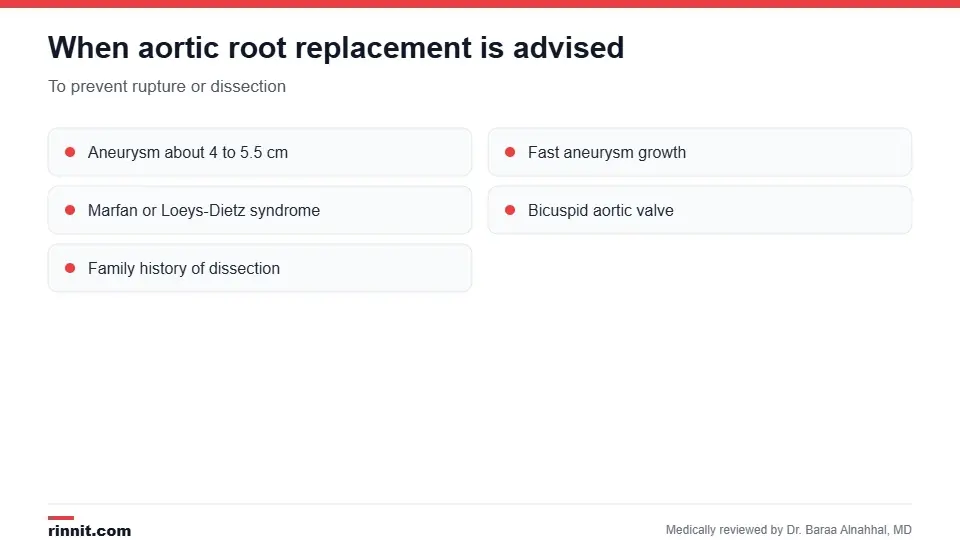
Uncontrolled blood pressure and smoking can speed aneurysm growth.
An aneurysm of about 4 to 5.5 cm.
Fast aneurysm growth.
A genetic condition such as Marfan syndrome or Loeys-Dietz syndrome.
A family history of aortic dissection. Sources: [1]
Timing also depends on your age, health and surgical risk. Sources: [1]
Types of aortic root replacement
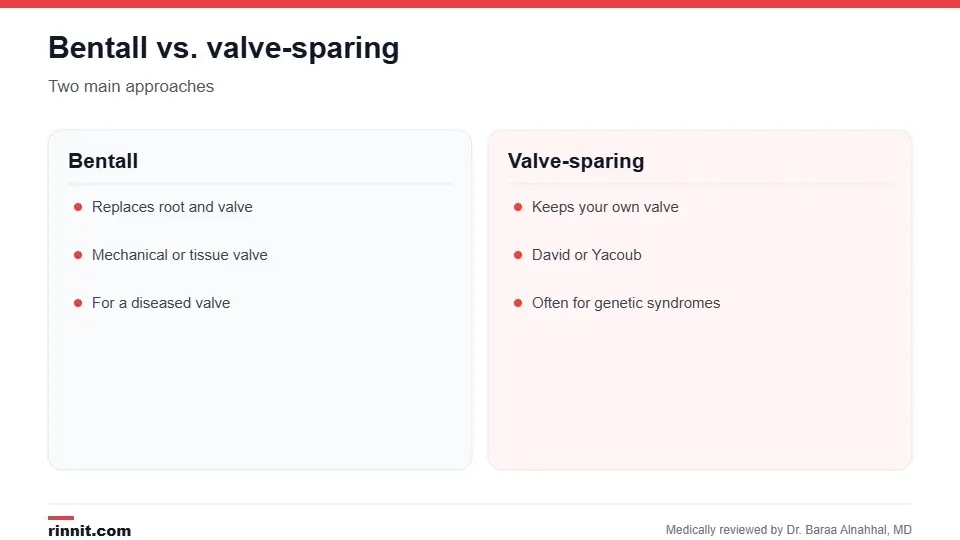
Valve-sparing surgery is often best for younger people with genetic syndromes.
Type | What it does | Often used for |
Bentall | Replaces root and valve (mechanical or tissue) | A diseased aortic valve |
Valve-sparing: Yacoub | Replaces root, keeps valve (remodeling) | Older people without genetic syndromes |
Valve-sparing: David | Replaces root, keeps valve (reimplantation) | Younger people with a genetic syndrome or bicuspid valve |
Learn more about valve-sparing aortic root replacement. Sources: [1, 2, 3]
How to prepare
A physical exam, blood work, CT or heart MRI, coronary angiogram and carotid ultrasound.
Review your medicines and supplements; some may need stopping.
Manage conditions like high blood pressure and COPD.
Tell your team if you get sick before surgery.
Don't smoke or use tobacco for at least a month before. Sources: [1]
What happens during surgery

Bentall takes about 4 to 5 hours; valve-sparing about 4 to 6 hours.
You get general anesthesia.
The surgeon opens your chest through the breastbone (sternotomy).
A heart-lung bypass machine takes over.
The bulging segment is removed and a graft is sewn in.
The valve is replaced (Bentall) or your own valve is reattached (valve-sparing).
The coronary arteries are reattached to the graft, and the incision is closed. Sources: [1]
Risks
Bleeding or blood clots.
Breathing problems.
Heart attack or stroke.
Graft or other infections.
Kidney failure.
Nerve damage. Sources: [1]
Risk is higher with heart, kidney or lung disease, a past stroke or older age. Sources: [1]
Recovery
You'll spend several days in the ICU and about a week in the hospital.
Full recovery takes at least 6 to 12 weeks, sometimes 2 to 3 months.
No driving or heavy lifting for 6 weeks.
Return to a non-physical job in 6 to 8 weeks.
Cardiac rehab helps you regain strength. Sources: [1]
Outlook
Aortic root replacement is a durable, long-term fix for most people. Mechanical valves last for life but need blood thinners. Tissue valves last at least 10 to 15 years in most people. Your own valve after valve-sparing surgery may last for life. Sources: [1, 3]
When to call your provider
Redness, swelling, drainage or separating edges at the incision.
Chest pain or shortness of breath at rest.
Leg swelling, dizziness or extreme tiredness.
Fever or chills. Sources: [1]
Call 911 for sudden severe chest or upper back pain, trouble breathing or fainting. Sources: [1]
Conclusion
Aortic root replacement removes a dangerous aneurysm before it can tear or burst. Choosing between the Bentall and valve-sparing approaches depends on your valve, age and genetics.
Keep learning: read about valve-sparing root replacement and open-heart surgery.
Frequently asked questions
What is aortic root replacement?
Surgery that replaces an aneurysm in the aortic root with a graft.
Why is it done?
To prevent a life-threatening rupture or dissection.
When is surgery recommended?
Usually at an aneurysm size of about 4 to 5.5 cm.
What is the Bentall procedure?
Replacing both the aortic root and the aortic valve.
What is valve-sparing surgery?
Replacing the root while keeping your own valve.
How long does surgery take?
About 4 to 6 hours.
How long is the hospital stay?
About one week.
When can I drive again?
Usually after about 6 weeks.
How long do replacement valves last?
Mechanical valves for life; tissue valves at least 10 to 15 years.
Will I need blood thinners?
Yes, with a mechanical valve.
Related Reading
Valve-Sparing Aortic Root Replacement: Preserving Your Natural Heart Valve keeping your own valve.
Aortic Aneurysm: Types, Causes, Dissection Risk & Complete Guide aortic aneurysms.
Marfan Syndrome: Symptoms, Causes, and Management Strategies a genetic cause of root aneurysms.
What Is Bicuspid Aortic Valve Disease? Symptoms, Causes, Diagnosis, and Treatment Explained a valve linked to aneurysms.
Open-Heart Surgery: Procedure, Preparation, and Recovery what open-heart surgery involves.
References
Cleveland Clinic. Aortic Root Replacement Surgery. Cleveland Clinic. Last updated January 19, 2026. https://my.clevelandclinic.org/health/treatments/22821-aortic-root-replacement
Wu J, Huang Y, Qiu J, et al. Is valve-sparing root replacement a safe option in acute type A aortic dissection? A systematic review and meta-analysis. Interactive Cardiovascular and Thoracic Surgery. 2019;29(5):766-775. PMID 31365078. https://doi.org/10.1093/icvts/ivz180
Zoupas I, Sarantopoulos A, Schizas N, et al. Bentall versus David procedure for aortic root replacement in patients with bicuspid aortic valve: systematic review and meta-analysis using reconstructed time-to-event data. Heart, Lung and Circulation. 2025;34(11):1209-1217. PMID 40962693. https://doi.org/10.1016/j.hlc.2025.03.020
Medical disclaimer
This article is for general education only and does not replace advice from a qualified healthcare professional. Talk to your doctor about your own diagnosis and treatment, and seek emergency care right away for severe or sudden symptoms.



Comments