Cardiopulmonary Bypass: How the Heart-Lung Machine Works

Updated: 2 days ago
Written and medically reviewed by Dr. Baraa Alnahhal, MD · Last reviewed: November 2026 · How we review
Quick Answer
Cardiopulmonary bypass (CPB) uses a heart-lung machine to take over the work of the heart and lungs during surgery. The machine adds oxygen to the blood, removes carbon dioxide and pumps it back, letting the surgeon work on a still heart. It's used for most open-heart surgeries. Risks rise the longer you're on the machine.
What the research says
The heart-lung machine supported better long-term graft results: in the ROOBY trial of 2,203 bypass patients, 1-year death, repeat procedures or heart attack occurred in 7.4% with the heart-lung machine versus 9.9% with beating-heart surgery, and more grafts stayed open (87.8% vs. 82.6%) (Shroyer AL et al., New England Journal of Medicine, 2009) [2]
Short-term outcomes were similar with or without the machine: in the CORONARY trial of 4,752 patients, death, stroke, heart attack or new kidney failure at 30 days were similar (10.3% on-pump vs. 9.8% off-pump), but on-pump surgery used more blood transfusions (Lamy A et al., New England Journal of Medicine, 2012) [3]
Key takeaways
Cardiopulmonary bypass uses a heart-lung machine during heart surgery.
The machine oxygenates and pumps blood while the heart is stopped.
It's used for CABG, valve surgery, aneurysm repair and transplants.
Heparin prevents clots, and cardioplegia stops the heart.
Shorter time on the machine means lower risk.
What is cardiopulmonary bypass?
Cardiopulmonary bypass is sometimes called being "on the pump." It diverts blood away from your heart and lungs so the surgeon can safely work on them. A specialist called a perfusionist runs the machine throughout surgery. Sources: [1]
When it's used

Some bypass surgeries are done on a beating heart without the machine.
Aneurysm surgery.
Heart transplant.
Lung transplant. Sources: [1]
Some people have off-pump bypass surgery instead, where the surgeon uses a device to steady the beating heart. Sources: [1]
Parts of the heart-lung machine
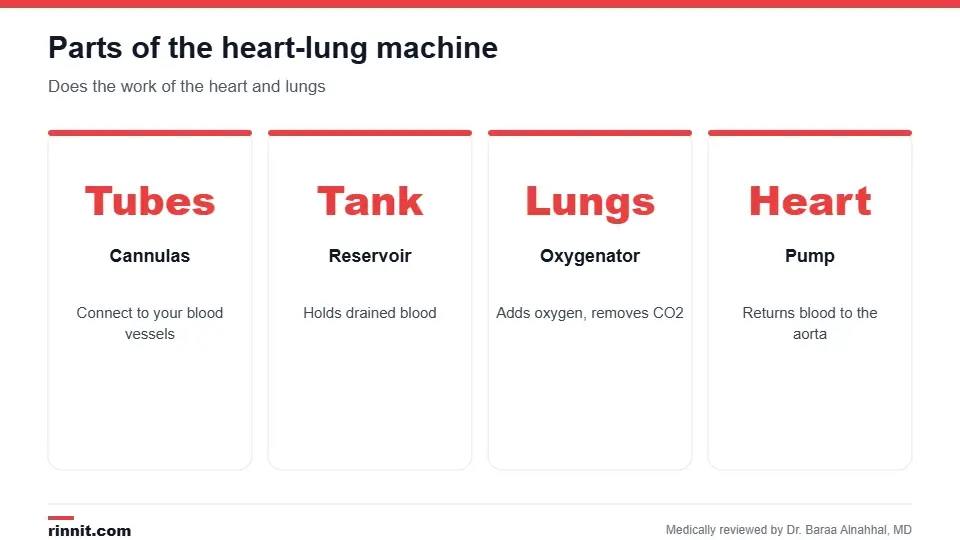
The machine does the jobs of both the heart and the lungs.
Part | What it does |
Cannulas | Tubes that connect the machine to your blood vessels |
Reservoir | Holds oxygen-poor blood drained from your body |
Oxygenator | Adds oxygen and removes carbon dioxide, acting as the lungs |
Pump | Sends blood back to the aorta, acting as the heart |
The machine also controls your body temperature and electrolytes, delivers medicines, protects the heart and saves blood lost during surgery. Sources: [1]
How it works
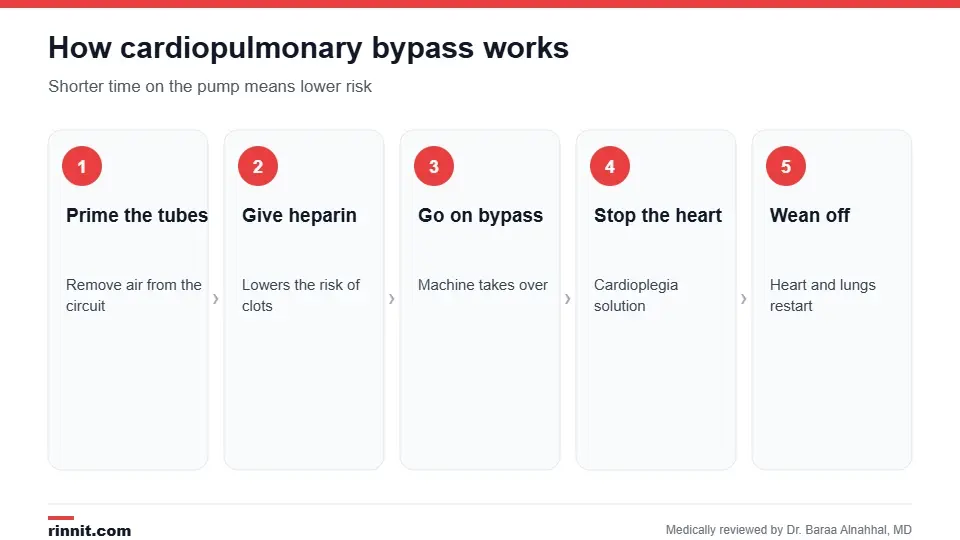
The goal is the shortest possible time on the machine.
The team primes the tubes with fluid or blood to remove air.
You get heparin, a blood thinner, to lower the risk of clots.
The tubes are connected to your blood vessels ("going on bypass").
A solution called cardioplegia stops your heart, and the ventilator is turned off.
The team monitors you closely during surgery.
You're slowly weaned off the machine as your heart and lungs start working again. Sources: [1]
Risks
Risk | Notes |
Bleeding and blood clots | Can happen during or after surgery |
Stroke or brain injury | Including from air or clots |
Kidney injury | Can range from mild to kidney failure |
Lung injury or fluid around the lungs | Pleural effusion |
Inflammation | A whole-body response to the machine |
Pancreatitis or organ failure | Rare |
Your risk depends on your health before surgery and how long you're on the machine. Complications are generally less likely when bypass lasts under three hours. Sources: [1, 2, 3]
Recovery
After you're weaned off the machine, you'll go to the intensive care unit (ICU). Recovery depends on the type of surgery, your age, your health and your time on the pump. Learn more about recovery after open-heart surgery. Sources: [1]
When to get emergency care
Call 911 for signs of a stroke: trouble walking or loss of balance.
Numbness or weakness on one side of the body.
Slurred speech, confusion or trouble understanding speech.
Trouble seeing clearly. Sources: [1]
Conclusion
Cardiopulmonary bypass makes complex heart surgery possible by safely taking over the work of the heart and lungs. Your surgical team keeps your time on the machine as short as possible to lower your risk.
Keep learning: read about ECMO, a related life-support machine, and CABG surgery.
Frequently asked questions
What is cardiopulmonary bypass?
The use of a heart-lung machine to take over the heart and lungs during surgery.
What does "on the pump" mean?
Being connected to the heart-lung machine.
Which surgeries use it?
CABG, valve surgery, aneurysm repair and heart or lung transplants.
Is my heart stopped during bypass?
Yes. A solution called cardioplegia stops it.
Who runs the machine?
A perfusionist.
How long can you be on bypass?
It varies; complications are lower when it lasts under three hours.
What are the risks?
Bleeding, clots, stroke, kidney injury and lung injury.
What is off-pump surgery?
Bypass surgery on a beating heart without the machine.
Is cardiopulmonary bypass the same as ECMO?
No. ECMO is longer-term life support outside the operating room.
Where do I go after surgery?
To the intensive care unit.
Related Reading
Heart Transplant: Who Needs One, Surgery and Recovery explains heart transplant surgery and recovery.
Coronary Artery Bypass Graft (CABG) Surgery: Procedure and Recovery the most common surgery that uses the heart-lung machine.
Off-Pump Bypass Surgery: How Beating-Heart CABG Works, Risks and Recovery bypass surgery without the machine.
Heart Valve Surgery: Types, Procedure and Recovery valve repair and replacement.
Open-Heart Surgery: Procedure, Preparation, and Recovery what to expect from open-heart surgery.
ECMO (Extracorporeal Membrane Oxygenation): How It Works, Types, Risks, and Recovery a related life-support machine.
References
Cleveland Clinic. What is Cardiopulmonary Bypass? Cleveland Clinic. Last updated August 31, 2022. https://my.clevelandclinic.org/health/treatments/24106-cardiopulmonary-bypass
Shroyer AL, Grover FL, Hattler B, et al. On-pump versus off-pump coronary-artery bypass surgery. New England Journal of Medicine. 2009;361(19):1827-1837. PMID 19890125. https://doi.org/10.1056/NEJMoa0902905
Lamy A, Devereaux PJ, Prabhakaran D, et al. Off-pump or on-pump coronary-artery bypass grafting at 30 days. New England Journal of Medicine. 2012;366(16):1489-1497. PMID 22449296. https://doi.org/10.1056/NEJMoa1200388
Medical disclaimer
This article is for general education only and does not replace advice from a qualified healthcare professional. Talk to your doctor about your own diagnosis and treatment, and seek emergency care right away for severe or sudden symptoms.



Comments