Heart Transplant: Who Needs One, Surgery and Recovery

Updated: 2 days ago
Written and medically reviewed by Dr. Baraa Alnahhal, MD · Last reviewed: November 2026 · How we review
Quick Answer
A heart transplant replaces a failing heart with a healthy donor heart. It's a last-resort treatment for end-stage heart failure when other treatments no longer help. The hospital stay is about three weeks, and you'll take anti-rejection medicines for life. About 91% of recipients are alive after one year, and median survival is about 14 years.
What the research says
A newer donor source worked just as well: in a trial of 180 heart transplant recipients, 6-month survival was 94% with hearts donated after circulatory death versus 90% with hearts from brain-dead donors (Schroder JN et al., New England Journal of Medicine, 2023) [2]
Long-term survival was similar or better: pooling 12 studies, 1-year death rates were 8.1% with circulatory-death donor hearts versus 10.2% with brain-death donor hearts, and 5-year death rates were 14.6% versus 20.6%; circulatory-death donation also expands the donor pool (Zong J et al., Transplantation, 2024) [3]
Key takeaways
A heart transplant replaces a failing heart with a donor heart.
It's for end-stage heart failure when other treatments don't work.
Surgery takes 4 to 10 hours, and the hospital stay is about three weeks.
You'll take anti-rejection medicines for life.
About 91% of recipients are alive one year later.
What is a heart transplant?
In heart failure, the heart is too weak to pump enough blood. A transplant gives you a donor heart matched to your blood type, immune cells and body size. U.S. surgeons performed 4,587 heart transplants in 2025, up from 2,804 in 2015. Sources: [1]
Who it's for
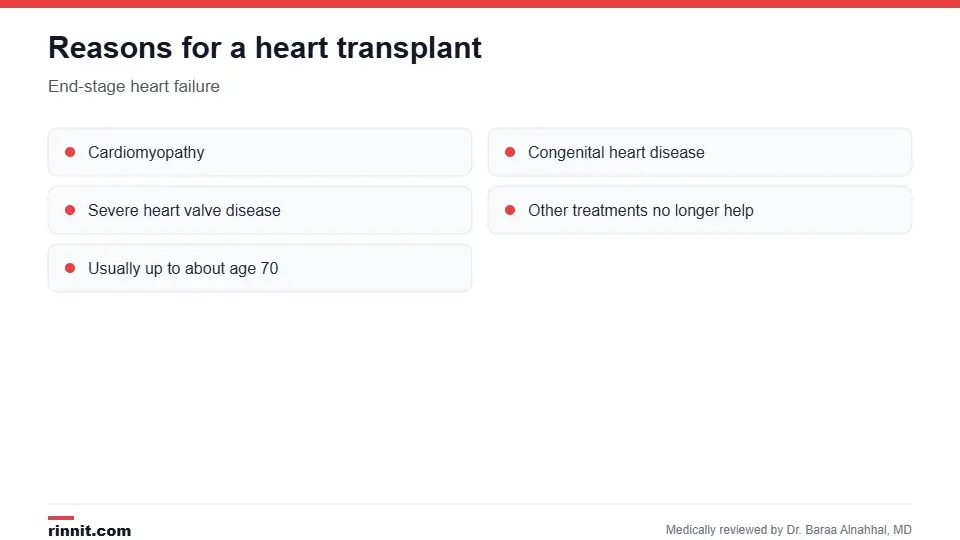
Most recipients are children or adults up to about age 70.
End-stage heart failure that doesn't respond to other treatments.
Cardiomyopathy, a disease of the heart muscle.
Congenital heart disease.
Severe heart valve disease. Sources: [1]
While waiting, some people need medicines or devices such as a ventricular assist device, ECMO or a total artificial heart. Sources: [1]
Getting on the waiting list

Waiting time can range from days to years.
A cardiologist refers you to a transplant center.
You have blood, urine and imaging tests and meet the transplant team.
The team confirms you're likely to survive and benefit.
You're placed on the national waiting list, from status 1 (sickest) to 6 (most stable).
When a matching heart is available, you're called to the hospital. Sources: [1]
Keep your vaccinations up to date, since anti-rejection medicines raise infection risk. Sources: [1]
What happens during surgery
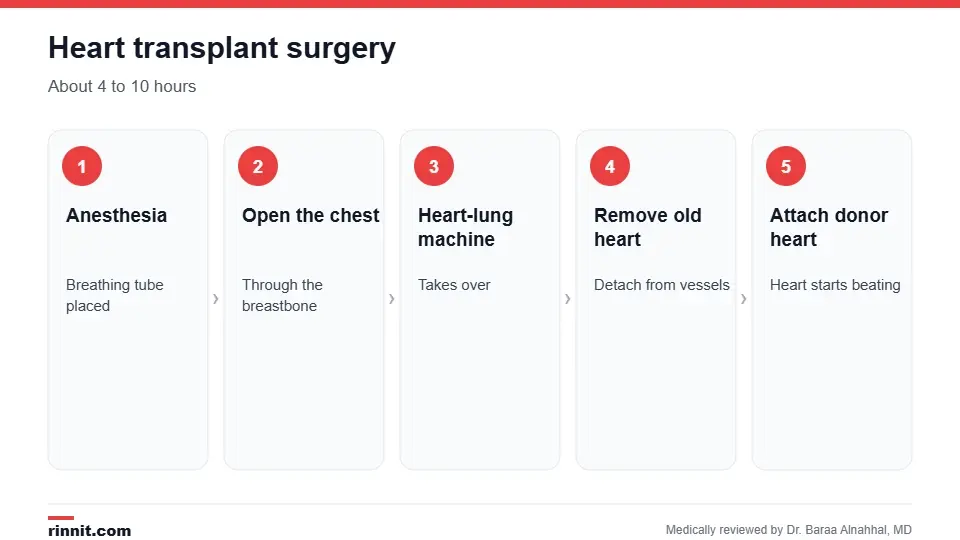
Surgery takes about 4 to 10 hours.
You get general anesthesia and a breathing tube.
The surgeon opens your chest through the breastbone.
A heart-lung machine takes over.
Your heart is removed from its blood vessels.
The donor heart is attached to those vessels.
A temporary pacing device may help the new heart start beating. Sources: [1]
Risks
Risk | Notes |
The immune system attacks the new heart | |
Infection | Most infection deaths happen in the first year |
Graft failure | Most deaths from this happen in the first 30 days |
Coronary artery narrowing | Cardiac allograft vasculopathy |
Medicine side effects | Kidney disease, high blood pressure, diabetes, osteoporosis |
Other | Arrhythmias, stroke, higher cancer risk |
Sources: [1]
Recovery
You'll stay in the hospital about three weeks, starting in intensive care.
Your incision heals in about six to eight weeks.
Full recovery takes several months.
Cardiac rehab helps you rebuild strength.
You'll take anti-rejection medicines for life and have regular checkups.
Support groups can help with the emotions that follow. Sources: [1]
Outlook
About 91% of North American recipients are alive one year after surgery, and half are alive at 14 years; some live more than 20 years. A second transplant is possible but more complex. Sources: [1, 2, 3]
When to get emergency care
A fever.
Drainage, redness or warmth around the incision.
Feeling or hearing your breastbone move or click.
A fast heart rate, dizziness or shortness of breath.
Any new feeling of illness. Sources: [1]
Conclusion
A heart transplant can save and extend life when heart failure has reached its final stage. Lifelong medicines, regular follow-up and healthy habits help protect your new heart.
Keep learning: read about heart failure and organ donation.
Frequently asked questions
What is a heart transplant?
Surgery that replaces a failing heart with a donor heart.
Who needs a heart transplant?
People with end-stage heart failure when other treatments don't work.
Is there an age limit?
Usually up to about 70, and sometimes 75.
How long is the wait?
From days to years.
How long does surgery take?
About 4 to 10 hours.
How long is the hospital stay?
About three weeks.
Will I need medicine for life?
Yes, anti-rejection medicines.
What is the survival rate?
About 91% at one year; median survival is about 14 years.
What is rejection?
When the immune system attacks the new heart.
Can you have a second heart transplant?
Yes, but it's more complex.
Related Reading
Heart Failure: Symptoms, Causes & Treatment Guide the condition that leads to transplant.
Understanding Heart Transplant Rejection: Types, Signs, and Management how rejection is recognized and treated.
Left Ventricular Assist Device (LVAD): How It Works, Benefits, Risks and Recovery a pump that supports the heart while waiting.
Organ Donation and Transplantation: How It Works, Who Can Donate, and What Recovery Looks Like how organ donation works.
Cardiopulmonary Bypass: How the Heart-Lung Machine Works the heart-lung machine used during surgery.
References
Cleveland Clinic. Heart Transplant: Surgery, Types & What To Expect. Cleveland Clinic. Last updated May 20, 2026. https://my.clevelandclinic.org/health/treatments/17087-heart-transplant
Schroder JN, Patel CB, DeVore AD, et al. Transplantation outcomes with donor hearts after circulatory death. New England Journal of Medicine. 2023;388(23):2121-2131. PMID 37285526. https://doi.org/10.1056/NEJMoa2212438
Zong J, Ye W, Yu J, et al. Outcomes of heart transplantation from donation after circulatory death: an up-to-date systematic meta-analysis. Transplantation. 2024;108(9):e264-e275. PMID 38578698. https://doi.org/10.1097/TP.0000000000005017
Medical disclaimer
This article is for general education only and does not replace advice from a qualified healthcare professional. Talk to your doctor about your own diagnosis and treatment, and seek emergency care right away for severe or sudden symptoms.



Comments