Heart Failure: Symptoms, Causes & Treatment Guide

Updated: 2 days ago
Medically reviewed by Dr. Baraa Alnahhal, MD · Last reviewed: September 2026
At a Glance
TL;DR: Heart failure means the heart muscle cannot pump blood as well as it should, so blood backs up and fluid builds up in the lungs and legs. It is a serious, sometimes life-threatening condition, but proper treatment and lifestyle changes can improve symptoms and help people live longer. Call 911 for chest pain, fainting, severe weakness, or sudden severe shortness of breath with pink foamy mucus.
Quick Answer:
Heart failure occurs when the heart muscle doesn’t pump blood as well as it should, and it may also be called congestive heart failure.
The most common cause is coronary artery disease; high blood pressure and heart valve disease are also leading causes.
Key symptoms include shortness of breath, fatigue, swollen legs and feet, rapid heartbeat, and a persistent cough.
Call 911 for chest pain, fainting, rapid irregular heartbeat with shortness of breath, or coughing up pink foamy mucus.
If you have heart failure, call your provider right away if symptoms suddenly worsen or you gain 5 pounds (2.3 kg) or more in a few days.
Diagnosis involves an exam plus tests such as blood tests, ECG/EKG, chest X-ray, and echocardiogram with an ejection fraction measurement.
Treatment combines medications (ACE inhibitors, beta blockers, diuretics, SGLT2 inhibitors, ARNIs), devices (ICD, CRT, VAD), procedures (valve repair, bypass surgery, transplant), and lifestyle changes.
Source currency note: This article is based on clinical information reviewed in January 2025; medical guidance changes over time, so confirm details with your healthcare professional.
What Is Heart Failure?

Heart failure occurs when the heart muscle doesn’t pump blood as well as it should. When this happens, blood often backs up and fluid can build up in the lungs, causing shortness of breath. Fluid can also build up in the legs, feet, and belly, causing swelling.
If you have heart failure, your heart cannot supply enough blood to meet your body’s needs. Some heart conditions slowly leave the heart too weak or stiff to fill and pump properly. These include narrowed arteries in the heart and high blood pressure.
Heart failure also may be called congestive heart failure. The name can be confusing — heart failure does not mean the heart has stopped working. It means the pumping is weaker than the body needs.
Key point: Heart failure can be life-threatening and some people need a heart transplant or a device to help the heart pump. But proper treatment may improve symptoms and may help some people live longer. Lifestyle changes can improve quality of life.
A typical heart has two upper and two lower chambers. The upper chambers, the right and left atria, receive incoming blood. The lower, more muscular chambers, the right and left ventricles, pump blood out. The heart valves act as gates that keep blood flowing in the right direction.
What Does Heart Failure Feel Like? The 12 Symptoms

Symptoms may develop slowly. Sometimes, heart failure symptoms start suddenly. The most common warning signs include:
Shortness of breath with activity or when lying down.
Fatigue and weakness.
Swelling in the legs, ankles and feet.
Rapid or irregular heartbeat.
Reduced ability to exercise.
Wheezing.
A cough that doesn’t go away or a cough that brings up white or pink mucus with spots of blood.
Swelling of the belly area.
Very rapid weight gain from fluid buildup.
Nausea and lack of appetite.
Difficulty concentrating or decreased alertness.
Chest pain if heart failure is caused by a heart attack.
Poor blood flow may also cause the skin to look blue or gray — these color changes may be easier or harder to see depending on your skin color. Some types of heart failure can lead to an enlarged heart.
When to Call 911
Call 911 or emergency medical help if you have any of the following:
Chest pain.
Fainting or severe weakness.
Rapid or irregular heartbeat with shortness of breath, chest pain or fainting.
Sudden, severe shortness of breath and coughing up white or pink, foamy mucus.
These symptoms may be due to heart failure, but there are many other possible causes. Don’t try to diagnose yourself. In the emergency room, professionals run tests to find out whether your symptoms are due to heart failure or something else.
When to Call Your Provider (If You Have Heart Failure)
Call your healthcare professional right away if you already have heart failure and:
Your symptoms suddenly get worse.
You develop a new symptom.
You gain 5 pounds (2.3 kilograms) or more within a few days.
Such changes could mean that existing heart failure is getting worse or that treatment isn’t working.
The 4 Types of Heart Failure
Heart failure usually begins with the lower left heart chamber, called the left ventricle — the heart’s main pumping chamber. But it can also affect the right side (the right ventricle), and sometimes it affects both sides of the heart.
Type | What’s affected | What happens |
Right-sided heart failure | Right ventricle (lower right chamber) | Fluid may back up into the belly, legs and feet, causing swelling. |
Left-sided heart failure | Left ventricle (lower left chamber) | Fluid may back up in the lungs, causing shortness of breath. |
Heart failure with reduced ejection fraction (HFrEF), also called systolic heart failure | Left ventricle | The ventricle can’t squeeze as strongly as it should, so the heart can’t pump enough blood to the body. |
Heart failure with preserved ejection fraction (HFpEF), also called diastolic heart failure | Left ventricle | The ventricle can’t relax or fill fully, so the heart has trouble filling with blood. |
The ejection fraction is the percentage of blood leaving your heart each time it squeezes. A measurement of 50% or higher is considered ideal — but you can still have heart failure even with an ideal number.
What Causes Heart Failure?
Heart failure can be caused by a weakened, damaged or stiff heart. If the heart is damaged or weakened, the chambers may stretch and get bigger and can’t pump out the needed amount of blood. If the main pumping chambers (the ventricles) are stiff, they can’t fill with enough blood between beats.
The heart muscle can also be damaged by certain infections, heavy alcohol use, recreational drug use, and some chemotherapy medicines. Your genes can play a role too.
The 7 Main Conditions That Cause Heart Failure
Cause | How it leads to heart failure |
Coronary artery disease and heart attack | The most common cause. Fatty deposits narrow the arteries and reduce blood flow. A heart attack happens when an artery feeding the heart becomes completely blocked, and the resulting muscle damage can leave the heart unable to pump well. |
High blood pressure (hypertension) | Forces the heart to work harder than it should; over time the muscle can become too stiff or too weak. |
Heart valve disease | A valve that isn’t working properly forces the heart to work harder, weakening it over time. Treating some types may reverse heart failure. |
Myocarditis (inflamed heart muscle) | Most commonly caused by a virus, including the COVID-19 virus; can lead to left-sided heart failure. |
Congenital heart defect | A heart condition you’re born with. If chambers or valves haven’t formed correctly, other parts work harder. |
Arrhythmias (irregular heart rhythms) | A too-fast rhythm creates extra work; a too-slow rhythm may also lead to heart failure. Treating the rhythm may reverse heart failure in some people. |
Other long-term diseases | Diabetes, HIV infection, an overactive or underactive thyroid, or a buildup of iron or protein can contribute to chronic heart failure. |
Sudden heart failure can also be caused by allergic reactions, any illness that affects the whole body, blood clots in the lungs, severe infections, use of certain medicines, or viruses that attack the heart muscle.
The 10+ Risk Factors for Heart Failure
Diseases and conditions that increase the risk of heart failure include:
Risk factor | Why it raises risk |
Coronary artery disease | Narrowed arteries limit the heart’s oxygen-rich blood supply, weakening the muscle. |
Heart attack | A sudden form of coronary artery disease; muscle damage can leave the heart unable to pump as well. |
Heart valve disease | A valve that doesn’t work properly raises risk. |
High blood pressure | The heart works harder than it has to. |
Irregular heartbeats | Frequent, fast beats can weaken the heart muscle. |
Congenital heart disease | Some people were born with changes in heart structure or function. |
Diabetes | Increases the risk of high blood pressure and coronary artery disease. |
Sleep apnea | Low blood-oxygen levels and more irregular heartbeats can weaken the heart. |
Obesity | Higher risk of developing heart failure. |
Viral infections | Some can damage the heart muscle. |
Medicines can also raise risk. The diabetes medicines rosiglitazone (Avandia) and pioglitazone (Actos) have been found to increase risk in some people — don’t stop taking them without talking to your healthcare professional first. Nonsteroidal anti-inflammatory drugs (NSAIDs) and some medicines for high blood pressure, cancer, blood conditions, irregular heartbeats, nervous system diseases, mental health conditions, lung and urinary conditions, and infections can also contribute.
Other risk factors include aging (the heart’s ability to work decreases with age, even in healthy people), heavy alcohol use, and smoking or tobacco use. If you smoke, quitting is one of the most important steps you can take.
Can Heart Failure Be Prevented?
One way to prevent heart failure is to treat and control the conditions that cause it — coronary artery disease, high blood pressure, diabetes and obesity. The same heart-healthy habits that manage heart failure can also help prevent it:
Don’t smoke.
Get plenty of exercise.
Eat healthy foods.
Maintain a healthy weight.
Reduce and manage stress.
Take medicines as directed.
It is never too early to make these changes. They can help prevent heart failure from starting or worsening.
How Is Heart Failure Diagnosed?
To diagnose heart failure, your healthcare professional examines you and asks about your symptoms and medical history. They check for risk factors such as high blood pressure, coronary artery disease or diabetes. They listen to your lungs and heart with a stethoscope — a whooshing sound called a murmur may be heard — and may look at the veins in your neck and check for swelling in your legs and belly.
The 10 Tests That Diagnose and Stage Heart Failure
Test | What it shows |
Blood tests | Can diagnose diseases affecting the heart, and can detect a specific protein made by the heart and blood vessels. Its level rises in heart failure. |
Chest X-ray | Shows the condition of the lungs and heart. |
Electrocardiogram (ECG or EKG) | A quick, painless test that records the heart’s electrical signals and shows how fast or slow the heart beats. |
Echocardiogram | Sound waves create images of the beating heart, showing size, structure, valves and blood flow. |
Ejection fraction measurement | Taken during an echocardiogram. Measures the percentage of blood the heart pumps out each squeeze; helps classify heart failure and guides treatment. 50% or higher is ideal. |
Exercise (stress) tests | Walking on a treadmill or riding a stationary bike while the heart is monitored; shows how the heart responds to activity. If you can’t exercise, medicines are used instead. |
Cardiac CT scan | X-rays create cross-sectional images of the heart. |
Cardiac MRI | Magnetic fields and radio waves create detailed images of the heart. |
Coronary angiogram | A thin flexible tube (catheter) is guided from a blood vessel (usually groin or wrist) to the heart; dye makes the heart arteries show clearly on X-ray and video, spotting blockages. |
Myocardial biopsy | Very small pieces of heart muscle are removed for examination; used to diagnose certain heart muscle diseases that cause heart failure. |
How Heart Failure Is Staged
During or after testing, your provider may tell you the stage of the disease. Staging helps determine the most appropriate treatment. There are two main systems, and providers often use them together.
System | Class / Stage | What it means |
New York Heart Association (NYHA) | Class 1 | No heart failure symptoms. |
NYHA | Class 2 | Everyday activities are fine, but exertion causes shortness of breath or fatigue. |
NYHA | Class 3 | It’s difficult to complete everyday activities. |
NYHA | Class 4 | Shortness of breath occurs even at rest — the most severe category. |
ACC/AHA | Stage A | Several risk factors but no signs or symptoms of heart failure. |
ACC/AHA | Stage B | Heart disease present but no signs or symptoms of heart failure. |
ACC/AHA | Stage C | Heart disease plus signs or symptoms of heart failure. |
ACC/AHA | Stage D | Advanced heart failure requiring specialized treatments. |
Your care professional can help you interpret your stage and what it means for your treatment plan.
How Is Heart Failure Treated?
Treatment depends on the cause. It often includes lifestyle changes and medicines. If another health condition is causing the heart to fail, treating it may reverse heart failure. Some people need surgery to open blocked arteries or a device to help the heart work better. With treatment, symptoms may improve.
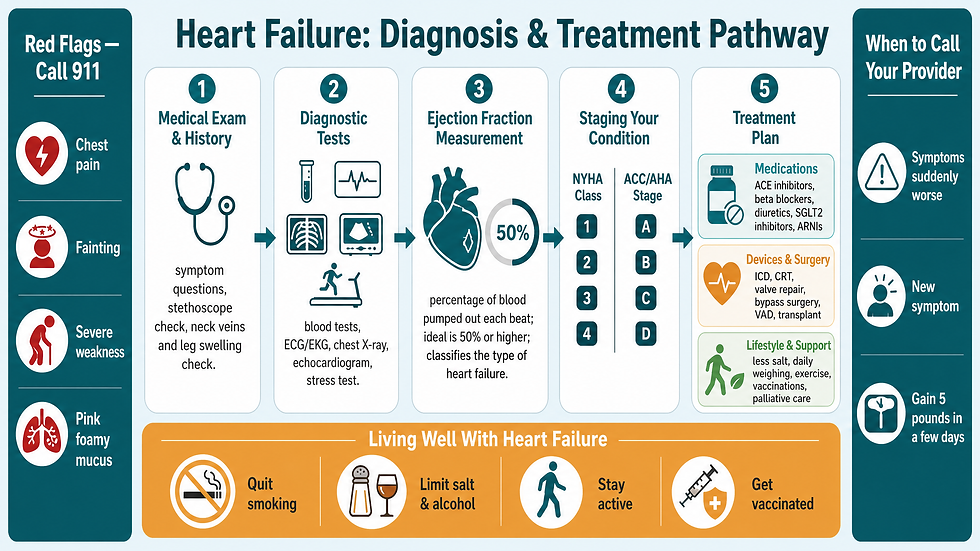
The 12 Medication Types Used for Heart Failure
A combination of medicines is usually used. The specific medicines depend on the cause and the symptoms.
Medication type | What it does | Examples |
ACE inhibitors | Relax blood vessels, lower blood pressure, improve blood flow, decrease strain on the heart. | Enalapril (Vasotec, Epaned), lisinopril (Zestril, Qbrelis), captopril |
ARBs | Many of the same benefits as ACE inhibitors; an option for people who can’t tolerate them. | Losartan (Cozaar), valsartan (Diovan), candesartan (Atacand) |
ARNIs | Combine two blood pressure medicines; used for some people with HFrEF and may help prevent hospital stays. | Sacubitril-valsartan (Entresto) |
Beta blockers | Slow the heart rate, lower blood pressure, reduce symptoms, and help the heart work better; may help you live longer. | Carvedilol (Coreg), metoprolol (Lopressor, Toprol-XL), bisoprolol |
Diuretics (water pills) | Make you urinate more often, preventing fluid buildup and reducing lung fluid so it’s easier to breathe. | Furosemide (Lasix, Furoscix) |
Potassium-sparing diuretics (aldosterone antagonists) | May help people with severe HFrEF live longer; can raise blood potassium to dangerous levels — discuss diet with your provider. | Spironolactone (Aldactone, CaroSpir), eplerenone (Inspra) |
SGLT2 inhibitors | Originally diabetes medicines, now among the first treatments for heart failure; studies show they lower the risk of hospital stays and death even in people without diabetes. | Canagliflozin (Invokana), dapagliflozin (Farxiga), empagliflozin (Jardiance) |
Digoxin (digitalis) | Helps the heart squeeze better and slows the heartbeat; reduces symptoms in HFrEF, especially with rhythm disorders like atrial fibrillation. | Digoxin (Lanoxin) |
Hydralazine + isosorbide dinitrate | Relaxes blood vessels; may be added when severe symptoms persist despite ACE inhibitors or beta blockers. | BiDil |
Vericiguat | Once-daily oral medicine (a soluble guanylate cyclase stimulator) for chronic heart failure; studies show fewer hospital stays and heart-disease-related deaths in high-risk patients. | Verquvo |
Positive inotropes | Given by IV in hospital for certain severe heart failure; help the heart pump and maintain blood pressure, but long-term use carries increased death risk in some people. | IV inotropes |
Other medicines | Prescribed for specific symptoms — nitrates for chest pain, statins for cholesterol, blood thinners to prevent clots. | Varies |
Your provider may change your medicine doses frequently — this is more common when you’ve just started a new medicine or when your condition is getting worse.
If you have a flare-up of symptoms, you may need to stay in the hospital to receive medicines that relieve symptoms, medicines that help the heart pump better, and oxygen through a mask or nasal tubes. People with severe heart failure may need supplemental oxygen long-term.
Surgery and Devices for Heart Failure
Procedure or device | When it’s used |
Coronary artery bypass graft surgery | If severely blocked arteries are causing heart failure. A healthy vessel from the leg, arm or chest is connected around the blockage to restore blood flow. |
Heart valve repair or replacement | If a damaged valve causes heart failure. Done as open-heart or minimally invasive surgery. |
Implantable cardioverter-defibrillator (ICD) | Prevents complications — it’s not a treatment for heart failure itself. Implanted under the chest skin, it monitors the heartbeat and corrects dangerous rhythms or shocks the heart back into rhythm if it stops. It can also pace a slow heartbeat. |
Cardiac resynchronization therapy (CRT) | For people whose lower chambers don’t pump in sync. A device sends electrical signals so the chambers squeeze in a coordinated way. Often used with an ICD. |
Ventricular assist device (VAD) | A mechanical pump that helps move blood from the lower chambers to the body, usually in the lower left chamber. Used while waiting for a transplant or as a permanent option for those who aren’t transplant candidates. |
Heart transplant | For people so severely affected that surgery and medicines don’t help. A transplant center team determines whether the procedure is safe and beneficial. |
Palliative and Hospice Care
Palliative care is special medical care that reduces symptoms and improves quality of life. Anyone with a serious or life-threatening illness can benefit — it treats the symptoms of the disease or eases the side effects of treatment.
In some people with heart failure, medicines no longer work and a heart transplant or device isn’t an option. In that case, hospice care may be recommended. Family and friends — with the aid of nurses, social workers and trained volunteers — provide emotional, psychological and spiritual support at home or in nursing homes and assisted living centers.
If you have an ICD, an important discussion to have with your family and healthcare team is whether the device should be turned off so that it can’t deliver shocks to keep the heart beating. Part of this discussion may involve an advance care directive — spoken and written instructions about your medical care if you become unable to speak for yourself.
Living Well With Heart Failure: 12 Lifestyle Steps
Making certain lifestyle changes often improves heart failure symptoms and may even stop the condition from getting worse.
Don’t smoke. Smoking damages blood vessels, raises blood pressure, lowers blood oxygen, and speeds up the heartbeat. Quitting is the best way to reduce heart disease risk, and you can’t be considered for a heart transplant if you continue to smoke. Avoid secondhand smoke too.
Check your legs, ankles and feet for swelling every day. Call your provider if the swelling worsens.
Weigh yourself regularly and ask your provider how often. Weight gain may mean your body is holding onto fluid. Call your provider if you gain 5 pounds (2.3 kilograms) or more within a few days.
Manage your weight. Even losing a small amount can improve heart health.
Eat a healthy diet with fruits and vegetables, whole grains, fat-free or low-fat dairy, and lean proteins. Limit saturated or trans fats.
Limit salt. Too much sodium makes the body hold onto water (water retention), which makes the heart work harder. Symptoms include shortness of breath and swollen legs, ankles and feet. Ask your provider about a no-salt or low-salt diet — and remember that salt is already added to prepared foods.
Limit alcohol. It can interfere with medicines, weaken the heart, and increase the risk of irregular heartbeats. Your provider may recommend that you don’t drink at all.
Ask how much fluid you can drink. Severe heart failure may require limiting fluids.
Stay as active as possible. Moderate exercise helps keep the heart and body healthy. Your provider may suggest a walking program or cardiac rehabilitation.
Reduce stress. Anxiety or anger can make the heart beat faster and blood pressure rise, which can make heart failure worse. Mindfulness and support groups can help.
Get better sleep. Heart failure can cause shortness of breath when lying down. Try sleeping with your head propped up on a pillow or wedge. If you snore or have other sleep challenges, get tested for sleep apnea.
Get recommended vaccinations — influenza, pneumonia and COVID-19.
Some people may also be told to take omega-3 fatty acid supplements; some research shows they may help reduce the need for hospital stays.
Coping and Support: 6 Daily Habits That Help
Managing heart failure requires open communication between you and your healthcare professional. Be honest about any challenges with diet, lifestyle and medicine use. Pay attention to how your body feels and tell your provider when you’re feeling better or worse.
Take medicines as directed. Don’t stop without talking to your provider. If side effects or costs are a concern, ask about options. Keep all scheduled appointments.
Use caution with other medicines and supplements. Over-the-counter pain and swelling medicines such as ibuprofen (Advil, Motrin IB) and naproxen sodium (Aleve) can make heart failure worse. Some diet pills and supplements may also be unsafe. Tell your provider about everything you take, including over-the-counter products.
Weigh yourself daily — first thing in the morning, after breakfast and after urinating. Write it down and bring the notes to checkups. A weight increase can signal fluid buildup.
Check your blood pressure at home. Write down the numbers and bring them to your checkups so your provider knows if treatment is working.
Know how to contact your provider. Keep the clinic and hospital phone numbers and directions handy.
Ask for help. Friends and family can help you meet your treatment goals. And if you have questions about intimacy — most people with heart failure can continue having sex once symptoms are under control — ask your provider.
Getting Ready for Your Appointment
If you’re worried about your heart failure risk, make an appointment with your healthcare professional. You may be referred to a cardiologist — a doctor trained in heart diseases. If heart failure is found early, treatment may be easier and more effective.
Appointments can be brief, so preparation helps:
Know any pre-appointment restrictions, such as fasting before certain tests.
Write down your symptoms, including any that seem unrelated.
Gather key personal information — family history of heart disease, stroke, high blood pressure or diabetes, and major recent stresses. Some causes of heart failure run in families.
List all medicines, vitamins and supplements with doses, and bring the list to every checkup.
Take someone along if possible — they may remember details you miss.
Write down your questions, ordered from most to least important.
Your questions | What your provider will likely ask you |
What’s the most likely cause of my symptoms? | When did you first notice your symptoms? |
Are there other possible causes? | Do symptoms occur all the time, or come and go? |
What tests will I need, and do they require special preparation? | How severe are your symptoms? |
What treatments are available, and which do you recommend? | What, if anything, improves your symptoms? |
What foods should I eat or avoid? | Does anything make your symptoms worse? |
What’s an appropriate level of physical activity, and do I have restrictions? | — |
How often should I be screened for changes? | — |
I have other conditions — how do we manage them together? | — |
Is there a generic for the medicine you’re prescribing? | — |
Do my family members need screening for conditions that cause heart failure? | — |
In the meantime, it’s never too early to quit smoking, cut down on salt, and eat healthy foods. These changes can help prevent heart failure from starting or worsening.
The Possible Complications
If you have heart failure, regular health checkups matter even when symptoms improve — your provider can examine you and run tests to check for complications. Depending on your age, overall health and the severity of the heart disease, complications may include:
Complication | What happens |
Kidney damage or failure | Heart failure can reduce blood flow to the kidneys; untreated, this can lead to kidney failure requiring dialysis. |
Other heart changes | Changes in the heart’s size and function may damage valves and cause irregular heartbeats. |
Liver damage | Fluid backup puts pressure on the liver and can cause scarring that makes it harder for the liver to work. |
Sudden cardiac death | A weak heart carries a risk of dying suddenly from a dangerous irregular heart rhythm. |
Conclusion and Next Steps
Heart failure is a serious condition — but it is not an automatic verdict. When the heart muscle weakens or stiffens, fluid backs up into the lungs and legs, bringing shortness of breath, fatigue and swelling. The most common cause is coronary artery disease, and high blood pressure, valve disease and viral infections also play major roles. The good news is that modern treatment works on multiple fronts: medications that reduce strain and help the heart pump, devices like ICDs and VADs, surgeries including valve repair and transplants, and daily habits that genuinely improve quality of life.
Your first step is a conversation with a healthcare professional. Knowing your symptoms, your ejection fraction, and your stage makes treatment easier to personalize — and catching heart failure early often makes treatment more effective. Track your weight daily, take medicines as directed, limit salt, stay active, and never hesitate to call 911 for chest pain, fainting, or sudden severe shortness of breath.
If you have unexplained shortness of breath, swollen ankles, or sudden weight gain, schedule an appointment with your healthcare professional today. Early evaluation can make treatment easier and more effective. And if you’re experiencing chest pain or fainting, call 911 immediately — don’t try to diagnose yourself.
Frequently Asked Questions
What is the difference between heart failure and a heart attack?
A heart attack happens suddenly when an artery feeding the heart becomes completely blocked, damaging the heart muscle. Heart failure is a longer-term condition in which the heart muscle can’t pump blood as well as it should. A heart attack is actually one of the leading causes of heart failure — the muscle damage can leave the heart unable to pump properly.
Is heart failure the same as congestive heart failure?
Yes. Heart failure may also be called congestive heart failure. The “congestion” refers to the fluid that backs up and builds up in the lungs, legs, feet and belly when the heart can’t pump efficiently.
Can heart failure be cured or reversed?
Heart failure itself is usually a long-term condition, but treating the underlying cause can sometimes reverse it. For example, treating certain types of heart valve disease or an irregular heart rhythm may reverse heart failure in some people. Proper treatment may improve symptoms and may help some people live longer.
What are the first signs of heart failure?
The earliest warning signs often include shortness of breath with activity or when lying down, fatigue and weakness, and swelling in the legs, ankles and feet. Other early signs include a persistent cough, wheezing, and a reduced ability to exercise.
How is heart failure staged, and what does my stage mean?
Providers use two systems together: the New York Heart Association (NYHA) classification (Classes 1–4, based on symptoms during activity and rest) and the ACC/AHA classification (Stages A–D, which includes people at risk who don’t have symptoms yet). Staging helps your provider determine the most appropriate treatment. Class 1/Stage A means no or minimal symptoms; Class 4/Stage D means the most severe, advanced heart failure.
What is a normal ejection fraction?
An ejection fraction of 50% or higher is considered ideal. It measures the percentage of blood leaving your heart each time it squeezes and is taken during an echocardiogram. Importantly, you can still have heart failure even if your ejection fraction is considered ideal (this is called heart failure with preserved ejection fraction).
What should I avoid if I have heart failure?
Avoid smoking and secondhand smoke, excess salt and alcohol, over-the-counter pain medicines like ibuprofen (Advil, Motrin IB) and naproxen (Aleve), unsafe diet pills and supplements, and ignoring sudden weight gain. Don’t stop prescription medicines without talking to your provider, and call right away if symptoms suddenly worsen or you gain 5 pounds (2.3 kg) or more in a few days.
Can you live a normal life with heart failure?
Many people with heart failure manage their condition well. Proper treatment, daily habits such as limiting salt and staying active, and regular checkups can improve symptoms and quality of life, and may help some people live longer. Open communication with your healthcare professional is key to finding the treatment plan that works best for you.
Related Reading
References
Heart failure: Symptoms & causes — clinical overview reviewed January 21, 2025
Heart failure: Diagnosis & treatment — clinical overview reviewed January 21, 2025
Disclaimer: This article is for general educational purposes only and is not a substitute for professional medical advice, diagnosis or treatment. Always seek the guidance of your healthcare professional with any questions about a medical condition. In a medical emergency, call 911 or your local emergency number.
Comments