TEER Procedure (Transcatheter Edge-to-Edge Repair): Steps, Risks and Recovery

Updated: 3 days ago
Written and medically reviewed by Dr. Baraa Alnahhal, MD · Last reviewed: November 2026 · How we review
Quick Answer: What is a TEER procedure?
TEER (transcatheter edge-to-edge repair) is a minimally invasive way to fix a leaky mitral or tricuspid heart valve. A doctor guides a catheter through a vein in the groin to the heart and places small metal clips that hold the valve leaflets together. It takes two hours or less, and most people go home in one or two days. [1]
What the research says
Mitral TEER reduced heart failure hospital stays and deaths. In a trial of 614 people with heart failure and moderate-to-severe or severe secondary mitral regurgitation, adding TEER to medical therapy lowered heart failure hospitalizations to 35.8% per patient-year, compared with 67.9% with medicine alone. Death within 24 months was 29.1% versus 46.1%. (Stone et al., The New England Journal of Medicine, 2018) [2]
Tricuspid TEER improved quality of life. In a randomized trial of 350 people with severe tricuspid regurgitation (mean age 78), quality-of-life scores rose by 12.3 points with TEER versus 0.6 points with medical therapy. At 30 days, 87.0% of the TEER group had no more than moderate leakage, and 98.3% were free of major adverse events. (Sorajja et al., The New England Journal of Medicine, 2023) [3]
Key takeaways
TEER repairs a leaky mitral or tricuspid valve by clipping the leaflet edges together. [1]
It is done through a vein in the groin, without opening the chest. [1]
It may be an option when the leak is severe or when surgery would be too risky. [1]
The procedure takes about two hours or less under general anesthesia. [1]
Most people stay in the hospital one or two days and may return to work and driving in about a week. [1]
What is a TEER procedure?
TEER stands for transcatheter edge-to-edge repair. It treats a leaky heart valve, either the mitral valve or the tricuspid valve. When the valve leaflets do not close properly, some blood leaks backward with each heartbeat. TEER clips the facing edges of the leaflets together so the valve closes more tightly and blood moves forward. [1]
Fixing the leak can improve symptoms and how much physical activity you can do. [1] To learn more about the leaks TEER treats, see our guides to mitral valve regurgitation and tricuspid valve regurgitation.
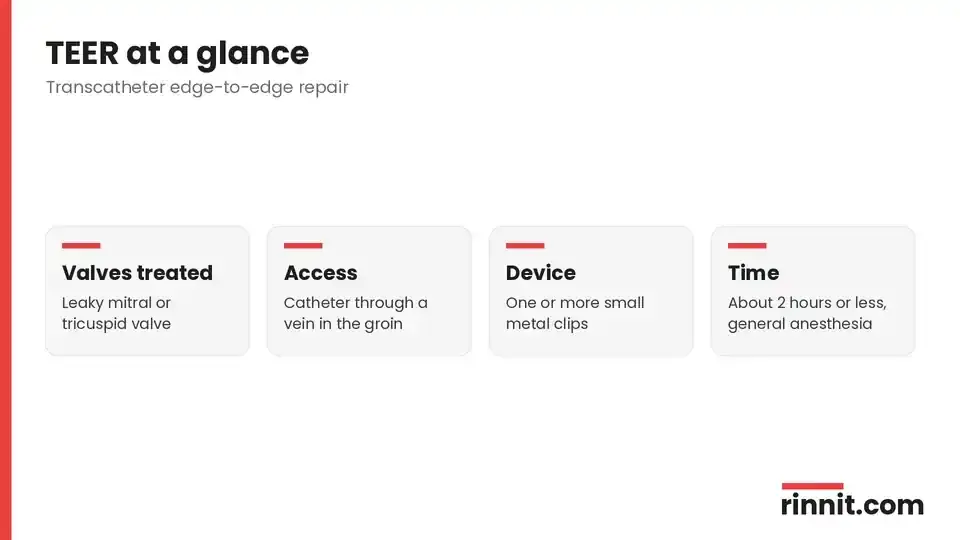
TEER repairs a leaky valve through a vein, without opening the chest.
Who is TEER for?
Your provider may consider TEER if your valve leak is severe, or if open-heart surgery would be too risky for you, for example because of other medical problems. [1]
TEER is less invasive than surgery because the team reaches the heart through a vein instead of opening the chest. Even so, it is not right for everyone. [1] Other options for a leaky mitral valve include mitral valve repair surgery and transcatheter mitral valve replacement (TMVR).
How do you prepare for TEER?
Before the procedure, you may have some of these tests: [1]
A physical exam
A six-minute walk test
A cardiopulmonary exercise test
An echocardiogram (heart ultrasound)
A heart CT scan
A coronary angiogram
A right heart catheterization
Your provider may also ask you to start taking a blood thinner before the procedure. [1]
What happens during a TEER procedure?
TEER takes about two hours or less, and you are fully asleep under general anesthesia. The main steps are: [1]

The valve is repaired through a vein, guided by imaging.
The doctor inserts a catheter into the femoral vein in your groin.
The catheter is guided to your heart using X-ray or ultrasound images.
If needed, it passes through the wall between the heart's upper chambers.
One or more metal clips are placed on the facing edges of the valve leaflets.
The catheter is removed, and the opening in the vein is closed and pressed to stop bleeding.
An echocardiogram checks how well the repair works.
Sources: [1]
TEER at a glance
Item | Typical detail |
Valves treated | Mitral or tricuspid |
Access | Femoral vein in the groin |
Anesthesia | General (you are asleep) |
Procedure time | About 2 hours or less |
Hospital stay | 1–2 days |
Return to work and driving | About 1 week, if your provider agrees |
Sources: [1]
What are the benefits and risks of TEER?
Benefits
A safe option for people who cannot have surgery
Less valve leakage
Better symptoms
Being able to walk farther in a six-minute walk test
A lower chance of being hospitalized for heart failure
Sources: [1]
Risks
Risk | What it means |
Bleeding, infection or blood clots | General risks of any catheter procedure |
Air blockage of a blood vessel | An air bubble blocks blood flow |
Pericardial effusion | Fluid builds up around the heart |
Clip detachment | A clip comes loose from the leaflet |
Abnormal heart rhythm | The heartbeat becomes irregular |
Hole in the heart wall | The opening made between the upper chambers does not close |
Valve narrowing or leaflet injury | The valve becomes too narrow (stenosis) or a leaflet is damaged |
Sources: [1]
What is recovery like after TEER?
After the procedure, you lie still on your back for several hours. You may stay in the hospital for one or two days. [1]
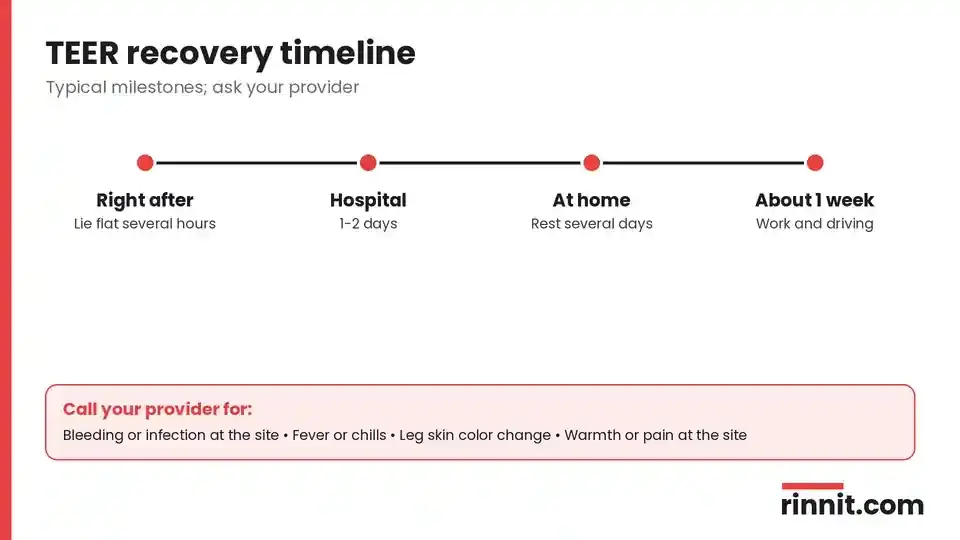
Many people are back to work and driving in about a week.
At home, rest and avoid exertion for several days. You may be able to return to work and drive in about a week, but check with your provider first. Follow-up visits usually include echocardiograms to check the repair. [1]
When should you call your provider?
Contact your provider if you notice: [1]
Signs of infection or bleeding where the catheter went in
Fever or chills
A change in the color of the skin on your leg
Warmth or pain at the catheter site
Conclusion
TEER repairs a leaky mitral or tricuspid valve by clipping the leaflet edges together through a vein in the groin. It can reduce leakage, ease symptoms and lower the chance of heart failure hospital stays, especially for people who cannot safely have open-heart surgery. [1]
If you are considering TEER, ask your care team whether your valve is a good fit for clips and how many of these procedures they perform. Choosing a team with plenty of experience can offer extra reassurance. [1]
Keep learning: Read our guides to heart failure, mitral valve disease and tricuspid valve surgery.
FAQ
What is a TEER procedure?
TEER (transcatheter edge-to-edge repair) is a minimally invasive procedure that clips the leaflets of a leaky mitral or tricuspid valve together through a catheter.
Which heart valves can TEER fix?
TEER can repair a leaky mitral valve or a leaky tricuspid valve.
Who is a candidate for TEER?
TEER may be considered when a valve leak is severe or when open-heart surgery would be too risky, for example because of other medical problems.
Is TEER open-heart surgery?
No. The doctor reaches the heart through a vein in the groin, so the chest is not opened.
How long does a TEER procedure take?
TEER usually takes about two hours or less under general anesthesia.
How long is the hospital stay after TEER?
Most people stay in the hospital for one or two days.
How long is recovery after TEER?
Rest for several days at home. Many people can return to work and driving in about a week, with their provider's approval.
What are the benefits of TEER?
Benefits include less valve leakage, better symptoms, walking farther and a lower chance of hospital stays for heart failure.
What are the risks of TEER?
Risks include bleeding, infection, blood clots, fluid around the heart, clip detachment, abnormal heart rhythm and valve narrowing or leaflet injury.
When should I call my doctor after TEER?
Call your provider for bleeding or infection at the catheter site, fever or chills, a change in leg skin color, or warmth or pain at the site.
How do I prepare for TEER?
You may have tests such as a physical exam, a six-minute walk test, a cardiopulmonary exercise test, an echocardiogram, a heart CT scan, a coronary angiogram or a right heart catheterization. Your provider may also ask you to start taking a blood thinner before the procedure [1].
Does TEER hurt, and what anesthesia is used?
You are fully asleep under general anesthesia during TEER, which takes about two hours or less. Afterward, you lie still on your back for several hours, and warmth or pain at the catheter site is a reason to contact your provider [1].
Related Reading
Learn more in our guide to What Is Mitral Valve Regurgitation? A Plain-Language Guide to This Common Heart Valve Problem.
Learn more in our guide to Tricuspid Valve Regurgitation: Symptoms, Causes, and Treatment Explained.
Learn more in our guide to Heart Failure: Symptoms, Causes & Treatment Guide.
References
Cleveland Clinic. TEER (Transcatheter Edge-to-Edge Repair). Cleveland Clinic. Last updated March 25, 2026. https://my.clevelandclinic.org/health/procedures/teer-procedure
Stone GW, Lindenfeld J, Abraham WT, et al. Transcatheter Mitral-Valve Repair in Patients with Heart Failure. N Engl J Med. 2018;379(24):2307-2318. PMID 30280640. https://doi.org/10.1056/NEJMoa1806640
Sorajja P, Whisenant B, Hamid N, et al. Transcatheter Repair for Patients with Tricuspid Regurgitation. N Engl J Med. 2023;388(20):1833-1842. PMID 36876753. https://doi.org/10.1056/NEJMoa2300525
Medical disclaimer
This article is for general education only and does not replace advice from a qualified healthcare professional. Talk to your doctor about your own diagnosis and treatment, and seek emergency care right away for severe or sudden symptoms.



Comments