What Is Mitral Valve Regurgitation? A Plain-Language Guide to This Common Heart Valve Problem

Updated: 2 days ago
Medically reviewed by Dr. Baraa Alnahhal, MD · Last reviewed: October 2026
Quick Answer: Key Facts About Mitral Valve Regurgitation
Mitral valve regurgitation is a leaky mitral valve, the valve between the heart's left upper and lower chambers, that does not close tightly, so some blood flows backward. Symptoms include fatigue, shortness of breath and a fluttering heartbeat. It is often found as a murmur and confirmed with an echocardiogram. Severe cases may need a valve clip or surgery. [1] [2]
Question | Answer |
What it is | A leaky mitral valve — the valve between the heart's upper left chamber (left atrium) and lower left chamber (left ventricle) doesn't close tightly, so some blood flows backward. |
Common symptoms | Fatigue, shortness of breath (especially lying down), a fast or fluttering heartbeat, an irregular heartbeat, and swollen feet or ankles. |
Main causes | Mitral valve prolapse (bulging valve flaps), heart attack, congenital heart defects, thickened heart muscle, damaged tissue cords, infections, rheumatic fever, or chest radiation. |
How it's found | Usually a whooshing sound called a murmur heard through a stethoscope, then confirmed with an echocardiogram (ultrasound pictures of the beating heart). |
Treatment | Mild cases may need only regular checkups. Severe cases can be treated with medicines, a mitral valve clip, or surgery to repair or replace the valve. |
What the research says
A larger leak signals higher risk, even without symptoms. In a Mayo Clinic cohort of 456 people with asymptomatic organic mitral regurgitation, the estimated five-year rates with medical management were 22% for death from any cause and 33% for cardiac events (cardiac death, heart failure, or new atrial fibrillation). People with an effective regurgitant orifice of at least 40 mm² had a five-year survival of 58%, lower than the 78% expected for the general population. (Enriquez-Sarano et al., N Engl J Med, 2005) [5]
Early surgery was linked to better long-term survival when the leak came from a flail leaflet. In an international registry of 2,097 people with flail mitral valve leaflets, 1,021 had no guideline-defined trigger for surgery; 575 were managed medically at first and 446 had surgery within 3 months. Ten-year survival was 86% with early surgery versus 69% with initial medical management, and ten-year heart failure rates were 7% versus 23%. New-onset atrial fibrillation did not differ. This was an observational registry, so it shows an association, not proof of cause. (Suri et al., JAMA, 2013) [6]
What Exactly Is Mitral Valve Regurgitation?
Your heart has four chambers and four valves. The valves act like one-way gates that keep blood moving in the right direction. Each valve has flaps called leaflets that open and close once during every heartbeat. [1]
The mitral valve sits between the two chambers on the left side of your heart: the left atrium (the upper chamber that receives incoming blood) and the left ventricle (the muscular lower chamber that pumps blood out to your body). [1] [3]
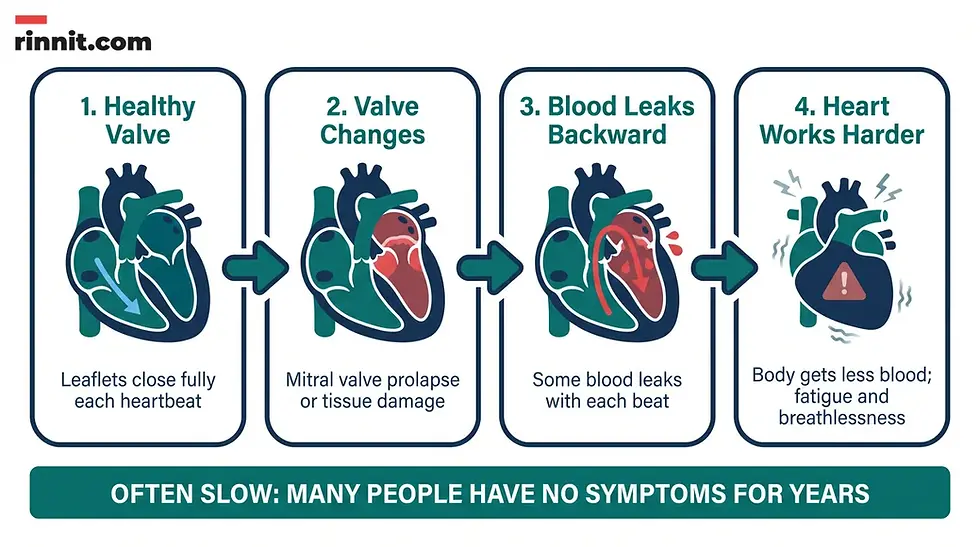
Mitral valve regurgitation is a common type of heart valve disease. The valve between the left heart chambers doesn't close fully, and blood leaks backward across the valve. [1]
This condition is also called mitral regurgitation (MR), mitral insufficiency, or mitral incompetence. All of those names mean the same thing: a leaky mitral valve. [1]
If only a little blood leaks, the heart usually keeps up without problems. But if a lot of blood leaks backward, the rest of the heart and body don't get enough blood. That's what causes tiredness and shortness of breath. [1]
Is Mitral Valve Regurgitation Common?

What Does a Leaky Mitral Valve Feel Like?
Many people with mitral valve regurgitation have no symptoms at all for many years. The condition is often mild and develops slowly. Sometimes it develops quickly — when that happens, it's called acute mitral valve regurgitation. [1]
When symptoms do appear, they include:
When Should You See a Doctor?
If you notice these symptoms, make an appointment for a health checkup. Your healthcare professional may send you to a cardiologist — a doctor trained in heart diseases. [1]
What Causes the Mitral Valve to Leak?
The heart has two upper chambers (the atria, which receive incoming blood) and two lower chambers (the ventricles, which pump blood out). Heart valves sit at the chamber openings and keep blood flowing the right way. In mitral valve regurgitation, the valve flaps simply don't close tightly, so blood moves backward when the valve is closed. [1]
Doctors group causes into two types:
What Are the Specific Causes?
Mitral valve prolapse (MVP) is one of the most common causes. [4] The valve flaps bulge back into the left atrium when the heart squeezes, which prevents the valve from closing tightly. [1] [4]
Rheumatic fever is a complication of untreated strep throat. It can damage the mitral valve and lead to regurgitation early or later in life — called rheumatic mitral valve disease. This is rare in the United States. [1]
A heart attack can damage the heart muscle that supports the mitral valve. A leaky valve caused this way is called ischemic mitral regurgitation. [1]
Congenital heart defects mean a person is born with changes in heart structure that affect the valves. [1]
Cardiomyopathy is thickening of the heart muscle. Two types are linked to mitral valve regurgitation: dilated cardiomyopathy and hypertrophic cardiomyopathy. [1]
Damaged tissue cords hold the valve flaps to the heart wall. Over time they can stretch or tear — especially in people with mitral valve prolapse — or a chest injury can damage them. A tear can cause blood to suddenly move backward through the valve. [1]
Endocarditis is an inflammation of the inner lining of the heart's chambers and valves, usually caused by an infection. Germs enter the bloodstream and stick to damaged areas in the heart. [1]
Radiation therapy for cancer in the chest can lead to mitral valve regurgitation, but this is rare. [1]
Who Is at Higher Risk?
A number of different things can raise your risk of developing a leaky mitral valve, also called mitral valve regurgitation.
Risk factor | How it raises risk |
Heart infections (endocarditis) [1] | Damages valve tissue [3] |
Heart attack [1] | Damages the muscle supporting the valve [1] |
Congenital heart defects [1] | The valve formed differently at birth |
History of other valve diseases [1] | Including mitral valve prolapse and mitral valve stenosis [1] |
Older age [1] | Valve tissue changes over time |
Radiation to the chest [1] | Can restrict the valve flaps [3] |
What Happens If It Goes Untreated?
Untreated mitral valve regurgitation usually causes no complications at all when it is mild. But severe mitral valve regurgitation can cause serious problems: [1]
Complication | What it means |
Atrial fibrillation (AFib) | An irregular, often very fast heartbeat. Raises the risk of blood clots and stroke. [1] |
Pulmonary hypertension | High blood pressure in the lungs' blood vessels. Fluid builds up in the lungs. [1] |
Congestive heart failure | The heart works harder to pump enough blood. The lower left chamber gets bigger, and untreated, the heart muscle weakens. [1] |
How Is Mitral Valve Regurgitation Diagnosed?
Diagnosis starts with a health checkup. Your healthcare professional asks about symptoms and medical history, then listens to your heart and lungs with a stethoscope. If you have mitral valve regurgitation, the professional may hear a whooshing sound called a murmur — the sound of blood leaking backward through the valve. [2]

Tests that may follow include:
Test | What it does |
Echocardiogram | Sound waves create pictures of the beating heart. A standard one (transthoracic, or TTE) confirms the leak and shows severity. A more detailed version (transesophageal, or TEE) takes pictures from inside the body. [2] |
ECG (EKG) | Sensor patches on the chest show how the heart is beating and can detect irregular heartbeats. [2] |
Chest X-ray | Shows the condition of the heart and lungs, including an enlarged heart or fluid in the lungs. [2] |
Cardiac MRI | Magnetic fields and radio waves make detailed heart pictures and help gauge severity. [2] |
Exercise stress test | Walking on a treadmill or riding a bike while the heart is checked. If you can't exercise, medicine can make the heart work the same way. [2] |
Cardiac catheterization | A thin tube is guided through an arm or groin blood vessel to the heart. Dye makes the arteries show up on X-rays. Not often used for diagnosis, but helpful when other tests fall short. [2] |
What Do the Four Stages Mean?
After testing confirms valve disease, your healthcare team assigns a stage. Staging helps decide the best treatment. [2]
What Are the Treatment Options?
Treatment goals are to help the heart work better, reduce symptoms, and prevent complications. If your regurgitation is mild, you may not need any treatment at all. Your team plans treatment based on your symptoms, disease stage, and overall health. [2]
Can Medicines Fix a Leaky Mitral Valve?
Medicines can't repair the valve, but they can ease symptoms and prevent complications: [2]
Medicine type | What it does |
Water pills (diuretics) | Reduce or prevent fluid buildup in the lungs and body [2] |
Blood thinners (anticoagulants) | Prevent blood clots if you have atrial fibrillation caused by the valve disease [2] |
Blood pressure medicines | Lower blood pressure, since high blood pressure makes the leak worse [2] |
When Is Surgery Needed?
A damaged mitral valve may eventually need repair or replacement, even without symptoms. Surgery is usually done through a cut in the chest, though some centers use robot-assisted (minimally invasive) surgery with robotic arms. [2]
Mitral valve repair removes and fixes part of the damaged valve so it closes fully again. The surgeon might patch holes, reconnect flaps, remove extra tissue, replace supporting cords, or tighten the valve ring with an artificial band (annuloplasty). Repair saves your own valve and protects heart function, so surgeons recommend it over replacement whenever possible. [2] [3]
Other repair options include:
Procedure | How it works |
Valvuloplasty | A catheter with a balloon opens a narrowed valve. The tube is guided through an arm or groin artery to the valve, inflated, then removed. [2] |
Mitral valve clip | A catheter with a clip is guided through a groin artery to the valve. The clip helps the flaps close more tightly and reduces the backward leak. An option for severe cases or people who aren't good surgery candidates. [2] |
Valve-in-valve | A catheter places a replacement valve inside a failing tissue valve. [2] |
Mitral valve replacement removes the valve entirely and replaces it with a mechanical valve or a biological tissue valve made from cow, pig, or human heart tissue. A mechanical valve requires blood thinners for life. Tissue valves can wear out and may need replacement later. After replacement, you'll usually take antibiotics before dental procedures to prevent a heart infection called infective endocarditis. [2]

What Lifestyle Changes Help?
Lifestyle changes protect your heart alongside medical treatment:
Change | Why it helps |
Don't smoke or use tobacco | Smoking is a major risk factor for heart disease [2] |
Eat healthy foods | Fruits, vegetables, whole grains; limit sugar, salt, and saturated fats [2] |
Get regular exercise | Keeps the heart healthy; amount depends on your disease stage [2] |
Keep a healthy weight | Being overweight raises heart disease risk [2] |
Limit alcohol | Heavy drinking causes irregular heartbeats; excessive use can weaken the heart muscle. If you drink: up to 1 drink a day for women, 2 for men [2] |
Get 7 to 9 hours of sleep | Poor sleep raises the risk of heart disease [2] |
Manage blood pressure, cholesterol, and blood sugar | Ask your team how often to check these [2] |
Reduce emotional stress | Try exercise, mindfulness, and support groups [2] |
One more note: if you have mitral valve regurgitation and are thinking about getting pregnant, talk with your healthcare team first. Pregnancy makes the heart work harder, and how your heart handles that depends on how much the valve leaks and how well the heart pumps. [2]
What's the Outlook?
How well a person does after diagnosis varies. The outlook depends on the cause of the valve disease, the stage, how severe the leak is, and how long the condition has been present. People who have valve repair at an experienced medical center generally have good outcomes. [2]
How can people live well with mitral valve regurgitation?
Most people with mild MR live normally with regular checkups. If your condition is more serious, the key is staying ahead of it: keep all follow-up appointments, take medicines as prescribed, make the heart-healthy lifestyle changes above, and report any new or worsening symptoms right away.
Take the Next Step
A leaky mitral valve often stays quiet for years — which is exactly why it shouldn't be ignored once symptoms appear.
If you feel unexplained fatigue, notice your heartbeat fluttering, or catch yourself short of breath when lying down, schedule a heart checkup. A stethoscope exam and a simple ultrasound can reveal whether a mitral valve leak is behind your symptoms — and catching it early means more options and better outcomes.
Start the conversation with a healthcare professional today.
Frequently Asked Questions
Is mitral valve regurgitation dangerous?
Mild mitral valve regurgitation usually causes no problems. Severe, untreated regurgitation can lead to irregular heartbeats, high blood pressure in the lungs, and heart failure. [1] That's why doctors monitor even mild cases.
Can a leaky mitral valve heal on its own?
No. The valve doesn't repair itself. Mild leaks may stay stable for years with watchful waiting, but a damaged valve may eventually need repair or replacement. [2]
What does the murmur sound like?
A murmur is a whooshing sound heard through a stethoscope. It's the sound of blood leaking backward through the valve during a heartbeat. [2]
Will I need surgery?
Not necessarily. Many people never need surgery. If your regurgitation is severe or causing symptoms, your team may recommend repair (preferred when possible), a mitral valve clip, or replacement. [2]
How is this different from mitral valve prolapse?
Mitral valve prolapse is when the valve flaps bulge back into the upper chamber. [1] [4] That bulging is one of the most common causes of mitral valve regurgitation — the leak that results. [4]
What tests confirm the diagnosis?
An echocardiogram (ultrasound of the heart) is the main test. Doctors may also use an ECG, chest X-ray, cardiac MRI, exercise stress test, or cardiac catheterization. [2]
Can I exercise with mitral valve regurgitation?
Yes — staying active keeps the heart healthy. But how much and how hard depends on your disease stage. Ask your healthcare team what's right for you. [2]
What's the difference between mechanical and tissue valves?
Mechanical valves are long-lasting but require blood thinners for life. Tissue valves (from cow, pig, or human heart tissue) don't need lifelong blood thinners but can wear out over time. [2]
Related Reading
Mitral Valve Replacement: Surgery, Valve Types and Recovery explains mitral valve replacement surgery.
Annuloplasty: Heart Valve Repair, Recovery and Results explains annuloplasty heart valve repair.
Read next on Rinnit.com:
Learn more in our guide to TEER Procedure (Transcatheter Edge-to-Edge Repair): Steps, Risks and Recovery.
Transthoracic Echocardiogram (TTE): What It Shows, What to Expect and Results explains the heart ultrasound used to diagnose and monitor heart conditions.
References
Mayo Clinic Staff. Mitral valve regurgitation - Symptoms & causes. Mayo Clinic. April 17, 2026. https://www.mayoclinic.org/diseases-conditions/mitral-valve-regurgitation/symptoms-causes/syc-20350178
Mayo Clinic Staff. Mitral valve regurgitation - Diagnosis & treatment. Mayo Clinic. April 17, 2026. https://www.mayoclinic.org/diseases-conditions/mitral-valve-regurgitation/diagnosis-treatment/drc-20350183
Douedi S, et al. Mitral Regurgitation. In: StatPearls. Treasure Island (FL): StatPearls Publishing; 2026 Jan-. PMID 31985928. https://www.ncbi.nlm.nih.gov/books/NBK553135/
Cleveland Clinic. Mitral Valve Prolapse: Symptoms & Causes. Cleveland Clinic. August 6, 2026. https://my.clevelandclinic.org/health/diseases/17241-mitral-valve-prolapse
Enriquez-Sarano M, et al. Quantitative determinants of the outcome of asymptomatic mitral regurgitation. N Engl J Med. 2005;352(9):875-883. PMID 15745978. https://doi.org/10.1056/NEJMoa041451
Suri RM, et al. Association between early surgical intervention vs watchful waiting and outcomes for mitral regurgitation due to flail mitral valve leaflets. JAMA. 2013;310(6):609-616. PMID 23942679. https://doi.org/10.1001/jama.2013.8643
Medical disclaimer
This article is for general informational purposes only and does not constitute medical advice. Always consult a qualified healthcare professional for diagnosis and treatment decisions.



Comments