Annuloplasty: Heart Valve Repair, Recovery and Results

Updated: 2 days ago
Written and medically reviewed by Dr. Baraa Alnahhal, MD · Last reviewed: November 2026 · How we review
Quick Answer
An annuloplasty is a heart procedure that repairs a leaky heart valve by placing a small ring around it to tighten and reinforce it. A leaky valve lets blood flow backward and, untreated, can lead to heart failure. The ring stays in place permanently and is placed through open-heart or minimally invasive surgery.
What the research says
Leak return rates differed by ring shape, but not significantly: a review of 20 studies with 1,876 people given mitral rings for ischemic regurgitation found leaks came back in 19% with flat rings versus 11% with saddle-shaped rings, and 14% with symmetric versus 7% with asymmetric rings (Micali LR et al., International Journal of Cardiology, 2020) [2]
Repair and replacement had similar survival in severe cases: in a trial of 251 people with severe ischemic mitral regurgitation, 2-year mortality was 19.0% after ring repair versus 23.2% after valve replacement, but moderate or severe leaking returned in 58.8% after repair versus 3.8% after replacement (Goldstein D et al., New England Journal of Medicine, 2016) [3]
Key takeaways
An annuloplasty places a ring around a leaky heart valve.
It treats valve regurgitation.
It can be done on any of the four heart valves.
It can be open-heart or minimally invasive.
The ring usually lasts for decades.
What is an annuloplasty?
It's a type of heart valve surgery that repairs rather than replaces the valve. It differs from valvuloplasty, which opens a narrowed valve. The heart tissue grows around the ring over time. Sources: [1]
Why it's done
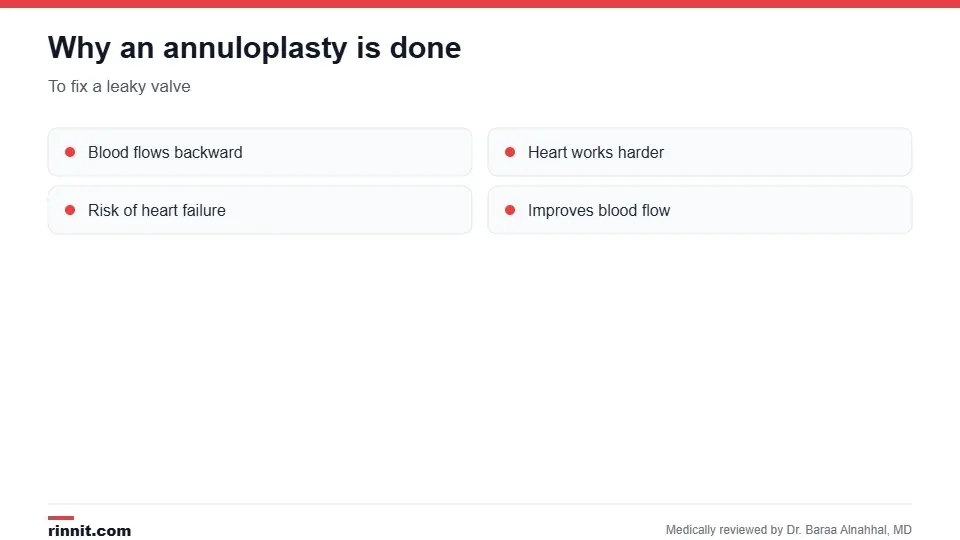
It reinforces the valve and improves blood flow.
To treat a leaky heart valve.
To help the heart pump more efficiently.
To lower the risk of heart failure. Sources: [1]
Types of annuloplasty

The ring stays in place permanently.
Type | Valve repaired |
Mitral | |
Tricuspid | |
Aortic | Aortic valve |
Pulmonary | Pulmonary valve |
For some people with mitral valve disease, a MitraClip placed through a catheter is a common minimally invasive alternative. Sources: [1, 2]
How to prepare
Follow your provider's instructions.
You'll usually fast starting the night before.
Tell your provider about any bleeding risks.
You may need to stop blood thinners for a while. Sources: [1]
What happens during the procedure

Minimally invasive surgery usually means a shorter stay.
Approach | How it's done |
Open-heart | One large chest incision; the ring is sewn around the valve |
Minimally invasive | A few small chest incisions, a camera and tiny tools |
A cardiac surgeon performs it under general anesthesia. Learn about minimally invasive mitral valve repair. Sources: [1]
Risks
Annuloplasty is generally safe. As with any surgery, there's a risk of infection or bleeding. Your overall risk depends on your health and heart condition. Sources: [1]
Recovery
You'll spend a few hours in a recovery area.
Minimally invasive: usually home in one to two days.
Open-heart: up to seven days in the hospital.
Avoid intense activity for at least a week.
Return to work in a week or two after minimally invasive surgery; after open-heart surgery, recovery usually takes 6 to 8 weeks, and longer for physical jobs. Sources: [1]
Outlook
For many people, results last a lifetime. Rings typically last several decades, and most people never need a replacement. In some severe cases, leaks can return, so follow-up is important. Sources: [1, 2, 3]
When to call your provider
Chest pain.
Dizziness or fainting.
Fever or chills.
Nausea or vomiting.
Swelling or pain that doesn't go away. Sources: [1]
Conclusion
An annuloplasty can fix a leaky valve with a small, permanent ring, often through a minimally invasive approach. Regular checkups help make sure your valve stays strong.
Keep learning: read about mitral valve repair and heart valve disease.
Frequently asked questions
What is an annuloplasty?
A procedure that places a ring around a leaky heart valve.
What does it treat?
Valve regurgitation, or a leaky valve.
Which valves can it fix?
Mitral, tricuspid, aortic and pulmonary valves.
What is the ring made of?
Mesh, metal or plastic.
Is the ring permanent?
Yes. It stays in place for life.
Is it open-heart surgery?
It can be, or it can be minimally invasive.
How long is the hospital stay?
One to two days if minimally invasive; up to seven days if open.
When can I go back to work?
In a week or two after minimally invasive surgery; often 6 to 8 weeks after open-heart surgery.
How long does it last?
Several decades for most people.
How is it different from valvuloplasty?
Valvuloplasty opens a narrowed valve; annuloplasty tightens a leaky one.
Related Reading
Mitral Valve Repair: Surgery Steps, Recovery Time, Risks and How Long It Lasts repairing the mitral valve.
Heart Valve Disease: Symptoms, Causes & Treatment an overview of valve disease.
Leaky Heart Valve: Causes, Symptoms, and Treatment Options the condition it treats.
What Is Mitral Valve Regurgitation? A Plain-Language Guide to This Common Heart Valve Problem a common leaky valve.
Heart Valve Replacement: Valve Types, Procedure and Recovery replacing a valve instead.
References
Cleveland Clinic. Annuloplasty: Valve Repair of the Heart. Cleveland Clinic. Last updated December 7, 2021. https://my.clevelandclinic.org/health/treatments/22224-annuloplasty
Micali LR, Parise G, Moula AI, et al. Are recurrence of ischemic mitral regurgitation and left ventricular reverse remodeling after restrictive annuloplasty ring dependent? International Journal of Cardiology. 2020;309:55-62. PMID 32178901. https://doi.org/10.1016/j.ijcard.2020.02.068
Goldstein D, Moskowitz AJ, Gelijns AC, et al. Two-year outcomes of surgical treatment of severe ischemic mitral regurgitation. New England Journal of Medicine. 2016;374(4):344-353. PMID 26550689. https://doi.org/10.1056/NEJMoa1512913
Medical disclaimer
This article is for general education only and does not replace advice from a qualified healthcare professional. Talk to your doctor about your own diagnosis and treatment, and seek emergency care right away for severe or sudden symptoms.



Comments