Heart Valve Replacement: Valve Types, Procedure and Recovery

Updated: 2 days ago
Written and medically reviewed by Dr. Baraa Alnahhal, MD · Last reviewed: November 2026 · How we review
Quick Answer
Heart valve replacement is a procedure that swaps a diseased heart valve that can't be repaired for a new one. Tissue valves usually last 10 to 20 years and don't need lifelong blood thinners; mechanical valves may last a lifetime but need lifelong warfarin. It can be done with open-heart surgery or a catheter procedure such as TAVR.
What the research says
TAVR beat surgery in low-risk patients: in the PARTNER 3 trial of 1,000 people with severe aortic stenosis, death, stroke or rehospitalization at 1 year occurred in 8.5% after TAVR versus 15.1% after open surgery, with a shorter hospital stay (Mack MJ et al., New England Journal of Medicine, 2019) [2]
Each approach has trade-offs: in 1,468 low-risk patients, TAVR had less bleeding (2.4% vs. 7.5%) and atrial fibrillation (7.7% vs. 35.4%) than surgery but more pacemaker implants (17.4% vs. 6.1%) (Popma JJ et al., New England Journal of Medicine, 2019) [3]
Key takeaways
Valve replacement swaps a damaged valve for a tissue or mechanical one.
Tissue valves last about 10 to 20 years; mechanical valves may last for life.
Mechanical valves need lifelong blood thinners.
It can be done with open-heart surgery or a catheter.
Most people recover in one to three months.
What is heart valve replacement?
Your heart has four valves. When one becomes too narrow or leaky and can't be repaired, replacing it restores normal blood flow. Replacement is one type of heart valve surgery. Sources: [1]
Why it's done

The aortic valve is replaced most often.
Aortic valve disease, such as aortic stenosis.
Tricuspid or pulmonary valve disease, which is less common.
Congenital heart disease.
Symptoms such as chest pain, shortness of breath or fainting. Sources: [1]
Types of replacement valves
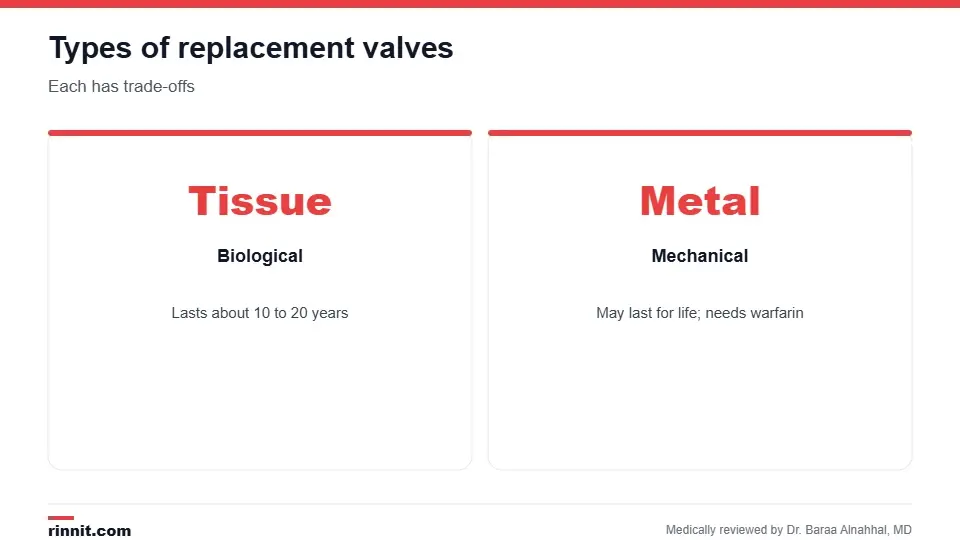
Your age and preferences help decide.
Valve | Made from | How long it lasts | Blood thinners |
Biological (tissue) | Cow, pig or human tissue | About 10 to 20 years | Usually not needed long term |
Mechanical | Metal or carbon | May last for life | Lifelong warfarin |
Mechanical valves may make a soft clicking sound. Your team weighs your age, your risk of future surgery and whether you can take blood thinners. Sources: [1]
Approaches
Approach | Examples |
Open-heart surgery | Surgical aortic valve replacement, Ross procedure, mitral or tricuspid replacement |
Catheter-based |
Catheter procedures are becoming more common, especially for the aortic valve, and usually mean a shorter hospital stay and faster recovery. Sources: [1, 2]
What happens during the procedure
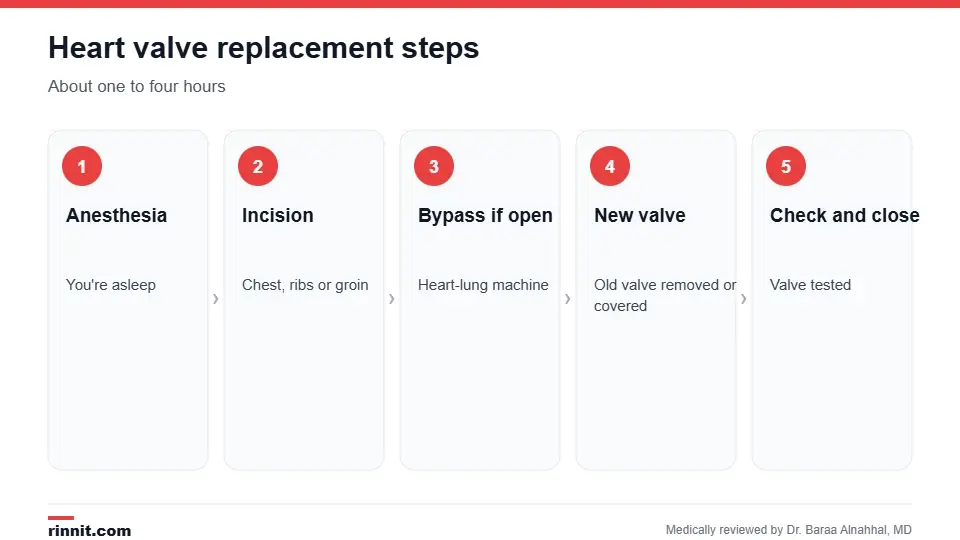
It takes about one to four hours.
You get anesthesia.
The surgeon makes an incision in your chest, between your ribs or in your groin.
For open surgery, a heart-lung machine takes over.
The diseased valve is removed, or the new valve is placed inside the old one.
The new valve is checked, and the incision is closed. Sources: [1]
Risks
Infection.
Bleeding.
Abnormal heart rhythms.
Heart attack or heart failure.
Kidney failure. Sources: [1, 3]
Recovery
You'll start in the ICU, then move to a regular room.
Expect fatigue for the first few weeks.
Avoid driving and heavy lifting until your provider says it's OK.
Cardiac rehab can help you recover.
Most people recover in one to three months; catheter procedures are usually faster. Sources: [1]
When to call your provider
Fever or chills.
An irregular pulse.
Pain, bruising or pus at the incision.
Leg pain, swelling or redness, which may mean a clot.
Sudden weight gain or swelling in your legs or feet.
Any fall or unusual bleeding if you take blood thinners. Sources: [1]
Conclusion
Heart valve replacement is a long-term fix for severe valve disease that relieves symptoms and helps you live longer. Talk with your team about which valve and approach fit your age, health and lifestyle.
Keep learning: read about TAVR and aortic valve replacement.
Frequently asked questions
What is heart valve replacement?
Replacing a diseased heart valve with a tissue or mechanical valve.
Which valve is replaced most often?
The aortic valve.
What's the difference between tissue and mechanical valves?
Tissue valves last 10 to 20 years; mechanical valves may last for life but need blood thinners.
How long does the procedure take?
About one to four hours.
What is TAVR?
A catheter procedure that replaces the aortic valve without opening the chest.
Will I need blood thinners?
For life with a mechanical valve; often not long term with a tissue valve.
How long is recovery?
About one to three months.
Why does my valve click?
Mechanical valves can make a soft clicking sound.
What are the risks?
Infection, bleeding, abnormal rhythms and, rarely, heart attack.
Can a replacement valve wear out?
Tissue valves often need replacing after 10 to 20 years.
Related Reading
Mitral Valve Replacement: Surgery, Valve Types and Recovery explains mitral valve replacement surgery.
Annuloplasty: Heart Valve Repair, Recovery and Results explains annuloplasty heart valve repair.
Heart Valve Surgery: Types, Procedure and Recovery repair and replacement options for heart valves.
Aortic Valve Replacement: What It Is, Who Needs It and How Recovery Works replacing the aortic valve.
TAVR (Transcatheter Aortic Valve Replacement): Procedure, Risks and Recovery catheter-based aortic valve replacement.
Transcatheter Mitral Valve Replacement (TMVR): Procedure, Risks and Recovery catheter-based mitral valve replacement.
Heart Valve Disease: Symptoms, Causes & Treatment the conditions that lead to valve replacement.
References
Cleveland Clinic. Heart Valve Replacement: Surgery & Recovery. Cleveland Clinic. Last updated September 3, 2025. https://my.clevelandclinic.org/health/treatments/23966-heart-valve-replacement
Mack MJ, Leon MB, Thourani VH, et al. Transcatheter aortic-valve replacement with a balloon-expandable valve in low-risk patients. New England Journal of Medicine. 2019;380(18):1695-1705. PMID 30883058. https://doi.org/10.1056/NEJMoa1814052
Popma JJ, Deeb GM, Yakubov SJ, et al. Transcatheter aortic-valve replacement with a self-expanding valve in low-risk patients. New England Journal of Medicine. 2019;380(18):1706-1715. PMID 30883053. https://doi.org/10.1056/NEJMoa1816885
Medical disclaimer
This article is for general education only and does not replace advice from a qualified healthcare professional. Talk to your doctor about your own diagnosis and treatment, and seek emergency care right away for severe or sudden symptoms.



Comments