Prostate Cryotherapy: Procedure, Side Effects and Results

Updated: 2 days ago
Written and medically reviewed by Dr. Baraa Alnahhal, MD · Last reviewed: November 2026 · How we review
Quick Answer
Prostate cryotherapy, or prostate cryoablation, treats prostate cancer by freezing and destroying cancer cells with thin needles called cryoprobes placed under ultrasound guidance. It's most often used when cancer comes back after radiation, but it can be a first treatment. Recovery takes about a week. Success is about 76% to 90% at three years, but lower after radiation.
What the research says
Salvage cryotherapy controlled cancer in over half: in a registry of 279 men treated after radiation failed, about 55% to 59% were free of rising PSA at 5 years; incontinence occurred in 4.4% and rectal fistula in 1.2% (Pisters LL et al., Journal of Urology, 2008) [2]
Cryotherapy compared with other salvage options: a review of 28 studies with 1,544 men with cancer returning after radiation found 2-year recurrence-free survival of 58% after salvage cryotherapy, with severe bowel side effects in 2% (Creta M et al., Prostate Cancer and Prostatic Diseases, 2025) [3]
Key takeaways
Prostate cryotherapy freezes and destroys cancer cells.
It's often used when cancer returns after radiation.
It can treat the whole prostate or part of it.
The procedure takes about 45 minutes.
Erectile problems and incontinence are the main side effects.
What is prostate cryotherapy?
It's a type of cryoablation. Partial-gland treatment is a form of focal therapy. It's minimally invasive and can be repeated. Sources: [1]
Who it's for
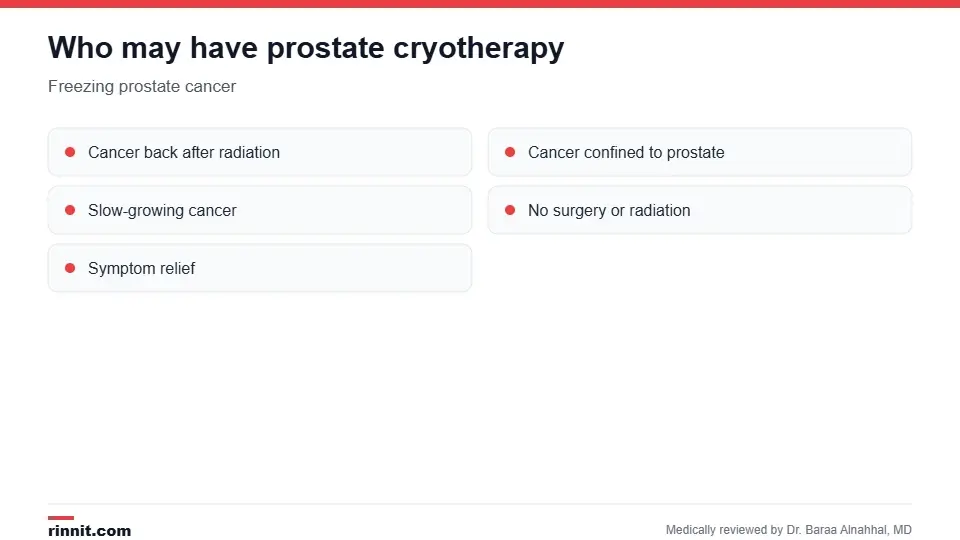
It's most often used after radiation fails.
Cancer that came back after radiation (prostate cancer recurrence).
Cancer confined to the prostate with a low risk of spread.
People who don't want, or can't have, surgery or radiation.
Relief of pain or other symptoms. Sources: [1]
Whole-gland vs. partial-gland
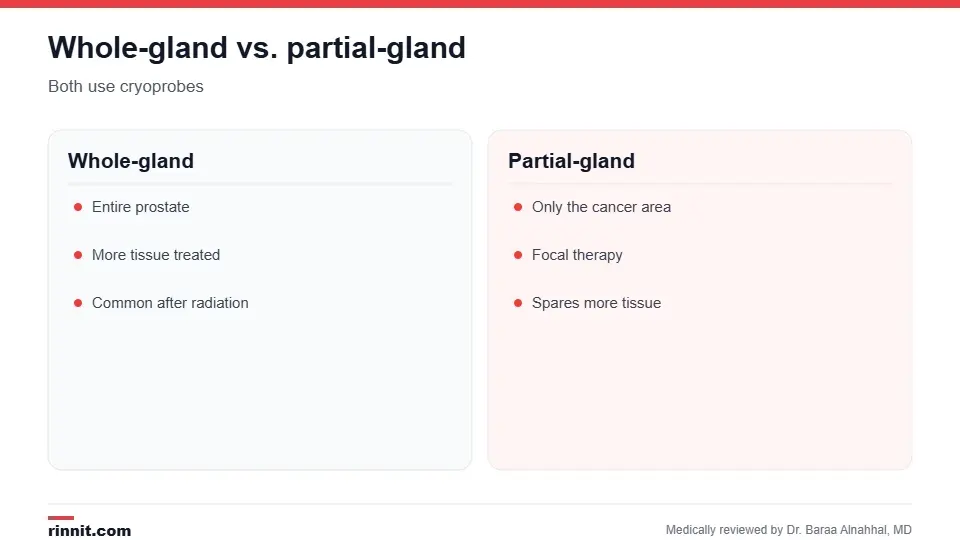
Your urologist recommends the best approach.
Type | What's treated |
Whole-gland | The entire prostate |
Partial-gland | Only the area with cancer |
Sources: [1, 3]
How to prepare
Fast for eight hours before.
Take a laxative to clear your colon.
Tell your provider about all medicines and supplements.
Arrange a ride home. Sources: [1]
What happens during the procedure

It takes about 45 minutes.
You get general or local anesthesia.
A catheter with warm saline protects your urethra.
Cryoprobes are inserted using ultrasound guidance.
Argon gas freezes the tumor into an ice ball.
Helium gas thaws it.
At least one more freeze-thaw cycle destroys the cells. Sources: [1]
The visit takes about two to three hours. Some people stay overnight. Sources: [1]
Risks
Erectile dysfunction.
Urinary incontinence, more likely after radiation.
Scrotal swelling.
Painful or burning urination, urgency or blood in urine.
Pelvic or rectal pain.
Rarely, injury to the rectum or bladder or a fistula. Sources: [1, 2]
Erection and bladder problems often improve significantly within 12 to 18 months. Sources: [1]
Recovery
Recovery usually takes about a week.
The catheter stays in for one to two weeks.
You may take an antibiotic.
Ask when you can resume activities. Sources: [1]
Outlook
Success is measured by PSA levels, tumor growth or the need for more treatment. Studies show success in about 76% to 90% of people three years after treatment, but about 55% to 60% when it's used after radiation, and treatment can be repeated. Sources: [1, 2, 3]
When to call your provider
Seek prompt care for fever; bloody, cloudy or foul-smelling urine; or pain. Sources: [1]
Conclusion
Prostate cryotherapy offers a minimally invasive way to destroy prostate cancer, especially when it returns after radiation. Talk with your urologist about side effects and follow-up PSA testing.
Keep learning: read about focal therapy and prostatectomy.
Frequently asked questions
What is prostate cryotherapy?
Freezing prostate cancer cells to destroy them.
When is it used?
Most often when cancer returns after radiation.
Can it be a first treatment?
Yes, for some people.
How cold does it get?
About -40°C.
How long does it take?
About 45 minutes.
Will I have a catheter?
Yes, for one to two weeks.
What are the main side effects?
Erectile dysfunction and urinary incontinence.
Do side effects improve?
Often, within 12 to 18 months.
How well does it work?
About 76% to 90% at three years, but about 55% to 60% after radiation.
Can it be repeated?
Yes.
Related Reading
Focal Therapy for Prostate Cancer targeted prostate treatments.
Prostate Cancer Recurrence: Complete Guide to Signs, Diagnosis, and Treatment Options when cancer comes back.
Cryoablation: Uses, Procedure, Benefits and Risks freezing to destroy tissue.
Prostatectomy: Types, Surgery, Risks and Recovery prostate removal surgery.
Prostate Brachytherapy: Procedure, Benefits, and Long-Term Outlook internal radiation.
References
Cleveland Clinic. Prostate Cryotherapy: Procedure, Risks & Results. Cleveland Clinic. Last updated October 17, 2023. https://my.clevelandclinic.org/health/treatments/16504-salvage-prostate-cryoablation
Pisters LL, Rewcastle JC, Donnelly BJ, et al. Salvage prostate cryoablation: initial results from the cryo on-line data registry. Journal of Urology. 2008;180(2):559-564. PMID 18554664. https://doi.org/10.1016/j.juro.2008.04.005
Creta M, Shariat SF, Marra G, et al. Local salvage therapies in patients with radio-recurrent prostate cancer following external beam radiotherapy: a systematic review and meta-analysis. Prostate Cancer and Prostatic Diseases. 2025;28(3):578-591. PMID 39223232. https://doi.org/10.1038/s41391-024-00883-3
Medical disclaimer
This article is for general education only and does not replace advice from a qualified healthcare professional. Talk to your doctor about your own diagnosis and treatment, and seek emergency care right away for severe or sudden symptoms.


Comments