Prostate Brachytherapy: Procedure, Benefits, and Long-Term Outlook

Updated: 3 days ago
Medically reviewed by Dr. Baraa Alnahhal, MD · Last reviewed: October 17, 2026
Prostate brachytherapy is a targeted form of radiation therapy that treats prostate cancer by placing tiny radioactive seeds directly into the prostate gland. This low-dose-rate (LDR) treatment allows for precise tumor targeting while sparing surrounding healthy tissue. The procedure is typically performed in under 90 minutes, and most patients return to normal activities within two days, with a high long-term success rate for localized cancer.
Quick Answer
Prostate brachytherapy is a minimally invasive radiation treatment for localized prostate cancer in which 50 to 100 tiny radioactive seeds are permanently implanted in the prostate. They release low-dose radiation over 10 to 12 months to destroy cancer cells while limiting exposure to the bladder and rectum. Data show a 97% prostate cancer–specific survival rate 17 years after treatment. [2]
What the research says
Long-term cancer control is strong, and the 97% figure refers to cancer-specific survival. In 757 men with localized prostate cancer treated with low-dose-rate brachytherapy and followed for more than 10 years (median 12.5 years), the 17-year rates were 79% for biochemical failure-free survival, 97% for distant metastasis-free survival, 97% for prostate cancer-specific survival, and 72% for overall survival (Lazarev et al., BJU Int, 2018).
Erectile function after brachytherapy varies widely between studies and age groups. In the 757-man cohort above, 25% of men who were potent at baseline remained potent at last follow-up, while in 423 men aged 60 or younger, 64% (151 of 237) of those potent before treatment had preserved erectile function at a median of 10.2 years, with 10-year and 15-year cancer-specific survival of 99% and 98% (Winoker et al., Brachytherapy, 2019).
Urinary symptoms are common early but usually resolve, and erectile function is relatively preserved compared with surgery. A review of low-dose-rate brachytherapy reports that urgency and frequency are often seen after the acute phase but usually resolve, urinary continence is well preserved over time, and erectile function declines yearly but is relatively preserved compared with radical prostatectomy (Tanaka, Prostate Int, 2023).
Research summaries are based on article abstracts retrieved from PubMed.
What is prostate brachytherapy?
Prostate brachytherapy, specifically permanent or low-dose-rate (LDR) brachytherapy, is an internal radiation treatment designed for cancer that has not spread beyond the prostate. By placing the radiation source directly inside the organ, medical teams can deliver a higher total dose of radiation to the tumor than is possible with external beam radiation, all while reducing the risk of damage to adjacent healthy tissues.
The treatment utilizes tiny capsules, often referred to as "seeds," which are roughly the size of a grain of rice. These implants are radioactive for several months, gradually losing their energy until they become inactive. Once the radiation is exhausted, the seeds remain safely and permanently in the prostate without causing further effects.
Eligibility and Success Factors
Healthcare providers typically recommend brachytherapy for patients with localized prostate cancer. The treatment is noted for its exceptional long-term outcomes, particularly for those with early-stage disease.
Factor | Detail |
Cancer Stage | Most effective for localized prostate cancer (Stage I or II) |
Success Rate | Approximately 97% prostate cancer–specific survival at 17 years post-treatment |
Treatment Type | Permanent Low-Dose-Rate (LDR) Brachytherapy |
Radiation Duration | Active for 10 to 12 months before becoming inert |
What should you expect during a prostate brachytherapy procedure?
The procedure is a precise medical intervention that requires a coordinated team of radiation oncologists, anesthesiologists, and nursing staff. It is performed in a hospital or specialized surgical center, usually under general anesthesia or heavy sedation to ensure patient comfort.
Preparation and Guidance
Upon arrival, the surgical team prepares the patient and administers anesthesia. The radiation oncologist then inserts an ultrasound probe into the rectum to visualize the prostate gland in real-time. This imaging allows the team to map the exact location for each radioactive seed, ensuring full coverage of the tumorous areas while avoiding critical structures like the urethra.
Seed Implantation
Using the ultrasound guidance, the physician inserts thin needles through the skin of the perineum (the area between the scrotum and the anus). These needles carry the radioactive implants, which are deposited directly into the prostate tissue. A typical procedure involves the placement of 50 to 100 seeds, depending on the size of the prostate and the extent of the cancer. The entire process generally takes between 60 and 90 minutes to complete.

What is recovery like after prostate brachytherapy?
Most patients experience a rapid recovery, often returning to their usual daily activities within 24 to 48 hours. However, specific precautions are necessary to ensure proper healing and radiation safety.
Activity Restrictions
While general activity can resume quickly, patients must avoid strenuous activities that put direct pressure on the groin area for at least two months. This includes activities such as:
Cycling or stationary biking
Horseback riding
Heavy lifting or intense lower-body workouts
Radiation Safety Precautions
Because the seeds are active for several months, they emit a very small amount of radiation. While this poses no risk to most people, patients are advised to follow the "20-minute rule" for two months: avoid having small children or pregnant women sit on their lap for more than 20 minutes at a time. Brief contact, such as hugging, is considered safe.

What are the potential side effects and risks of prostate brachytherapy?
Like all medical procedures, prostate brachytherapy carries risks of side effects. These are generally categorized by when they occur following the implantation.
Short-Term Side Effects
Immediately following the procedure, patients may experience mild soreness, swelling, or bruising in the perineal area, which typically resolves within three days. Over the next six to eight weeks, urinary symptoms are common as the radiation takes effect:
Increased frequency and urgency of urination
A burning sensation during urination
Minor traces of blood in the urine
Long-Term Considerations
While brachytherapy has fewer long-term complications than many other treatments, some patients may experience persistent issues.
Side Effect | Frequency / Detail |
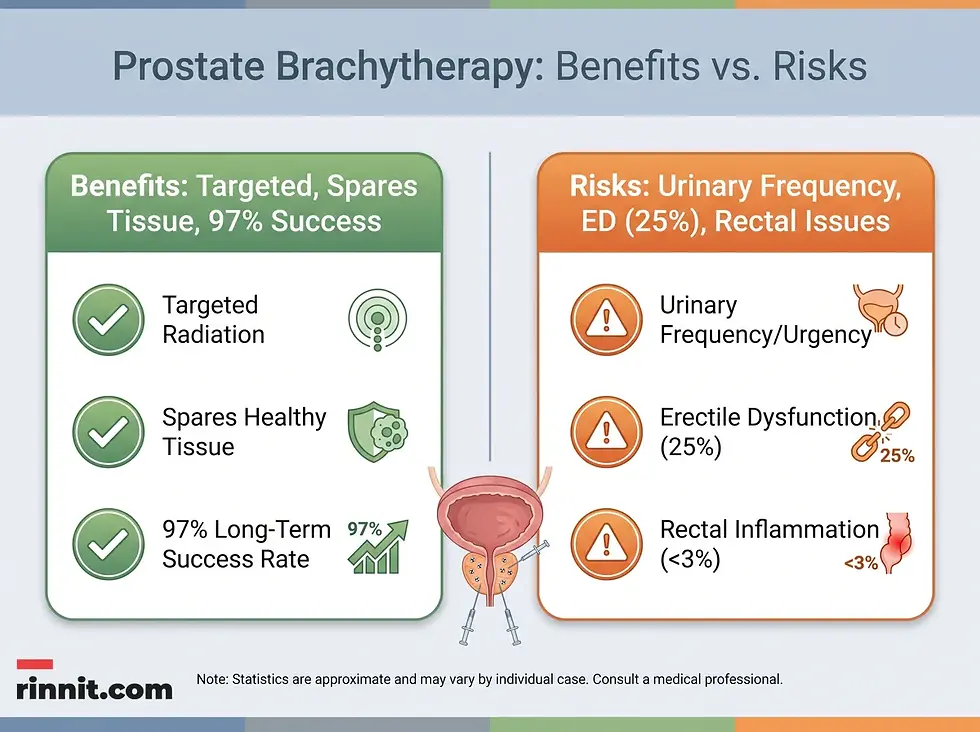
Erectile Dysfunction | Common over time; in one long-term study only 25% of men potent before treatment were still potent, and reported rates vary between studies |
Radiation Proctitis | Rectal inflammation affecting fewer than 3% of patients |
Radiation Cystitis | Uncommon bladder inflammation; requires medical attention if blood is seen |
Conclusion
Prostate brachytherapy is a highly successful, minimally invasive option for men with localized prostate cancer. Its ability to deliver targeted radiation with a high degree of precision results in excellent long-term survival rates and a relatively quick return to normal life. Patients should consult with a radiation oncologist to determine if they meet the clinical criteria for this internal radiation approach.
"Low-dose rate brachytherapy targets cancerous prostate tumors and reduces the chance that radiation will harm nearby healthy tissue. This treatment causes fewer long-term complications and side effects than other types of radiation therapy"
Frequently Asked Questions
Is the radiation from the seeds dangerous to others?
The radiation levels are very low and mostly contained within the prostate. However, as a precaution, patients should avoid prolonged lap contact with children or pregnant women for the first two months.
Do the seeds need to be removed?
No, the seeds are permanent. They lose their radioactivity over 10 to 12 months and remain in the prostate safely as inert metal capsules.
Will I set off airport security scanners?
It is possible for the seeds to trigger highly sensitive radiation detectors at airports. Patients are typically provided with a medical ID card to explain the presence of the implants to security personnel.
How soon can I return to work?
Most men can return to sedentary or light-duty work within one to two days. Those with physically demanding jobs should consult their provider.
Does the procedure affect sexual function?
Erection problems are common over time: in one long-term study only about 25% of men who were potent before treatment stayed potent, though the decline is often more gradual than after radical surgery.
What is the survival rate for this treatment?
Long-term studies have shown a 17-year prostate cancer–specific survival rate of approximately 97% for patients receiving LDR brachytherapy for localized cancer.
Can I drive myself home after the procedure?
No, because anesthesia is used, you will need a responsible adult to drive you home and stay with you for the first 24 hours.
Is there blood in the urine after the procedure?
Slight bleeding or pink-tinted urine is common for a few days. However, you should contact your doctor if you see large clots or experience severe pain.
What happens if a seed is passed in the urine?
While rare, a seed may occasionally be passed. Patients are often advised to use a strainer for a few days and, if a seed is found, to handle it only with tweezers and store it in a sealed container as instructed by their clinic.
Do I still need PSA tests after brachytherapy?
Yes, regular PSA (Prostate-Specific Antigen) tests are essential to monitor the effectiveness of the treatment and ensure the cancer has not recurred.
How do I prepare for prostate brachytherapy?
Your radiation oncologist explains what you need to do to get ready. Because you may have anesthesia or pain medication before or after treatment, someone will need to bring you to the appointment and take you home, and if treatment is spread over several days you may need to stay in the hospital [1].
Does prostate brachytherapy hurt, and what anesthesia is used?
You have anesthesia before the implant is placed, either general anesthesia (you are asleep) or local anesthesia that numbs the area, so the procedure should not hurt. Afterward, mild soreness, swelling or bruising in the perineal area is common and usually settles within a few days [1].
When should I call my doctor after prostate brachytherapy?
Contact your healthcare provider if you have trouble breathing or swallowing, severe stomach upset, vomiting or diarrhea, difficulty urinating or stopping urine from leaking, or difficulty controlling your bowels [1].
Related Reading
Prostate Cryotherapy: Procedure, Side Effects and Results explains prostate cryotherapy.
Prostatectomy: Types, Surgery, Risks and Recovery explains prostate removal surgery and recovery.
References
Cleveland Clinic. Brachytherapy. Cleveland Clinic Health Library. Last updated August 18, 2026. https://my.clevelandclinic.org/health/treatments/16500-brachytherapy
Lazarev S, Thompson MR, Stone NN, Stock RG. Low-dose-rate brachytherapy for prostate cancer: outcomes at >10 years of follow-up. BJU Int. 2018;121(5):781-790. PMID: 29319928. DOI: 10.1111/bju.14122
Winoker JS, Omidele OO, Stock RG, Stone NN. Long-term oncological and functional outcomes support use of low-dose-rate brachytherapy with or without external beam radiation in young men (≤60 years) with localized prostate cancer. Brachytherapy. 2019;18(2):192-197. PMID: 30635196. DOI: 10.1016/j.brachy.2018.12.005
Tanaka N. The oncologic and safety outcomes of low-dose-rate brachytherapy for the treatment of prostate cancer. Prostate Int. 2023;11(3):127-133. PMID: 37745911. DOI: 10.1016/j.prnil.2023.01.004
Medical disclaimer
This article is for informational purposes only and is not a substitute for professional medical advice, diagnosis, or treatment. Always seek the advice of your physician or other qualified health provider with any questions you may have about a medical condition.



Comments