Cryoablation: Uses, Procedure, Benefits and Risks

Updated: 2 days ago
Written and medically reviewed by Dr. Baraa Alnahhal, MD · Last reviewed: November 2026 · How we review
Quick Answer
Cryoablation is a minimally invasive treatment that uses extreme cold to freeze and destroy abnormal tissue, such as cancer cells. A thin, needle-like cryoprobe is guided into the tumor with ultrasound, CT or MRI. It treats small or early-stage tumors and tumors that can't be safely removed with surgery. Most people go home the same day.
What the research says
Ablation matched surgery on most outcomes for small kidney tumors: in 27 studies of 13,996 people with small kidney tumors, ablation including cryoablation had similar kidney function, complications and cancer death rates to partial nephrectomy, though surgery lowered the risk of the tumor coming back locally (Yanagisawa T et al., Urologic Oncology, 2022) [2]
Cryoablation competed with open surgery for kidney cancer: in a network meta-analysis of 32 studies of early kidney cancer, 5-year recurrence-free survival after percutaneous or laparoscopic cryoablation did not differ significantly from open partial nephrectomy (Shaaban Abdelgalil M et al., Journal of Vascular and Interventional Radiology, 2025) [3]
Key takeaways
Cryoablation freezes and destroys abnormal tissue.
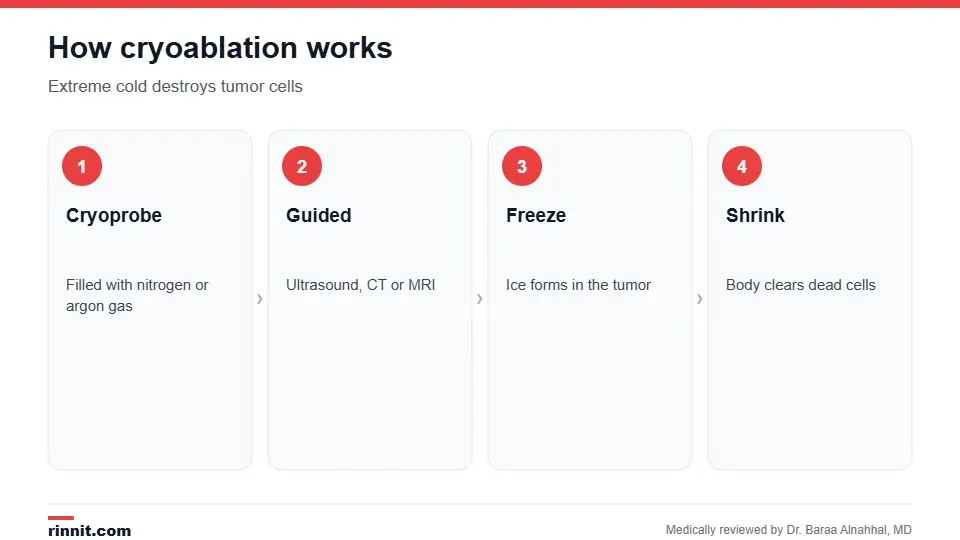
A cryoprobe is guided into the tumor with imaging.
It treats small tumors and tumors that can't be removed.
Most people go home the same day.
Recovery usually takes two to seven days.
What is cryoablation?
Cryoablation is a type of ablation therapy. It's also called cryosurgery or percutaneous cryotherapy. After the ice melts, the tumor shrinks and your body gradually clears the dead cells. Sources: [1]
What it treats

It may also shrink tumors pressing on nerves or organs.
Small or early-stage tumors that can be reached.
Tumors that can't be safely removed, such as very large tumors or those near organs.
Metastatic cancer causing pain (palliative cryoablation).
Kidney, liver, lung, prostate, cervical and thyroid cancers, and sarcomas. Sources: [1]
How it works
Laparoscopic cryoablation can use more than one probe.
The cryoprobe uses liquid nitrogen, liquid nitrous oxide or compressed argon gas. In laparoscopic cryoablation, several small cuts let the surgeon use more than one probe and an ultrasound probe. Sources: [1]
How to prepare
Fast for several hours if you'll have general anesthesia.
Arrange a ride home.
You may need to stop aspirin, NSAIDs or blood thinners.
Take any medicines to prevent pain or infection as directed. Sources: [1]
What happens during the procedure
Cancer cryoablation may take several hours.
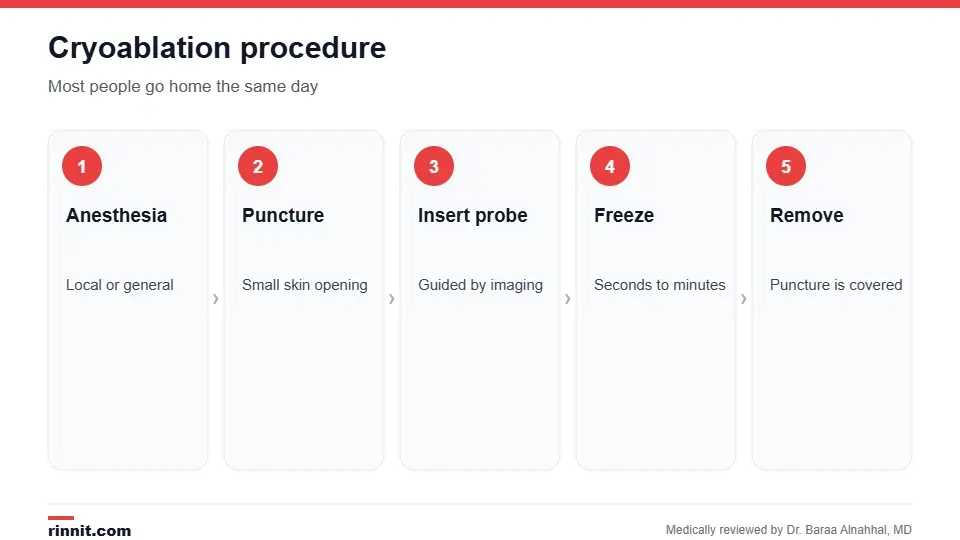
You get local or general anesthesia.
The provider makes a small puncture and inserts the cryoprobe.
Real-time imaging guides the probe to the tumor.
The probe freezes the tumor for a few seconds or minutes, sometimes more than once.
The probe is removed and the puncture is covered. Sources: [1]
Cancer cryoablation may take several hours. Sources: [1]
Benefits and risks
Benefits | Possible risks |
No incision | Skin burn |
Fewer side effects | Anesthesia side effects such as nausea |
Less scarring | Damage to nearby tissue or organs |
Less damage to nearby tissue | Infection |
Most go home the same day | Nerve damage causing numbness or weakness |
Cryoablation is generally very safe, but it isn't an option for every cancer type or stage. Sources: [1, 2]
Recovery
You'll be monitored in recovery if you had general anesthesia.
Most people go home the same day; some stay overnight.
Most return to work and usual activities within two to seven days.
A follow-up checkup is usually a few weeks later. Sources: [1]
Outlook
Research shows cryoablation is generally safe and effective. For small kidney cancers, studies show results comparable to surgery for many people. Sources: [1, 2, 3]
When to call your provider
Excessive swelling.
Fever over 101 degrees Fahrenheit.
Pus from the probe site.
Redness or skin color changes near the puncture. Sources: [1]
Conclusion
Cryoablation offers a way to destroy tumors without open surgery and with a quick recovery. Ask your care team whether it fits your cancer type and stage.
Keep learning: read about ablation for kidney cancer and radiofrequency ablation.
Frequently asked questions
What is cryoablation?
A treatment that uses extreme cold to destroy abnormal tissue.
What cancers can cryoablation treat?
Kidney, liver, lung, prostate, cervical and thyroid cancers and sarcomas.
Does cryoablation need an incision?
No. A needle-like probe is inserted through a small puncture.
What gas is used?
Liquid nitrogen, liquid nitrous oxide or argon gas.
Is cryoablation painful?
You get local or general anesthesia.
How long does it take?
Cancer cryoablation may take several hours.
Will I stay in the hospital?
Most people go home the same day.
How long is recovery?
Usually two to seven days.
Is cryoablation as good as surgery?
For small kidney cancers, studies show similar results for many people.
What are the risks?
Skin burns, infection, nerve damage and damage to nearby tissue.
Related Reading
Prostate Cryotherapy: Procedure, Side Effects and Results explains prostate cryotherapy.
Cryotherapy of the Cervix: Procedure, Risks and Recovery explains cryotherapy of the cervix.
Ablation Therapy: A Minimally Invasive Approach to Tissue Destruction an overview of ablation.
Ablation for Kidney Cancer: A Less Invasive Treatment Option ablation for kidney tumors.
Cryotherapy: Uses, Procedure, Risks and Recovery other cold treatments.
Radiofrequency Ablation (RFA): A Guide to Long-Term Pain Management heat-based ablation.
Kidney Cancer: Symptoms, Causes & Treatment Guide a cancer cryoablation treats.
References
Cleveland Clinic. Cryoablation: What It Is, Used For, Benefits & Risks. Cleveland Clinic. Last updated April 14, 2025. https://my.clevelandclinic.org/health/treatments/16903-cryoablation
Yanagisawa T, Mori K, Kawada T, et al. Differential efficacy of ablation therapy versus partial nephrectomy between clinical T1a and T1b renal tumors: a systematic review and meta-analysis. Urol Oncol. 2022;40(7):315-330. PMID 35562311. https://doi.org/10.1016/j.urolonc.2022.04.002
Shaaban Abdelgalil M, Ghazou A, Aldemerdash MA, et al. Thermal ablation modalities that best compete with partial nephrectomy for T1a and T1b renal cell carcinoma: a network meta-analysis. J Vasc Interv Radiol. 2025;36(10):1475-1491.e53. PMID 40617477. https://doi.org/10.1016/j.jvir.2025.05.032
Medical disclaimer
This article is for general education only and does not replace advice from a qualified healthcare professional. Talk to your doctor about your own diagnosis and treatment, and seek emergency care right away for severe or sudden symptoms.



Comments