Cryotherapy of the Cervix: Procedure, Risks and Recovery

Updated: 2 days ago
Written and medically reviewed by Dr. Baraa Alnahhal, MD · Last reviewed: November 2026 · How we review
Quick Answer
Cryotherapy of the cervix, or cervical cryosurgery, uses extreme cold to freeze and destroy abnormal cells on the cervix. It treats precancerous cells (cervical dysplasia), unusual bleeding, cervicitis and genital warts. It's done in the office in under 10 minutes, with mild cramps common. It works about 9 in 10 times.
What the research says
Cryotherapy cured most precancerous lesions: a review of 77 papers covering 28,827 treated cases found cryotherapy cured 94% of CIN1, 92% of CIN2 and 85% of CIN3 lesions, with minimal complications (Sauvaget C et al., International Journal of Gynaecology and Obstetrics, 2013) [2]
LEEP lowered recurrence, but cryotherapy caused less bleeding: in a review of 8 trials, cryotherapy had an 86% higher risk of recurrence than LEEP, but about half the risk of minor bleeding (Hurtado-Roca Y et al., Revista de Saude Publica, 2020) [3]
Key takeaways
Cervical cryotherapy freezes and destroys abnormal cervical cells.
It treats precancer, unusual bleeding and genital warts.
It takes under 10 minutes in the office.
Avoid sex and tampons for up to three weeks.
It works about 9 in 10 times.
What is cryotherapy of the cervix?
It's a form of cryoablation. It works best when abnormal cells are only on the cervix's surface. Many providers prefer a LEEP procedure because it removes tissue for testing. Sources: [1]
Why it's done

It works best for cells on the cervix surface.
Precancerous cells, such as cervical dysplasia.
Unusual or unexplained cervical bleeding.
Cervicitis (inflammation of the cervix).
Genital warts. Sources: [1]
Cryotherapy vs. LEEP
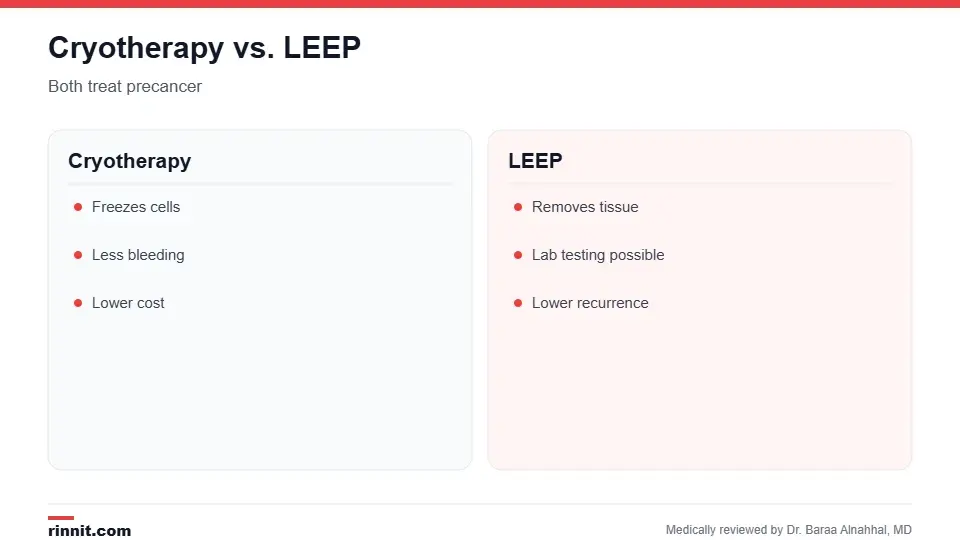
Your provider helps you choose.
Feature | Cryotherapy | LEEP |
How it works | Freezes cells | Cuts out tissue |
Lab testing of tissue | Not possible | Yes |
Bleeding | Less | More |
Recurrence | Higher | Lower |
Cost | Lower | Higher |
Cryotherapy isn't for severe dysplasia (CIN 3), cells covering a large area or cells growing deeper. Sources: [1, 2, 3]
How to prepare
Don't put anything in your vagina for 24 to 48 hours before.
Your provider may numb your cervix. Sources: [1]
What happens during the procedure
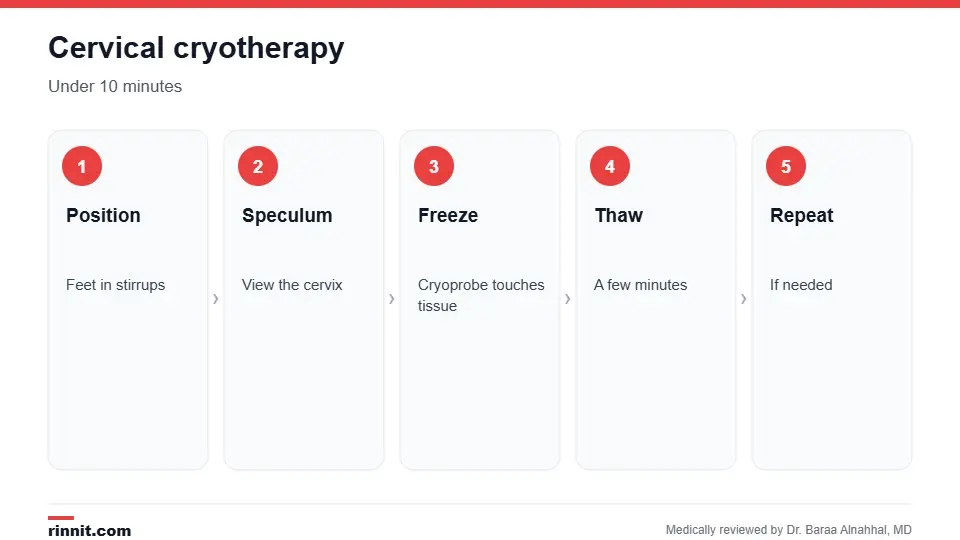
It takes under 10 minutes.
You lie on an exam table with your feet in stirrups.
A speculum is placed to see your cervix.
The cryoprobe touches the tissue and freezes it.
The area thaws for a few minutes.
Freezing may be repeated. Sources: [1]
You may feel light cramping, slight dizziness or cold right after. Sources: [1]
Risks
Cramps or pain.
Spotting.
Fainting or dizziness right after.
Infection or a flare of pelvic infection.
Scarring that narrows the cervix (cervical stenosis).
Freeze burns. Sources: [1, 3]
Because tissue isn't removed, it can't be tested, and some abnormal cells may be missed. It generally isn't expected to affect future pregnancy. Sources: [1]
Recovery
You can go home right away.
Watery, slightly bloody discharge is normal for a few weeks; use pads, not tampons.
Avoid sex and putting anything in your vagina for up to three weeks.
Follow-up may include a Pap smear, LEEP or biopsy. Sources: [1]
Outlook
Cryotherapy works about 9 in 10 times for cells that could lead to cancer. Abnormal cells usually don't return; if they do, another treatment may be needed. Sources: [1, 2]
When to call your provider
Fever of 100.4°F (38°C) or higher.
Heavy vaginal bleeding.
Severe belly pain.
Foul-smelling vaginal discharge. Sources: [1]
Conclusion
Cervical cryotherapy is a quick, low-cost way to destroy abnormal cervical cells and lower your cancer risk. Keep up with follow-up tests to make sure the cells are gone.
Keep learning: read about LEEP and cervical cancer screening.
Frequently asked questions
What is cryotherapy of the cervix?
Freezing and destroying abnormal cells on the cervix.
What does it treat?
Precancerous cells, unusual bleeding, cervicitis and genital warts.
Does it hurt?
It shouldn't; mild cramping is common.
How long does it take?
Under 10 minutes.
Is it better than LEEP?
LEEP has lower recurrence; cryotherapy causes less bleeding and costs less.
Is discharge normal afterward?
Yes, watery discharge for a few weeks.
When can I have sex again?
After up to three weeks.
Does it work?
About 9 in 10 times.
Will it affect pregnancy?
It generally isn't expected to.
Do I need follow-up?
Yes, such as a Pap test or biopsy.
Related Reading
LEEP: Procedure, Purpose, Side Effects and Recovery the main alternative.
What Is Cervical Dysplasia (Cervical Intraepithelial Neoplasia)? precancerous cervical cells.
Colposcopy: Purpose, Procedure, Biopsy, Results and Recovery an exam to find abnormal cells.
Cervical Cancer Screening: Tests, Schedule by Age and What Results Mean tests for cervical cancer.
Cryoablation: Uses, Procedure, Benefits and Risks freezing to destroy tissue.
References
Cleveland Clinic. Cryotherapy of the Cervix: HPV, Procedure, Risks & Recovery. Cleveland Clinic. Last updated July 31, 2026. https://my.clevelandclinic.org/health/treatments/9120-cryosurgery-of-the-cervix
Sauvaget C, Muwonge R, Sankaranarayanan R. Meta-analysis of the effectiveness of cryotherapy in the treatment of cervical intraepithelial neoplasia. International Journal of Gynaecology and Obstetrics. 2013;120(3):218-223. PMID 23265830. https://doi.org/10.1016/j.ijgo.2012.10.014
Hurtado-Roca Y, Becerra-Chauca N, Malca M. Efficacy and safety of cryotherapy, cold cone or thermocoagulation compared to LEEP as a therapy for cervical intraepithelial neoplasia: systematic review. Revista de Saude Publica. 2020;54:27. PMID 32187314. https://doi.org/10.11606/s1518-8787.2020054001750
Medical disclaimer
This article is for general education only and does not replace advice from a qualified healthcare professional. Talk to your doctor about your own diagnosis and treatment, and seek emergency care right away for severe or sudden symptoms.



Comments