Cervical Cancer Screening: Tests, Schedule by Age and What Results Mean

Updated: 2 days ago
Written and medically reviewed by Dr. Baraa Alnahhal, MD · Last reviewed: November 2026 · How we review
Quick Answer: What is cervical cancer screening?
Cervical cancer screening checks for early cervical cancer and precancerous cell changes before you have symptoms. People at average risk should be screened from age 21 to 65: a Pap test every 3 years from 21 to 29, then a Pap test every 3 years or an HPV test or cotest every 5 years. [1]
What the research says
HPV-based screening protects better than Pap tests alone. In four European trials with 176,464 women aged 20 to 64 followed for a median of 6.5 years, HPV-based screening gave 60 to 70% greater protection against invasive cervical cancer than cytology, supporting 5-year screening intervals from age 30. (Ronco et al., The Lancet, 2014) [2]
HPV testing finds more precancer earlier. In the HPV FOCAL trial of 19,009 Canadian women aged 25 to 65, primary HPV testing led to fewer high-grade precancers (CIN3+) at 48 months than cytology: 2.3 vs 5.5 per 1,000 (risk ratio 0.42). (Ogilvie et al., JAMA, 2018) [3]
Key takeaways
Screening finds precancer and early cancer before symptoms, which can prevent cervical cancer. [1]
The three options are an HPV test, a Pap test and an HPV/Pap cotest. [1]
Average-risk screening runs from age 21 to 65, even if you've had the HPV vaccine. [1]
An abnormal result does not mean you have cancer; most abnormal cells have noncancerous causes. [1]
Follow-up may include a pelvic exam, colposcopy and biopsy. [1]
What is cervical cancer screening?
Cervical cancer screening is a group of tests that detect early-stage cervical cancer or precancerous cells on the cervix before they cause symptoms. Finding and treating precancer early stops it from progressing to cancer. [1]

Your provider may use one of three methods: [1]
Test | What it looks for |
HPV test | High-risk strains of human papillomavirus (HPV) that cause cervical cancer |
Pap test (Pap smear) | Abnormal cervical cells that are cancerous or could become cancerous without treatment |
HPV/Pap cotest | Both high-risk HPV and abnormal cells from the same sample |
Sources: [1]
Screening is still needed if you've had the HPV vaccine. The vaccine prevents most cancer-causing HPV strains, but not all of them. And if you're in the screening age range and have never been tested, it's not too late to start. [1]
How is cervical cancer screening done?
Your provider gently collects cells from your cervix with a soft brush, usually during a pelvic exam, and sends the sample to a lab. The lab checks it for HPV, abnormal cells or both, depending on the test ordered. [1]
How often should you get screened?
The U.S. Preventive Services Task Force (USPSTF) sets screening guidelines by age for people at average risk. Your provider may suggest more frequent tests if your risk is higher, for example if you are immunocompromised or have had abnormal results before. [1]
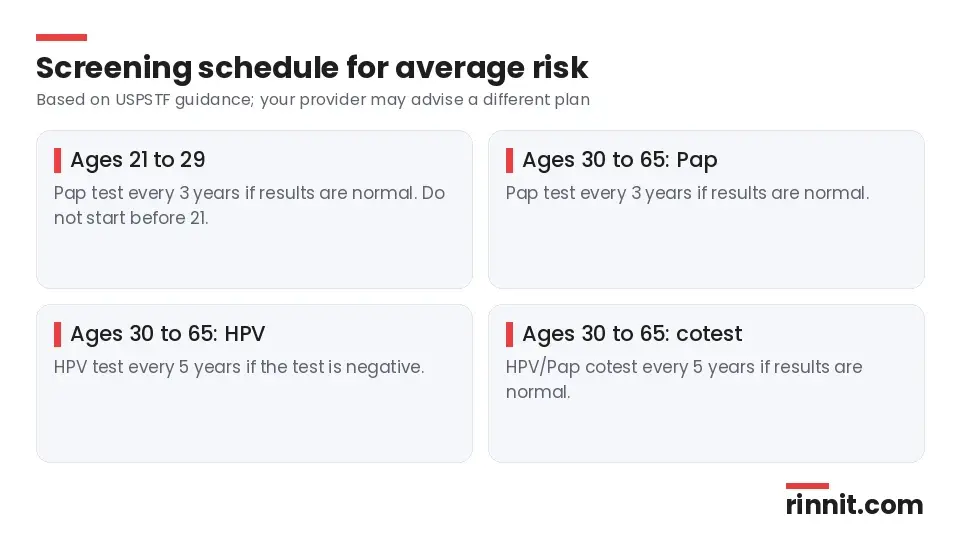
Age | Recommended options if results are normal |
Under 21 | No screening, even if sexually active |
21 to 29 | Pap test every 3 years |
30 to 65 | Pap test every 3 years, HPV test every 5 years, or HPV/Pap cotest every 5 years |
Sources: [1]
Why screening doesn't start before 21
HPV infections in younger people often clear on their own, not all precancers turn into cancer, and the ones that do usually take several years. [1]
The American Cancer Society approach
Because these cancers grow slowly and the vaccine works well, the American Cancer Society now recommends an HPV test every 5 years starting at age 25. Your gynecologist or primary care physician will recommend the schedule and tests that fit your health. [1] Large trials support HPV-based screening with longer gaps between tests. [2] [3]
How do you prepare for screening?
Your provider will give you instructions. You may be asked to: [1]
Avoid vaginal sex for two days before the test.
Avoid putting anything in your vagina, such as tampons, vaginal creams or lubricants, for two days beforehand.
Book the appointment for a day after your period has ended.
Sometimes the test can still be done during your period, so ask your provider. [1]
What are the risks?
You may have light bleeding after the cells are collected, but it doesn't last long. Pap and HPV tests are safe and are among the most important tools for preventing cervical cancer. [1]
What do the results mean?
Results can take up to three weeks. [1]
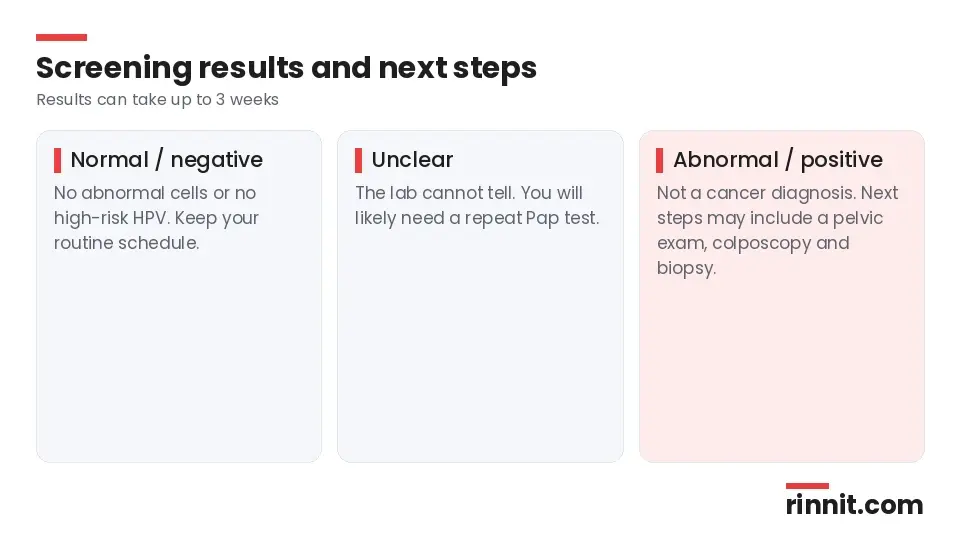
Result | What it means |
Normal / negative | No abnormal cells were found; on an HPV test, you're negative for high-risk HPV |
Abnormal / positive | Abnormal cells were found, or you tested positive for high-risk HPV |
Unclear / unsatisfactory | The lab couldn't tell whether the cells are normal; you'll likely need a repeat Pap test |
Sources: [1]
What happens after an abnormal result?
An abnormal result is not a cancer diagnosis. Most abnormal cervical cells come from noncancerous causes such as infection or irritation, but more tests are needed to be sure. You may need: [1]
A physical exam: your provider checks for signs such as swollen lymph nodes and does a pelvic exam if one wasn't done at screening.
A colposcopy: a lighted magnifying instrument gives a closer look at the abnormal area.
A biopsy: a small tissue sample is removed, often during the colposcopy, and tested.
Biopsy results show whether abnormal cells are cancer, precancer or unrelated to cancer. [1]
Questions to ask your provider
Contact your provider with any questions about screening. Useful questions include: [1]
What is my risk of cervical cancer?
Which tests do you recommend for me?
How often should I be screened?
How should I prepare?
What do my results mean?
Conclusion
Cervical cancer cases and deaths have fallen over the past several years thanks to screening and the HPV vaccine. Finding and treating precancer prevents cancer from forming, and early cervical cancer can often be cured. [1]
A few minutes of mild discomfort every 3 to 5 years can save your life. Keep screening on your routine care list and follow up promptly on any abnormal result.
Keep learning: Read our guides to the Pap smear and the HPV test. For more background, see the National Cancer Institute page on cervical cancer screening.
FAQ
What is cervical cancer screening?
Tests that look for precancerous cells or early cervical cancer before symptoms appear. [1]
What tests are used for cervical cancer screening?
An HPV test, a Pap test, or both together as an HPV/Pap cotest. [1]
At what age should cervical cancer screening start?
At age 21 for people at average risk, even if they are sexually active. [1]
How often should I get a Pap test?
Every 3 years from ages 21 to 29, and every 3 years from 30 to 65 if you choose Pap testing alone. [1]
How often do I need an HPV test?
From ages 30 to 65, every 5 years if your HPV test or HPV/Pap cotest is normal. [1]
Do I need screening if I had the HPV vaccine?
Yes. The vaccine prevents most cancer-causing HPV strains but not all. [1]
When can I stop cervical cancer screening?
People at average risk generally stop at age 65; ask your provider what applies to you. [1]
How do I prepare for a cervical cancer screening?
Avoid vaginal sex and vaginal products for two days and schedule the test after your period. [1]
Does an abnormal result mean I have cancer?
No. Most abnormal cells have noncancerous causes, but you will need follow-up tests. [1]
How long do results take?
Up to three weeks. [1]
Related Reading
Cryotherapy of the Cervix: Procedure, Risks and Recovery explains cryotherapy of the cervix.
Cervical Cancer: Symptoms, Screening, Diagnosis, Treatment and Support explains the cancer that screening aims to prevent or catch early.
What Is Cervical Dysplasia (Cervical Intraepithelial Neoplasia)? covers the precancerous cell changes that screening finds.
Understanding HPV: Causes, Symptoms, and Prevention explains the virus that causes most cervical cancers and that HPV tests detect.
Cancer Screening: Which Tests Are Recommended, When to Start and the Risks gives an overview of recommended cancer screening tests, starting ages and the benefits and risks.
References
Cleveland Clinic. Cervical Cancer Screening: Purpose, Types & Results. Cleveland Clinic. Last updated January 17, 2025. https://my.clevelandclinic.org/health/diagnostics/cervical-cancer-screening
Ronco G, Dillner J, Elfström KM, et al. Efficacy of HPV-based screening for prevention of invasive cervical cancer: follow-up of four European randomised controlled trials. Lancet. 2014;383(9916):524-532. PMID 24192252. https://doi.org/10.1016/S0140-6736(13)62218-7
Ogilvie GS, van Niekerk D, Krajden M, et al. Effect of Screening With Primary Cervical HPV Testing vs Cytology Testing on High-grade Cervical Intraepithelial Neoplasia at 48 Months: The HPV FOCAL Randomized Clinical Trial. JAMA. 2018;320(1):43-52. PMID 29971397. https://doi.org/10.1001/jama.2018.7464
Medical disclaimer
This article is for general education only and does not replace advice from a qualified healthcare professional. Talk to your doctor about your own diagnosis and treatment, and seek emergency care right away for severe or sudden symptoms.



Comments