Pap Smear (Pap Test): Age, Procedure, Results and How Often to Get One

Updated: 6 days ago
Written and medically reviewed by Dr. Baraa Alnahhal, MD · Last reviewed: November 2026 · How we review
Quick Answer: What is a Pap smear?
A Pap smear, also called a Pap test, is a quick screening test that collects cells from your cervix so a lab can look for abnormal or precancerous changes. It finds cell changes early, before they turn into cervical cancer, and can also pick up some infections and inflammation. Most people start screening at age 21. [1]
What the research says
An HPV test misses fewer serious cell changes than a Pap test alone. A Cochrane review of 40 studies with more than 140,000 women found pooled sensitivity for CIN 2+ of 62.5% for conventional Pap cytology and 72.9% for liquid-based cytology, versus 89.9% for an HPV DNA test; cytology was more specific (96.6% and 90.3% versus 89.9%). (Koliopoulos et al., Cochrane Database of Systematic Reviews, 2017) [2]
A negative Pap test is reassuring, but a negative HPV test is more so. The same review concluded that HPV tests lead to more unnecessary referrals, while cytology has a greater chance of a false-negative result. (Koliopoulos et al., Cochrane Database of Systematic Reviews, 2017) [2]
HPV self-sampling performed at least as well as a clinician-collected Pap test. A 2025 meta-analysis of 16 studies found pooled cytology sensitivity for CIN 2+ of 87%, compared with 90% for PCR-based HPV testing on self-collected samples and 93% on clinician-collected samples. (Phillips et al., Cancer Epidemiology, Biomarkers & Prevention, 2025) [3]
Key takeaways
A Pap smear screens for cervical cancer by checking cervical cells for abnormal or precancerous changes. [1]
Most people need a Pap test every 3 years from age 21 to 29, and every 3 years (Pap alone) or 5 years (Pap/HPV co-test) from age 30 to 65. [1]
The test takes only a few minutes in a provider's office and may feel uncomfortable but should not hurt. [1]
Results can take up to 3 weeks and are reported as normal, unclear or abnormal. [1]
An abnormal result does not mean you have cancer; it usually leads to a repeat test or a colposcopy. [1]
More than 95% of people treated for precancerous cells never develop cervical cancer. [1]
What is a Pap smear used for?
A Pap smear is a screening test for cervical cancer. A provider collects cells from the cervix, the lower, narrow end of the uterus, and a lab checks them for abnormal or potentially cancerous changes. [1]
The test is named after Dr. George Papanicolaou, who developed it. It is considered the gold standard for preventing cervical cancer because it can catch changes long before they become cancer. [1]
What can a Pap smear find?
A Pap smear can detect:
Cervical cancer cells
Dysplasia, meaning cells that look abnormal and could become precancerous
Human papillomavirus (HPV), when the lab is asked to test for it
Some infections and inflammation, such as trichomonas, bacterial overgrowth or yeast infections
A Pap smear does not test for gonorrhea or chlamydia. Those infections need separate tests. [1]
Is a Pap smear the same as a pelvic exam or an HPV test?
A pelvic exam does not always include a Pap smear, but a Pap smear almost always happens during a pelvic exam. [1]
A Pap test and an HPV test are different tests, but they can use the same sample. When both are done together, it is called a co-test. Your provider tells the lab whether to look for cell changes, HPV or both. [1]
Who needs a Pap smear, and how often?
How often you need a Pap smear depends mainly on your age and health history. For people at average risk, the general schedule looks like this: [1]
Age | How often | Notes |
Under 21 | Not needed | The risk of cervical cancer is very low |
21 to 29 | Every 3 years | Pap test alone |
30 to 65 | Every 3 years or every 5 years | 3 years with a Pap test alone; 5 years with a Pap/HPV co-test |
Over 65 | Usually not needed | Only if you have never had abnormal cells or cervical cancer and had 3 normal results in a row in the past 10 years |
Sources: [1]

Your provider may change this schedule based on your personal risk factors.
Who may need more frequent screening?
You may need Pap smears more often, or after age 65, if you have: [1]
HIV or a weakened immune system, including from chemotherapy
Exposure to diethylstilbestrol (DES) before birth (this drug was prescribed until about 1971)
A history of cervical cancer
A history of irregular Pap smear results
Do you need a Pap smear if you are not sexually active?
Yes. Screening is still recommended starting at age 21, because not every cervical cancer is linked to sexual activity. [1]
Do you need a Pap smear after a hysterectomy?
If your hysterectomy left all or part of your cervix in place, you still need regular Pap smears. If your cervix was removed, whether you need testing depends on why you had surgery. People who had a hysterectomy because of ovarian, uterine or cervical cancer may still need tests of the vaginal tissue. [1]
How do you prepare for a Pap smear?
A few simple steps help make sure the sample gives a clear result. For at least 2 days before your test, avoid: [1]
Vaginal sex
Tampons
Vaginal creams or medicines
Spermicidal foams or jellies
Lubricants
Douches
Try to book your test for a time when you are not on your period. If your period starts, check with your provider. Some providers will still do the test near the end of a period, when bleeding is light. [1]
What happens during a Pap smear?
A Pap smear is done in your provider's office and takes just a few minutes. [1]
You undress from the waist down, or fully if you are given a gown, and lie back on the exam table with your heels in stirrups. A drape covers you.
Your provider gently inserts a speculum into your vagina. This tool holds the vaginal walls open so the cervix can be seen.
Using a small brush or spatula, your provider collects cells from your cervix.
The cells are placed in a tube or jar, and the speculum is removed.
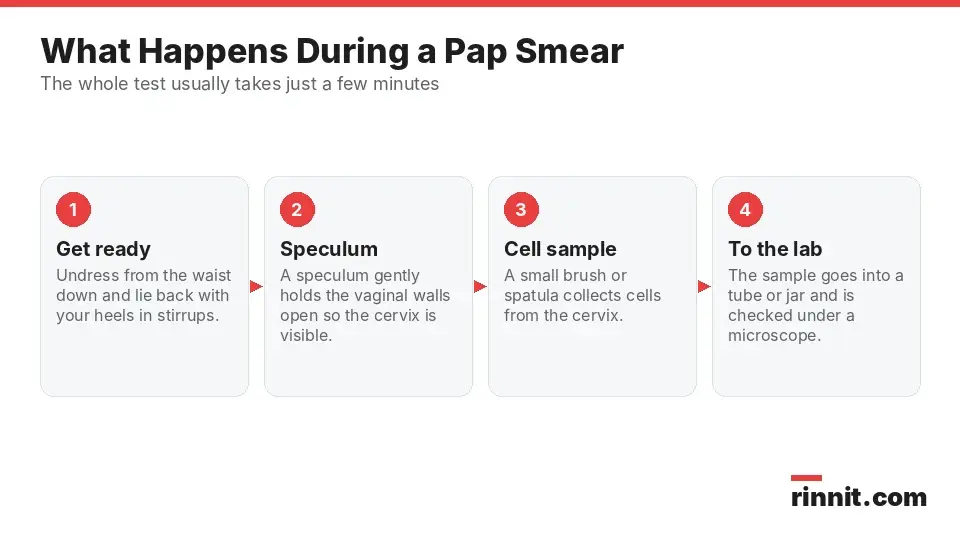
The sample is then sent to a lab, where a pathologist looks at the cells under a microscope. [1]
Does a Pap smear hurt?
A Pap smear should not hurt, although it may feel uncomfortable or feel briefly unpleasant. Some people notice light bleeding afterward. [1]
How long do Pap smear results take?
Results can take up to 3 weeks to reach your provider. [1]
What do Pap smear results mean?
Pap smear results fall into three main groups. [1]
Result | What it means | Usual next step |
Normal (negative) | No irregular cells were found | Your next test is in at least 3 years |
Unclear | The lab could not tell whether the cells were normal or abnormal | A repeat test may be needed |
Abnormal, low grade | Precancerous changes that, if they become cancer, would likely take several years | Follow-up testing, often colposcopy |
Abnormal, high grade | Precancerous changes more likely to become cancer sooner | Follow-up testing, often colposcopy |
Sources: [1]

An unclear or abnormal result does not mean you have cancer. [1]
What happens after an abnormal Pap smear?
The most common next step is a colposcopy. Your provider uses a colposcope, a magnifying instrument, to look closely at your cervix and vagina. If any area looks abnormal, small tissue samples are taken and sent to a lab. [1]
Some providers repeat the Pap smear first to confirm the result. A Pap smear can screen for cervical cancer, but it cannot diagnose it; only follow-up testing can do that. [1]
Treatment works well. More than 95% of people treated for precancerous cervical cells do not go on to develop cervical cancer. [1]
How accurate is a Pap smear?
Pap smears are very safe and highly reliable. As with any screening test, there is a small, rare chance of a false-negative or otherwise incorrect result. [1]
Research shows that a Pap test alone can miss some precancerous changes that an HPV test would find. In a large Cochrane review, Pap cytology caught 62.5% to 72.9% of serious cell changes (CIN 2+), compared with 89.9% for an HPV DNA test. Cytology was more specific, so it led to fewer unnecessary referrals, but a negative HPV test was more reassuring than a negative Pap test. [2]
This is one reason many people aged 30 to 65 get a Pap/HPV co-test, which allows a longer gap of 5 years between screenings. [1]
What are the risks of a Pap smear?
A Pap smear is a very safe test. The main side effect is light bleeding or spotting for a short time afterward. [1]
The bigger risk comes from skipping screening. You can decline a Pap test, but without it, cervical cancer may go unnoticed until it is more advanced and harder to treat. [1]
When should you call your doctor?
Contact your provider if: [1]
Discomfort after your Pap smear lasts more than a few minutes
Bleeding lasts longer than 24 hours
Conclusion
A Pap smear is a short, simple test that looks for cervical cell changes long before they can turn into cancer. Most people need one every 3 to 5 years between ages 21 and 65, and the process takes only a few minutes.
If your result is unclear or abnormal, it is usually a signal for closer follow-up, not a cancer diagnosis. Keeping up with your screening schedule, and following through on any repeat test or colposcopy, is one of the most effective ways to protect yourself from cervical cancer.
Keep learning: Read about the HPV Vaccine: Who Should Get It, the Shot Schedule, and How Well It Protects, and see Cone Biopsy: A Comprehensive Guide to Cervical Conization for one way abnormal cervical cells can be evaluated further.
FAQ
What is a Pap smear?
A Pap smear (Pap test) is a screening test that collects cells from the cervix to look for abnormal or precancerous changes. It helps prevent cervical cancer by finding changes early.
Why is a Pap smear done?
It is done to screen for cervical cancer and dysplasia. It can also detect HPV when requested, and may pick up some infections such as trichomonas or yeast.
At what age should you start getting Pap smears?
Most people start at age 21. Screening is not needed before 21 because the risk of cervical cancer is very low.
How often do you need a Pap smear?
From 21 to 29, every 3 years. From 30 to 65, every 3 years with a Pap test alone or every 5 years with a Pap/HPV co-test.
How do I prepare for a Pap smear?
For 2 days before the test, avoid vaginal sex, tampons, vaginal medicines or creams, spermicides, lubricants and douches. Try to schedule it when you are not on your period.
Does a Pap smear hurt?
It should not hurt, though it can feel uncomfortable. Light bleeding afterward is possible.
How long does a Pap smear take?
The test itself takes just a few minutes in your provider's office. Results can take up to 3 weeks.
What does a normal Pap smear result mean?
A normal (negative) result means no irregular cells were found. Most people can wait at least 3 years before their next test.
Does an abnormal Pap smear mean I have cancer?
No. An abnormal result means some cells look changed, and it usually leads to a repeat test or a colposcopy. More than 95% of people treated for precancerous cells do not develop cervical cancer.
How accurate is a Pap smear?
Pap smears are highly reliable, but there is a small chance of a false-negative result. Pairing the Pap test with an HPV test improves detection.
When should I call my doctor after a Pap smear?
Call your provider if discomfort lasts more than a few minutes or bleeding lasts longer than 24 hours.
Related Reading
Cervical Cancer: Symptoms, Screening, Diagnosis, Treatment and Support covers the cancer that Pap smear screening is designed to prevent, including its symptoms and how it is treated.
What Is Cervical Dysplasia (Cervical Intraepithelial Neoplasia)? explains the precancerous cell changes a Pap smear most often finds and what happens next.
HPV Infection: What It Is, the Four Types of Warts, and How It Is Treated describes the virus behind most cervical cell changes and why HPV testing is often paired with a Pap smear.
Trichomoniasis: Symptoms, Causes, Diagnosis and Treatment — What You Need to Know covers a common infection that can sometimes show up on a Pap smear sample.
References
Cleveland Clinic. Pap Smear: Test, Age, Duration, Results & Frequency. Cleveland Clinic. Last updated August 19, 2024. https://my.clevelandclinic.org/health/diagnostics/4267-pap-smear
Koliopoulos G, Nyaga VN, Santesso N, et al. Cytology versus HPV testing for cervical cancer screening in the general population. Cochrane Database Syst Rev. 2017;8(8):CD008587. PMID 28796882. https://doi.org/10.1002/14651858.CD008587.pub2
Phillips SA, Denoël S, Wentzensen N, et al. Accuracy of HPV Self-Collection Compared with Clinician-Collected HPV Testing and Cytology: A Meta-analysis. Cancer Epidemiol Biomarkers Prev. 2025;34(9):1467-1471. PMID 40643571. https://doi.org/10.1158/1055-9965.EPI-25-0362
Medical disclaimer
This article is for general education only and does not replace advice from a qualified healthcare professional. Talk to your doctor about your own diagnosis and treatment, and seek emergency care right away for severe or sudden symptoms.



Comments