HPV Test: Who Needs It, How It's Done and What Results Mean

Updated: 2 days ago
Written and medically reviewed by Dr. Baraa Alnahhal, MD · Last reviewed: November 2026 · How we review
Quick Answer: What is an HPV test?
An HPV test checks cells from the cervix for the high-risk strains of human papillomavirus (HPV) that can cause cervical cancer, including HPV 16 and HPV 18. People with a cervix aged 30 to 65 should be screened regularly, and a normal result means retesting in 5 years. A positive result does not mean you have cancer. [1]
What the research says
HPV-based screening prevents more cervical cancers than Pap tests alone. Follow-up of four European randomized trials with 176,464 women aged 20 to 64 found HPV-based screening cut invasive cervical cancer by 40% compared with cytology (rate ratio 0.60), giving 60% to 70% greater protection and supporting 5-year screening intervals from age 30. (Ronco et al., The Lancet, 2014) [2]
Self-collected samples work well with the right test. A meta-analysis of 56 accuracy studies and 25 trials found PCR-based HPV tests were as sensitive on self-collected vaginal samples as on clinician samples (ratio 0.99), and mailing self-sampling kits more than doubled participation among underscreened women. (Arbyn et al., BMJ, 2018) [3]
Key takeaways
HPV tests look for the few high-risk HPV strains that cause almost all cervical cancers. [1]
Screening is recommended for people with a cervix aged 30 to 65. [1]
The sample is collected like a Pap smear, and the test itself happens in a lab. [1]
A positive result means higher risk, not cancer. [1]
Standard STI tests do not check for HPV, and there is no HPV test for males. [1]
What is an HPV test?
An HPV test screens for the virus that can cause cervical cancer. HPV is a common sexually transmitted infection spread through skin-to-skin contact. There are more than 100 strains: some cause warts on the hands, feet and face, about 30 can affect the genitals, and only a few high-risk strains cause cervical cancer. HPV tests check for those high-risk strains, including the most common cancer-causing types, HPV 16 and HPV 18. [1]
Healthy bodies clear most HPV infections within a few years. Over time, though, high-risk strains can cause precancerous changes (cervical dysplasia) that may become cancer. Almost all cervical cancers come from high-risk HPV, which is why screening matters. Current HPV tests can only detect HPV if you have a cervix. [1]
Who needs an HPV test?
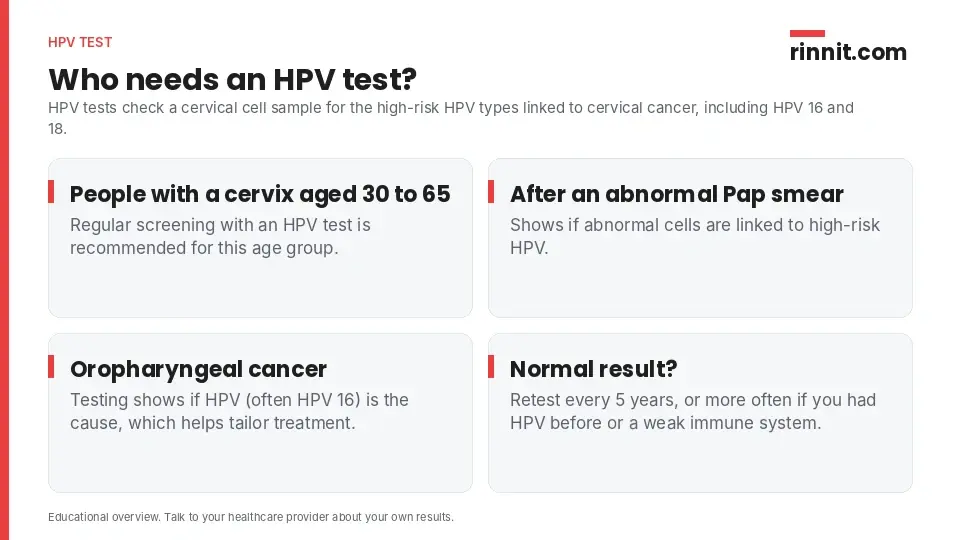
Situation | Why the test is used |
You have a cervix and are 30 to 65 | Regular screening with an HPV test is recommended for this age group |
You had an abnormal Pap smear | Shows whether abnormal cervical cells are linked to high-risk HPV |
You have oropharyngeal (throat) cancer | Shows whether HPV, especially HPV 16, is the cause, which helps tailor treatment; HPV-linked cases have a better outlook |
Sources: [1]
If your result is normal, retest every 5 years. You may need more frequent screening if you have tested positive before or have a condition that weakens your immune system, such as HIV. [1]
How is an HPV test done?
An HPV test is a lab test. A pathologist examines cells or tissue from your cervix for HPV DNA to see whether HPV is present and which type it is. The sample is usually collected in one of two ways: [1]
Pap smear: a provider collects cells from your cervix. Many visits include both tests, called an HPV/Pap co-test, which checks for precancerous or cancer cells (Pap) and HPV DNA (HPV test).
Cervical biopsy: after an abnormal Pap, a provider removes cervical tissue, sometimes during a colposcopy, which uses a special microscope to look closely at the cervix.
Sources: [1]
How do you prepare for an HPV test?
Preparation is the same as for a Pap smear, so nothing interferes with the results: [1]
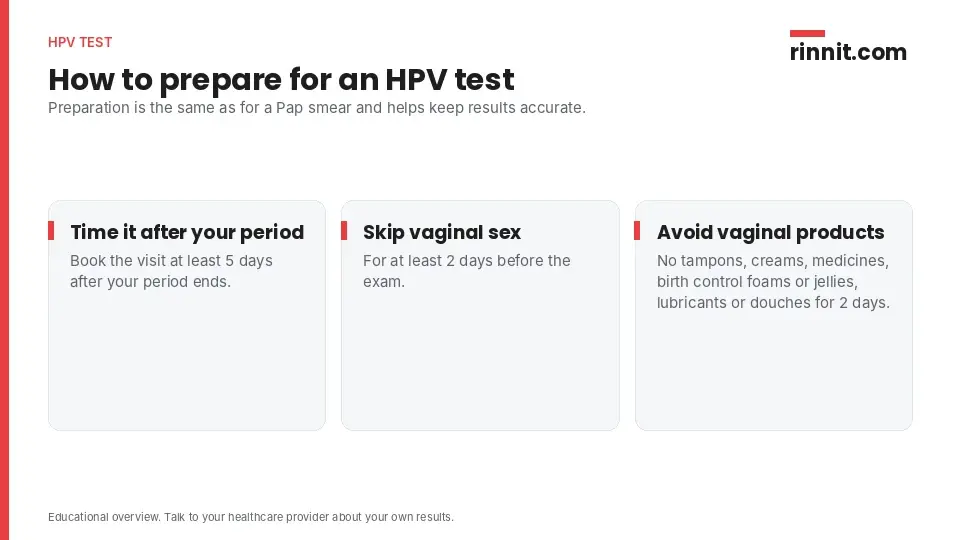
Schedule the appointment at least 5 days after your period ends.
Avoid vaginal sex for at least 2 days before the exam.
Do not use tampons, vaginal creams or medicines, birth control foams or jellies, lubricants or douches for at least 2 days before.
If the HPV test is part of a biopsy, your provider will give you any extra instructions. [1]
What happens during an HPV test?
You lie on your back on an exam table with your feet in stirrups. Your provider then: [1]
Gently inserts a speculum into your vagina to see your cervix. You may feel pressure; you can ask for the smallest speculum that still works.
Uses a small spatula and soft brush to collect cells from your cervix.
Prepares the sample and sends it to a lab, where it is tested for HPV DNA.
Sources: [1]
What do HPV test results mean?
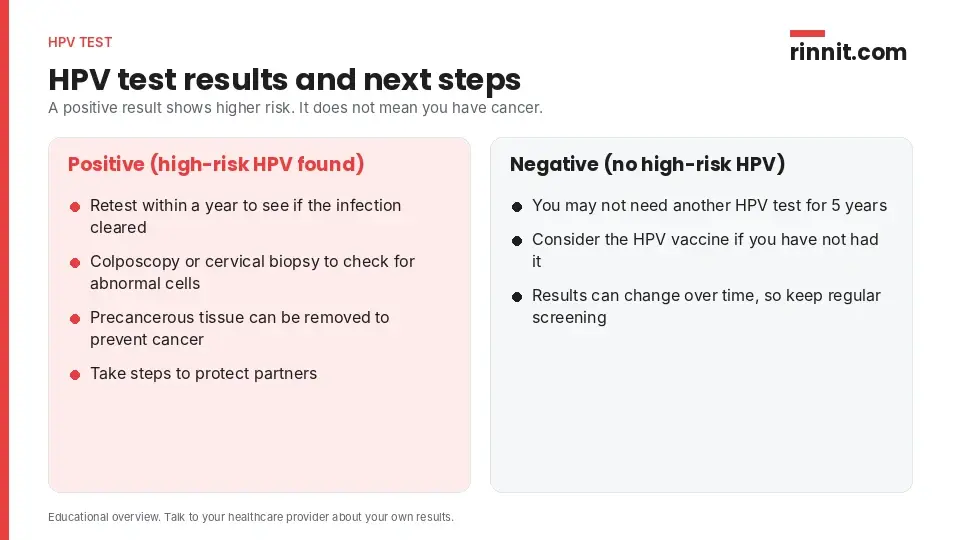
Result | What it means | Possible next steps |
Positive | You have a high-risk HPV strain that raises your risk of cervical cancer. It does not mean you have cancer. | Retest within a year, colposcopy or cervical biopsy, and protect your partners |
Negative | No high-risk HPV strain was found. | You may not need another HPV test for 5 years; consider the HPV vaccine if you have not had it |
Sources: [1]
With a positive result, your body may still clear the infection, or HPV may slowly change healthy cells. A positive test tells your provider how often to check you. If precancerous changes appear, the abnormal tissue can be removed, which can prevent cervical cancer. If your partner has a cervix, it is a good idea for them to be tested too. [1]
Can HPV results change over time?
Yes. You may test positive and later test negative because your body cleared the infection, or test negative and later positive after a new exposure. HPV is very common, so regular testing helps you stay ahead of it. [1]
HPV testing and STI screening
Routine STI screenings test blood or fluids and do not include HPV, because an HPV test needs a cervical or vaginal sample, collected by a provider or, with some FDA-approved kits, by yourself. The only way to know you have cervical HPV is an HPV test or a Pap/HPV co-test. [1]
Can men be tested for HPV?
There are no HPV tests for males, and no FDA-approved tests check for HPV anywhere other than the cervix. HPV-related cancers in men, such as penile and anal cancer, are much less common than cervical cancer, but men can still pass HPV to partners. Warts on any part of the body, including the penis and scrotum, are a sign of HPV, and some providers offer anal Pap smears for people at risk. [1]
Conclusion
HPV testing catches the high-risk virus before healthy cervical cells turn cancerous, which is why it is a key part of routine care for people with a cervix aged 30 to 65. A positive result is common and nothing to be ashamed of; it simply means closer follow-up. Ask your provider which test or co-test you need and how often. [1]
Keep learning: Read our guides to HPV, cervical cancer and the HPV vaccine. For more on HPV and cancer, see the National Cancer Institute.
FAQ
What is an HPV test?
An HPV test checks a sample of cervical cells for the high-risk strains of human papillomavirus that can cause cervical cancer, including HPV 16 and HPV 18 [1].
Who should get an HPV test?
People with a cervix aged 30 to 65 should have regular HPV screening, and it is also used after an abnormal Pap smear [1].
How often do I need an HPV test?
If your result is normal, retest every 5 years. You may need testing more often if you had HPV before or have a weakened immune system, such as from HIV [1].
Is the HPV test the same as a Pap smear?
No. A Pap test looks for abnormal or precancerous cells, while an HPV test looks for HPV DNA. They are often done together as a co-test [1].
Does an HPV test hurt?
It is usually the same as a Pap smear. You may feel some pressure when the speculum is inserted [1].
How do I prepare for an HPV test?
Schedule it at least 5 days after your period ends and avoid vaginal sex, tampons, vaginal creams or medicines, lubricants and douches for 2 days before [1].
Does a positive HPV test mean I have cancer?
No. It means you have a high-risk HPV strain that raises your risk, so your provider will monitor you more closely [1].
What happens after a positive HPV test?
You may retest within a year, have a colposcopy or cervical biopsy, and take steps to protect your partners [1].
Does HPV show up on a regular STD test?
No. Routine STI screenings do not include HPV, because the test needs a cervical or vaginal sample [1].
Is there an HPV test for men?
No. There is no FDA-approved HPV test for males, though some providers offer anal Pap smears for people at risk [1].
Related Reading
Learn more in our guide to Understanding HPV: Causes, Symptoms, and Prevention.
Learn more in our guide to Cervical Cancer: Symptoms, Screening, Diagnosis, Treatment and Support.
Learn more in our guide to What Is Cervical Dysplasia (Cervical Intraepithelial Neoplasia)?.
Learn more in our guide to Oropharyngeal Cancer: Symptoms, Causes, Diagnosis, Treatment, and Outlook — What You Need to Know.
References
Cleveland Clinic. Human Papillomavirus (HPV) Test: Results & Interpretation. Cleveland Clinic. Last updated November 9, 2023. https://my.clevelandclinic.org/health/diagnostics/22163-human-papillomavirus-hpv-test
Ronco G, Dillner J, Elfström KM, et al. Efficacy of HPV-based screening for prevention of invasive cervical cancer: follow-up of four European randomised controlled trials. Lancet. 2014;383(9916):524-532. PMID 24192252. https://doi.org/10.1016/S0140-6736(13)62218-7
Arbyn M, Smith SB, Temin S, et al. Detecting cervical precancer and reaching underscreened women by using HPV testing on self samples: updated meta-analyses. BMJ. 2018;363:k4823. PMID 30518635. https://doi.org/10.1136/bmj.k4823
Medical disclaimer
This article is for general education only and does not replace advice from a qualified healthcare professional. Talk to your doctor about your own diagnosis and treatment, and seek emergency care right away for severe or sudden symptoms.



Comments