Cancer Screening: Which Tests Are Recommended, When to Start and the Risks

Updated: 2 days ago
Written and medically reviewed by Dr. Baraa Alnahhal, MD · Last reviewed: November 2026 · How we review
Quick Answer: What is cancer screening?
Cancer screening is testing for signs of cancer before you have any symptoms. It can find some cancers early, when they are easier to treat, and find precancerous changes that can be treated before cancer develops. Most people start regular screening in their 40s, but those at higher risk may start sooner.
What the research says
Screening lowers deaths from specific cancers, but gains in overall lifespan are small. A meta-analysis of randomized trials with more than 2 million participants estimated that sigmoidoscopy screening added about 110 days of life, while mammography, PSA testing, colonoscopy, stool testing and lung CT screening showed no statistically significant gain in lifetime, with follow-up of 10 to 15 years. (Bretthauer et al., JAMA Internal Medicine, 2023) [2]
Yearly low-dose CT cut lung cancer deaths: in the National Lung Screening Trial of 53,454 people at high risk, yearly low-dose CT lowered lung cancer deaths by 20% compared with chest X-rays, though most positive scans turned out to be false alarms (Aberle DR et al., New England Journal of Medicine, 2011) [3]
Key takeaways
Cancer screening looks for cancer or precancer before symptoms appear, when treatment works best. [1]
Average-risk adults are advised to start breast screening at 40, cervical screening at 21 and colon screening at 45. [1]
Lung cancer screening is offered to people aged 50 to 80 who have a 20 pack-year smoking history and smoke now or quit within the past 15 years, and PSA testing may be discussed at ages 55 to 69. [1]
Screening has risks too, mainly inaccurate results and overdiagnosis, which can lead to care that does not help. [1]
A screening result is not a diagnosis; unusual results lead to more tests, and a normal result is not a guarantee. [1]
What is cancer screening?
Cancer screenings are tests that check for signs of cancer before symptoms appear. They can catch some cancers at an early stage and sometimes detect precancerous changes, which allows prevention. Screening can involve a physical exam, imaging such as a mammogram or CT scan, laboratory tests of blood or tissue, and genetic testing. [1]
Who should be screened for cancer?
Most people begin regular screening in their 40s, and some screenings start earlier. People at high risk, such as those with a family history of cancer or a known cancer-causing gene change, may need to start sooner or test more often. Your healthcare provider decides which screenings you need and when. [1]

Screening starting ages for average-risk adults.
Which cancer screening tests are recommended?
Screenings for average-risk adults
Cancer | Starting age | Recommended tests and timing |
Breast | 40 | Mammogram every two years; higher-risk people may need more frequent screening or a breast MRI |
Cervical | 21 | Pap smear every three years from 21 to 29; from 30 to 65, Pap and HPV test every five years, Pap every three years or HPV test every five years |
Colon | 45 | Colonoscopy every 10 years, stool tests every one to three years, virtual colonoscopy or flexible sigmoidoscopy every five years, or sigmoidoscopy every 10 years plus a yearly stool test |
Sources: [1]
Other screenings to discuss with your provider
Cancer | What is offered |
Lung | A yearly low-dose CT scan for people aged 50 to 80 with a 20 pack-year smoking history who smoke now or quit within the past 15 years |
Prostate | A PSA blood test, which a provider may recommend between ages 55 and 69 |
Oral | No official recommendation; a dentist may check during routine visits |
Skin | A dermatologist skin check; evidence that it lowers skin cancer deaths is lacking |
Multiple cancers | A blood test that looks for more than 50 cancer types; not FDA-approved for routine use |
Sources: [1]
People who have had surgery on their reproductive organs, including a hysterectomy, may need an adjusted plan, since the specific procedure determines whether cervical screening is still needed. [1]
What are the benefits and risks of cancer screening?
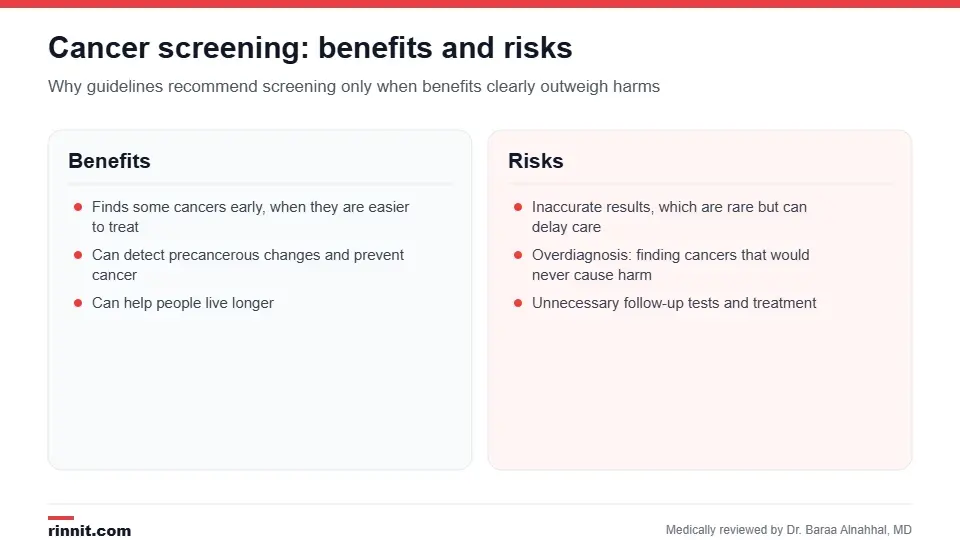
Weighing the benefits and risks of screening.
Benefits | Risks |
Finding cancer early, when it is easier to treat | Inaccurate results, which are rare but can delay care |
Detecting and treating precancerous changes | Overdiagnosis: finding cancers that would never have caused harm |
Curing some cancers and helping people live longer | Unnecessary follow-up tests and treatment that do not improve outlook |
Sources: [1]
Guidelines recommend a screening test only when its benefits clearly outweigh its risks. [1] That balance is debated: a large analysis of randomized trials found that only sigmoidoscopy clearly extended life, by about 110 days on average, while other common tests did not show a measurable gain in lifespan over 10 to 15 years, even though they reduce deaths from the cancer they target. [2]
What do cancer screening results mean?
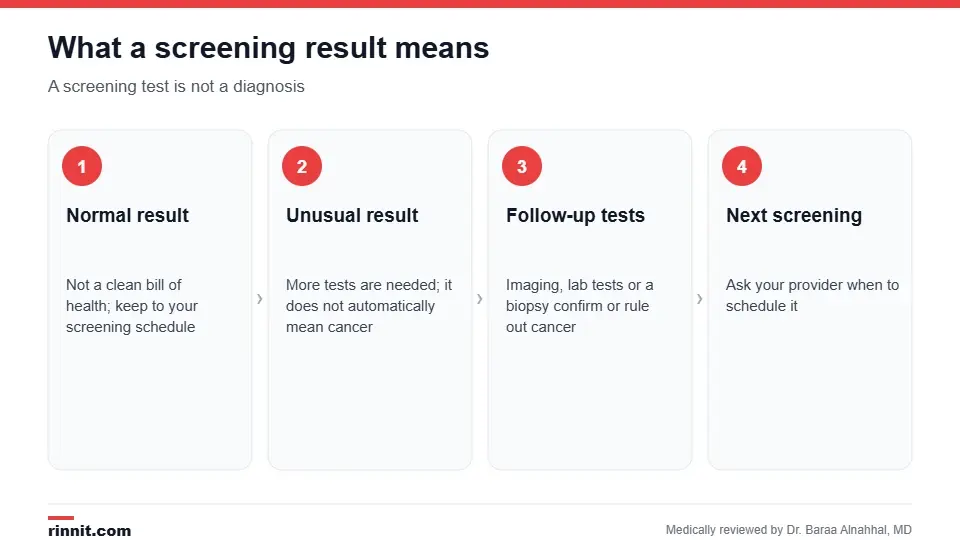
How to understand a screening result.
A screening result is not a cancer diagnosis, and a normal result is not a clean bill of health, because cancer can start small and grow slowly. Unusual results lead to additional tests, which do not automatically mean you have cancer. Some results are ready within a few days; others take about a week. Ask your provider when to schedule your next screening. [1]
When should you call a doctor?
Call your provider if you notice a new lump, unexplained bleeding, a sore that does not heal, unexplained weight loss or any symptom that worries you, even if your last screening was normal. [1]
Conclusion
Cancer screening can find cancer and precancer early, when treatment works best. For average-risk adults, that means a mammogram from 40, cervical screening from 21 and colon screening from 45, with lung and prostate screening for those who qualify. [1]
Screening also carries risks, so the right plan depends on your age, family history and personal risk. Talk with your provider about which tests you need and how often, and follow up on any unusual result. [1]
Keep learning: Read our guide to colorectal cancer screening, the screening with the strongest evidence for extending life.
Frequently asked questions
What is cancer screening?
Testing for signs of cancer or precancer before symptoms appear.
At what age should cancer screening start?
Most people start in their 40s, but cervical screening starts at 21, colon screening at 45 and high-risk people may start sooner.
Which cancers have screening tests?
Breast, cervical and colon cancer for average-risk adults, plus lung and prostate cancer for people who meet certain criteria.
How often should I have a mammogram?
Every two years from age 40 for average-risk people; higher-risk people may need more frequent screening.
How often should I have cervical screening?
A Pap smear every three years from 21 to 29; from 30 to 65, a Pap and HPV test every five years, a Pap every three years or an HPV test every five years.
When should colon cancer screening start?
At age 45, with a colonoscopy every 10 years or stool tests every one to three years.
Who should have lung cancer screening?
People aged 50 to 80 with a 20 pack-year smoking history who smoke now or quit within the past 15 years, using a yearly low-dose CT scan.
What are the risks of cancer screening?
Inaccurate results and overdiagnosis, which can lead to unnecessary tests and treatment.
Does a normal screening result mean I do not have cancer?
No. It is reassuring but not a guarantee, so keep to your screening schedule and report new symptoms.
What happens if a screening result is unusual?
Your provider orders more tests, which do not automatically mean cancer is present.
Related Reading
Colorectal Cancer Screening: When to Start, Test Options and What Results Mean explains colonoscopy, stool tests and other options for colon cancer screening.
Breast Cancer Screening: When to Start, How Often and Which Tests Are Used covers when to start mammograms and which tests are available.
Cervical Cancer Screening: Tests, Schedule by Age and What Results Mean explains Pap smears and HPV tests by age.
Lung Cancer Screening: Who Should Get It, How Low-Dose CT Works and What Results Mean describes low-dose CT screening for people with a smoking history.
PSA Test: Normal Levels by Age, How to Prepare and What High Results Mean covers the prostate cancer blood test and how to interpret results.
Liquid Biopsy: Blood Testing for Tumor Cells and Tumor DNA explains the blood test that looks for tumor cells and tumor DNA.
References
Cleveland Clinic. Cancer Screening: Types, Tests & Guidelines. Cleveland Clinic. Last updated March 27, 2025. https://my.clevelandclinic.org/health/diagnostics/24118-cancer-screening
Bretthauer M, Wieszczy P, Løberg M, et al. Estimated Lifetime Gained With Cancer Screening Tests: A Meta-Analysis of Randomized Clinical Trials. JAMA Intern Med. 2023;183(11):1196-1203. PMID 37639247. https://doi.org/10.1001/jamainternmed.2023.3798
Aberle DR, Adams AM, Berg CD, et al. Reduced lung-cancer mortality with low-dose computed tomographic screening. N Engl J Med. 2011;365(5):395-409. PMID 21714641. https://doi.org/10.1056/NEJMoa1102873
Medical disclaimer
This article is for general education only and does not replace advice from a qualified healthcare professional. Talk to your doctor about your own diagnosis and treatment, and seek emergency care right away for severe or sudden symptoms.



Comments