Colonoscopy: Purpose, Prep, Procedure, Results and Risks

Updated: 6 days ago
Written and medically reviewed by Dr. Baraa Alnahhal, MD · Last reviewed: November 2026 · How we review
Quick Answer: What is a colonoscopy?
A colonoscopy is an exam of your large intestine, including the colon, rectum and anus, using a long, thin, flexible tube with a light and camera. Doctors use it to screen for colorectal cancer, find the cause of bowel symptoms, take biopsies and remove polyps, often in the same visit [1].
What the research says
One screening colonoscopy lowered colorectal cancer risk over 10 years. In a randomized trial with follow-up data on 84,585 adults aged 55 to 64, the 10-year risk of colorectal cancer was 0.98% in the group invited to screening versus 1.20% with usual care, an 18% reduction, even though only 42% of those invited were screened. The drop in colorectal cancer deaths (0.28% vs. 0.31%) was not statistically clear (Bretthauer et al., The New England Journal of Medicine, 2022) [2]
Serious complications are uncommon. A meta-analysis of 21 population-based studies found perforation in 0.5 per 1,000 colonoscopies, bleeding in 2.6 per 1,000 and death in 2.9 per 100,000. Bleeding after polyp removal was higher, at 9.8 per 1,000, and complications were less frequent for screening and surveillance exams than for diagnostic ones (Reumkens et al., The American Journal of Gastroenterology, 2016) [3]
Some polyps are missed, and good bowel prep helps. Across 43 publications and more than 15,000 back-to-back colonoscopies, about 26% of adenomas, 9% of advanced adenomas and 27% of serrated polyps were missed on the first exam. Adequate bowel preparation was linked to lower miss rates (Zhao et al., Gastroenterology, 2019) [4]
Key takeaways
A colonoscopy can screen, diagnose and treat in one procedure, including removing polyps and taking biopsies [1].
Routine colorectal cancer screening is recommended to start at age 45, and a normal exam usually does not need repeating for 10 years [1].
Bowel prep is the most important part of getting ready: a poorly cleaned colon can mean an incomplete or repeated exam [1, 4].
The exam itself takes about 30 minutes, plus about 15 minutes if polyps are removed, and you should plan for about two hours at the facility [1].
Sedation means you should not feel pain inside your colon, but you will need someone to drive you home [1].
Serious problems such as a tear or heavy bleeding are rare [1, 3].
What is a colonoscopy used for?
A colonoscopy can be preventive, diagnostic or therapeutic, and one exam is often all three [1].
Purpose | What it means | Examples |
Screening | Checking for disease before symptoms start | Finding colorectal polyps or early cancer in adults 45 and older |
Diagnosis | Looking for the cause of symptoms | Bleeding, bowel habit changes, ongoing belly pain, weight loss |
Treatment | Fixing a problem through the scope | Removing polyps, sealing wounds, injecting medicine, placing stents |
Sources: [1]
Screening for colorectal cancer
Most people have their first colonoscopy as a routine screening test. Colorectal cancer is the second-leading cause of cancer death in the U.S. when men and women are combined., yet it is preventable when found early [1].
You may be due for a screening colonoscopy if you [1]:
Are older than 45 and have never had one
Have not had one in the past 10 years
Had tissue removed during your last colonoscopy
Have a family history of colorectal cancer
Have an inherited condition such as familial adenomatous polyposis (FAP) or Lynch syndrome
Have inflammatory bowel disease
Finding the cause of symptoms
Your doctor may suggest a colonoscopy if you have unexplained rectal bleeding or discharge, diarrhea, constipation, bowel incontinence, belly pain that does not go away or weight loss you cannot explain. In children, not gaining weight as expected can also be a reason [1].
The exam can help diagnose ulcerative colitis, Crohn's disease, other forms of colitis including ischemic colitis, diverticulosis and diverticulitis, ulcers and perforations, large bowel blockages, and colorectal polyps and cancer [1]. Your doctor can take a small tissue sample (biopsy) for lab testing during the exam [1].
Treating problems on the spot
Through the scope, the doctor can remove polyps (polypectomy), seal bleeding wounds, inject medicine, clear blockages, place a stent to hold a narrowed area open and treat tissue with laser therapy [1].
How do you prepare for a colonoscopy?
Bowel preparation is the most important part of getting ready. If your colon is not clean, your doctor may not be able to see the whole lining, and the exam may need to be rescheduled or the prep repeated [1]. Research also links good prep with fewer missed polyps [4].
A typical prep looks like this [1]:
Eat a low-fiber diet for two or three days before the exam.
Switch to clear liquids only on the last day.
Take a laxative formula in the afternoon or evening before the exam to empty your bowels.
Expect to spend several hours near a bathroom, then try to get a good night's sleep.
Arrive for your procedure, which usually happens the next morning.
Because sedation takes about a full day to wear off, arrange for a responsible adult to drive you home. Most facilities require this [1].
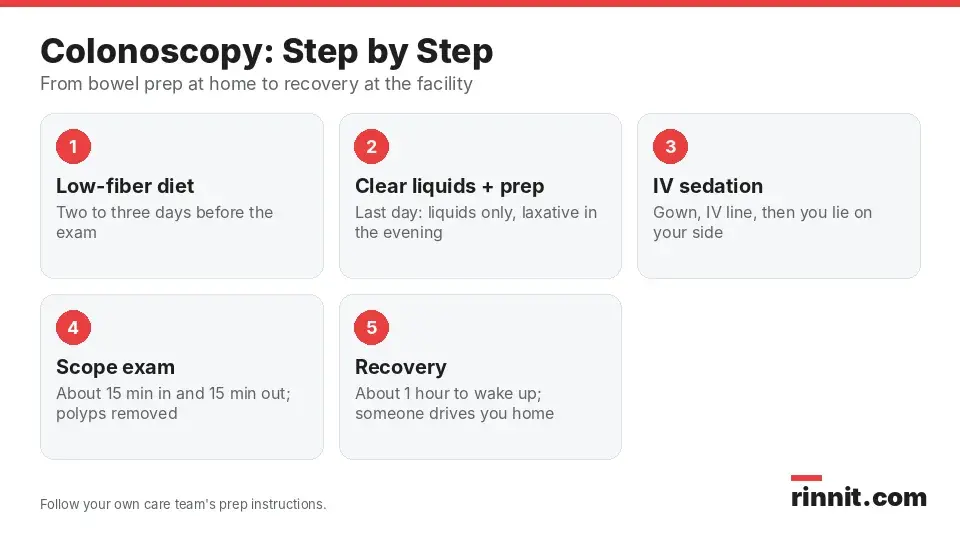
Following the prep instructions closely gives you the best chance of a complete exam.
What happens during a colonoscopy?
A gastroenterologist or colorectal surgeon trained in endoscopy performs the exam [1]. After you change into a gown, a nurse places an IV line in your arm to give sedatives and pain medicine [1].
You lie on your side with your knees drawn up toward your chest. The doctor gently inserts the lighted scope through your anus and guides it to the far end of the colon, where it meets the small intestine [1]. Gas is pumped in to open the colon so the doctor can see clearly on a video monitor [1].
The doctor looks at the lining on the way in and again on the way out [1]. If they find polyps, they usually remove them right away. Polyps show up in about 30% of routine colonoscopies, and most are not cancer [1].
What kind of sedation is used?
There are two main options, and you can talk with your care team about which is right for you [1]:
General anesthesia: a controlled state of unconsciousness.
Conscious sedation: you are relaxed and less aware. You may or may not fall asleep, and you usually will not remember much afterward.
Does a colonoscopy hurt?
With sedation, you should not feel pain inside your colon, even if the doctor removes tissue or uses laser therapy [1].
You may feel some pressure or gas pain as the scope moves forward, because carbon dioxide is used to inflate the colon [1]. You may even fall asleep during the exam [1].
How long does a colonoscopy take?
The scope usually takes about 15 minutes to advance and about 15 minutes to withdraw. Removing polyps may add about 15 minutes [1]. With check-in, sedation and recovery, plan to be at the facility for about two hours [1].
When | What to expect |
2 to 3 days before | Low-fiber diet |
Last day before | Clear liquids only, then laxative prep in the afternoon or evening |
Procedure | About 30 minutes, plus about 15 minutes if polyps are removed |
First hour after | Wake up and rest while staff check your vital signs |
First 24 hours | Sedation wears off: no driving, machinery or big decisions |
Days to weeks | Biopsy results come back, if tissue was taken |
Sources: [1]

You can eat normally once you feel ready, but the effects of sedation last into the next day.
What happens after a colonoscopy?
You will rest in a recovery area for about an hour while you wake up, and staff will watch your vital signs and check for problems [1]. Your doctor will usually talk with you about what they saw and anything they did during the exam [1].
It takes about 24 hours for anesthesia to fully wear off. Do not drive, use machinery or make important decisions until the next day [1].
In the first one to two hours, you may have gas pain, bloating or nausea, which should pass quickly [1]. You can go back to your usual diet when you feel ready [1]. If tissue was removed, light bleeding from the rectum for a few days can happen [1].
What do colonoscopy results mean?
Your doctor knows most findings right away and will send a formal report by mail or electronically [1]. Biopsy results take longer, from a few days to a few weeks [1].
Taking tissue does not automatically mean your doctor suspects cancer. Biopsies may be taken as a precaution or to check for conditions such as microscopic colitis [1].
If your colonoscopy is normal, you usually do not need another one for 10 years [1]. Abnormal findings may include [1]:
Bleeding in the digestive tract that is not controlled
Polyps that are benign, precancerous or cancerous
Inflammation (colitis) from infection, poor blood flow (ischemia) or autoimmune disease
Long-term tissue damage or scarring
A blockage or narrowing (stenosis)
Diverticulosis, small pouches in the colon wall
How accurate is a colonoscopy?
Compared with other screening tests, colonoscopy has higher sensitivity for finding early cancer and precancerous changes [1]. It also combines diagnosis and treatment in one procedure, and a positive result on another test still leads to a colonoscopy [1].
No exam is perfect. In pooled studies of back-to-back colonoscopies, about one in four adenomas was missed on the first pass, and flat or serrated polyps were missed more often [4]. A thorough bowel prep is one of the best ways you can help your doctor see clearly [1, 4].
What are the alternatives to a colonoscopy?
Other screening tests exist, but an abnormal result on any of them means you will need a colonoscopy [1].
Test | How it works | Prep and sedation | How often if normal |
Colonoscopy | Camera exam of the whole large intestine | Full bowel prep and sedation | Every 10 years |
Stool tests | Check stool for hidden blood (one type also looks for DNA changes) | Stool sample | Every 1 to 3 years |
Virtual colonoscopy | CT scan that builds 3D images of the colon | Same bowel prep, no anesthesia | Every 5 years |
Sources: [1]
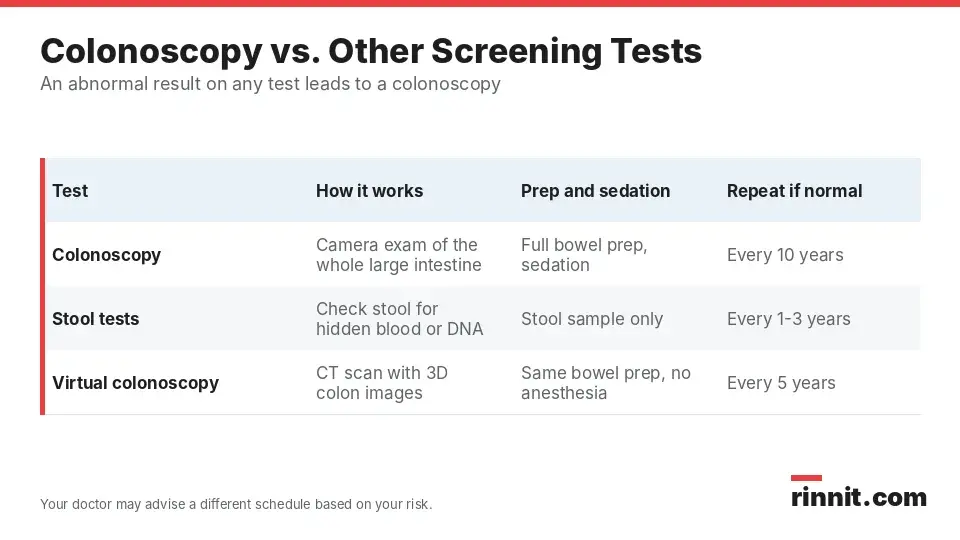
Talk with your doctor about which screening option fits your risk and history.
What are the risks of a colonoscopy?
Complications are rare, but they can happen [1]:
An injury to the colon wall, such as a tear
Bleeding that will not stop after tissue removal
Infection that needs antibiotics
A reaction to the anesthesia
Large population studies put perforation at about 0.5 per 1,000 exams and bleeding at about 2.6 per 1,000, with higher bleeding rates when polyps are removed [3]. Screening exams carry fewer complications than diagnostic ones [3].
Conclusion
A colonoscopy gives your doctor a direct view of your large intestine and lets them remove polyps or take biopsies in the same visit. That combination is why it remains a central test for colorectal cancer screening and for finding the cause of bowel symptoms [1, 2].
The prep is the hardest part for most people, but it is also what makes the exam work. With sedation, the procedure is usually painless, it takes about half an hour, and a normal result typically means you will not need another one for 10 years [1].
Keep learning: For a side-by-side look at related scopes, read Lower Endoscopy: Colonoscopy vs. Sigmoidoscopy, Prep, Procedure and Recovery. To plan your prep, see Colonoscopy Prep: What to Eat, What to Drink and When to Start and Preparing for Your Colonoscopy: A Guide to the Bowel Prep Kit.
FAQ
What is a colonoscopy?
A colonoscopy is an exam that uses a thin, flexible tube with a light and camera to look inside your colon, rectum and anus. Your doctor can also take biopsies and remove polyps during the exam [1].
Why would I need a colonoscopy?
The most common reason is routine colorectal cancer screening starting at age 45. It is also used to look for the cause of rectal bleeding, bowel changes, ongoing belly pain or unexplained weight loss [1].
How often should I have a colonoscopy?
If your exam is normal, you usually do not need another one for 10 years. You may need one sooner if you had tissue removed, have a family history of colorectal cancer, an inherited syndrome or inflammatory bowel disease [1].
How do I prepare for a colonoscopy?
Eat a low-fiber diet for two or three days, have only clear liquids on the last day and take a laxative formula the afternoon or evening before. Arrange for someone to drive you home [1].
Does a colonoscopy hurt?
With sedation, you should not feel pain inside your colon. You may feel some pressure or gas cramps as the colon is inflated [1].
How long does a colonoscopy take?
The exam takes about 30 minutes, plus about 15 minutes if polyps are removed. Plan for about two hours at the facility [1].
Can I drive after a colonoscopy?
No. Sedation takes about 24 hours to wear off, so you should not drive, use machinery or make important decisions until the next day [1].
When will I get my colonoscopy results?
Your doctor usually shares the main findings right after the exam. Biopsy results take a few days to a few weeks [1].
Is bleeding normal after a colonoscopy?
Light rectal bleeding for a few days can happen if tissue was removed. Bleeding that will not stop is a rare complication, so contact your doctor if bleeding is heavy or continues [1].
What are the risks of a colonoscopy?
Rare risks include a tear in the colon wall, heavy bleeding after tissue removal, infection and a reaction to anesthesia [1, 3].
Related Reading
Contrast Enema for Children: What to Expect for Your Child explains the X-ray test that views a child's colon.
Gastrointestinal (GI) Tests: Types, Preparation and What to Expect explains the main types of tests used to check the digestive tract.
Enteroscopy: Seeing and Treating the Small Intestine explains the scope exam that reaches deep into the small intestine.
Colon Polyps: Complete Guide to Symptoms, Causes, and Treatment explains what the growths found and removed during a colonoscopy are and why some can turn into cancer.
Colon Cancer: Symptoms, Screening, Diagnosis, Treatment and Support covers the disease colonoscopy screening aims to prevent or catch early.
Inflammatory Bowel Disease: Symptoms, Causes, and Treatment explains Crohn's disease and ulcerative colitis, which colonoscopy helps diagnose and monitor.
Diverticulitis: Symptoms, Causes, Treatment & Diet — Complete Guide covers the inflamed colon pouches that a colonoscopy can reveal.
Lynch Syndrome: Symptoms, Causes, Inheritance, Diagnosis, and Screening explains the inherited condition that calls for earlier and more frequent colonoscopy screening.
Meckel's Scan: How It Finds Meckel's Diverticulum, Preparation and Accuracy explains the nuclear medicine scan that finds a bleeding Meckel's diverticulum.
References
Cleveland Clinic. Colonoscopy: What it is, Procedure Details, Results. Cleveland Clinic. Last updated November 30, 2022. https://my.clevelandclinic.org/health/diagnostics/4949-colonoscopy
Bretthauer M, Løberg M, Wieszczy P, et al. Effect of Colonoscopy Screening on Risks of Colorectal Cancer and Related Death. N Engl J Med. 2022;387(17):1547-1556. PMID 36214590. https://doi.org/10.1056/NEJMoa2208375
Reumkens A, Rondagh EJA, Bakker CM, et al. Post-Colonoscopy Complications: A Systematic Review, Time Trends, and Meta-Analysis of Population-Based Studies. Am J Gastroenterol. 2016;111(8):1092-1101. PMID 27296945. https://doi.org/10.1038/ajg.2016.234
Zhao S, Wang S, Pan P, et al. Magnitude, Risk Factors, and Factors Associated With Adenoma Miss Rate of Tandem Colonoscopy: A Systematic Review and Meta-analysis. Gastroenterology. 2019;156(6):1661-1674.e11. PMID 30738046. https://doi.org/10.1053/j.gastro.2019.01.260
Medical disclaimer
This article is for general education only and does not replace advice from a qualified healthcare professional. Talk to your doctor about your own diagnosis and treatment, and seek emergency care right away for severe or sudden symptoms.



Comments