Inflammatory Bowel Disease: Symptoms, Causes, and Treatment

Updated: 2 days ago
Medically reviewed by Dr. Baraa Alnahhal, MD. Last reviewed October 13, 2026. This content is for educational purposes and is not medical advice.
Quick Answer
Inflammatory bowel disease is chronic inflammation of the digestive tract, most often from Crohn's disease or ulcerative colitis. [1] Symptoms include persistent diarrhea, belly pain, blood in the stool, weight loss and extreme tiredness. [1] The exact cause is unknown but likely involves immune response, genes and environment. Treatment includes anti-inflammatory medicines, nutritional support and surgery when medicines are not enough. [5]
What the research says
IBD is now a global disease with a high burden. A systematic review of 147 population-based studies found that IBD prevalence exceeded 0.3% in North America, Oceania, and many European countries, while incidence has been rising in newly industrialised countries such as Brazil (annual change of +11.1% for Crohn's disease and +14.9% for ulcerative colitis) (Ng et al., The Lancet, 2017). [6]
Smoking affects Crohn's disease and ulcerative colitis differently. In a meta-analysis of 13 studies on ulcerative colitis and 9 on Crohn's disease, current smoking was associated with Crohn's disease (odds ratio 1.76; 95% CI 1.40 to 2.22) but with lower odds of ulcerative colitis (odds ratio 0.58; 95% CI 0.45 to 0.75), while former smokers had higher odds of ulcerative colitis (odds ratio 1.79; 95% CI 1.37 to 2.34) (Mahid et al., Mayo Clinic Proceedings, 2006). [7]
Ulcerative colitis raises colorectal cancer risk about 2.4-fold. A meta-analysis of 8 population-based cohort studies found that an average of 1.6% of people with ulcerative colitis were diagnosed with colorectal cancer over 14 years of follow-up, with a pooled standardized incidence ratio of 2.4 (95% CI 2.1 to 2.7) and 4.8 (95% CI 3.9 to 5.9) for extensive colitis (Jess et al., Clinical Gastroenterology and Hepatology, 2012). [8]
Key Facts at a Glance
Aspect | Summary |
What it is | Chronic inflammation and swelling of digestive tract tissues |
Two main types | Crohn's disease and ulcerative colitis [1] |
Most common symptoms | Diarrhea, belly pain, blood in stool, fatigue, weight loss [1] |
Who gets it most | Usually diagnosed before age 30, though it can start in the 50s or 60s [1] |
Main treatment goal | Reduce inflammation, achieve long-term remission, prevent complications |
Treatment approach | Medicines first; nutritional support and surgery when needed |
What Is Inflammatory Bowel Disease?
Inflammatory bowel disease, usually called IBD, is an umbrella term for a group of conditions that cause swelling and inflammation of the tissues in the digestive tract. The inflammation is chronic, meaning it persists over time rather than clearing up on its own.
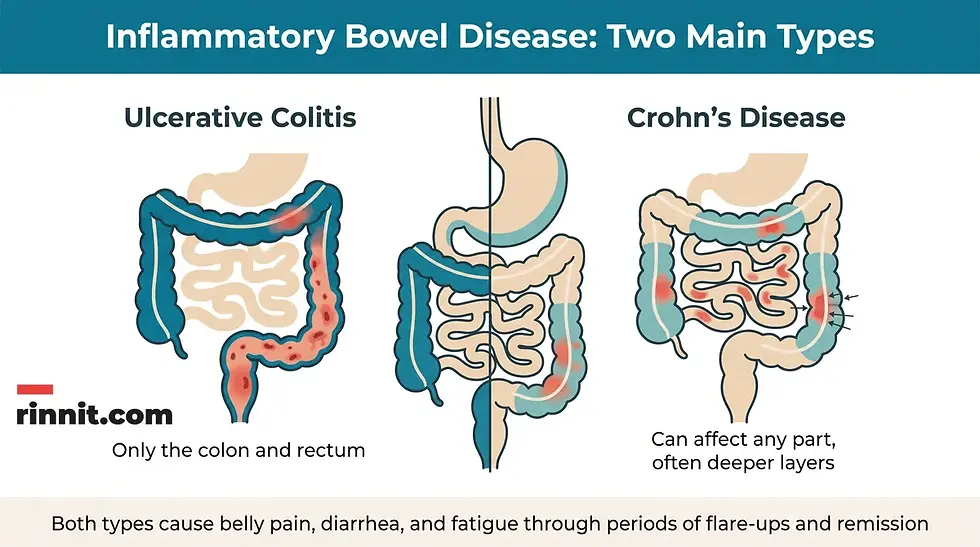
The two most common types of IBD are quite different in where they strike.
Ulcerative colitis involves inflammation and sores, called ulcers, along the lining of the colon and rectum. [1]
Crohn's disease inflames the lining of the digestive tract, often reaching into the deeper layers. It most commonly affects the small intestine, particularly the last part called the ileum, but it can also affect the large intestine and, less commonly, the upper digestive tract.
For some people, IBD is only a mild illness. For others, it causes disability and can lead to life-threatening complications. The disease runs a course of flare-ups and remission rather than constant symptoms.
Symptoms
IBD symptoms vary depending on how severe the inflammation is and where it occurs in the digestive tract. [1] Symptoms may range from mild to severe, and a person with IBD is likely to have periods of active illness followed by periods of remission. [1]
The symptoms common to both Crohn's disease and ulcerative colitis include:

When to See a Doctor
See a healthcare professional if you experience a lasting change in your bowel habits or if you develop any of the symptoms listed above. Although inflammatory bowel disease usually is not fatal, it is a serious disease that may cause life-threatening complications in some people.
Causes
The exact cause of inflammatory bowel disease remains unknown. [1] In the past, diet and stress were suspected causes. Healthcare professionals now know that these factors may aggravate IBD, but they are not the cause of it. [1] Several factors likely play a role in its development.
Possible factor | How it may contribute |
Immune system | An atypical immune response attacks cells in the digestive tract while trying to fight an invading virus or bacterium |
Genes | Several genetic markers are associated with IBD, and it is more common in people with affected family members, though most people with IBD have no family history [1] |
Environmental triggers | Factors that affect the gut microbiome, such as a sterile childhood environment, an early gastrointestinal infection, antibiotics in the first year of life, or being mostly bottle-fed |
Risk Factors
Certain factors raise the likelihood of developing inflammatory bowel disease.
Age. Most people who get IBD are diagnosed before they are 30 years old. However, some people do not develop the disease until their 50s or 60s. [1]
Race or ethnicity. IBD is more common in white people, but it can occur in anyone. The number of people with IBD is increasing in other races and ethnicities. [1]
Family history. Your risk is higher if you have a blood relative, such as a parent, sibling, or child, with the disease. [1]
Cigarette smoking. Cigarette smoking is the most important controllable risk factor for Crohn's disease. Smoking may actually help prevent ulcerative colitis [7], but its harm to overall health outweighs any benefit, and quitting improves the general health of the digestive tract.
Nonsteroidal anti-inflammatory medicines (NSAIDs). Medicines such as ibuprofen, naproxen sodium, and diclofenac may increase the risk of developing IBD or worsen the disease in people who already have it.
Complications
Ulcerative colitis and Crohn's disease share some complications and have others that are specific to each condition.
Complications found in both conditions include colon cancer (the risk rises when the disease affects most of the colon, so routine colonoscopy screening typically begins about 8 to 10 years after diagnosis [1]), inflammation of the skin, eyes, and joints during flare-ups [1], side effects from medicines such as infection risk and, with corticosteroids, osteoporosis and high blood pressure [1], an uncommon liver-affecting condition called primary sclerosing cholangitis [1], increased blood clots in veins and arteries, and severe dehydration from too much diarrhea [1].
Crohn's disease can specifically cause bowel obstruction from a thickened and narrowed bowel [1], malnutrition and anemia from poor nutrient absorption [1], fistulas (abnormal connections that form when inflammation extends through the intestinal wall, which can become infected and form an abscess), and an anal fissure (a small tear in the tissue lining the anus [1]).
Ulcerative colitis can specifically cause toxic megacolon, in which the colon rapidly widens and swells [1], and a perforated colon (a hole in the colon), which most commonly results from toxic megacolon but can occur on its own.
Diagnosis
To confirm a diagnosis of IBD, a healthcare professional generally recommends a combination of tests and procedures. [2] No single test is used alone. [3]
Test type | What it checks |
Blood tests | Signs of infection, anemia, inflammation levels, liver function, and past infections such as tuberculosis [2] |
Stool studies | Blood, infection-causing bacteria or parasites in the stool, and inflammation markers such as calprotectin [2] |
Colonoscopy | A view of the entire colon and parts of the small intestine; a biopsy taken during the exam is what confirms IBD versus other forms of inflammation [2] |
Flexible sigmoidoscopy | Examines the rectum and the last portion of the colon; used instead of a full colonoscopy when the colon is badly inflamed [2] |
Upper endoscopy | Examines the esophagus, stomach, and first part of the small intestine when nausea, vomiting, or upper abdominal pain is present [2] |
Capsule endoscopy | A swallowed camera capsule transmits images to a recorder; used to help diagnose Crohn's disease in the small intestine; not done if a bowel obstruction is suspected [2] |
Imaging tests | X-ray to rule out serious complications; CT enterography for detailed views of the small bowel; MRI to evaluate fistulas without radiation exposure |
Treatment
The goal of inflammatory bowel disease treatment is to reduce the inflammation that triggers symptoms. In the best cases, this leads not only to symptom relief but also to long-term remission and a reduced risk of complications. IBD treatment usually involves either medicines or surgery. [2]

Medicines
Anti-inflammatory medicines are often the first step in treating ulcerative colitis, typically for mild to moderate disease. [2] This group includes aminosalicylates such as mesalamine, balsalazide, and olsalazine. [2] Time-limited courses of corticosteroids are also used to bring symptoms under control; in addition to being anti-inflammatory, steroids suppress the immune system. The medicine recommended depends on the area of the colon that is affected.
Immunomodulators work in various ways to suppress the immune response that releases inflammation-inducing chemicals into the body. Examples include azathioprine, mercaptopurine, and methotrexate. [2]
Small molecules are newer oral medicines. Janus kinase inhibitors, or JAK inhibitors, such as tofacitinib and upadacitinib, reduce inflammation by targeting parts of the immune system that cause inflammation in the intestines. [2] Ozanimod is a different type of small molecule known as an S1P receptor modulator. Notably, the FDA has issued a warning that early studies of tofacitinib showed an increased risk of serious heart-related conditions and cancer; anyone taking it should not stop without first talking with a healthcare professional.
Biologics are a newer category of therapy directed at neutralizing the proteins in the body that cause inflammation. Some are given as intravenous (IV) infusions and others as self-injections. [2] Examples include infliximab, adalimumab, golimumab, certolizumab, vedolizumab, ustekinumab, and risankizumab. [2]
Antibiotics may be used alongside other medications or when infection is a concern, for example in perianal Crohn's disease. Commonly prescribed antibiotics include ciprofloxacin and metronidazole. [2]
Other Medicines and Supplements
Some additional medicines may help relieve symptoms, but always talk with a healthcare professional before taking any nonprescription medicine.
Fiber supplements such as psyllium or methylcellulose can relieve mild to moderate diarrhea by adding bulk to the stool, and loperamide may work for more severe diarrhea. However, antidiarrheals can be harmful in some people with strictures or certain infections, so consult your care team first.
For mild pain, acetaminophen may be recommended. NSAID pain relievers, including ibuprofen, naproxen sodium, and diclofenac, are best avoided because they can make symptoms, and the disease itself, worse. Vitamins and nutritional supplements may be recommended when the body is not absorbing enough nutrients. [3] [5]
Nutritional Support
When weight loss is significant, a healthcare professional may recommend enteral nutrition (a special diet delivered through a feeding tube) or parenteral nutrition (nutrients injected into a vein). [2] This nutritional support improves overall nutrition and allows the bowel to rest, which can reduce inflammation in the short term.
If you have a narrowing or stricture in the bowel, your care team may recommend a low-residue diet. [2] This diet helps minimize the chance that undigested food will get stuck in the narrowed area and cause a blockage.
Surgery
If diet and lifestyle changes, drug therapy, or other treatments do not relieve IBD symptoms, surgery may be recommended.
Surgery for ulcerative colitis involves removal of the entire colon and rectum. [2] An internal pouch is then made and attached to the anus, allowing stool to pass without an external bag. When a pouch is not possible, surgeons create a permanent abdominal opening called an ileal stoma, where stool collects in an attached bag.
Up to two-thirds of people with Crohn's disease require at least one surgery in their lifetimes. However, surgery does not cure Crohn's disease. [2] The surgeon removes the damaged part of the digestive tract and reconnects the healthy sections, and surgery can also close fistulas and drain abscesses. The benefits of surgery for Crohn's disease are usually temporary because the disease recurs in many people, often near the reconnected tissue. The best approach is to follow surgery with medicine to lessen the risk of recurrence. [2]
Lifestyle and Home Remedies
Changes in diet and lifestyle can help manage IBD symptoms and lengthen the time between flare-ups, even when they may not feel like enough on their own.
Diet. No firm evidence shows that food causes inflammatory bowel disease, but some foods and beverages can worsen symptoms, especially during a flare-up. [2] Keeping a food diary to track what you eat and how you feel helps identify trigger foods. [2] Practical suggestions include limiting dairy products (many people find diarrhea, belly pain, and gas improve this way, and a lactase enzyme product may help if lactose is the problem), eating five or six small meals a day rather than two or three larger ones, drinking plenty of liquids (water is best, while alcohol and caffeine stimulate the intestines and carbonated drinks produce gas), and checking with your care team about multivitamins or meeting a registered dietitian if you are losing weight.
Smoking. Smoking increases the risk of Crohn's disease and makes it worse once you have it. [2] People with Crohn's disease who smoke are more likely to have relapses and to need medicines and repeat surgeries. [2] While smoking may help prevent ulcerative colitis [7], its harm to overall health outweighs any benefit, and quitting improves the general health of the digestive tract.
Stress. The link between stress and Crohn's disease is debated, but many people with the condition report symptom flares during high-stress periods. Regular exercise, even mild exercise, can reduce stress, relieve depression, and adjust bowel function. [2] Biofeedback and regular relaxation or deep-breathing exercises are other options worth discussing with your care team.
Probiotics and complementary approaches. Researchers suspect that adding more of the beneficial bacteria normally found in the digestive tract might help fight IBD. Although research is limited, some evidence suggests that probiotics taken alongside medicines may be helpful. Few complementary and alternative treatments have been studied in well-designed trials, so discuss anything you are considering with your care team.
Coping and Support
IBD takes an emotional toll as well as a physical one. When symptoms are severe, life can revolve around a constant need to find a toilet [2], and even mild symptoms can make being out in public difficult. These factors can lead to depression. [2]
Three steps help many people cope. First, become informed: learning as much as possible about IBD from reputable sources, such as the Crohn's and Colitis Foundation [2], is one of the best ways to manage the condition. Second, consider joining a support group, which can provide practical information and emotional reassurance. [2] Third, talking with a therapist who understands IBD and the emotional difficulties it causes can be genuinely helpful. [2]
Although living with IBD can feel discouraging, research is ongoing and the outlook is improving.
Conclusion
Inflammatory bowel disease is a chronic condition, but it is a manageable one. Knowing your type, Crohn's disease or ulcerative colitis, is the starting point, because treatment is tailored to where the inflammation lives in the digestive tract. Medicines have advanced considerably, from aminosalicylates and corticosteroids to small molecules and biologics, and they now keep many people symptom-free for years at a time. Diet adjustments, stress management, and quitting smoking add real benefits, and surgery remains a reliable option when medicines fall short.
The single most important step is staying in close touch with your treatment team. Routine monitoring, including regular colonoscopies to screen for colon cancer, catches problems early. If you notice a lasting change in bowel habits, blood in your stool, or any of the symptoms described in this article, make an appointment with a healthcare professional. The sooner IBD is identified and treated, the better the long-term outlook.
Take action. Understanding your digestive health is the first step toward living well with inflammatory bowel disease. If you notice a lasting change in your bowel habits, blood in your stool, or any other symptom described above, make an appointment with a healthcare professional.
Frequently Asked Questions
What is the difference between Crohn's disease and ulcerative colitis? Crohn's disease can affect any part of the digestive tract, most often the small intestine, and it inflames deeper layers of the bowel wall. [1] [5] Ulcerative colitis affects only the colon and rectum and involves inflammation and ulcers along the lining. [1]
What are the main symptoms of inflammatory bowel disease? The most common symptoms of both conditions are diarrhea, belly pain and cramping, blood in the stool, loss of appetite, losing weight without trying, and feeling extremely tired. [1] Symptoms come and go in flare-ups followed by periods of remission. [1]
Does diet or stress cause inflammatory bowel disease? No. Diet and stress can aggravate IBD, but they do not cause it. [1] The exact cause is unknown, but experts believe it involves an abnormal immune response, genes, and environmental factors that affect the gut microbiome. [3]
How is inflammatory bowel disease treated? Treatment focuses on reducing inflammation. [2] It typically involves medicines (aminosalicylates, corticosteroids, immunomodulators, small molecules, and biologics) along with nutritional support, diet changes, and, when medicines are not enough, surgery. [2] [5]
Will inflammatory bowel disease shorten my life? IBD does not significantly change overall lifespan. The bigger concern is quality of life, and with the right treatment plan, most people can stay largely symptom-free for extended periods. Routine monitoring helps prevent serious complications such as colon cancer.
Related Reading on Rinnit
Colonoscopy: Purpose, Prep, Procedure, Results and Risks: A colonoscopy lets your doctor see inflammation in the colon and take biopsies to help diagnose and monitor Crohn's disease and ulcerative colitis.
Albumin Blood Test: What It Checks, How It's Done and What Results Mean explains how an albumin blood test works and why IBD can lower albumin levels.
C-Reactive Protein (CRP) Test: Normal Levels, High CRP and What Results Mean explains what this inflammation blood test measures and what high levels mean.
Fecal Calprotectin Test: IBD vs IBS, How to Collect a Sample and Results explains the stool test that checks for gut inflammation.
Trusted External Resources
Crohn's & Colitis Foundation: IBD research, support, and education
National Institute of Diabetes and Digestive and Kidney Diseases: Crohn's Disease
MedlinePlus (National Library of Medicine): Crohn's Disease
Related Reading
Specific Carbohydrate Diet (SCD): Foods, Benefits and Risks explains the Specific Carbohydrate Diet.
Biosimilars: What They Are, Safety and How They Compare to Biologics explains biosimilar medicines.
References
Mayo Clinic Staff. Inflammatory bowel disease (IBD): Symptoms and causes. Mayo Clinic. August 21, 2026. https://www.mayoclinic.org/diseases-conditions/inflammatory-bowel-disease/symptoms-causes/syc-20353315
Mayo Clinic Staff. Inflammatory bowel disease (IBD): Diagnosis and treatment. Mayo Clinic. August 21, 2026. https://www.mayoclinic.org/diseases-conditions/inflammatory-bowel-disease/diagnosis-treatment/drc-20353320
National Institute of Diabetes and Digestive and Kidney Diseases. Crohn's Disease. NIDDK. Last reviewed July 2024. https://www.niddk.nih.gov/health-information/digestive-diseases/crohns-disease
Crohn's & Colitis Foundation. IBD Research, Support & Education. Crohn's & Colitis Foundation. Accessed October 14, 2026. https://www.crohnscolitisfoundation.org/
National Library of Medicine. Crohn's Disease. MedlinePlus. Last updated October 18, 2023. https://medlineplus.gov/crohnsdisease.html
Ng SC, Shi HY, Hamidi N, et al. Worldwide incidence and prevalence of inflammatory bowel disease in the 21st century: a systematic review of population-based studies. Lancet. 2017;390(10114):2769-2778. PMID 29050646. https://doi.org/10.1016/S0140-6736(17)32448-0
Mahid SS, Minor KS, Soto RE, et al. Smoking and inflammatory bowel disease: a meta-analysis. Mayo Clin Proc. 2006;81(11):1462-71. PMID 17120402. https://doi.org/10.4065/81.11.1462
Jess T, Rungoe C, Peyrin-Biroulet L. Risk of colorectal cancer in patients with ulcerative colitis: a meta-analysis of population-based cohort studies. Clin Gastroenterol Hepatol. 2012;10(6):639-45. PMID 22289873. https://doi.org/10.1016/j.cgh.2012.01.010



Comments