Specific Carbohydrate Diet (SCD): Foods, Benefits and Risks

Updated: 2 days ago
Written and medically reviewed by Dr. Baraa Alnahhal, MD · Last reviewed: November 2026 · How we review
Quick Answer
The Specific Carbohydrate Diet (SCD) is an eating plan that removes certain carbohydrates, including all grains, most sugars and high-lactose dairy. It's used to help manage Crohn's disease, ulcerative colitis, microscopic colitis and juvenile idiopathic arthritis. It may bring a digestive disease into remission for some people, but it's hard to follow and may cause nutrient gaps.
What the research says
SCD worked about as well as a Mediterranean diet: in the DINE-CD trial of 194 adults with mild to moderate Crohn's disease, symptom remission at 6 weeks was 46.5% on the SCD versus 43.5% on a Mediterranean diet, so the easier Mediterranean diet may be preferred (Lewis JD et al., Gastroenterology, 2021) [2]
The diet was hard for children to stick with: in 54 personalized trials in children aged 7 to 18 with IBD, only 39% completed the trial and 44% withdrew; the SCD and a modified SCD worked similarly (Kaplan HC et al., American Journal of Gastroenterology, 2022) [3]
Key takeaways
The SCD removes grains, most sugars and high-lactose dairy.
It may help Crohn's disease, ulcerative colitis and other conditions.
It focuses on whole, unprocessed foods.
It's restrictive and may cause nutrient gaps.
A dietitian can help you follow it safely.
What is the Specific Carbohydrate Diet?
Dr. Sidney Haas developed the SCD in the 1920s for children with celiac disease. It became popular in the late 1980s through Elaine Gottschall's book "Breaking the Vicious Cycle." Researchers are still studying how it works. Sources: [1]
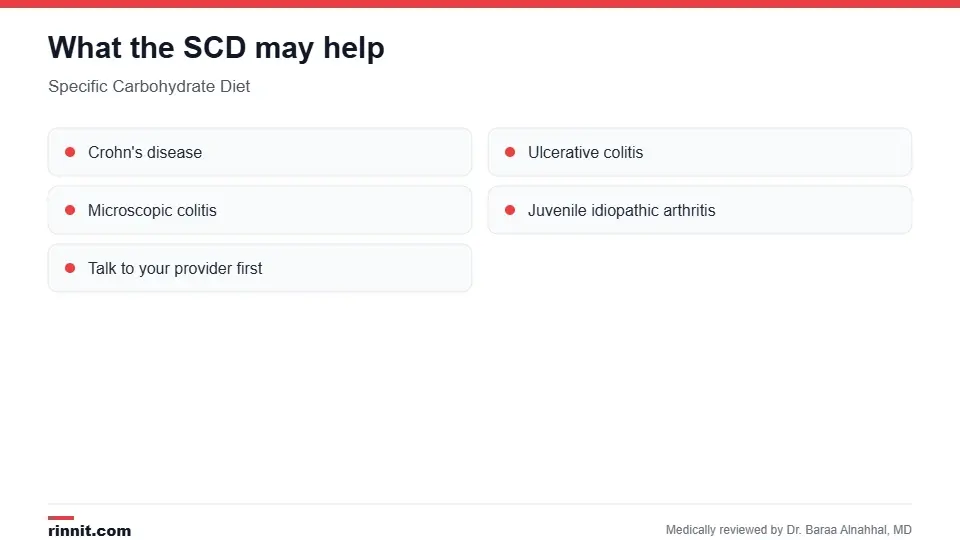
What it may help
Research doesn't confirm it helps diverticulitis, celiac disease or cystic fibrosis.
Crohn's disease.
Microscopic colitis.
Juvenile idiopathic arthritis. Sources: [1]
No research confirms it helps diverticulitis, celiac disease or cystic fibrosis. Sources: [1]
Foods allowed and avoided
A modified version may add rice, oats, potato and quinoa.
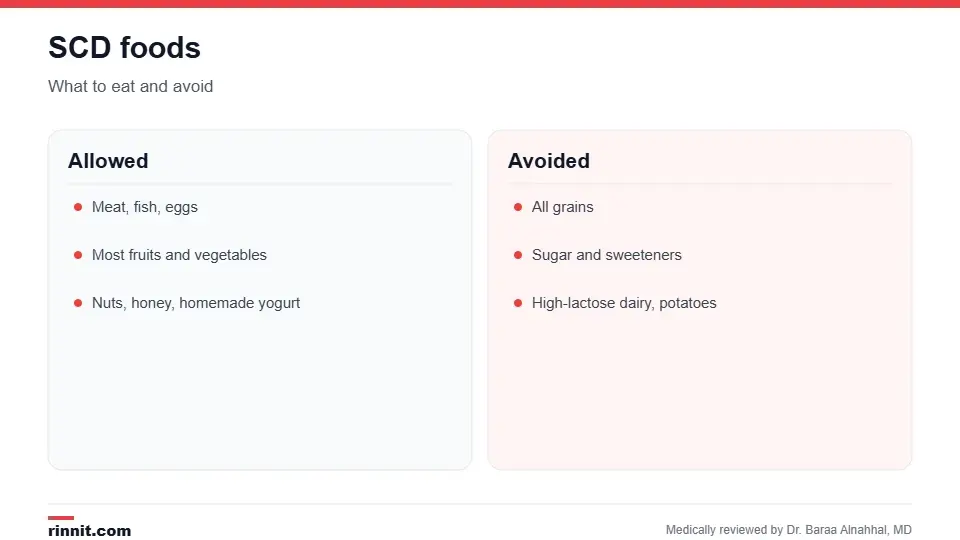
Allowed | Avoided |
Additive-free meat, fish and poultry | Grains such as wheat, rice, corn and oats |
Eggs | Sugar and sweeteners |
Most fresh or unsweetened fruits and vegetables | High-lactose dairy |
Nuts and natural peanut butter | Canned or processed meats |
Honey | Starchy vegetables like potatoes |
Certain cheeses and homemade yogurt | Some legumes, like soybeans and chickpeas |
A modified version may add rice, oats, potatoes and quinoa. Sources: [1]
How to start
Homemade yogurt should ferment at least 24 hours.
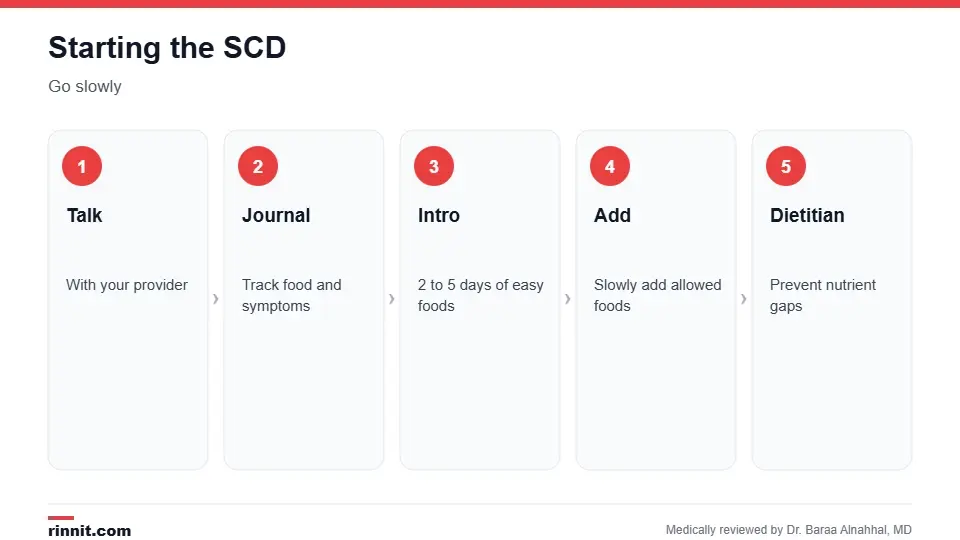
Talk with your provider first.
Keep a food and symptom journal.
Start with a two- to five-day introduction of a few easy-to-tolerate foods.
Slowly add other allowed foods.
Work with a registered dietitian to avoid nutrient gaps. Sources: [1]
Risks
Hard to follow socially and when eating out.
Can be costly.
Risk of malnutrition and unhealthy weight loss.
Possible low calcium and vitamins B, D and E. Sources: [1, 3]
Long-term use
Some people follow the SCD for life. Others slowly add foods back after a year without symptoms or switch to a modified version, and they can restart the diet if symptoms return. Sources: [1]
Results
The SCD may bring a digestive disease into remission. In one study of 200 people with Crohn's disease, nearly half who followed it had less pain, fatigue and sleep problems. Sources: [1, 2]
When to call your provider
Rectal bleeding.
Ongoing gas, bloating or diarrhea.
Chronic pain.
Extreme weight loss.
Unexplained fatigue or weakness. Sources: [1]
Conclusion
The Specific Carbohydrate Diet may ease symptoms of some digestive diseases by cutting out certain carbs. Planning with a dietitian helps you get enough nutrients while you follow it.
Keep learning: read about inflammatory bowel disease and the elemental diet.
Frequently asked questions
What is the Specific Carbohydrate Diet?
A diet that removes grains, most sugars and high-lactose dairy.
What conditions may it help?
Crohn's disease, ulcerative colitis, microscopic colitis and juvenile arthritis.
Can I eat bread on the SCD?
No. All grains are avoided.
Is honey allowed?
Yes.
Can I eat yogurt?
Homemade yogurt fermented at least 24 hours is allowed.
Are potatoes allowed?
No, except in some modified versions.
Does the SCD work?
It may help some people, but results vary.
Is it safe?
It can cause nutrient gaps, so a dietitian can help.
How long do people follow it?
Some for life; others add foods back after a year.
Is it better than a Mediterranean diet?
One study found similar results for Crohn's disease.
Related Reading
Inflammatory Bowel Disease: Symptoms, Causes, and Treatment an overview of IBD.
Ulcerative Colitis: Symptoms, Causes, Diagnosis, and Treatment Explained a condition the diet may help.
Elemental Diet: What It Is, Uses and How It Works another diet for gut conditions.
Low-FODMAP Diet: What It Is, Phases, Foods and How to Follow It another gut-friendly diet.
Surgery for Ulcerative Colitis: Types, Procedures, and Recovery surgical options for colitis.
References
Cleveland Clinic. Specific Carbohydrate Diet (SCD): How It Works & Benefits. Cleveland Clinic. Last updated July 19, 2022. https://my.clevelandclinic.org/health/treatments/23543-scd-specific-carbohydrate-diet
Lewis JD, Sandler RS, Brotherton C, et al. A randomized trial comparing the specific carbohydrate diet to a Mediterranean diet in adults with Crohn's disease. Gastroenterology. 2021;161(3):837-852.e9. PMID 34052278. https://doi.org/10.1053/j.gastro.2021.05.047
Kaplan HC, Opipari-Arrigan L, Yang J, et al. Personalized research on diet in ulcerative colitis and Crohn's disease: a series of N-of-1 diet trials. American Journal of Gastroenterology. 2022;117(6):902-917. PMID 35442220. https://doi.org/10.14309/ajg.0000000000001800
Medical disclaimer
This article is for general education only and does not replace advice from a qualified healthcare professional. Talk to your doctor about your own diagnosis and treatment, and seek emergency care right away for severe or sudden symptoms.



Comments