Elemental Diet: What It Is, Uses and How It Works

Updated: 2 days ago
Written and medically reviewed by Dr. Baraa Alnahhal, MD · Last reviewed: November 2026 · How we review
Quick Answer
An elemental diet is a short-term medical treatment in which a liquid formula that needs very little digestion replaces food. This lets the gut rest, eases inflammation and starves bacteria of undigested food. It's used for SIBO, Crohn's disease and eosinophilic esophagitis, usually for two to eight weeks. Always follow it with medical supervision.
What the research says
Elemental diets worked best for eosinophilic esophagitis: a meta-analysis of 33 studies with 1,317 people found amino acid-based elemental diets brought tissue remission in 90.8%, compared with 72.1% for a six-food elimination diet and 45.5% for allergy test-directed diets (Arias A et al., Gastroenterology, 2014) [2]
Formula-only feeding helped adults with Crohn's disease: a meta-analysis of 40 studies with 2,459 adults found exclusive formula feeding gave 66% remission in real-world studies, though steroids worked better in head-to-head trials, and elemental and non-elemental formulas worked equally well (Kaur K et al., Indian Journal of Gastroenterology, 2026) [3]
Key takeaways
An elemental diet replaces food with an easy-to-absorb formula.
It rests the gut and reduces bacteria and inflammation.
It treats SIBO, IMO, Crohn's disease and EoE.
It lasts a few weeks, depending on the condition.
Foods are added back slowly afterward.
What is an elemental diet?
The formula contains free amino acids, simple carbohydrates, fats such as medium-chain triglycerides (MCTs), vitamins, minerals and electrolytes. It's not common and is very restrictive, so it's usually recommended only after other treatments are tried. Sources: [1]
What it treats

It's used only with a clear medical reason.
Small intestinal bacterial overgrowth (SIBO).
Intestinal methanogen overgrowth (IMO).
Crohn's disease.
Eosinophilic esophagitis (EoE) and other eosinophilic digestive disorders.
Conditions that affect digestion or absorption. Sources: [1]
Full vs. partial elemental diet
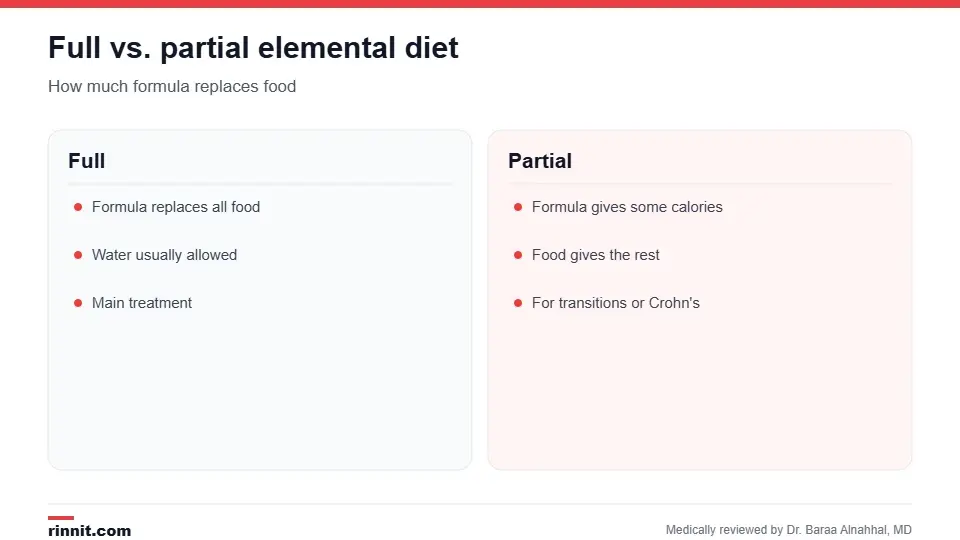
Ask before drinking tea or coffee on a full diet.
Type | What it means | Used for |
Full | Formula replaces all food; water usually allowed | Main treatment |
Partial (half) | Formula gives some calories, food the rest | Extra nutrition, transitions, Crohn's management |
Sources: [1]
How long it lasts

Don't extend the diet on your own.
Condition | Typical length |
SIBO or IMO | Two to three weeks |
Crohn's disease | Six to eight weeks |
Eosinophilic esophagitis | About six weeks, then a check for improvement |
Sources: [1, 2, 3]
How to follow it
A provider or dietitian chooses the formula and daily amount.
It comes ready to drink or as a powder; follow mixing directions exactly.
Split it into servings and sip slowly; drinking fast can cause cramping or diarrhea.
Chilling it or using a straw may help with taste.
Some people need a feeding tube.
Don't add ingredients without asking your care team. Sources: [1]
Side effects
Nausea, belly pain, cramping or bloating.
Diarrhea.
Headaches, fatigue or dizziness.
Blood sugar changes.
Unwanted weight loss.
Fewer bowel movements, which isn't always constipation. Sources: [1]
After the diet
Foods are added back slowly, sometimes with a half-elemental or low-FODMAP diet. Your provider may suggest probiotics or medicines that help the gut move. Results vary: some people feel better during treatment, others only after, and SIBO can come back if its cause remains. Sources: [1]
When to call your provider
You can't tolerate the prescribed amount.
Repeated vomiting or diarrhea, weakness or dizziness.
Signs of dehydration, like dark urine.
Unintended weight loss or abnormal blood sugar.
Get immediate care for severe belly pain, a swollen belly, nonstop vomiting, bloody or black stool or confusion. Sources: [1]
Conclusion
An elemental diet can calm some digestive conditions by giving your gut a rest. Following it under medical guidance and reintroducing foods slowly gives you the best chance of lasting relief.
Keep learning: read about eosinophilic esophagitis and the low-FODMAP diet.
Frequently asked questions
What is an elemental diet?
A short-term treatment where a liquid formula replaces food.
What does an elemental diet treat?
SIBO, IMO, Crohn's disease and eosinophilic esophagitis.
What's in the formula?
Amino acids, simple carbs, fats, vitamins, minerals and electrolytes.
Can I drink water?
Usually yes; ask before having tea or coffee.
How long does it last?
From two to three weeks up to six to eight weeks.
What's a partial elemental diet?
Formula provides some calories and food provides the rest.
How do I make it taste better?
Chill it, sip slowly or use a straw.
What are the side effects?
Nausea, cramping, diarrhea, headaches and fatigue.
What happens after the diet?
Foods are slowly added back.
Can I do it on my own?
No. It needs medical supervision.
Related Reading
Specific Carbohydrate Diet (SCD): Foods, Benefits and Risks explains the Specific Carbohydrate Diet.
Eosinophilic Esophagitis: Symptoms, Causes, and Treatment a condition the diet treats.
Eosinophilic Gastritis (EG): What Causes It — Symptoms, Causes, and When to Get Medical Care — A Complete Guide a related eosinophilic disorder.
Low-FODMAP Diet: What It Is, Phases, Foods and How to Follow It a diet used after.
Strictureplasty for Intestinal Narrowing surgery for Crohn's narrowing.
Hypereosinophilic Syndrome: Symptoms, Causes & Treatment a related eosinophil condition.
References
Cleveland Clinic. Elemental Diet: What It Is & How It Works. Cleveland Clinic. Last updated August 26, 2026. https://my.clevelandclinic.org/health/treatments/22053-elemental-diet
Arias A, González-Cervera J, Tenias JM, et al. Efficacy of dietary interventions for inducing histologic remission in patients with eosinophilic esophagitis: a systematic review and meta-analysis. Gastroenterology. 2014;146(7):1639-1648. PMID 24534634. https://doi.org/10.1053/j.gastro.2014.02.006
Kaur K, Singh A, Kaur S, et al. Exclusive enteral nutrition for induction of remission in Crohn's disease in adults: a systematic review and meta-analysis of randomized trials and real-world studies. Indian Journal of Gastroenterology. 2026;45(3):452-473. PMID 42065851. https://doi.org/10.1007/s12664-026-01989-3
Medical disclaimer
This article is for general education only and does not replace advice from a qualified healthcare professional. Talk to your doctor about your own diagnosis and treatment, and seek emergency care right away for severe or sudden symptoms.



Comments