Eosinophilic Gastritis (EG): What Causes It — Symptoms, Causes, and When to Get Medical Care — A Complete Guide

Updated: 3 days ago
Medically reviewed by Dr. Baraa Alnahhal, MD · Last reviewed: October 2026
Quick Answer
Eosinophilic gastritis (EG) is a rare, chronic disease in which too many eosinophil white blood cells build up in the stomach, causing inflammation and damage, usually from an abnormal immune response to foods [4]. Symptoms include abdominal pain, nausea, vomiting and diarrhea [4]. There is no cure, but dietary changes and medications such as corticosteroids manage symptoms effectively [4].
What the research says
Non-esophageal eosinophilic gut diseases, which include eosinophilic gastritis, are uncommon even among people with digestive symptoms. In a meta-analysis of 10 studies with 13,377 participants referred to outpatient clinics for gastrointestinal symptoms, the overall prevalence of non-esophageal eosinophilic gastrointestinal diseases was 1.9% (95% CI 0.575–3.894), with high variation between studies and no prospective studies available to measure how often new cases appear (PubMed: Licari et al., J Allergy Clin Immunol Pract, 2020 [1]).
Good-quality treatment trials for eosinophilic gastritis are still scarce. A 2026 systematic review and meta-analysis of monoclonal antibody trials found 8 randomized trials (865 participants) in eosinophilic esophagitis, but only 3 randomized trials (155 participants) in eosinophilic gastritis — too few to pool. The gastritis studies suggested similar trends, and the authors called for larger, standardized trials (PubMed: Irfan et al., J Clin Gastroenterol, 2026 [2]).
Early reports suggest the antibody drug dupilumab may help some people. In a retrospective case series of 12 patients with eosinophilic gastritis and/or duodenitis, every patient improved on at least one symptom, all 4 patients with gastritis who had follow-up biopsies reached histologic remission, and median peak gastric eosinophil counts fell from 80.5 to 7.5 per high-power field. The authors describe this as preliminary evidence from a small, uncontrolled series (PubMed: Sia et al., Clin Transl Gastroenterol, 2024 [3]).
What Is Eosinophilic Gastritis?
Eosinophilic gastritis (EG) is a rare disease that affects your stomach. A type of white blood cell called eosinophils builds up, causing inflammation (swelling) and damage [4].
EG can affect anyone at any age [4]. It's a chronic (long-term) disease [4]. But your healthcare provider can help you manage symptoms with regular testing and diet changes.
What are eosinophils?
Eosinophils (ee-oh-sin-oh-fills) are one of several types of white blood cells that support your immune system. Your bone marrow — the soft tissue inside bones — normally produces a small number of eosinophils [4]. In a healthy person, they represent about 1% to 5% of white blood cells [4].
Allergens, infections, medications, or cancer can cause eosinophils to increase — a condition called eosinophilia [4]. They also release substances (enzymes and proteins) to destroy unhealthy cells [4].
When your body produces too many eosinophils, you can develop inflammation in the tissues of your stomach (gastritis) or other organs [4].
Key term | What it means |
Eosinophils | White blood cells that support your immune system; normally 1% to 5% of white blood cells in a healthy person [4] |
Eosinophilia | An increase in eosinophils, which can be caused by allergens, infections, medications, or cancer [4] |
Gastritis | Inflammation in the tissues of your stomach [4] |
Eosinophilic gastritis (EG) | Too many eosinophils build up in the stomach, causing inflammation, swelling, and damage [4] |

Who Is Affected by Eosinophilic Gastritis?
Eosinophilic gastritis affects people of all ages [4]. Healthcare providers most often diagnose EG in adults between ages 30 and 50 [4]. Slightly more males than females develop the disease [4].
You may be at higher risk of developing EG if you have a history of allergic disorders or a family member with a related disease [4]. People who develop EG often have allergic conditions such as asthma, food intolerance or food allergies, hay fever (allergic rhinitis), runny nose (rhinitis), and skin rash (eczema) [4].
Risk factor | Why it matters |
Age 30 to 50 | The age range where providers most often diagnose EG [4] |
Male sex | Slightly more males than females develop the disease |
Allergic disorders | People who develop EG often have asthma, food allergies or intolerance, hay fever, rhinitis, or eczema [4] |
Family history | A family member with a related disease raises your risk |
How Common Is Eosinophilic Gastritis?
Healthcare providers believe that eosinophilic gastritis is a relatively rare disease [4]. However, it's likely underdiagnosed because EG symptoms are like symptoms of many other conditions [4].
The Family of Eosinophilic Gastrointestinal Disorders
Eosinophilic gastritis is one type of eosinophilic gastrointestinal disease (EGID). These conditions can affect different parts of your digestive system. You may have more than one disorder at once [4], which happens when you have high numbers of eosinophils.
Disorder | Abbreviation | Part of the digestive system affected |
Eosinophilic esophagitis | EoE | Esophagus — the most common EGID [4] |
Eosinophilic duodenitis | — | First part of your small intestine [4] |
Eosinophilic enteritis | EoN | Small bowel [4] |
Eosinophilic gastritis | EG | Stomach |
Eosinophilic gastroenteritis | EGE | Primarily stomach and small intestine [4] |
EC | Large intestine (colon) [4] |
Other types of eosinophilic disease that can affect your GI system include hypereosinophilic syndrome, which involves the blood and any organ, and eosinophilic granulomatosis with polyangiitis (EGPA), which can affect many organs, including your heart [4].
What Causes Eosinophilic Gastritis?
Healthcare providers don't always know the exact cause of eosinophilic gastritis. In most cases, people develop EG due to an abnormal immune system response to certain foods [4].
Symptoms: What Does EG Feel Like?
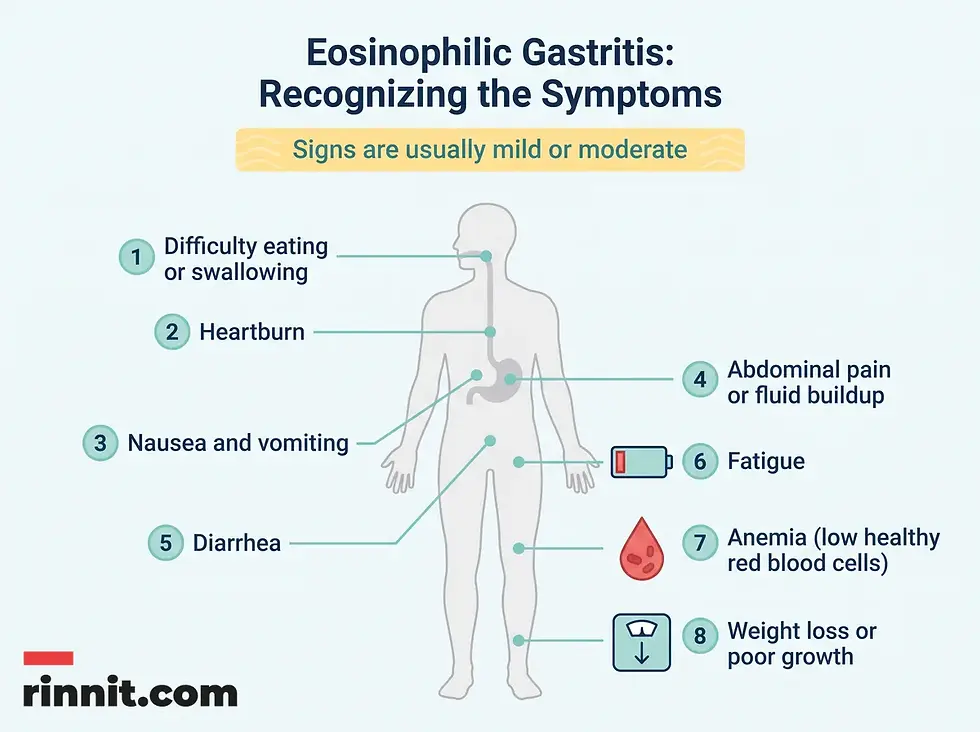
Signs of eosinophilic gastritis are usually mild or moderate [4]. Common symptoms include abdominal pain or fluid buildup (ascites), diarrhea, difficulty eating (loss of appetite) or swallowing (dysphagia), fatigue, heartburn, low levels of healthy red blood cells (anemia), nausea and vomiting, and weight loss or poor growth [4].
Symptom | What you might experience |
Abdominal pain or fluid buildup | Pain in the belly, or ascites — fluid buildup in the abdomen [4] |
Diarrhea | Frequent loose stools |
Difficulty eating or swallowing | Loss of appetite, or dysphagia — trouble swallowing [4] |
Fatigue | Ongoing tiredness |
Heartburn | Burning sensation in the chest or upper stomach |
Anemia | Low levels of healthy red blood cells [4] |
Nausea and vomiting | Queasiness and throwing up |
Weight loss or poor growth | Unexplained weight loss; in children, poor growth |
Diagnosis: How Is Eosinophilic Gastritis Diagnosed?
It can take a while to diagnose eosinophilic gastritis due to its common symptoms [4]. It is typically diagnosed based on blood work showing a high eosinophil count, changes in the stomach on endoscopy, and looking at tiny specimens from the stomach under the microscope [4].
If the increased eosinophils are present in the deeper layers of the stomach wall rather than the superficial lining, it might be hard to see those eosinophils with simple biopsies, and it can take longer to diagnose the disease [4].
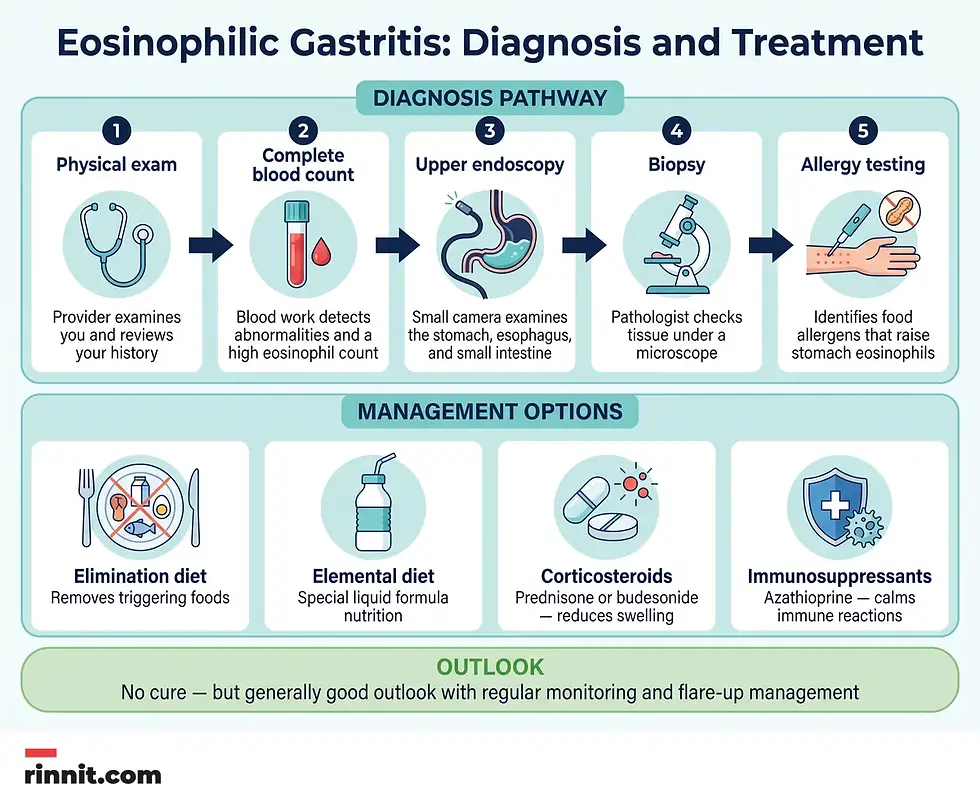
To diagnose EG, your healthcare provider does a physical exam, asks you about your medical history, and orders blood tests — including a complete blood count — to detect abnormalities and help rule out other conditions [4]. Other tests your provider may order include:
Test | What happens | What it shows |
Physical exam and medical history | Provider examines you and asks about your history [4] | First step in the EG evaluation |
Blood tests (complete blood count) | Blood work to detect abnormalities [4] | Can show a high eosinophil count; helps rule out other conditions [4] |
Upper endoscopy | Provider uses a small tube with a tiny camera to examine parts of your stomach, esophagus, and small intestine [4] | Looks for swelling, irritation, or injury to your stomach; can confirm an EG diagnosis [4] |
Biopsy | A small tissue portion is removed during the endoscopy; a pathologist analyzes the samples in a laboratory [4] | If the eosinophil count is higher than normal, this can indicate eosinophilic gastritis [4] |
Allergy testing | Identifies food allergens that may cause increased eosinophils in your stomach [4] | Knowing the allergens helps guide diagnosis and treatment |
Treatment: How Is Eosinophilic Gastritis Treated?
Eosinophilic gastritis has no cure, but medications or dietary changes can help you manage symptoms [4]. Following treatment guidelines can help you lead an active, healthy life [4].
Eosinophilic gastritis usually doesn't require emergency medical attention, but severe belly pain, repeated vomiting, vomiting blood or black stools need urgent care [4]. Early diagnosis and treatment can help prevent severe complications such as malnutrition, especially in infants and children [4].
EG treatment depends on your symptoms and disease severity [4]. Your provider may recommend dietary changes to prevent food allergens from triggering symptoms [4]. These may include an elimination diet, which removes certain foods from your diet that can cause allergic reactions [4], or an elemental diet, which replaces food with nutrition from a special liquid formula [4]. Your infant may need a new type of baby formula to ease EG symptoms [4]. In some cases, children and adults need to take iron supplements [4].
You may also receive medications: corticosteroids (such as prednisone or budesonide) to reduce swelling, and immunosuppressants (such as azathioprine) to decrease the immune system's reactions [4].
Treatment component | What it involves | Goal |
Elimination diet | Removes certain foods from your diet that can cause allergic reactions [4] | Prevents food allergens from triggering symptoms |
Elemental diet | Replaces food with nutrition from a special liquid formula [4] | Prevents food allergens from triggering symptoms |
Baby formula change | Infant may need a new type of baby formula [4] | Eases EG symptoms in infants |
Iron supplements | Taken by some children and adults [4] | Addresses anemia (low healthy red blood cells) |
Corticosteroids | Prednisone or budesonide [4] | Reduces swelling [4] |
Immunosuppressants | Azathioprine [4] | Decreases the immune system's reactions [4] |
Outlook: What Can I Expect?
For most people, the outlook for eosinophilic gastritis is generally good, though it's a chronic condition where patients can experience flare-ups of the disease [4]. Your healthcare provider works with you throughout your life to manage eosinophilic gastritis and ease your symptoms [4].
You receive regular endoscopies and biopsies to check on your condition [4]. Monitoring helps your provider adjust treatment, if needed, so you or your child can avoid complications [4]. Follow your provider's guidelines and keep medical appointments to ensure timely care.
Outlook question | What the evidence says |
Is the outlook good? | For most people, yes — the outlook is generally good [4] |
Is it chronic? | Yes — patients can experience flare-ups of the disease [4] |
Is it life-threatening? | No — EG doesn't require emergency medical attention [4] |
What can be prevented? | Severe complications such as malnutrition, especially in infants and children, with early diagnosis and treatment [4] |
How is it monitored? | Regular endoscopies and biopsies, so treatment can be adjusted to avoid complications [4] |
Can you live an active, healthy life? | Yes — following treatment guidelines can help you lead an active, healthy life [4] |
Prevention: How Can I Reduce My Risk?
Your ability to reduce your risk of developing eosinophilic gastritis depends on the underlying condition [4]. Allergies are the most common cause of high eosinophil levels [4]. Dietary changes and medication can help prevent or control your immune system's allergic reactions [4]. A healthy diet and lifestyle can help reduce your overall risk of disease [4].
Risk-reduction step | Why it helps |
Talk to your provider about allergies | Allergies are the most common cause of high eosinophil levels |
Talk to your provider about family history | A family member with a related disease raises your risk |
Follow dietary changes and medication | Can help prevent or control allergic reactions [4] |
Maintain a healthy diet and lifestyle | Helps reduce your overall risk of disease [4] |
Living With EG: When to Seek Care
Seek care for eosinophilic gastritis when you feel stomach pain or symptoms that get worse [4]. Talk with your provider about your symptoms and how they respond to dietary changes or medication [4]. Your provider may refer you to a GI specialist called a gastroenterologist [4].
The degree to which EG impacts your life depends on the severity of your symptoms, any underlying condition, and treatment success [4]. In most cases, having eosinophilic gastritis means adjusting your diet to avoid food allergens and possibly taking medication [4].
For many people, dietary changes can mean physical and emotional challenges [4]. It may be difficult at first to plan around meals and social occasions [4]. You may not be able to eat some of your favorite foods [4]. But by following treatment guidelines and seeking support when you need it, you can feel better and stay active [4].
Warning signs
Warning sign | What to do |
Stomach pain or symptoms that get worse | Seek care — talk with your provider about symptoms and how they respond to diet changes or medication [4] |
Worsening symptoms despite treatment | Your provider may refer you to a gastroenterologist (GI specialist) [4] |
Signs of malnutrition | Early diagnosis and treatment helps prevent severe complications, especially in infants and children [4] |
If you feel stomach pain or your symptoms get worse, contact a healthcare provider and ask whether eosinophilic gastritis could be the cause.
Key Takeaways
Eosinophilic gastritis is a rare, chronic stomach disease, but it is one you can actively manage. Its root driver is well understood — too many eosinophil white blood cells building up in your stomach and causing inflammation and damage — and in most cases the trigger is an abnormal immune response to certain foods. If you have allergic conditions like asthma, hay fever, or food allergies and unexplained stomach pain, nausea, or heartburn, it's worth raising EG with your provider, especially since the disease is likely underdiagnosed. While there is no cure, elimination or elemental diets plus medications like corticosteroids and immunosuppressants can ease symptoms, and most people enjoy a generally good outlook with regular monitoring.
Take the Next Step
If you feel stomach pain or your symptoms get worse, don't wait — contact a healthcare provider and ask whether eosinophilic gastritis could be the cause. Your provider may refer you to a gastroenterologist for endoscopy and allergy testing.
Related reading: Eosinophilia · Eosinophilic Colitis · Gastritis
Further reading: American Partnership for Eosinophilic Disorders (APFED) · CURED Foundation · Consortium of Eosinophilic Gastrointestinal Disease Researchers (CEGIR)
Frequently Asked Questions
1. What is eosinophilic gastritis?
Eosinophilic gastritis (EG) is a rare, chronic disease that affects your stomach. A type of white blood cell called eosinophils builds up in the stomach, causing inflammation (swelling) and damage. It can affect anyone at any age and is typically managed with regular testing, diet changes, and medication.
2. What are eosinophils?
Eosinophils are one of several types of white blood cells that support your immune system. Your bone marrow normally produces a small number of them — in a healthy person they represent about 1% to 5% of white blood cells. Allergens, infections, medications, or cancer can cause eosinophils to increase, and too many eosinophils can create inflammation in the tissues of your stomach or other organs.
3. What causes eosinophilic gastritis?
Healthcare providers don't always know the exact cause. In most cases, people develop EG due to an abnormal immune system response to certain foods. Allergies are the most common cause of high eosinophil levels, and people who develop EG often have conditions like asthma, food allergies, hay fever, or eczema.
4. Who is most affected by eosinophilic gastritis?
EG affects people of all ages, but providers most often diagnose it in adults between ages 30 and 50. Slightly more males than females develop the disease. You're at higher risk if you have a history of allergic disorders or a family member with a related disease.
5. What are the symptoms of eosinophilic gastritis?
Signs are usually mild or moderate and include abdominal pain or fluid buildup (ascites), diarrhea, difficulty eating (loss of appetite) or swallowing (dysphagia), fatigue, heartburn, anemia (low healthy red blood cells), nausea and vomiting, and weight loss or poor growth.
6. How is eosinophilic gastritis diagnosed?
Diagnosis typically involves blood work showing a high eosinophil count (including a complete blood count), changes in the stomach seen on upper endoscopy, and microscopic examination of tiny stomach tissue specimens (biopsy) taken during the endoscopy. Allergy testing may identify food allergens that raise stomach eosinophils. Diagnosis can take longer if the increased eosinophils sit in the deeper stomach wall layers rather than the superficial lining.
7. Is there a cure for eosinophilic gastritis?
No. EG has no cure, but medications or dietary changes can help you manage symptoms. Following treatment guidelines can help you lead an active, healthy life.
8. How is eosinophilic gastritis treated?
Treatment depends on your symptoms and disease severity. Options include an elimination diet that removes triggering foods, an elemental diet using a special liquid formula, a new baby formula for infants, iron supplements in some cases, corticosteroids (such as prednisone or budesonide) to reduce swelling, and immunosuppressants (such as azathioprine) to decrease the immune system's reactions.
9. Is eosinophilic gastritis life-threatening?
Usually not. EG rarely needs emergency care, but get urgent care for severe belly pain, repeated vomiting, vomiting blood or black stools. However, early diagnosis and treatment can help prevent severe complications such as malnutrition, especially in infants and children.
10. What's the outlook for eosinophilic gastritis?
For most people the outlook is generally good, though EG is a chronic condition where patients can experience flare-ups. You receive regular endoscopies and biopsies to check on your condition, and monitoring helps your provider adjust treatment so you or your child can avoid complications.
11. Will eosinophilic gastritis affect my quality of life?
The impact depends on symptom severity, any underlying condition, and treatment success. In most cases it means adjusting your diet to avoid food allergens and possibly taking medication. Dietary changes can bring physical and emotional challenges at first, but by following treatment guidelines and seeking support when needed, you can feel better and stay active.
12. How can I reduce my risk of eosinophilic gastritis?
Risk depends on the underlying condition, since allergies are the most common cause of high eosinophil levels. Dietary changes and medication can help prevent or control allergic reactions, a healthy diet and lifestyle reduce your overall risk, and you should talk to your provider if you have allergies or a family history of EG.
Related Reading
Elemental Diet: What It Is, Uses and How It Works explains the elemental diet.
References
Licari A, Votto M, Scudeller L, et al. Epidemiology of nonesophageal eosinophilic gastrointestinal diseases in symptomatic patients: a systematic review and meta-analysis. J Allergy Clin Immunol Pract. 2020;8(6):1994-2003.e2. doi:10.1016/j.jaip.2020.01.060. PMID: 32061717.
Irfan Q, Zaidi SMM, Alvi MH, et al. Monoclonal antibodies for eosinophilic esophagitis and gastritis: a systematic review and meta-analysis. J Clin Gastroenterol. 2026;60(1):20-27. doi:10.1097/MCG.0000000000002249. PMID: 40961248.
Sia T, Bacchus L, Tanaka R, et al. Dupilumab can induce remission of eosinophilic gastritis and duodenitis: a retrospective case series. Clin Transl Gastroenterol. 2024;15(1):e00646. doi:10.14309/ctg.0000000000000646. PMID: 37753954.
Cleveland Clinic. Eosinophilic Gastritis. Cleveland Clinic Health Library. Medically reviewed; last updated July 25, 2022. https://my.clevelandclinic.org/health/diseases/23571-eosinophilic-gastritis
Medical Disclaimer
This article is for informational purposes only and does not constitute medical advice. Always seek the advice of your physician or other qualified health provider with any questions you may have regarding a medical condition. Never disregard professional medical advice or delay in seeking it because of something you have read here.



Comments