Gastritis: Symptoms, the 8 Risk Factors, and How to Calm an Inflamed Stomach Lining

Updated: 2 days ago
Medically reviewed by Dr. Baraa Alnahhal, MD · Last reviewed: September 2026
Gastritis is a general term for a group of conditions with one thing in common: inflammation of the lining of the stomach. The stomach lining is a mucus-lined barrier that protects the stomach wall, and when that barrier is weakened or injured, digestive juices damage and inflame the lining. The most common causes are an H. pylori bacterial infection and the regular use of certain pain relievers called NSAIDs; drinking too much alcohol also contributes. Gastritis may appear suddenly (acute) or slowly over time (chronic), and it can cause a gnawing or burning ache in the upper belly, nausea, and fullness after eating — or no symptoms at all. Untreated, it can lead to stomach ulcers and bleeding, but for most people gastritis is not serious and improves quickly with treatment. See a provider if symptoms last a week or longer, and seek care right away for severe pain, vomiting blood, or black stools.
Quick Answer
What is it? Inflammation of the lining of the stomach — the mucus-lined barrier that protects the stomach wall.
Most common causes: H. pylori bacterial infection and regular use of NSAID pain relievers (ibuprofen, naproxen); excessive alcohol also contributes.
Symptoms: Gnawing or burning upper-belly ache (indigestion), nausea, vomiting, and fullness in the upper abdomen after eating — but it may cause no symptoms at all.
When to see a doctor: If symptoms last a week or longer; right away for severe pain, vomiting you cannot stop, dizziness, vomiting blood, or black stools.
How it's diagnosed: H. pylori stool or breath tests, endoscopy (a camera tube with possible biopsies), and sometimes a barium swallow X-ray.
Treatment: Depends on the cause — antibiotics for 7–14 days to kill H. pylori, plus proton pump inhibitors, acid blockers, or antacids; stopping NSAIDs or alcohol may relieve acute cases.
Is it serious? For most people it is not serious and improves quickly with treatment — but untreated, it can lead to ulcers, bleeding, and rarely a higher stomach cancer risk.
What is gastritis?
Gastritis is a general term for a group of conditions with one thing in common: inflammation of the lining of the stomach. To understand what that means, it helps to know a little about the organ itself.
The stomach is a muscular sac. It is about the size of a small melon that expands when you eat or drink, and it can hold as much as a gallon (about 4 liters) of food or liquid. Once the stomach grinds the food, strong muscle contractions called peristaltic waves push the food toward the pyloric valve, which leads to the upper part of the small intestine, called the duodenum.
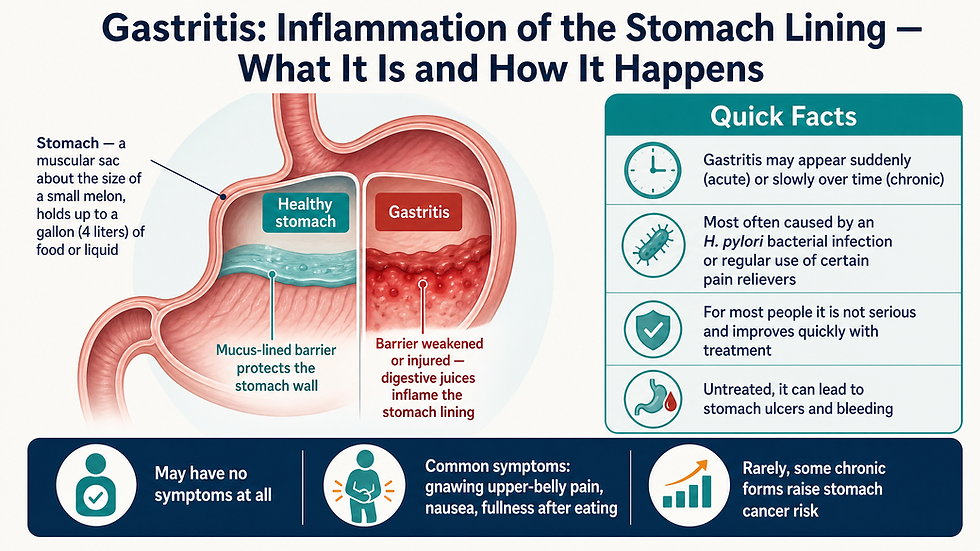
The stomach lining acts as a mucus-lined barrier that protects the stomach wall. Weaknesses or injury to the barrier allow digestive juices to damage and inflame the stomach lining — that is gastritis.
Gastritis may occur suddenly (acute gastritis) or appear slowly over time (chronic gastritis). In some cases, gastritis can lead to ulcers and an increased risk of stomach cancer. For most people, however, gastritis isn't serious and improves quickly with treatment.
What does gastritis feel like? Recognizing the symptoms
Gastritis doesn't always cause symptoms. When it does, the symptoms may include a gnawing or burning ache in the upper belly — called indigestion, which may become either worse or better after eating — nausea (an unsettled, queasy stomach), vomiting (which may occur with or without nausea), and a feeling of fullness in your upper abdomen after eating.

When to see a doctor
Nearly everyone has had indigestion and stomach irritation at some point. Usually, indigestion doesn't last long and doesn't require medical care. See your healthcare professional if you have symptoms of gastritis for a week or longer.
Seek medical attention right away if you have any of the following: severe pain; vomiting where you cannot hold any food down; or feeling lightheaded or dizzy. Also tell your healthcare professional if your stomach discomfort happens after taking medicines, especially aspirin or other pain relievers. If you are vomiting blood, have blood in your stools, or have stools that appear black, see your healthcare professional right away to find the cause.
What causes gastritis?
Gastritis is an inflammation of the stomach lining. The stomach lining is a mucus-lined barrier that protects the stomach wall. Weaknesses or injury to the barrier allows digestive juices to damage and inflame the stomach lining. Several diseases and conditions can increase the risk of gastritis. These include inflammatory conditions, such as Crohn's disease.
For most people, the inflammation is the result of one of two everyday culprits: infection with the bacterium that causes most stomach ulcers, or the regular use of certain pain relievers. Drinking too much alcohol also can contribute.
What raises your risk? The 8 known risk factors
Factors that increase your risk of gastritis include a bacterial infection (H. pylori is one of the most common human infections worldwide, though only some infected people develop gastritis — sensitivity to the germs could be inherited or caused by lifestyle choices such as smoking and diet), regular use of pain relievers (NSAIDs including ibuprofen and naproxen sodium can cause both acute and chronic gastritis, especially with regular or excessive use), older age (the stomach lining tends to thin with age, and older adults are more likely to have H. pylori infection or autoimmune disorders), and excessive alcohol use (alcohol can irritate and break down your stomach lining, more likely to cause acute gastritis).
Other risk factors include stress (severe stress due to major surgery, injury, burns, or severe infections can cause acute gastritis), cancer treatment (chemotherapy medicines or radiation treatment can increase your risk), autoimmune gastritis (the body attacks the cells that make up the stomach lining, more common in people with other autoimmune disorders such as Hashimoto's disease and type 1 diabetes, and can be associated with vitamin B-12 deficiency), and other diseases and conditions (gastritis may be associated with HIV/AIDS, Crohn's disease, celiac disease, sarcoidosis, and parasitic infections).
What can happen if it goes untreated?
Left untreated, gastritis may lead to stomach ulcers and stomach bleeding. Rarely, some forms of chronic gastritis may increase your risk of stomach cancer. This risk is increased if you have extensive thinning of the stomach lining and changes in the lining's cells. Tell your healthcare professional if your symptoms aren't improving despite treatment for gastritis.
How is gastritis diagnosed?
Your healthcare professional is likely to suspect gastritis after talking to you about your medical history and performing an exam. To find the exact cause, you also may have a stool test (checked in a lab for H. pylori), a breath test (you drink a tasteless liquid containing radioactive carbon, which H. pylori germs break down, then blow into a sealed bag — if your breath sample contains the radioactive carbon, you're infected), an endoscopy (a long, thin, flexible tube with a tiny camera passes down the throat into the esophagus, stomach, and small intestine to look for inflammation; a biopsy may be taken and tested), or a barium swallow X-ray (you swallow a white, metallic barium liquid that coats your digestive tract, making an ulcer more visible on X-ray images).
Depending on your age and medical history, endoscopy may be recommended as the first test instead of testing for H. pylori.

How is gastritis treated?
Treatment of gastritis depends on the specific cause. Acute gastritis caused by NSAIDs or alcohol may be relieved simply by stopping use of those substances.
Medicines used to treat gastritis include antibiotics, which kill H. pylori — a combination is prescribed and the full course, usually 7 to 14 days, should be completed, often alongside an acid-blocking medicine, with retesting afterward to confirm H. pylori is gone. Proton pump inhibitors (PPIs) block the parts of cells that produce acid, reducing acid and promoting healing; they're available by prescription or over the counter, though long-term high-dose use may increase fracture risk, so ask about a calcium supplement. Acid blockers (histamine blockers) reduce the amount of acid released into your digestive tract, relieving pain and encouraging healing, and are also available by prescription or over the counter. Antacids neutralize existing stomach acid for rapid pain relief but can cause constipation or diarrhea and are generally not used as primary treatment, since PPIs and acid blockers are more effective with fewer side effects.
Lifestyle and home remedies
Two practical steps can provide symptom relief while treatment takes effect. First, don't drink alcohol — alcohol can irritate the mucous lining of your stomach. Second, consider switching pain relievers: if you use pain relievers that increase your risk of gastritis, ask your healthcare professional whether acetaminophen may be an option, as it is less likely to stir up your stomach problem.
Preparing for your appointment
Make an appointment with a doctor or other healthcare professional if you have any symptoms that worry you. If your healthcare professional thinks you might have gastritis, you may be referred to a gastroenterologist — a doctor who specializes in digestive disorders.
Because appointments can be brief, preparation helps you make the most of your time. At the time you make the appointment, ask whether there are any pre-appointment restrictions, such as diet limits. Write down your symptoms, including any that may not seem related to the reason for your visit. Record key personal information, including major stresses or recent life changes. Make a list of all medicines, vitamins, or supplements you are taking, with doses. Take a family member or friend along, since it can be difficult to remember everything said during an appointment. And write down your questions, listed from most to least important, in case time runs out.
Before your appointment, avoid drinking alcohol and eating foods that seem to irritate your stomach, such as those that are spicy, acidic, fried, or fatty. But talk to your healthcare professional before stopping any prescription medicines you are taking.
Bottom line: an inflamed stomach lining is usually fixable
Gastritis is one of those digestive problems where the outlook is genuinely good for most people: it is not serious and improves quickly with treatment. The catch is that it also often asks for patience — persistent indigestion, nausea, or fullness after eating deserve attention after a week, not six months of self-managed suffering. And the warning signs are non-negotiable: severe pain, vomiting you can't stop, vomiting blood, or black stools mean seek care right away.
Your next step: if your stomach has been bothering you for a week or more — or if your discomfort started after regular pain reliever use or heavy drinking — book an appointment. Bring your medicine list, your symptom timeline, and your questions. Most cases are traced to a simple, treatable cause, and most people feel better quickly once it is addressed.
FAQ
What are the main symptoms of gastritis?
The most common symptoms are a gnawing or burning ache or pain — called indigestion — in your upper belly, which may become either worse or better after eating. Other symptoms include nausea, vomiting, and a feeling of fullness in your upper abdomen after eating. Importantly, gastritis doesn't always cause symptoms at all.
What causes gastritis?
Most often, gastritis results from infection with H. pylori — the bacterium that causes most stomach ulcers — or from the regular use of certain pain relievers (NSAIDs like ibuprofen and naproxen). Drinking too much alcohol also can contribute. Inflammatory conditions such as Crohn's disease can increase risk.
Is gastritis serious?
For most people, gastritis isn't serious and improves quickly with treatment. But left untreated, it may lead to stomach ulcers and stomach bleeding. Rarely, some forms of chronic gastritis may increase your risk of stomach cancer, especially if there is extensive thinning of the stomach lining and changes in the lining's cells.
How is gastritis diagnosed?
A provider usually suspects gastritis from your medical history and exam, then confirms the cause with one or more tests: a stool or breath test for H. pylori, an endoscopy (a camera tube passed down the throat, sometimes with biopsies), or a barium swallow X-ray, where a metallic barium liquid coats the digestive tract to make an ulcer more visible.
What is the treatment for gastritis?
Treatment depends on the cause. Acute gastritis from NSAIDs or alcohol may resolve by stopping those substances. H. pylori is treated with 7 to 14 days of combination antibiotics plus an acid-blocking medicine, followed by retesting. Proton pump inhibitors and acid blockers reduce acid and promote healing, while antacids provide rapid but temporary pain relief.
Can I manage gastritis at home?
Yes, two practical steps help: avoid alcohol, which irritates the mucous lining of your stomach, and consider switching pain relievers — ask your provider whether acetaminophen may be an option, since it is less likely to stir up your stomach problem. Before your appointment, also avoid spicy, acidic, fried, and fatty foods.
References
This article is for general informational purposes and is not a substitute for professional medical advice, diagnosis, or treatment. Always consult a qualified healthcare professional about any medical condition.
Comments