Allergic Asthma: The Breathing Condition Triggered by the Air Around You

Updated: 2 days ago
Medically reviewed by Dr. Baraa Alnahhal, MD · Last reviewed: September 2026
TL;DR
Allergic asthma is a breathing condition where your airways tighten when you inhale an allergen — most often dust mites, pollen, animal dander, or mold spores. It is the most common type of asthma: of the roughly 25 million people with asthma in the United States, about 60% have allergies. Diagnosis typically involves a spirometry breathing test plus a skin or blood allergy test to find your specific triggers. There is no cure, but combining trigger avoidance with the right medications — from rescue inhalers to allergy shots and biologics — can keep symptoms under control. The goal is a manageable condition, not a disabling one.
Quick Answer
What it is: Allergic (allergy-induced) asthma is a condition where your airways tighten and become inflamed when you breathe in an allergen such as mold, pollen, pet dander, or dust mites. It is the most common type of asthma and affects both children and adults. [1]
How common it is: About 25 million people in the United States have asthma, and approximately 60% of that group have allergies — making allergy-induced asthma the most common asthma type. [1]
How it is diagnosed: Providers typically use spirometry (blowing into a tube that measures air movement) and methacholine testing; if asthma is confirmed, a skin or blood test identifies which environmental allergens are your triggers. [1]
How it is treated: Treatment combines allergen avoidance (cleaning routines, allergen-proof bedding, closed windows during peak pollen, air filters, a written action plan) with medications such as leukotriene modifiers, allergy shots, rescue inhalers, antihistamines, corticosteroids, and biologics. There is no cure, but symptoms can improve significantly. [1]
What Exactly Is Allergic Asthma?
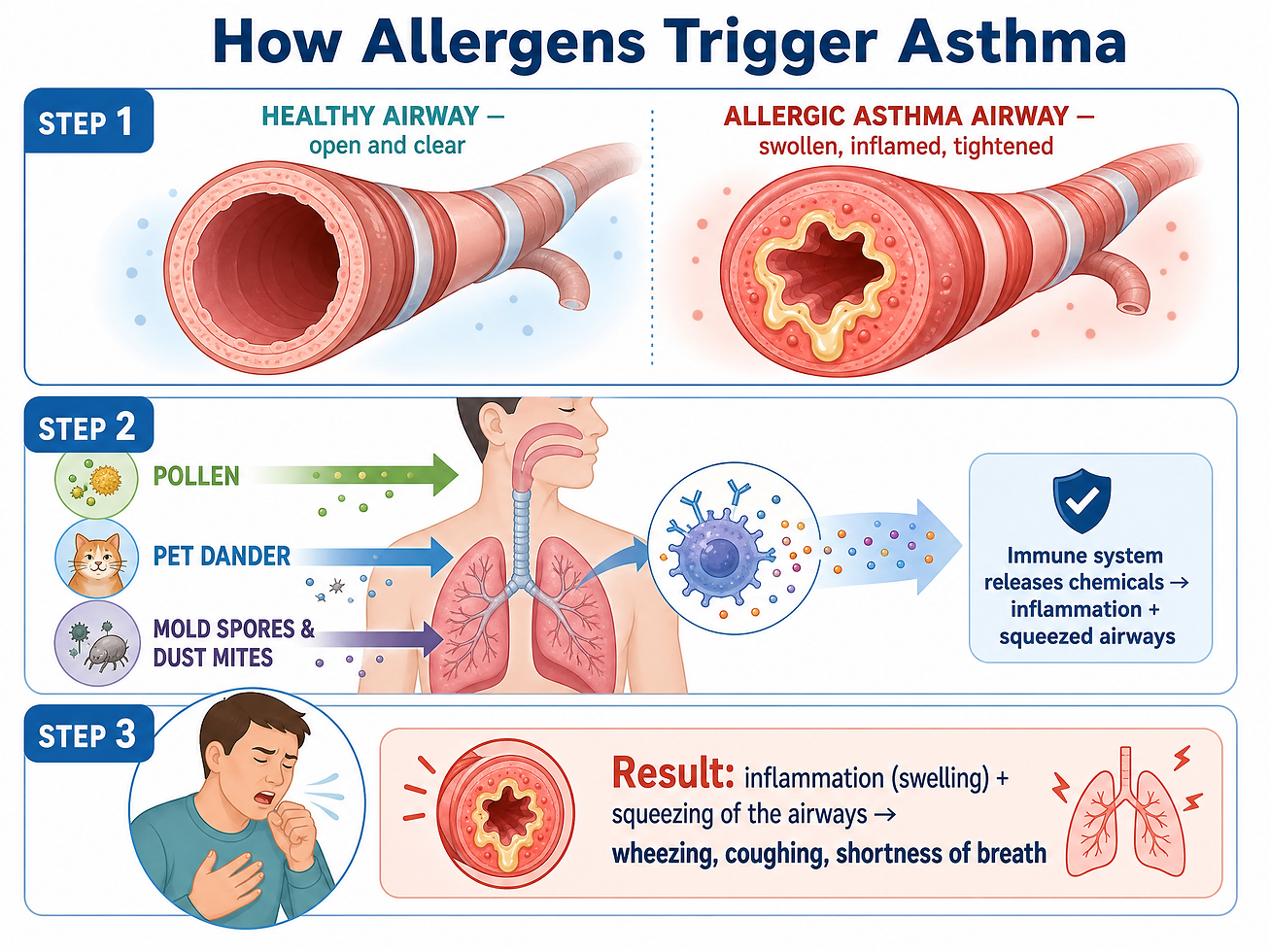
Allergic or allergy-induced asthma is a breathing condition where your airways tighten when you breathe in an allergen. Most often, these allergens are in the air — like dust mites, pollen, animal dander, or mold spores. [1]
The mechanism is an immune system misfire. When you have allergies, your body creates a response to something it thinks is a threat — the allergen. Your immune system fires up all of its defenses to fight off this danger, releasing various chemicals that cause inflammation, or swelling, and squeezing of your airways upon exposure to an allergen. [1]
Allergic asthma is very common in both children and adults. [1]
How Common Is Allergic Asthma?
Allergic asthma is the most common type of asthma. In the United States, about 25 million people have asthma. Out of that group, approximately 60% have allergies. [1]
| Prevalence fact | Detail | | --- | --- | | Most common asthma type | Allergic asthma is the leading form of asthma [1] | | US asthma total | About 25 million people in the United States have asthma [1] | | Allergy share | Approximately 60% of people with asthma also have allergies [1] | | Who it affects | Very common in both children and adults [1] |
What Does Allergic Asthma Feel Like?
If you have allergic asthma, you may have many of the same symptoms you would experience with other types of asthma. These core symptoms include feeling short of breath, coughing frequently (especially at night), wheezing (a whistling noise during breathing), and chest tightness — feeling like something is pressing on your chest. [1]
Allergen exposure can also trigger allergy-specific symptoms, including a stuffy nose, nasal drainage, itchy or watery eyes, and a rash or hives. [1]
Symptoms can range from mild respiratory complaints to severe asthma attacks. During an asthma attack, your airways tighten, making it difficult to breathe. You may also feel chest pressure, wheeze, and cough. Importantly, the symptoms of an allergic asthma attack are the same as an asthma attack caused by something else — the difference between the two is the cause of the asthma attack. [1]
| Symptom category | What you experience | | --- | --- | | Core asthma symptoms | Shortness of breath; frequent coughing, especially at night; wheezing (whistling noise); chest tightness [1] | | Allergen-triggered symptoms | Stuffy nose; nasal drainage; itchy or watery eyes; rash or hives [1] | | During an attack | Airways tighten, breathing becomes difficult, chest pressure, wheezing, coughing [1] | | Key distinction | Attack symptoms are identical to other asthma attacks — only the cause differs [1] |
What Allergens Trigger Allergic Asthma?
Allergens can be all around you — in your indoor and outdoor environments. When you have allergic asthma, inhaling these allergens can set off (trigger) your symptoms. It is important to know what can trigger your asthma so that you can manage your condition. [1]
| Trigger | Where it comes from | What specifically triggers it | | --- | --- | --- | | Pets and animals | Fur, urine, saliva, or pet dander (flakes of skin) [1] | Dander and animal secretions [1] | | Pollen | Powdery substance from trees, grass, weeds, and ragweed [1] | Tree and grass pollen in spring; weeds and ragweed in fall [1] | | Mold | Places that hold moisture (like basements); outdoors on warm, humid days, after mulching, or after rainfall [1] | Airborne mold spores [1] | | Dust mites | Microscopic organisms that feed on human skin, living on carpets, soft furniture, pillows, and mattresses [1] | Both the mites themselves and their feces [1] | | Cockroaches | Many homes and older buildings [1] | Feces, saliva, and body parts [1] |
Food allergies may trigger allergic asthma in some people, but food allergies are rarely the cause of allergic asthma alone. [1]
Who Is at Risk for Allergic Asthma?
You are more at risk of having allergy-induced asthma if you have allergies or a family history of allergies. [1]
| Risk factor | Why it matters | | --- | --- | | Personal allergy history | People with allergies are more likely to have allergic asthma [1] | | Family history of allergies | A family allergy history raises your risk [1] |
How Serious Is Allergic Asthma?
Allergy-induced asthma can be serious and cause complications. Beyond the breathing symptoms themselves, the condition can ripple into daily life in several measurable ways. [1]
| Complication | What it means in practice | | --- | --- | | Sleep disruptions | Nighttime symptoms interfere with rest [1] | | Missing school and work | Attacks and symptoms force absences [1] | | Inability to exercise | Physical activity becomes difficult or impossible [1] | | Inability to join outdoor activities | Social activities outdoors or involving lots of walking become off-limits [1] | | Higher rates of hospitalization and illness | More frequent and more serious respiratory episodes [1] |
How Is Allergic Asthma Diagnosed?
Your healthcare provider will order tests to determine if you have allergic asthma. The two most common tests are spirometry and bronchoprovocation testing. [1]
Spirometry is a breathing test that involves taking a deep breath in and then exhaling into a tube. This tube connects to a computer that collects information about how well the air moves when you breathe in and out. Spirometry can also be done with a bronchodilator (inhaler medication). Bronchodilator tests look at how well your airways relax before and after taking an inhaler medication. [1]
Bronchoprovocation testing (methacholine) is similar to spirometry, but your provider uses a medication called methacholine to see if your airways constrict or tighten after taking it. [1]
If your provider determines you have asthma, they will recommend either a blood test or skin test to help determine if environmental allergens are potential triggers. During a skin test, a provider puts small drops of liquid containing various allergens on your skin and gently scratches the skin to allow allergens to enter the top layer. If you are allergic to the substance, your skin will react by swelling or developing tiny, raised bumps. In certain cases, a blood test can identify allergic triggers, though allergy blood tests can miss a small percentage of allergies compared to skin testing. [1]
| Diagnostic test | What happens | What it tells your provider | | --- | --- | --- | | Spirometry | Deep breath in, exhale into a tube connected to a computer measuring air movement [1] | How well air moves in and out of your airways [1] | | Spirometry with bronchodilator | Same test repeated with an inhaler medication [1] | How well airways relax before and after medication [1] | | Methacholine (bronchoprovocation) testing | A medication is inhaled to test airway response [1] | Whether your airways constrict or tighten after taking it [1] | | Skin allergy test | Drops of allergen liquids scratched into the top skin layer [1] | Swelling or tiny raised bumps indicate allergy; the most complete trigger picture [1] | | Blood allergy test | A lab blood draw [1] | Can identify allergic triggers, but may miss a small percentage of allergies that skin testing catches [1] |
How Do I Manage and Treat Allergic Asthma?
Your healthcare provider will work with you to treat both your allergies and your asthma. Some treatments work for asthma, while others treat just allergies, and some treatments can help manage both conditions. Treatment can involve avoiding the allergen or making lifestyle changes, plus medications. [1]
Avoiding the Allergen
Your provider will help you figure out what is triggering your asthma and find ways to either avoid or manage these allergens. Often, these triggers are in your environment. Once you know what they are, you can manage your interactions with them — for example, hiring someone to cut your grass if pollen triggers your asthma, or avoiding places with many animals if dander is your trigger. [1]
| Environment step | Recommendation | | --- | --- | | Cleaning routine | Frequent mopping and dusting; wash bedding and pillows in hot water every week [1] | | Bedding | Use dust- and allergen-proof sheets and pillows on your bed [1] | | Pollen season | Keep house and car windows closed during peak pollen season; avoid being outside when pollen counts are highest; wear glasses, face masks, or other protective equipment outdoors [1] | | Air quality | Use high-quality filters in home air conditioning units or run an air purifier [1] | | Action plan | Develop a written plan covering when to take medications, what to do if medications are not working, who to call, and what to do during an asthma attack [1] |
Medical Treatment
| Medication | How it works | Notes | | --- | --- | --- | | Leukotriene modifiers | A group of medications that treat both allergies and asthma; montelukast is one of the most common [1] | Dual-action: covers allergy and asthma symptoms [1] | | Allergy shots (immunotherapy) | Regular injections of the allergen build up tolerance over time, reducing how your immune system reacts [1] | Long-term tolerance building [1] | | Rescue inhalers | Fast relief by opening up your airways so you can breathe better [1] | For symptom relief in the moment [1] | | Antihistamines | Reduce mild to moderate allergy symptoms like itchy skin or watery eyes [1] | May be part of a combined treatment plan [1] | | Corticosteroids | Oral and inhaled forms prevent symptoms by reducing inflammation in your airways [1] | Preventive, inflammation-focused [1] | | Biologics | Small injected proteins that treat the underlying cause of asthma [1] | For moderate or severe allergic asthma [1] |
What Is the Long-Term Outlook?
There is not a cure for allergic asthma. However, symptoms can get better or worse depending on your environment and exposures. [1]
Can Allergic Asthma Be Prevented?
While asthma itself can't be prevented, you can reduce your risk of an allergic asthma attack by understanding and avoiding triggers and ensuring you are using the best medical treatment to manage your asthma. [1]
When Should I See a Healthcare Provider — or the ER?
Contact your healthcare provider if you have asthma symptoms due to allergens so they can work on a treatment plan with you. Symptoms to watch for include coughing or wheezing, shortness of breath or breathing difficulties, and allergy symptoms like a stuffy nose, itchy and watery eyes, or skin rash. [1]
Go to the ER if you are having a severe asthma attack and either do not have an inhaler or your symptoms are not improving after using it — go to the nearest emergency department or call 911 (or your local emergency service number). People experiencing an allergy can also go into anaphylaxis, which is a life-threatening allergic reaction. [1]
| Situation | What to do | | --- | --- | | Recurring allergen symptoms | Contact your provider to build a treatment plan [1] | | Severe attack, no inhaler | Go to the nearest emergency department or call 911 [1] | | Severe attack, inhaler not helping | Same — emergency care immediately [1] | | Any signs of anaphylaxis | Emergency care — it is a life-threatening allergic reaction [1] |
Conclusion: Take Control of the Air Around You
Allergic asthma is the most common type of asthma, and the cause is woven through the environments where we live and work — pollen in the spring air, dander on furniture, mold in damp corners, dust mites in bedding. The immune system treats these harmless substances as threats, triggering inflammation and squeezing your airways tight. There is no cure, but the combination of trigger identification, environmental control, and the right medication mix means most people can get symptoms firmly under control.
Your next step: If you cough or wheeze more at night, get short of breath around pets or in certain seasons, or keep a rescue inhaler within reach more often than you would like, schedule an appointment with a healthcare provider this week. Ask specifically about spirometry and a skin or blood allergy test so you know exactly which allergens are driving your symptoms. If you already have a diagnosis, ask your provider to review your current medications and update your written asthma action plan.
Questions to Ask Your Provider
| Question | Why it matters | | --- | --- | | Which allergens are triggering my asthma? | A skin or blood test identifies your specific triggers so avoidance can be targeted [1] | | Should I take a daily preventive medication or just a rescue inhaler? | Corticosteroids and leukotriene modifiers prevent symptoms rather than treating them after they start [1] | | Am I a candidate for allergy shots? | Immunotherapy can reduce your immune system's reaction over time [1] | | What should I do during an asthma attack that does not improve? | A written action plan covers medications, escalation steps, and who to call [1] |
Frequently Asked Questions
What is allergic asthma?
Allergic or allergy-induced asthma is a condition where your airways tighten when you breathe in an allergen — most often dust mites, pollen, animal dander, or mold spores. Your immune system treats the allergen as a threat and releases chemicals that cause inflammation and squeezing of your airways. [1]
How many people have allergic asthma?
It is the most common type of asthma. About 25 million people in the United States have asthma, and approximately 60% of that group have allergies. It is very common in both children and adults. [1]
What are the symptoms of allergic asthma?
Core symptoms include shortness of breath, frequent coughing (especially at night), wheezing (a whistling noise), and chest tightness. Allergen exposure can also cause a stuffy nose, nasal drainage, itchy or watery eyes, and a rash or hives. [1]
What triggers allergic asthma attacks?
The five most common triggers are pets and animals (fur, urine, saliva, dander), pollen (trees and grass in spring; weeds and ragweed in fall), mold (damp basements, humid days, after rainfall), dust mites (carpets, pillows, mattresses — both the mites and their feces), and cockroaches (feces, saliva, body parts). Food allergies rarely cause it alone. [1]
Who is most at risk?
You are more at risk if you have allergies yourself or a family history of allergies. [1]
How is allergic asthma diagnosed?
Providers typically use spirometry (blowing into a tube to measure air movement, sometimes with a bronchodilator) and methacholine testing to confirm asthma, then order a skin or blood allergy test to identify your environmental triggers. Skin tests are more complete — blood tests can miss a small percentage of allergies. [1]
Is there a cure for allergic asthma?
No. There is not a cure, but symptoms can get better or worse depending on your environment and exposures. Avoiding triggers and using the right medical treatment reduces the risk of attacks. [1]
What medications treat allergic asthma?
Treatment options include leukotriene modifiers (which treat both allergies and asthma), allergy shots (immunotherapy), rescue inhalers, antihistamines, oral and inhaled corticosteroids, and biologics for moderate to severe cases. [1]
When should I go to the emergency room?
If you are having a severe asthma attack and either do not have an inhaler or your symptoms are not improving after using it, go to the nearest emergency department or call 911. An allergy can also progress to anaphylaxis, a life-threatening allergic reaction. [1]
References
American Academy of Allergy Asthma and Immunology — Is Your Asthma Allergic?
American College of Allergy, Asthma and Immunology — Asthma & Breathing Problems
American Lung Association — Don't Fear Spring Allergies and Asthma
Asthma and Allergy Foundation of America — Allergens and Allergic Asthma
Chabra R, Gupta M — Allergic and Environmentally Induced Asthma, StatPearls (2023)
Medical disclaimer: This article is for general informational purposes only and is not a substitute for professional medical advice, diagnosis, or treatment. Always seek the guidance of a qualified healthcare provider with any questions you may have regarding a medical condition. Never disregard professional medical advice or delay seeking it because of something you have read here.
Comments