Allergy Testing: Types, How to Prepare and What Results Mean

Updated: 2 days ago
Written and medically reviewed by Dr. Baraa Alnahhal, MD · Last reviewed: November 2026 · How we review
Quick Answer: What is allergy testing?
Allergy testing finds the substances (allergens) that trigger your allergy symptoms, such as pollen, mold, pet dander, insect venom, latex, medicines or foods. An allergist exposes you to small amounts of likely allergens in a controlled setting through a skin prick, intradermal, patch, blood (IgE) or oral challenge test. Most skin test results are ready during your visit. [1]
What the research says
Skin and blood tests rarely miss a true food allergy but can over-call one. A meta-analysis of 24 studies (2,831 participants) checked against supervised food challenges found peanut skin prick testing had 95% sensitivity but only 61% specificity, and specific IgE blood testing 96% and 59%. (Soares-Weiser et al., Allergy, 2014) [3]
Component blood tests can make food allergy diagnosis more specific. A 2024 review of 149 studies with 24,489 patients found that IgE to the peanut component Ara h 2 was 92% specific and to the cashew component Ana o 3 was 94% specific. (Riggioni et al., Allergy, 2024) [2]
Skin prick testing works well for hay fever. Across 7 studies with 430 patients, skin prick testing for allergic rhinitis had a pooled sensitivity of 85% and specificity of 77%. (Nevis et al., Allergy, Asthma & Clinical Immunology, 2016) [4]
Key takeaways
Allergy tests identify the specific substances that cause your symptoms. [1]
The skin prick test is the most common type; blood, intradermal, patch and oral challenge tests are also used. [1]
You may need to stop antihistamines 3 to 7 days before skin testing. [1]
A positive result shows sensitivity to an allergen, but it does not guarantee you will react to it in daily life. [1]
At-home allergy test kits are not very reliable, so work with a provider. [1]
What is allergy testing?
An allergy happens when your immune system mistakes a harmless substance for a threat and makes immunoglobulin E (IgE) antibodies against it. These antibodies trigger the release of chemicals that cause allergy symptoms. Allergy testing exposes you to small amounts of common allergens in a controlled way to see which ones you react to. [1]
Common allergens tested include mold, pollen, pet dander, bee stings or venom, latex and foods such as peanuts, milk and soy. A "full" or comprehensive panel usually checks several common airborne allergens, such as pollen, ragweed, grass, dust and pet dander. [1]
What are the types of allergy tests?
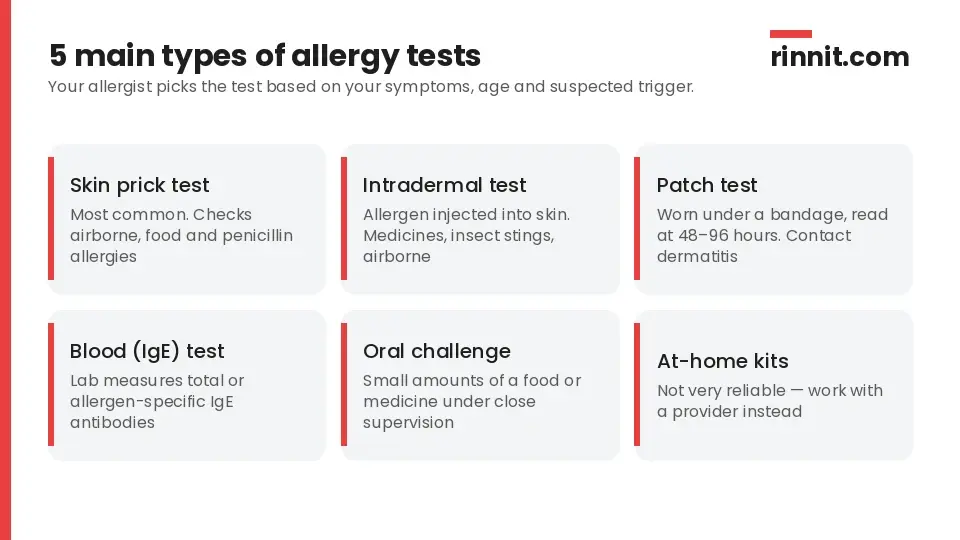
Five main allergy tests and what each one checks.
An allergist chooses the test based on your symptoms, your age and the substance they suspect. [1]
Test | How it works | What it checks for |
Skin prick (scratch) test | A thin needle or small device pricks or scratches allergen drops into the skin of your forearm or back | Airborne, food and penicillin allergies |
Intradermal test | A small amount of allergen is injected into the skin, often after an unclear skin prick result | Airborne allergens, medicines and insect stings |
Patch test | Allergens are placed on your skin under a bandage and checked 48 to 96 hours later | Causes of contact dermatitis |
Blood (IgE) test | A lab measures total IgE or IgE to specific allergens in a blood sample | Many allergens, especially when skin testing is not suitable |
Oral challenge test | You eat or swallow small amounts of a suspected food or medicine under close supervision | Food and medicine allergies |
Sources: [1]
Skin prick test
This is the most common allergy test. A provider pricks the skin with a thin needle, or places drops of allergen on the skin and lightly scratches it. If you are allergic, redness, a rash or raised round bumps called wheals usually appear within 15 minutes. [1]
Blood (IgE) test
A blood sample goes to a lab, where allergens are added and IgE is measured. A total IgE test measures all your IgE antibodies, while a specific IgE test measures your response to one allergen. [1]
Oral challenge test
You take a small amount of the suspected food or medicine in your provider's office, usually with an allergist present, so the team can treat any reaction right away. [1]
Who should get allergy testing?
Your provider may recommend testing if: [1]
Allergy symptoms are bothering you
You have asthma and need to find triggers that make it worse
You have had anaphylaxis, a severe reaction that can cause hives or swelling, trouble breathing and a sudden drop in blood pressure
Symptoms that may suggest an allergy
Allergic rhinitis (hay fever): headaches, itchy or watery eyes, congestion, sneezing, runny nose, wheezing, chronic cough and sore throat
Food allergy: symptoms usually start within 30 minutes of eating but can appear up to 2 hours later, including skin and breathing symptoms, nausea, vomiting, belly pain, diarrhea, pale skin, weak pulse or dizziness
Contact allergy (latex, fragrance, nickel): burning, blisters, hives, swelling, rash or itchy skin
Sources: [1]
How do you prepare for allergy testing?
Your provider may ask you to stop taking antihistamines 3 to 7 days before the test because they can affect the results. Keep taking your asthma medicine if you need it, and ask your provider for instructions that fit your situation. [1]
What happens during allergy testing?
Skin tests cause a reaction where the skin was pricked or scratched. Mild itching, watery eyes and congestion are common and expected, because they help your provider see whether you are allergic. Most symptoms fade within 1 to 2 hours, though redness or bumps can last several hours. A blood test is a single draw from a vein in your arm. [1]
After a patch test, do not put anything on the tested skin at home, and ask your provider what to do if strong itching or burning develops. [1]
How long does allergy testing take?
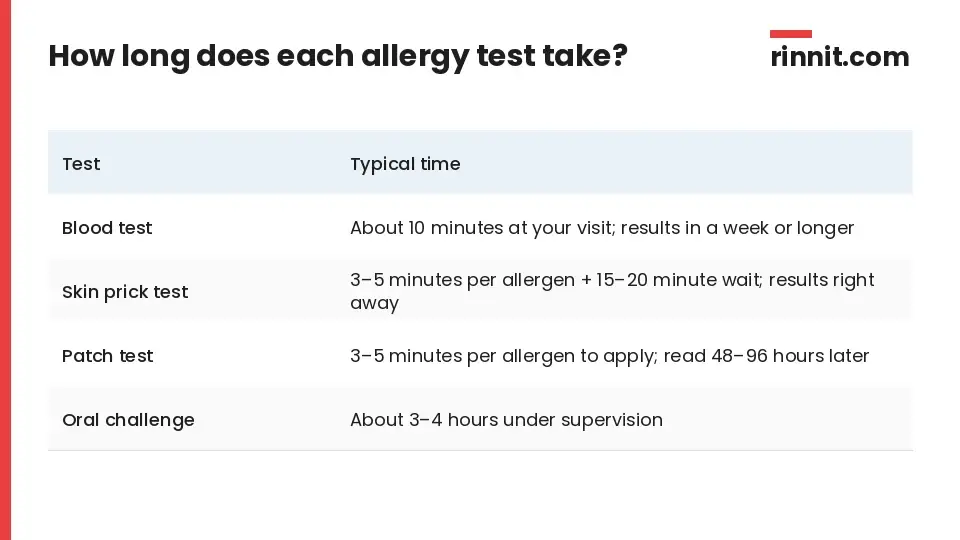
How long each allergy test usually takes.
Test | Typical time |
Blood test | About 10 minutes at your visit |
Skin prick test | 3 to 5 minutes per allergen, plus 15 to 20 minutes to watch for reactions |
Patch test | About 3 to 5 minutes per allergen to apply, then a return visit 48 to 96 hours later |
Oral challenge test | About 3 to 4 hours |
Sources: [1]
Is allergy testing safe?
Allergy tests are safe and effective. The most serious risk is anaphylaxis, which is rare, and providers keep emergency epinephrine nearby. This is why skin tests and food challenges are done in the office. [1]
What do allergy test results mean?
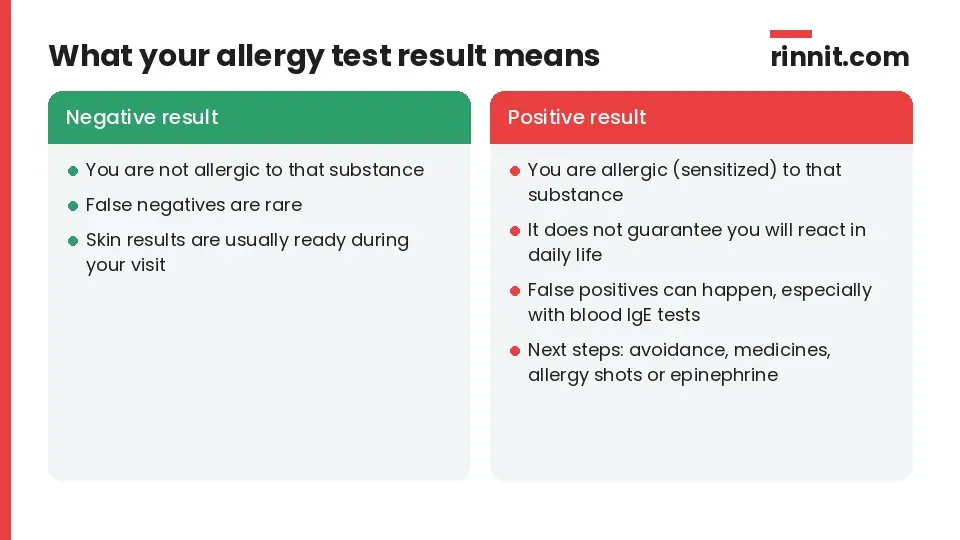
A positive result shows sensitivity, not a guaranteed reaction.
Most skin test results are ready right away. Patch test results take several days, and blood test results can take a week or longer. [1]
Negative result: you are not allergic to that substance. False negatives are rare.
Positive result: you are allergic to that substance, but it does not guarantee you will react to it in real life. False positives can happen, especially with blood IgE tests.
Sources: [1]
What happens after a positive result?
Depending on your results, your provider may recommend: [1]
Limiting exposure, such as staying indoors when pollen counts are high
Daily medicines such as antihistamines or nasal sprays
Allergy shots (immunotherapy), usually for 3 to 5 years for the most benefit
A medical alert card or jewelry if you have a severe allergy
Carrying an epinephrine injector at all times if you are at risk of anaphylaxis
Can children have allergy testing?
Yes. Adults and children can be tested, but skin prick testing usually is not done in babies younger than 6 months, and blood tests may be slightly less accurate in children under 5. [1]
When should you see a provider?
See a provider for any allergy symptoms. Allergic reactions are unpredictable and can become severe even if earlier ones were mild. [1]
Conclusion
Allergy testing turns guesswork into a clear list of triggers, so you and your provider can plan avoidance, medicines or immunotherapy. A positive result is a clue, not a final verdict, and your history matters just as much.
If you have symptoms that keep coming back, ask your provider or an allergist which test fits you.
Keep learning: Read our guide to allergies and how your immune system reacts or learn about allergy shots (immunotherapy). For more background, see the MedlinePlus page on allergy testing.
FAQ
What is allergy testing?
A test that exposes you to small amounts of possible allergens in a controlled setting to find what triggers your symptoms. [1]
What are the main types of allergy tests?
Skin prick, intradermal, patch, blood (IgE) and oral challenge tests. [1]
Which allergy test is most common?
The skin prick (scratch) test. [1]
How long does a skin prick test take?
About 3 to 5 minutes per allergen, plus a 15 to 20 minute wait for reactions. [1]
Do I need to stop antihistamines before allergy testing?
Your provider may ask you to stop them 3 to 7 days before, because they can affect results. [1]
Does allergy testing hurt?
Skin tests can cause mild itching or irritation that usually fades within 1 to 2 hours. [1]
Is allergy testing safe?
Yes; severe reactions such as anaphylaxis are rare, and providers keep epinephrine nearby. [1]
Does a positive allergy test mean I will react?
Not always; it shows you are sensitized, and false positives can happen, especially with blood IgE tests. [1]
Can babies and children be tested for allergies?
Yes, but skin prick testing is usually not done before 6 months of age. [1]
Are at-home allergy tests reliable?
Not very; some test the wrong antibodies, so work with a provider instead. [1]
Related Reading
Antihistamines: Types, Uses and Side Effects explains how antihistamines relieve allergy symptoms.
Oral Food Challenge: How the Gold-Standard Food Allergy Test Works explains the supervised feeding test that confirms or rules out a food allergy.
Allergies: What Happens in Your Immune System, What the Symptoms Mean, and How to Take Control explains the immune reaction allergy tests look for.
Allergic Rhinitis (Hay Fever): Symptoms, Triggers, and Treatment That Actually Works covers one of the most common reasons for allergy testing.
Food Allergy: Symptoms, Causes, Treatment & Complete Guide explains food allergies that skin, blood and challenge tests help confirm.
Allergic Asthma: The Breathing Condition Triggered by the Air Around You describes asthma triggers that testing can identify.
Anaphylaxis: Symptoms, Triggers, and Why Epinephrine Is the Only Emergency Treatment covers the severe reaction testing helps you avoid.
Contact Dermatitis: Symptoms, Causes, Diagnosis & Treatment — Complete Guide explains the skin condition patch testing is used to diagnose.
Allergy Blood Test (IgE): What It Shows, How It Compares With Skin Tests and What Results Mean explains the IgE blood test used to diagnose allergies.
Patch Test for Skin Allergies: How It Works, How to Prepare and What Results Mean explains the skin test that finds the cause of allergic contact dermatitis.
Allergy Skin Test: Prick, Intradermal and Patch Tests, Preparation and Results explains the prick, intradermal and patch tests used to find allergies.
References
Cleveland Clinic. Allergy Testing: Purpose, Types, Indications & Results. Cleveland Clinic. Last updated February 16, 2024. https://my.clevelandclinic.org/health/diagnostics/21495-allergy-testing
Riggioni C, Ricci C, Moya B, et al. Systematic review and meta-analyses on the accuracy of diagnostic tests for IgE-mediated food allergy. Allergy. 2024;79(2):324-352. PMID 38009299. https://doi.org/10.1111/all.15939
Soares-Weiser K, Takwoingi Y, Panesar SS, et al. The diagnosis of food allergy: a systematic review and meta-analysis. Allergy. 2014;69(1):76-86. PMID 24329961. https://doi.org/10.1111/all.12333
Nevis IF, Binkley K, Kabali C. Diagnostic accuracy of skin-prick testing for allergic rhinitis: a systematic review and meta-analysis. Allergy Asthma Clin Immunol. 2016;12:20. PMID 27127526. https://doi.org/10.1186/s13223-016-0126-0
Medical disclaimer
This article is for general education only and does not replace advice from a qualified healthcare professional. Talk to your doctor about your own diagnosis and treatment, and seek emergency care right away for severe or sudden symptoms.



Comments