Patch Test for Skin Allergies: How It Works, How to Prepare and What Results Mean

Updated: 2 days ago
Written and medically reviewed by Dr. Baraa Alnahhal, MD · Last reviewed: November 2026 · How we review
Quick Answer
Patch testing finds the substances that cause allergic contact dermatitis, an itchy rash that appears where the skin touched something you're allergic to. Small amounts of common allergens are taped to your back for about 48 hours, with a final reading at about 96 hours. A red, itchy, raised spot under an allergen means you're allergic to it.
What the research says
Piercings are a major driver of nickel allergy: a meta-analysis found people with piercings were 5.9 times more likely to have nickel allergy in the general population, with piercings accounting for an estimated 82% of nickel allergy among those exposed; European earrings released excess nickel less often (11%) than Asian or North American ones (about a third) (von Spreckelsen B et al., Contact Dermatitis, 2025) [2]
Eczema and contact allergy overlap in children: an updated meta-analysis found no overall link between atopic dermatitis and positive patch tests in adults, but children and adolescents with atopic dermatitis were 34% more likely to have contact sensitization, supporting patch testing in young people with hard-to-control eczema (Jensen MB et al., Contact Dermatitis, 2026) [3]
Key takeaways
Tests for delayed (type IV) skin allergies that cause allergic contact dermatitis.
Common allergens: metals (nickel, cobalt, gold), fragrances, preservatives, hair dye, rubber, adhesives, topical antibiotics and steroids.
Patches stay on your back for about 48 hours; readings at about 48 and 96 hours over three visits.
Avoid sun on your back, medicated creams and moisturizers beforehand; antihistamines are usually fine.
Keep patches dry; no showers over the back or heavy sweating until the final reading.
What is patch testing?
Contact dermatitis can be irritant (direct damage to the skin) or allergic (an immune reaction). Allergic contact dermatitis develops hours to days after contact, so the cause is often hard to pin down. Patch testing reproduces the reaction on a small area of skin under controlled conditions. Each patch holds about 10–12 substances, and a standard series is often combined with extra allergens based on your job, hobbies and products. Sources: [1]
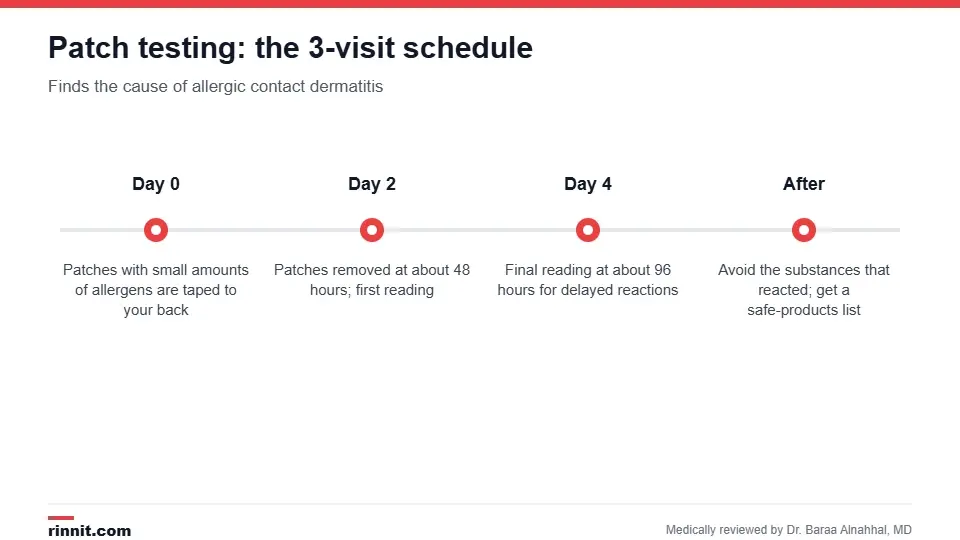
Patch testing usually takes three visits in one week.
Why is it done?
A rash that keeps coming back or doesn't improve with treatment.
A rash in a pattern that suggests contact, such as under a watch, waistband or on the eyelids.
Suspected work-related dermatitis, for example in healthcare, hairdressing or construction.
Hard-to-control eczema, especially in children.
Before some implants, when metal allergy is suspected. Sources: [1, 3]
What allergens are tested?
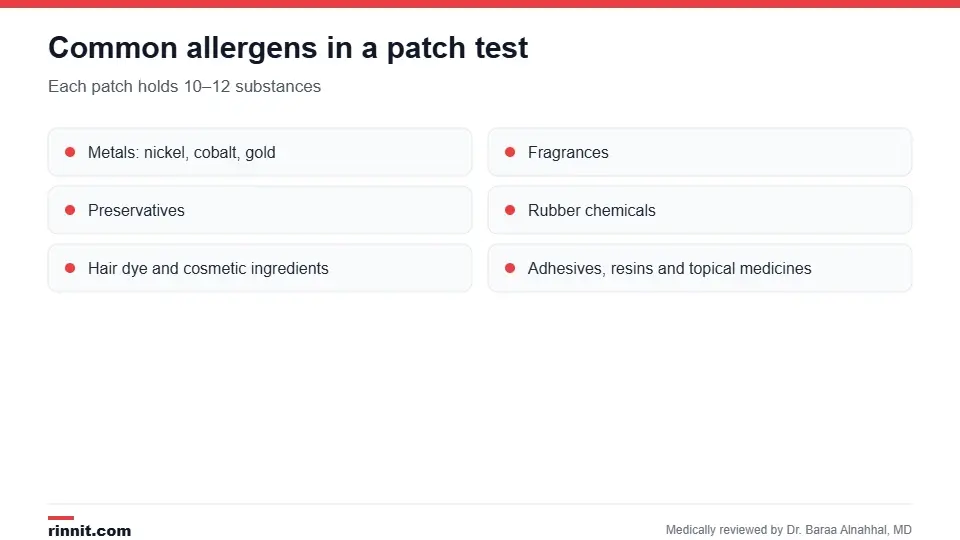
A standard series covers the most common contact allergens.
Group | Examples | Where you meet it |
Metals | Nickel, cobalt, gold, chromium | Jewelry, piercings, belt buckles, cement |
Fragrances | Fragrance mixes, balsam of Peru | Perfumes, lotions, cleaning products |
Preservatives | Methylisothiazolinone, formaldehyde releasers | Cosmetics, shampoos, wipes |
Hair dye | Paraphenylenediamine (PPD) | Permanent and black henna dyes |
Rubber chemicals | Thiurams, carbamates | Gloves, shoes, elastic |
Medicines | Neomycin, bacitracin, topical steroids | Creams and ointments |
Plastics and adhesives | Acrylates, epoxy resins | Nail products, glues, medical tape |
Sources: [1]
How do I prepare?
Avoid sun exposure and tanning on your back for 1–2 weeks.
Stop medicated creams on your back for about 1 week.
Don't apply moisturizer to your back on the day of the test.
Antihistamines are usually fine, because they don't block this type of reaction.
Tell your provider if you take prednisone or other medicines that suppress the immune system.
Bring products you use, if asked, and wear a dark shirt you don't mind getting marked.
If your back is hairy, an electric razor may be used to shave it. Sources: [1]
What happens during testing?
Day 1 (for example Monday): patches are applied to your upper back and their positions marked.
Day 3 (about 48 hours): patches are removed and the first reading is done.
Day 5 (about 96 hours): a final reading picks up delayed reactions. Sources: [1]
While the patches are on, keep your back dry, avoid showers that wet your back, and avoid exercise or activities that make you sweat. Don't scratch or press on the patches. Sources: [1]
Understanding your results

Reactions are graded by how red, raised and blistered the skin is.
Reading | What the skin shows |
Negative (−) | No reaction |
Weak positive (+) | Redness and mild raised skin |
Strong positive (++) | Redness, swelling and small bumps or blisters |
Extreme positive (+++) | Intense redness, swelling and blisters that may spread |
Irritant reaction | Patchy redness or a glazed look without a true allergy |
A positive test shows an allergy, but your provider also decides whether it explains your rash, based on where you get it and what you're exposed to. You'll get a list of the substance's names and where it is found, so you can avoid it. Sources: [1]
Risks
Itching or irritation under positive patches is common. Rarely, a reaction lasts weeks, the skin darkens or lightens, or a new sensitization develops. Severe allergic reactions such as anaphylaxis are very rare. Call 911 or go to the emergency room if you have swelling of the face, lips or tongue, or trouble breathing. Sources: [1]
Conclusion
Patch testing identifies the specific substances behind allergic contact dermatitis, so you can avoid them and stop the rash from returning. It takes a week and a few visits, with a dry back in between. Ask your provider for a written list of any positive allergens and the product names they appear under.
Keep learning: read about nickel allergy and other types of allergy testing.
Frequently asked questions
What does a patch test check for?
Delayed skin allergies that cause allergic contact dermatitis.
How long do the patches stay on?
About 48 hours, with a final reading at about 96 hours.
Can I shower during patch testing?
Avoid getting your back wet until the final reading; you can wash other areas carefully.
Can I take antihistamines?
Usually yes. They don't affect patch test results.
What should I avoid before the test?
Sun on your back for 1–2 weeks, medicated creams on your back for 1 week and moisturizer on the test day.
What does a positive patch test look like?
A red, itchy, raised or blistered spot under one allergen.
Is patch testing the same as a skin prick test?
No. Prick tests check for immediate allergies; patch tests check for delayed contact allergies.
Does patch testing hurt?
No. Positive spots may itch.
Can children have patch testing?
Yes, especially those with eczema that's hard to control.
What happens after a positive result?
You'll get a list of the allergen's names and products to avoid.
Related Reading
Contact Dermatitis: Symptoms, Causes, Diagnosis & Treatment — Complete Guide the rash patch testing helps explain.
Nickel Allergy: The Complete Guide the most common contact allergen.
Allergy Testing: Types, How to Prepare and What Results Mean an overview of skin, blood and patch tests.
Eyelid Dermatitis: The Complete Guide to Symptoms, Causes, Treatment and Prevention a rash often caused by contact allergens.
Atopic Dermatitis (Eczema): Symptoms, Causes & Treatment — Complete Guide eczema that can overlap with contact allergy.
Allergy Skin Test: Prick, Intradermal and Patch Tests, Preparation and Results explains the prick, intradermal and patch tests used to find allergies.
References
Cleveland Clinic. Patch Testing for Skin Allergies: Procedure & Results. Cleveland Clinic. Last updated April 21, 2025. https://my.clevelandclinic.org/health/diagnostics/patch-test
von Spreckelsen B, Jensen MB, Johansen JD, et al. Nickel allergy and piercings: a systematic review and meta-analysis. Contact Dermatitis. 2025;93(4):275-284. PMID 40611585. https://doi.org/10.1111/cod.14837
Jensen MB, Kursawe Larsen C, Hamann CR, et al. Association between atopic dermatitis and contact sensitization: an updated systematic review and meta-analysis. Contact Dermatitis. 2026;94(3):201-225. PMID 41423749. https://doi.org/10.1111/cod.70074
Medical disclaimer
This article is for general education only and does not replace advice from a qualified healthcare professional. Talk to your doctor about your own diagnosis and treatment, and seek emergency care right away for severe or sudden symptoms.



Comments