Allergy Skin Test: Prick, Intradermal and Patch Tests, Preparation and Results

Updated: 2 days ago
Written and medically reviewed by Dr. Baraa Alnahhal, MD · Last reviewed: November 2026 · How we review
Quick Answer
An allergy skin test helps find out what you're allergic to by placing tiny amounts of possible allergens on or under the skin and watching for a reaction. The three types are the skin prick test, the intradermal test and the patch test. You'll usually need to stop antihistamines beforehand.
What the research says
Skin prick tests are sensitive for food allergy: a European review of 149 studies with 24,489 patients found that skin prick tests with fresh cow's milk and raw egg had high sensitivity, 90% and 94%, for milk and egg allergy, though blood tests for specific allergen components were more specific (Riggioni C et al., Allergy, 2024) [2]
A positive test doesn't always mean allergy: a systematic review of 22 studies of peanut allergy found skin prick testing was less accurate than a blood test for the peanut component Ara h 2, especially for confirming allergy when a test is positive (Klemans RJ et al., Clinical & Experimental Allergy, 2015) [3]
Key takeaways
Three types: skin prick, intradermal and patch tests.
Prick and intradermal results are read in about 15 minutes; patch tests take about 4 days.
Stop antihistamines before testing, as your provider directs.
A bigger wheal usually means greater sensitivity, but results must match your symptoms.
The main risk, anaphylaxis, is rare, and staff are ready to treat it.
What is an allergy skin test?
Allergies happen when your immune system overreacts to a harmless substance. In an allergy skin test, an allergist exposes a small patch of skin to suspected allergens. If you're sensitized, allergy antibodies (IgE) on skin cells trigger a local reaction. Skin tests are one part of allergy testing, along with your history and sometimes an allergy blood test. No test is 100% accurate, so results are most useful when an allergist interprets them. Sources: [1]
Types of allergy skin tests
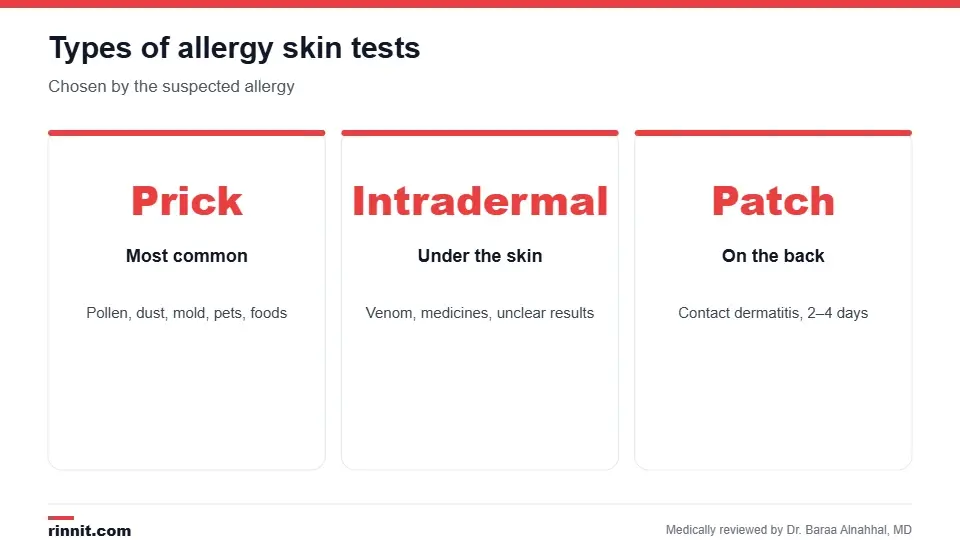
Each test suits a different kind of allergy.
Test | How it's done | Used for | Results |
Skin prick | Drops of allergen; skin lightly pricked | Pollen, dust mites, mold, pets, foods, some medicines | About 15 minutes |
Intradermal | Tiny injection just under the skin | Venom, penicillin and other medicines, unclear prick results | About 15 minutes per stage |
Patches taped to the back for 2–4 days | Contact dermatitis, such as nickel or fragrance | About 4 days |
Sources: [1]
Why is it done?
Symptoms of allergic rhinitis (hay fever), such as sneezing, congestion and itchy eyes.
Asthma that may be triggered by allergens.
Suspected food allergy.
A past severe reaction (anaphylaxis) to food, insect stings or medicines.
Skin rashes after contact with products or metals (patch testing). Sources: [1]
How do I prepare?
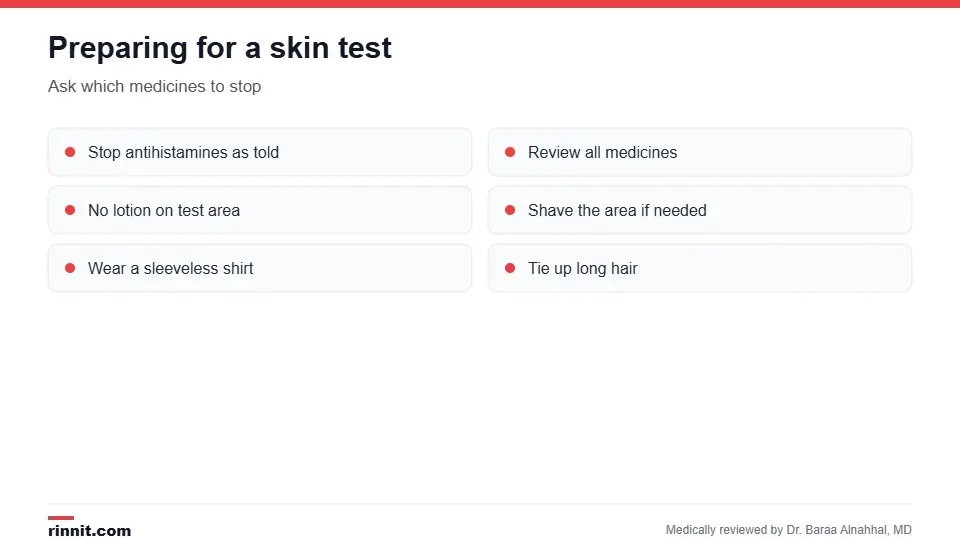
Ask your provider exactly which medicines to stop and when.
Stop prescription and over-the-counter antihistamines for the time your provider recommends; some other medicines can also interfere.
Don't put lotion or other skincare products on the test area that day.
Shave the test area, usually the forearm or upper back, if needed.
Wear a sleeveless or button-down shirt, and tie up long hair.
For a patch test, plan to avoid showering, swimming and heavy sweating for several days. Sources: [1]
What happens during the test?
The skin is cleaned, and the allergist marks a label for each allergen.
Prick test: a drop of each allergen is placed on the skin, which is then lightly pricked; it feels like a tiny pinch. A histamine drop (positive control) and saline drop (negative control) are included.
After about 15 minutes, the allergist measures any wheals with a ruler.
Intradermal test: a tiny amount is injected just under the skin and read after about 15 minutes; stronger doses may follow. It takes about 60–90 minutes.
Patch test: patches stay on your back for 2–4 days before being removed and read. Sources: [1]
Understanding your results
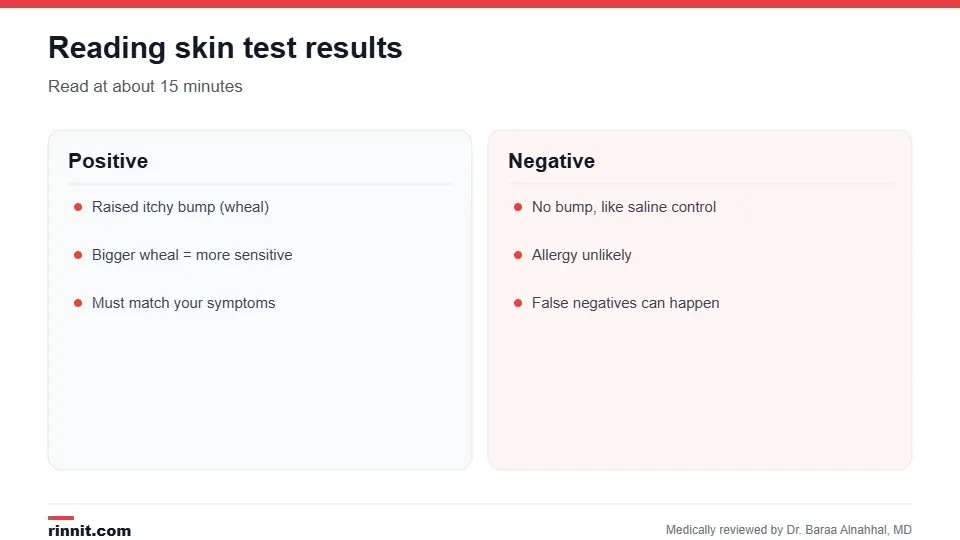
Results are compared with the histamine and saline controls.
A positive result shows a raised, red, itchy bump. A bigger wheal usually means you're more sensitive, but it doesn't predict how severe a reaction will be. A negative result means you're probably not allergic to that substance. False positives and false negatives happen, so your allergist matches results with your symptoms and may order blood tests or a supervised food challenge. The bumps usually fade within hours, sometimes a few days. Sources: [1, 2, 3]
Risks
Serious reactions are rare. The main risk is anaphylaxis, which staff are trained to treat immediately with epinephrine. Itching and swelling at test sites are common and temporary. Sources: [1]
What happens next?
Depending on your results, your plan may include avoiding the allergen, allergy medicines, allergy shots (immunotherapy), an epinephrine auto-injector and a medical alert bracelet. Sources: [1]
Conclusion
An allergy skin test is a quick, reliable way to identify what triggers your allergy symptoms. Preparing properly, especially stopping antihistamines, helps make results accurate, and an allergist's interpretation turns them into a practical plan.
Keep learning: read about allergy testing and the patch test.
Frequently asked questions
What does an allergy skin test check?
Whether your skin reacts to allergens such as pollen, pets, foods, venom or medicines.
Does an allergy skin test hurt?
It feels like tiny pinches, and the bumps may itch.
How long does it take?
Prick tests take less than an hour; intradermal tests about 60–90 minutes; patch tests 2–4 days.
Do I need to stop antihistamines?
Yes. Ask your provider exactly when to stop them.
What does a positive result look like?
A raised, red, itchy bump called a wheal.
Does a bigger bump mean a worse allergy?
It usually means more sensitivity, but not necessarily a more severe reaction.
Can results be wrong?
Yes. False positives and negatives happen, so results are matched with symptoms.
Is an allergy skin test safe?
Yes. Severe reactions are rare and treated right away.
Can children have allergy skin tests?
Yes, and numbing cream may be used.
What's the difference between a skin test and an allergy blood test?
A skin test shows a reaction on your skin; a blood test measures allergy antibodies in your blood.
Related Reading
Allergy Testing: Types, How to Prepare and What Results Mean an overview of all allergy tests.
Allergy Blood Test (IgE): What It Shows, How It Compares With Skin Tests and What Results Mean a blood test alternative to skin testing.
Patch Test for Skin Allergies: How It Works, How to Prepare and What Results Mean the skin test for contact dermatitis.
Allergic Rhinitis (Hay Fever): Symptoms, Triggers, and Treatment That Actually Works seasonal and year-round nasal allergies.
Food Allergy: Symptoms, Causes, Treatment & Complete Guide food allergies that skin tests help identify.
References
Cleveland Clinic. Allergy Skin Test: Purpose, Procedure & Results. Cleveland Clinic. Last updated April 12, 2023. https://my.clevelandclinic.org/health/diagnostics/24912-allergy-skin-test
Riggioni C, Ricci C, Moya B, et al. Systematic review and meta-analyses on the accuracy of diagnostic tests for IgE-mediated food allergy. Allergy. 2024;79(2):324-352. PMID 38009299. https://doi.org/10.1111/all.15939
Klemans RJ, van Os-Medendorp H, Blankestijn M, et al. Diagnostic accuracy of specific IgE to components in diagnosing peanut allergy: a systematic review. Clin Exp Allergy. 2015;45(4):720-730. PMID 25226880. https://doi.org/10.1111/cea.12412
Medical disclaimer
This article is for general education only and does not replace advice from a qualified healthcare professional. Talk to your doctor about your own diagnosis and treatment, and seek emergency care right away for severe or sudden symptoms.



Comments